This article is published on an independent advisory platform and does not constitute legal representation or legal advice. No attorney-client relationship is formed through this content. Legal services are only provided by licensed attorneys under a separate engagement.
What if the 7,000-mile gap between Tel Aviv and New York didn’t have to feel like a barrier to being an active, present parent? Many international families find that managing a 7-hour or 10-hour time difference leads to missed connections and unnecessary conflict. It’s difficult to maintain a bond when your relationship relies on a screen, and the fear of parental alienation can feel very real. However, by establishing clear virtual visitation guidelines and best practices, you can turn these digital windows into a stable bridge for your child.
You’ll learn how to move beyond casual video calls to create a structured, formalized visitation schedule that holds weight in the Israeli legal system. We’ll preview age-appropriate engagement strategies and look at how specialized co-parenting tools help manage the logistical complexity of cross-border life. For more visual guidance, you can also explore resources on the Israel Family Law YouTube channel. This article provides the strategic foundation you need to protect your parental bond and achieve legal clarity. Get clarity before you commit. Request a confidential consultation.
Key Takeaways
- Understand how virtual visitation serves as a legally mandated bridge to maintain your parental bond across international borders.
- Learn to identify the “Golden Hour” for calls to manage the 7-to-10-hour time difference between IL and the US effectively.
- Discover virtual visitation guidelines and best practices for age-appropriate engagement, including the concept of “parallel play.”
- Find out how to document missed visits or technical issues professionally to avoid unnecessary conflict and maintain a clear record.
- Identify the specific clauses required in a cross-border parenting plan to ensure hardware costs and connection standards are clearly defined.
This article is published on an independent advisory platform and does not constitute legal representation or legal advice. No attorney-client relationship is formed through this content. Legal services are only provided by licensed attorneys under a separate engagement.
What is Virtual Visitation in a Cross-Border Context?
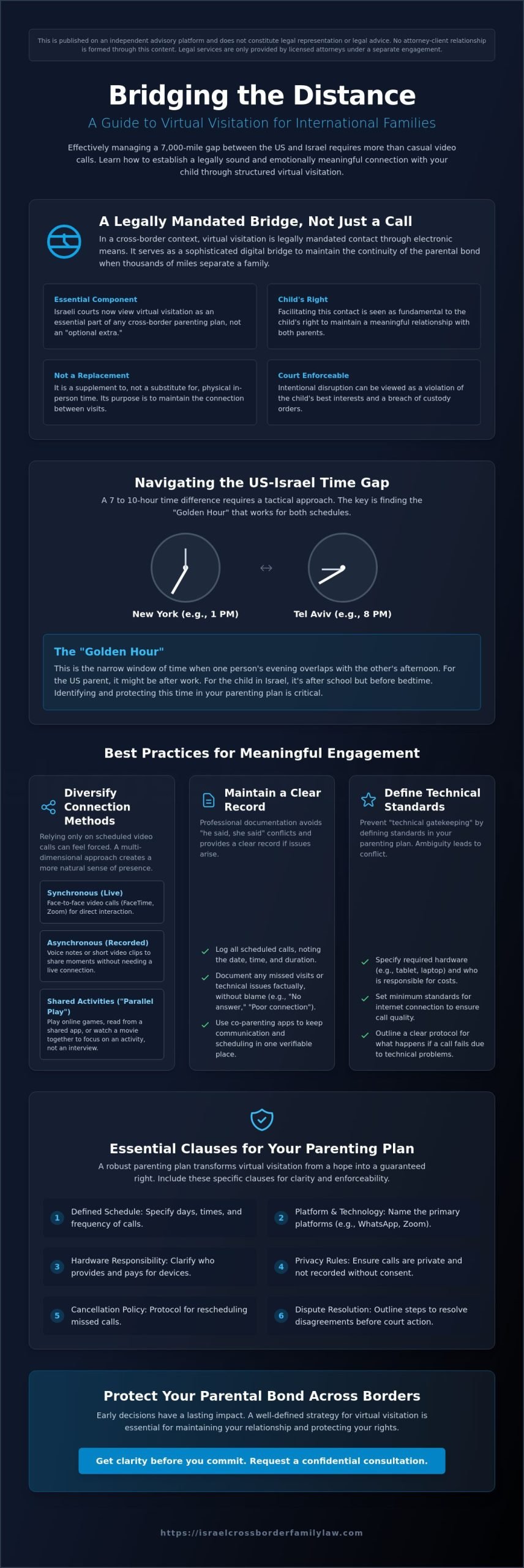
In the context of international custody and relocation, virtual visitation is defined as legally mandated contact between a child and a parent through electronic means. It isn’t a replacement for physical presence. Instead, it serves as a sophisticated digital bridge that maintains the continuity of the parental bond when thousands of miles separate the family. For those unfamiliar with the term, What is Virtual Visitation describes how these arrangements have evolved from simple phone calls into comprehensive, court-ordered protocols.
Technology has fundamentally altered the landscape of international parenting. Platforms like Zoom, WhatsApp, and FaceTime are no longer just social tools; they’ve become the primary vehicles for exercising parental rights. For a non-custodial parent living in the US while the child resides in IL, these digital interactions are critical. They provide the only consistent way to participate in the child’s daily life, from seeing a new tooth to hearing about a school project.
To better understand how these digital interactions are structured in a professional setting, watch this overview:
The Legal Status of Virtual Contact in Israel
Israeli family courts place a high premium on the child’s right to maintain a meaningful relationship with both parents. While there isn’t a specific statute titled “Virtual Visitation Law” in IL, the judiciary incorporates these requirements into broader custody and visitation orders. The global pandemic accelerated this trend. What was once viewed as an “optional extra” is now considered an “essential component” of any cross-border parenting plan. IL judges expect parents to cooperate in facilitating this contact, viewing any intentional disruption as a potential violation of the child’s best interests.
Beyond Video Calls: Methods of Connection
Effective virtual visitation guidelines and best practices suggest that connection should be multi-dimensional. Relying solely on a 30-minute video call can feel forced, especially for younger children. Diversifying the methods of contact helps create a more natural sense of presence. Synchronous video calls via FaceTime or WhatsApp remain the standard for face-to-face interaction. However, asynchronous communication, such as sending voice notes or short video clips, allows the parent to be part of the child’s day without requiring a live connection. Shared digital spaces, like online gaming or reading apps, allow for “parallel play,” where the focus is on a shared activity rather than a face-to-face interview.
Establishing these virtual visitation guidelines and best practices early in the legal process helps prevent future disputes. It’s vital to distinguish between a quick check-in and scheduled visitation. A check-in is often informal. Scheduled visitation is a protected block of time that requires the same level of respect as a physical visit. Get clarity before you commit. Request a confidential consultation.
This article is published on an independent advisory platform and does not constitute legal representation or legal advice. No attorney-client relationship is formed through this content. Legal services are only provided by licensed attorneys under a separate engagement.
Guidelines for Managing US-Israel Time Zone Challenges
Managing a relationship across a 7,000-mile gap requires more than just good intentions; it requires a tactical approach to scheduling. For families bridging the US and IL, the time difference is typically 7 hours for the East Coast (EST) and 10 hours for the West Coast (PST). This creates a narrow window, often referred to as the “Golden Hour,” where one parent is starting or ending their day while the child is in a receptive state in IL. Identifying this window is the first step in establishing virtual visitation guidelines and best practices that actually work.
A significant hurdle in these cross-border situations is the inconsistency of Daylight Savings Time (DST) shifts. The US and IL rarely change their clocks on the same day. This results in a two-to-three-week period each year where the time difference shifts by an hour. If your parenting plan doesn’t account for these discrepancies, it often leads to missed calls and accusations of gatekeeping. A robust protocol should specify whether the call time follows the child’s local time or the parent’s local time during these transition periods to maintain order.
Creating a Predictable Schedule
Consistency provides emotional security for a child. In an international context, this means setting specific start and end times rather than leaving the window open. It’s also vital to remember that the Israeli school week runs from Sunday to Friday. A Sunday morning in the US is a regular school and work day in IL. Successful plans factor in these cultural and systemic differences to avoid “on-call” anxiety for the custodial parent and frustration for the distant parent. Establishing a recurring schedule helps everyone involved treat the digital visit with the same importance as a physical one.
Flexibility vs. Rigidity in International Plans
While court orders provide the baseline, virtual visitation guidelines and best practices often benefit from a degree of “controlled flexibility.” For example, Best practices for virtual visitation suggest implementing a “Three-Strike Rule” for technical failures. If the internet drops or a call is missed due to a genuine error, the plan should mandate a makeup window within 24 hours. This prevents minor technical glitches from escalating into legal disputes or claims of alienation.
Managing expectations for holidays and birthdays is equally complex. Since US and Jewish holidays rarely align, parents should pre-negotiate “bonus” calls for these special occasions. If you are struggling to find a balance between legal rigidity and practical reality, you might find it helpful to seek strategic guidance on your specific situation. Get clarity before you commit. Request a confidential consultation.
This article is published on an independent advisory platform and does not constitute legal representation or legal advice. No attorney-client relationship is formed through this content. Legal services are only provided by licensed attorneys under a separate engagement.
Best Practices for Meaningful Engagement at a Distance
Engagement in a cross-border context is about the quality of the connection rather than the sheer number of minutes spent on a call. While the technical definition of What is Virtual Visitation focuses on the use of electronic communication, the practical reality is that parents must be creative to stay relevant in their child’s life. Moving beyond the standard “how was school?” interview is essential for maintaining a bond across the 7,000-mile gap. Establishing a “Visitation Station” in both homes, such as a specific desk or a comfortable chair used only for these calls, helps the child mentally transition into “parent time.”
One of the most effective virtual visitation guidelines and best practices is the concept of “parallel play.” This involves both parent and child staying on a video call while performing separate tasks, like the child doing homework while the parent reads a book. It removes the pressure of constant conversation and mimics the natural “being in the same room” feeling of physical custody. Screen sharing also allows parents to watch movies together, play digital games, or even help with school assignments in real-time.
Activities for Different Developmental Stages
Toddlers: Focus on short, high-energy bursts of interaction. Use interactive storytime where the parent holds a physical book to the camera or “show and tell” where the child introduces their toys to the screen. These sessions should be flexible and guided by the child’s attention span.
School-age: This stage often presents a challenge for international parents due to the language barrier in Israeli schools. While competitors suggest basic homework help, a more strategic approach involves using screen sharing for English-language subjects or collaborative digital art projects. Games like Roblox or Minecraft provide a shared environment where the parent and child can work toward a common goal.
Teens: Older children often prefer autonomy. Instead of long, formal video calls, focus on text-based check-ins or sharing interests through digital links. Watching a sports match “together” while on a voice call or discussing a new music release helps the parent remain a consistent presence without being overbearing.
Parental Etiquette During Virtual Visits
The success of virtual contact depends heavily on the custodial parent’s cooperation. Their role is to facilitate the connection by ensuring the device is charged and providing a quiet, distraction-free environment. It’s critical to avoid “coaching” the child from behind the camera or using the call as an opportunity to interrogate the other parent about legal or financial matters. The child must be allowed to speak with the distant parent in a private, distraction-free environment without the other parent being present in the room or monitoring the audio. Get clarity before you commit. Request a confidential consultation.
This article is published on an independent advisory platform and does not constitute legal representation or legal advice. No attorney-client relationship is formed through this content. Legal services are only provided by licensed attorneys under a separate engagement.
Addressing Objections and Technical Gatekeeping
In international parenting, technology can sometimes be leveraged as a tool for obstruction rather than connection. Common justifications like “the child is too tired” or “the Wi-Fi is unstable” often mask a deeper pattern of gatekeeping. While a single technical failure is a nuisance, a consistent series of missed calls can indicate the beginning of parental alienation. In cross-border cases, where physical distance already strains the bond, these digital disruptions carry significant weight in the eyes of the court. Following established virtual visitation guidelines and best practices helps you distinguish between genuine technical hurdles and deliberate interference.
When one parent consistently blocks access, the impact on the child’s psychological well-being can be profound. It often leads to a sense of abandonment that is difficult to repair without early intervention. If you notice that “internet issues” only seem to occur during your scheduled time, or if the child is suddenly “too busy” every Sunday at 10:00 AM EST, you are likely facing a strategic barrier rather than a technical one. Identifying these patterns early is essential for protecting your parental rights in IL.
Strategies for Resistance
If a child appears reluctant to engage, the solution is rarely a longer or more forced call. Instead, focus on short, high-value interactions that respect the child’s routine. If the custodial parent frequently claims the child is unavailable, you should check if your parenting plan includes a digital version of the “Right of First Refusal.” This clause requires the custodial parent to offer you the opportunity for a virtual visit if the child is being left with a third party during your scheduled time. Understanding your rights within international custody and relocation frameworks is essential for maintaining these boundaries and ensuring that the child’s schedule isn’t used as an excuse for non-compliance.
Documenting and Evidencing Interference
Courts in IL require evidence, not anecdotes. Using specialized communication applications like OurFamilyWizard or TalkingParents creates a court-ready record of every attempted connection and every reported failure. These tools provide an unalterable log that can prove a pattern of behavior rather than a one-time glitch. Distinguishing a genuine error from a deliberate act of gatekeeping becomes much simpler when you have a timestamped history of communication. For more detailed strategies on handling these high-conflict situations, you can view resources on the Israel Family Law YouTube channel. Documenting these instances through a neutral third-party platform ensures that your claims are backed by data rather than emotion.
If your digital access is being consistently blocked despite your best efforts to cooperate, reach out to discuss a strategy for restoring your parental rights. Get clarity before you commit. Request a confidential consultation.
This article is published on an independent advisory platform and does not constitute legal representation or legal advice. No attorney-client relationship is formed through this content. Legal services are only provided by licensed attorneys under a separate engagement.
Formalizing Virtual Visitation in Your Parenting Plan
A handshake agreement or a verbal promise is rarely sufficient when managing a relationship across the Atlantic. To protect your parental bond, you must move beyond casual arrangements and embed specific, enforceable clauses into your legal parenting plan. Generic phrases like “reasonable telephone access” are a common pitfall in divorce for international families. These vague terms often lead to ambiguity and conflict, as they don’t define what “reasonable” means when one parent is in Los Angeles and the other is in Tel Aviv.
Your agreement should explicitly detail the logistical requirements of digital contact. This includes specifying which parent is responsible for providing the necessary hardware, such as a tablet or laptop, and ensuring the child has access to high-speed internet. It’s also vital to include “make-up” provisions. If a scheduled visit is missed due to a school event or a technical failure, the plan should mandate a specific window for the visit to be rescheduled. These virtual visitation guidelines and best practices ensure that the digital connection is treated with the same legal weight as physical custody.
In high-conflict scenarios, virtual visitation rights are often discussed within the broader context of the Hague Convention. While the Convention primarily deals with the return of children in abduction cases, a well-drafted visitation plan can serve as evidence of the intended “habitual residence” and the established pattern of care. Formalizing these rights provides a layer of security that protects both the child’s routine and the parent’s legal standing.
Jurisdictional Nuances
An international parenting plan must be strategically drafted to ensure it’s recognized and enforceable in both the relevant US state and IL. Because legal systems differ significantly, a clause that works in a local court might not be easily enforced by an Israeli judge. You need to ensure the language used is clear enough to be interpreted by authorities in both jurisdictions. Moving beyond the “reasonable access” trap is the only way to prevent future litigation and ensure your time with your child isn’t subject to the other parent’s whims.
Next Steps: Securing Your Connection
The most important step you can take is seeking clarity before signing any relocation agreement. Early decisions have a lasting impact on your ability to remain a present parent. A comprehensive cross-border strategy allows you to address potential conflicts before they arise, turning virtual visitation into a reliable tool for long-term family stability. Get clarity before you commit. Request a confidential consultation.
This article is published on an independent advisory platform and does not constitute legal representation or legal advice. No attorney-client relationship is formed through this content. Legal services are only provided by licensed attorneys under a separate engagement.
Securing Your Parental Bond Across the US-Israel Border
Establishing a successful long-distance relationship requires moving beyond casual video calls. By implementing structured virtual visitation guidelines and best practices, you can mitigate the challenges of significant time zone gaps and technical gatekeeping. You’ve seen how specific, enforceable clauses in your parenting plan provide the stability necessary for your child to thrive while maintaining a meaningful connection with both parents. These early strategic decisions are what prevent future litigation and protect the child’s best interests.
Navigating the multi-jurisdictional complexity of family law in IL and the US demands a specialized approach. We offer deep US-Israel cross-border expertise and feature practitioners licensed in multiple jurisdictions who maintain a strategic focus on international family stability. Get clarity before you commit. Request a confidential consultation.
You don’t have to navigate these 7,000 miles alone. With a clear strategy and the right legal framework, your digital bridge can remain strong and secure for years to come.
This article is published on an independent advisory platform and does not constitute legal representation or legal advice. No attorney-client relationship is formed through this content. Legal services are only provided by licensed attorneys under a separate engagement.
Frequently Asked Questions
Is virtual visitation legally enforceable in Israel?
Virtual visitation is legally enforceable in IL when it is specifically incorporated into a court-approved parenting plan or judgment. While there is no standalone statute, Israeli family courts treat digital contact as a mandatory component of maintaining the child’s best interests in cross-border cases. If a parent fails to comply with the order, the other parent can seek enforcement through the court system to restore contact.
What happens if the other parent constantly “forgets” the scheduled Zoom call?
Persistent failure to facilitate scheduled calls should be documented immediately using communication logs or co-parenting applications. Courts distinguish between an occasional technical glitch and a deliberate pattern of obstruction. If the behavior continues, it may be necessary to file a motion for enforcement to ensure the virtual visitation guidelines and best practices outlined in your agreement are respected and followed by both parties.
How much time should a virtual visit last for a 5-year-old?
For a 5-year-old, a virtual visit typically lasts between 15 and 30 minutes depending on the child’s attention span and the specific activity involved. Rather than expecting a long conversation, focus on interactive tasks like reading a story together or playing a digital game. Shorter, more frequent calls often yield better results for younger children than one long, exhausting session that feels like an interview.
Can I use virtual visitation to replace in-person visits if I move to the US?
Virtual visitation is intended to supplement in-person time, not replace it entirely. If you relocate to the US, your parenting plan should include a combination of digital contact and substantial blocks of physical visitation during school holidays or summer breaks. Israeli courts generally view virtual contact as a tool to bridge the gap between physical visits rather than a substitute for physical presence.
Who is responsible for providing the iPad or laptop for the child’s calls?
Responsibility for providing hardware should be clearly defined in your written parenting agreement to avoid unnecessary disputes. Often, the custodial parent ensures the child has access to a functioning device and high-speed internet, while the non-custodial parent may agree to cover the initial cost of the equipment. Clarity on these logistical details is essential for the long-term success of any international parenting arrangement.
Does virtual visitation count toward child support calculations in IL?
Virtual visitation typically does not impact child support calculations in IL, as these are primarily based on the child’s needs, parental income, and physical overnight stays. However, the costs associated with international travel for physical visits or specific technology expenses are often factored into the overall financial arrangement. Each case depends on the specific economic circumstances and the existing court orders for the family.
What if my child refuses to speak during the video call?
If a child refuses to speak, try transitioning to “parallel play” where you both remain on the call while performing separate activities. You might read a book aloud or draw while the child plays with toys nearby. This reduces the pressure on the child and maintains your presence in their environment without forcing a verbal interaction they may not be ready for at that moment.
How do we manage the 7-hour time difference between New York and Tel Aviv?
Managing the 7-hour difference between New York and Tel Aviv requires identifying a “Golden Hour” in the late afternoon or early evening in IL. This usually corresponds to the morning hours in New York before the school day begins. Adhering to virtual visitation guidelines and best practices involves setting a recurring schedule that respects the child’s school routine and the parent’s professional work commitments.

Article by
Gabriel Lior
A Personal Journey That Became a Mission
The advisory was founded by an American father Gabriel Lior, LLB, MBA , global entrepreneur, and cross-border advisor who spent more than a decade navigating the Israeli family court system firsthand and now lives in Singapore with his son.
As a divorced parent in a cross-border family, Gabriel faced nearly every legal challenge a foreign parent can encounter in Israel — including child custody disputes, child support proceedings, property matters in Israel and abroad, false accusations, and complex immigration and relocation proceedings.
Over the years, he learned the hard way how difficult it is for non-Israeli parents to understand the system, identify the right legal strategy, and choose the right legal representation — especially when language, culture, and jurisdictional differences are involved. He also witnessed how foreign parents and new immigrants are often disadvantaged or taken advantage of by service providers and institutions simply because they lack local knowledge or fluency.
From Client to Advisor
To truly understand — and survive — the system, Gabriel pursued formal legal education in Israel, completing two Israeli law degrees, alongside a BA and MBA earned in the United States. This was never about becoming a practicing attorney, but about gaining a deep, structural understanding of how the system works — and where it breaks down for foreign parents.
This rare combination of:
Firsthand client experience
Israeli legal and US business education
International business and negotiation training
Decades of commercial execution
created a unique perspective – one that understands both sides of the table.
After years of litigation, persistence, and at times self-representation, he ultimately succeeded in securing custody of his son and relocating abroad through a rare legal victory in the Israeli Supreme Court — becoming one of the first fathers in Israel to do so under these circumstances.
Disclaimer
Important Disclaimer:
The information provided on this website and in its content is for general informational and educational purposes only and does not constitute legal advice, legal opinion, or legal representation.
Gabriel Lior is not licensed to practice law in Israel (nor is he interested in doing so) and does not provide legal services, despite having completed 2 Law Degrees. The services offered are advisory in nature and are intended to provide general guidance, strategic insight, and information regarding cross-border family law considerations.
No attorney-client relationship is formed by accessing this website, reading its content, or communicating with us.
Any decisions made based on this information are at your own discretion and risk. For legal advice specific to your situation, you should consult a licensed attorney in the relevant jurisdiction.
Where appropriate, we may refer clients to independent, licensed attorneys or professionals. Such referrals do not constitute legal representation and no liability is assumed for services provided by third parties.