This article is published on an independent advisory platform (not a law firm) and does not constitute legal representation or an attorney-client relationship. Legal services are only provided by licensed attorneys under a separate engagement.
In the high-stakes environment of cross-border litigation, the traditional win-loss binary is often a dangerous illusion that can lead to years of avoidable conflict. You might find yourself asking, what does success look like in my case when I’m caught between the Rabbinical and Civil court systems in Israel? For many international families, a courtroom victory that destroys a co-parenting relationship or leaves assets tied up in appeals isn’t a win at all. Real success requires a shift in perspective from short-term dominance to long-term stability and protection.
It’s natural to feel anxious about the race to court or the fear of losing access to your children across borders. We agree that the complexity of the Israeli legal landscape creates significant confusion for those unfamiliar with the system. This article will help you move beyond the binary and define a strategic, sustainable outcome for your matter. We’ll explore how to protect your parental rights, ensure financial finality, and create a roadmap that actually works for your life in Israel.
Key Takeaways
- Shift your focus from a win-at-all-costs approach to a strategic plan that prioritizes long-term family stability and financial preservation.
- Learn how to define what does success look like in my case by focusing on jurisdictional clarity and protecting global assets from double-claims.
- Evaluate the practical differences between litigation and mediation to choose the path that offers the most sustainable finality for your family.
- Identify why the first 30 days are critical for gathering cross-border evidence that meets the standards of both Israeli and foreign legal systems.
- Understand how a cross-border advisor bridges the gap between your expectations and the unique cultural and systemic realities of the Israeli legal landscape.
This article is published on an independent advisory platform (not a law firm) and does not constitute legal representation or an attorney-client relationship. Legal services are only provided by licensed attorneys under a separate engagement.
Defining Success in the Context of US-Israel Family Law
Real success in a cross-border matter isn’t a static point or a single court order. It’s the moment your legal strategy aligns with your long-term family and financial priorities. In domestic cases, you might focus on a specific number or a custody schedule. International matters require a much broader lens. You have to consider how decisions made in an Israeli courtroom will affect your life, your assets, and your travel rights years down the line. Determining what does success look like in my case starts with identifying your non-negotiables before the first motion is filed.
The complexity of Israel’s legal system, which includes both civil Family Courts and religious Rabbinical Courts, means that “winning” in one forum might lead to complications in another. This is especially true if a ruling isn’t recognized internationally. Moving away from a win-at-all-costs mentality helps you avoid unnecessary legal depletion, both emotionally and financially. Clarity is your best tool. Knowing your risks before you commit to a specific path ensures you aren’t fighting battles that don’t serve your ultimate goal.
To better understand this concept, watch this helpful video:
Success vs. Victory: Understanding the Difference
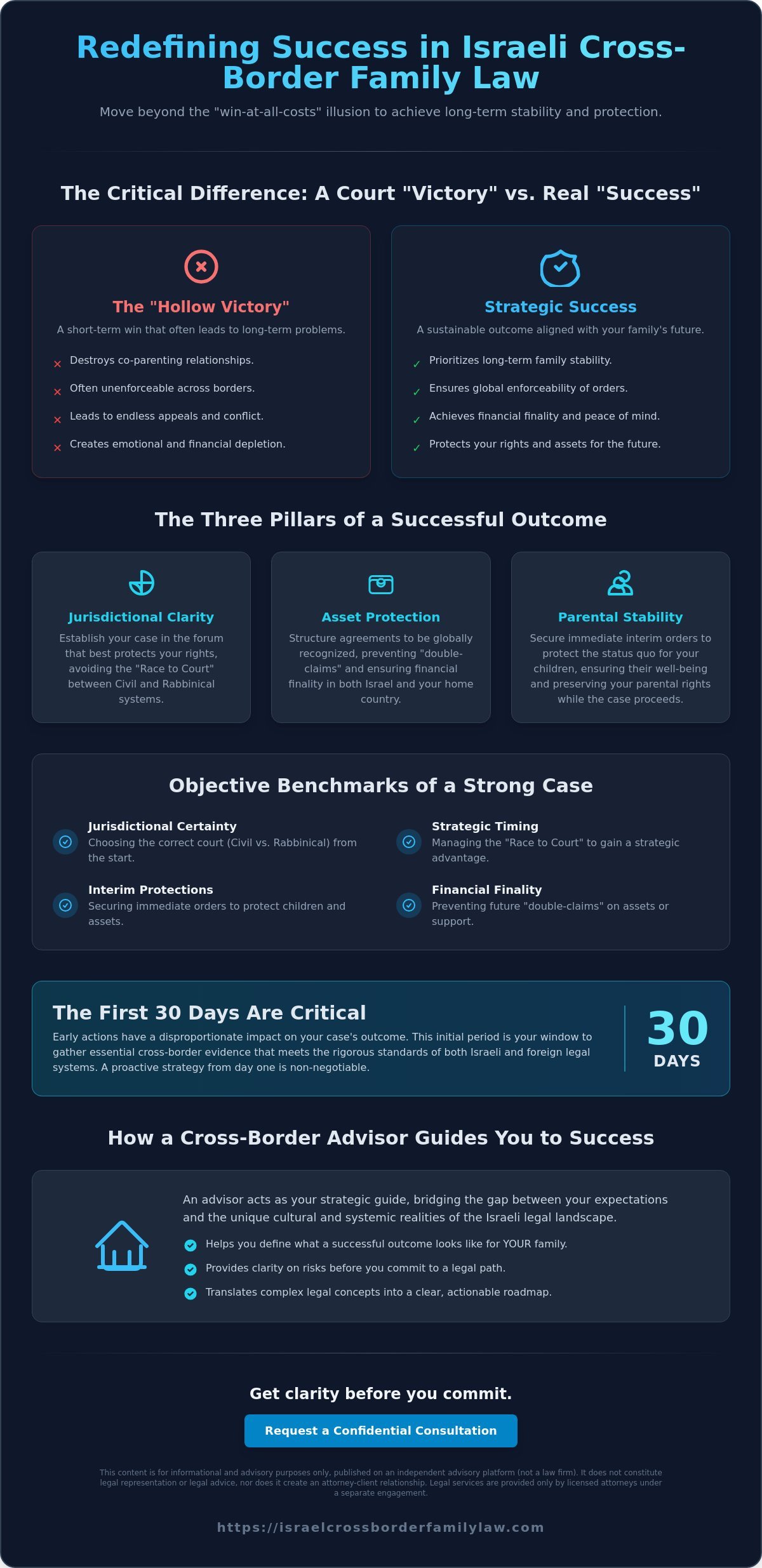
A court victory that destroys family relationships is rarely a true success for an expat or international family. We often see the “hollow win.” This happens when someone achieves a judgment that looks good on paper but is impossible to enforce across borders. For example, the enforcement timeline for a foreign child support order in Israel typically spans 6 to 18 months. If your strategy doesn’t account for these practical delays, the “victory” provides no immediate relief. Prioritizing peace of mind and finality over prolonged litigation often leads to a more sustainable life for everyone involved.
The Objective Benchmarks of a Strong Case
While emotions run high during a divorce or custody dispute, success should be measured against objective benchmarks. A strong case outcome in Israel often includes:
- Jurisdictional Certainty: Establishing your case in the forum that best understands your international background and specific needs.
- Strategic Timing: Managing the “Race to Court” risks between the Civil and Rabbinical systems. Since November 2017, Rabbinical courts have had expanded authority to rule on children’s financial needs, making the choice of venue more critical than ever.
- Interim Protections: Securing immediate orders that protect the status quo for your children and your assets while the larger case moves forward.
- Financial Finality: Ensuring that property divisions or support agreements are structured to prevent “double-claims” in both Israel and your home country.
When you ask, what does success look like in my case, you’re looking for a roadmap that leads to stability. It’s about making informed choices today that protect your rights tomorrow.
This article is published on an independent advisory platform (not a law firm) and does not constitute legal representation or an attorney-client relationship. Legal services are only provided by licensed attorneys under a separate engagement.
The Three Pillars of a Successful Outcome in Israel
Establishing structural stability is the foundation of any cross-border legal strategy. When clients ask, what does success look like in my case, we point to three specific areas: jurisdiction, assets, and children. If any one of these is left vulnerable, the entire legal outcome remains fragile. Success means achieving an outcome that is enforceable not just in Israel, but in any country where you hold assets or residency. It’s about creating a finality that stands the test of time and international scrutiny.
Gaining a clear understanding of these pillars early in the process can save years of litigation. If you’re ready to explore how these factors apply to your specific situation, you may want to reach out for an initial discussion to clarify your objectives.
Jurisdictional Clarity as a Primary Goal
Being the first to file in IL can often define the success of the entire case. Because Israel operates a dual legal system, the choice between Family Court and Rabbinical Court impacts every financial and custodial decision. Success involves securing a forum that understands your specific cultural and financial background. For international families, this also means understanding how the Hague Convention governs your ability to travel or relocate with children. A successful strategy also leverages US-Israel tax treaties. This ensures that financial settlements or the division of foreign pensions don’t lead to double taxation or unexpected liabilities that could deplete your wealth.
Protecting the Future of the Family Unit
A successful custody arrangement requires more than just a schedule. It requires a “Mirror Order” that a foreign court will recognize and enforce. Without this, your parental rights may stop at the border, leaving you vulnerable if a parent decides not to return a child after a visit abroad. Success also means securing child support that reflects the actual cost of living. With Israel’s cost of living estimated to be 30-40% higher than the United States, a basic US support order often fails to meet a child’s needs in IL.
The verified minimum for essential needs in Israel is currently between ₪1,400 and ₪1,600 per month per child, excluding housing costs. Success is ensuring these payments are linked to the Consumer Price Index (CPI) to protect against inflation. For the paying parent, success involves establishing a “self-support reserve.” In Israel, this typically ensures you’re left with at least ₪5,500 per month after payments. Balancing these needs while maintaining a functional co-parenting relationship across time zones is the ultimate benchmark of a successful cross-border case.
This article is published on an independent advisory platform (not a law firm) and does not constitute legal representation or an attorney-client relationship. Legal services are only provided by licensed attorneys under a separate engagement.
Litigation vs. Mediation: Comparing Paths to Success
Choosing between litigation and mediation is a strategic decision that fundamentally alters the trajectory of your legal matter. In the Israeli legal landscape, success can be either “imposed” by a judge or “negotiated” through mutual agreement. When you evaluate what does success look like in my case, you must weigh the desire for a swift, controlled resolution against the potential need for judicial intervention. For international families, this choice often involves a cost-benefit analysis that extends beyond legal fees to include the preservation of the marital pot and the emotional health of children living across borders.
Understanding the cultural and systemic differences within IL courts is essential for making this choice. If you’re currently exploring your options, it’s helpful to look at how each path handles the specific pressures of a cross-border life.
When Litigation is the Necessary Path
Litigation is sometimes the only viable path to protect your interests. If you’re dealing with a bad-faith actor or facing jurisdictional “kidnapping” attempts under the Hague Convention, the Family Court provides essential protections. Successful litigation in these scenarios involves using the court’s power to compel transparency in international asset disclosure, especially when one party attempts to hide properties or income in foreign jurisdictions. In IL, for Jewish families, the role of the “Get” (religious divorce) is also a critical component of success. Ensuring the religious divorce is handled alongside civil matters prevents future status issues that could haunt a family for generations. While litigation is adversarial, it provides a structured environment where a judge can enforce discovery and protect the vulnerable.
The Strategic Advantages of Mediation
Conversely, mediation offers a path to a more bespoke success. Israeli courts are often overburdened, and cultural differences in how judges view family dynamics can lead to unpredictable results for expats. Mediation allows you to create solutions that a standard court order might overlook, such as specific travel protocols or currency exchange protections for international support payments. This approach is central to Divorce & Separation for International Families who want to maintain control over their future rather than leaving it to a third party. By lowering emotional and financial costs, mediation preserves assets that would otherwise be depleted by years of conflict.
Ultimately, the path you choose determines how much control you retain over the finality of your case. A judge’s ruling is final but may not satisfy either party’s long-term needs. A negotiated agreement, while requiring compromise, ensures that the outcome is tailored to the specific realities of your cross-border life. When considering what does success look like in my case, remember that the most sustainable resolutions are often those where both parties have a hand in the design.
This article is published on an independent advisory platform (not a law firm) and does not constitute legal representation or an attorney-client relationship. Legal services are only provided by licensed attorneys under a separate engagement.
Strategic Steps to Shape Your Case Outcome
Success is built on tactical choices made long before a judge enters the room. When you consider what does success look like in my case, you must view the first 30 days as the most critical window for action. Early intervention allows you to secure your position before the other party can dictate the terms of the engagement. This stage requires a shift from emotional reaction to strategic preparation. It’s about gathering the right data and making decisions that protect your long-term interests.
The Importance of Early Decisions
In Israel, the “Race for Jurisdiction” is a defining systemic reality. Because the Civil and Rabbinical courts share authority over many family matters, being the first to file can determine which legal framework applies to your property or support claims. A “wait and see” approach is often the biggest threat to success in IL. Your initial communications with a spouse, even via text or email, can be used as evidence in court to establish intent or child custody preferences. Understanding how the advisory works helps you navigate these early pitfalls with a clear roadmap.
Success also depends on gathering “cross-border evidence” that satisfies both Israeli and US standards. You can’t assume that a US bank statement or property valuation will be accepted without the proper legal certifications or translations. A multi-qualified advisory team that understands both legal systems is essential for bridging this gap. They ensure your evidence is ready for the pace of Israeli litigation while protecting your interests in your home country. This preparation prevents the “fairness gap” where a party loses a claim simply because their documentation didn’t meet local procedural requirements.
Navigating Cultural and Systemic Differences
Many expats face what we call the “Anglo disadvantage” in the Israeli courtroom. You might expect the slow, deliberate pace of a US court, but Israeli proceedings are often faster and more informal. Success requires translating your US values of “fairness” into the specific legal framework of IL. What feels fair to you may not be what the law requires. Managing these expectations early prevents frustration and allows you to focus on achievable goals. It’s about distinguishing between your personal desire for justice and the legal reality of what an Israeli judge can actually grant.
If you’re concerned about how these systemic differences will impact your outcome, you should request a strategic review to align your expectations with Israeli legal reality. Preparing for the procedural style of Israeli litigation is a necessary step in defining what does success look like in my case. By focusing on strategy rather than just the win, you create a more resilient path forward that accounts for the unique complexities of a cross-border life.
This article is published on an independent advisory platform (not a law firm) and does not constitute legal representation or an attorney-client relationship. Legal services are only provided by licensed attorneys under a separate engagement.
How a Cross-Border Advisor Guides You to Success
A cross-border advisor serves as a critical bridge between your foreign expectations and the procedural reality of the Israeli legal system. While a litigating attorney is primarily focused on the tactical battle within the courtroom, an advisor maintains a bird’s-eye view of the entire landscape. This neutral perspective is vital for assessing the actual strength of your case. Without this high-level clarity, you might find yourself asking what does success look like in my case only after you’ve already committed significant resources to a path that may not serve your long-term objectives. Developing a comprehensive strategy before any papers are filed ensures that your actions are deliberate rather than reactive.
Empowerment in a legal matter comes from making choices based on clarity, not fear. When you understand the risks and the likely outcomes within the IL courts, the anxiety of the unknown begins to dissipate. An advisor helps you translate your values into a framework that an Israeli judge or mediator can respect. This alignment is what allows you to move forward with confidence, knowing that your strategy accounts for both Israeli law and the international implications of your case.
Defining Your Personal Success Map
Success in a cross-border matter is rarely about getting everything you want. It’s about securing the things you need most. We guide clients through the creation of a success scorecard for their financial and parental goals. This process involves identifying your absolute non-negotiables, such as specific travel rights or the protection of a foreign pension, versus areas where compromise might be beneficial to reach a final settlement. Defining these priorities through a Confidential Case Review allows you to enter negotiations with a clear set of objectives and a realistic understanding of what is achievable.
The Role of Strategy Before Representation
The most successful outcomes are often determined before a client ever sits down with a trial lawyer. By focusing on high-level strategy first, you avoid the common trap of the billable hour, where litigation can take on a life of its own. An advisory call is the first step toward a successful outcome because it allows for a frank discussion of risks without the pressure of immediate representation. You can learn more About the Cross-Border Advisory and how this strategic layer protects you from the systemic pitfalls of the Israeli legal landscape. When you know what does success look like in my case, you can hire the right local counsel and give them the specific direction they need to protect your future.
Get clarity before you commit. You are welcome to reach out for a confidential advisory call or send a message via WhatsApp to discuss your strategy.
This article is published on an independent advisory platform (not a law firm) and does not constitute legal representation or an attorney-client relationship. Legal services are only provided by licensed attorneys under a separate engagement.
Securing Your Path to Stability
Defining what does success look like in my case requires moving beyond the simple win-loss binary. True success in the Israeli legal system is found when your legal strategy aligns with your long-term family and financial goals. We’ve explored how early decisions regarding jurisdiction and asset preservation can prevent years of unnecessary conflict. By choosing between litigation and mediation based on your specific risks, you maintain control over your family’s future.
Our advisory approach focuses on risk mitigation and high-level strategy for international families facing complex US-Israel jurisdictional conflicts. We provide the calm, expert perspective needed to navigate these cultural and systemic differences without the pressure of immediate litigation. Taking the time to build a success map today protects your parental rights and financial stability tomorrow. This proactive planning ensures that your decisions are made from a place of clarity rather than fear.
Get clarity before you commit. Request a confidential case review to begin shaping your strategic roadmap. You can move forward with confidence when you have a clear plan in place.
This article is published on an independent advisory platform (not a law firm) and does not constitute legal representation or an attorney-client relationship. Legal services are only provided by licensed attorneys under a separate engagement.
Frequently Asked Questions
What does success look like if my spouse has already filed in Israel?
Success means immediately assessing whether the chosen court has the proper authority to rule on all aspects of your life. If your spouse filed in the Rabbinical Court, you must evaluate if matters like child support or property division were properly linked to the divorce claim. A successful response often involves challenging jurisdiction or ensuring the case moves to the Civil Family Court if that forum better reflects your international lifestyle and values.
Can I achieve a successful outcome without going to court in Israel?
You can absolutely achieve success through mediation or negotiated settlements without ever stepping into a courtroom for a trial. For many international families, this is the preferred path because it avoids the unpredictability of a judge’s ruling and preserves the family’s financial assets. However, success in this context requires that any agreement is formalized as a court judgment and structured as a Mirror Order to ensure it is enforceable in both Israel and your home country.
How does the Rabbinical Court impact the definition of success for women?
The Rabbinical Court’s impact depends on how religious status and financial claims are managed within the dual legal system. Since November 2025, these courts have expanded authority to rule on children’s upbringing expenses and medical care. Success for women often involves ensuring that the Get, or religious divorce, isn’t used as a bargaining chip for financial concessions. A clear strategy helps maintain your rights across both the religious and civil systems to ensure a fair outcome.
Is success possible if my assets are split between the US and Israel?
Success is highly achievable with split assets if your strategy accounts for the US-Israel tax treaty and multi-jurisdictional reporting requirements. You must ensure that property divisions don’t trigger unintended tax liabilities or reporting penalties in either country. When asking what does success look like in my case, consider that a successful outcome includes a finality that foreign financial institutions and tax authorities will recognize without further litigation or double taxation.
How much does it cost to achieve a successful outcome in a cross-border case?
The total cost varies based on the complexity of your international assets and the level of conflict between parties. While court filing fees in Israel are relatively low, such as approximately 802 NIS for certain child support modifications, the primary cost is often the time spent in prolonged litigation. Success involves a constant cost-benefit analysis where you avoid spending more on legal fees than the actual value of the assets or rights you are trying to protect.
What happens if my definition of success changes during the legal process?
It is common for priorities to shift as you learn more about the Israeli legal landscape and the realities of cross-border life. Success is an iterative process that requires regular strategic reviews of your Success Scorecard. If your goals change, success means having the flexibility to pivot your strategy to mitigate new risks. When you reconsider what does success look like in my case, the goal is to keep your core non-negotiables, like parental access, at the forefront of every decision.
Can I enforce a successful Israeli judgment in the United States?
Enforcing an Israeli judgment in the US is possible but requires specific procedural steps and language that satisfies international comity. Success means the original Israeli order was drafted with international enforcement in mind, using terms that US courts recognize and respect. Without this foresight, you may face a second, expensive legal battle abroad. A successful outcome is one that provides global finality, allowing you to move on with your life regardless of which country you choose to call home.
Get clarity before you commit. Request a confidential consultation to discuss your specific roadmap.

Article by
Gabriel Lior
A Personal Journey That Became a Mission
The advisory was founded by an American father Gabriel Lior, LLB, MBA , global entrepreneur, and cross-border advisor who spent more than a decade navigating the Israeli family court system firsthand and now lives in Singapore with his son.
As a divorced parent in a cross-border family, Gabriel faced nearly every legal challenge a foreign parent can encounter in Israel — including child custody disputes, child support proceedings, property matters in Israel and abroad, false accusations, and complex immigration and relocation proceedings.
Over the years, he learned the hard way how difficult it is for non-Israeli parents to understand the system, identify the right legal strategy, and choose the right legal representation — especially when language, culture, and jurisdictional differences are involved. He also witnessed how foreign parents and new immigrants are often disadvantaged or taken advantage of by service providers and institutions simply because they lack local knowledge or fluency.
From Client to Advisor
To truly understand — and survive — the system, Gabriel pursued formal legal education in Israel, completing two Israeli law degrees, alongside a BA and MBA earned in the United States. This was never about becoming a practicing attorney, but about gaining a deep, structural understanding of how the system works — and where it breaks down for foreign parents.
This rare combination of:
Firsthand client experience
Israeli legal and US business education
International business and negotiation training
Decades of commercial execution
created a unique perspective – one that understands both sides of the table.
After years of litigation, persistence, and at times self-representation, he ultimately succeeded in securing custody of his son and relocating abroad through a rare legal victory in the Israeli Supreme Court — becoming one of the first fathers in Israel to do so under these circumstances.
Disclaimer
Important Disclaimer:
The information provided on this website and in its content is for general informational and educational purposes only and does not constitute legal advice, legal opinion, or legal representation.
Gabriel Lior is not licensed to practice law in Israel (nor is he interested in doing so) and does not provide legal services, despite having completed 2 Law Degrees. The services offered are advisory in nature and are intended to provide general guidance, strategic insight, and information regarding cross-border family law considerations.
No attorney-client relationship is formed by accessing this website, reading its content, or communicating with us.
Any decisions made based on this information are at your own discretion and risk. For legal advice specific to your situation, you should consult a licensed attorney in the relevant jurisdiction.
Where appropriate, we may refer clients to independent, licensed attorneys or professionals. Such referrals do not constitute legal representation and no liability is assumed for services provided by third parties.