This article is published on an independent advisory platform and is for informational purposes only. It does not constitute legal representation or an attorney-client relationship.
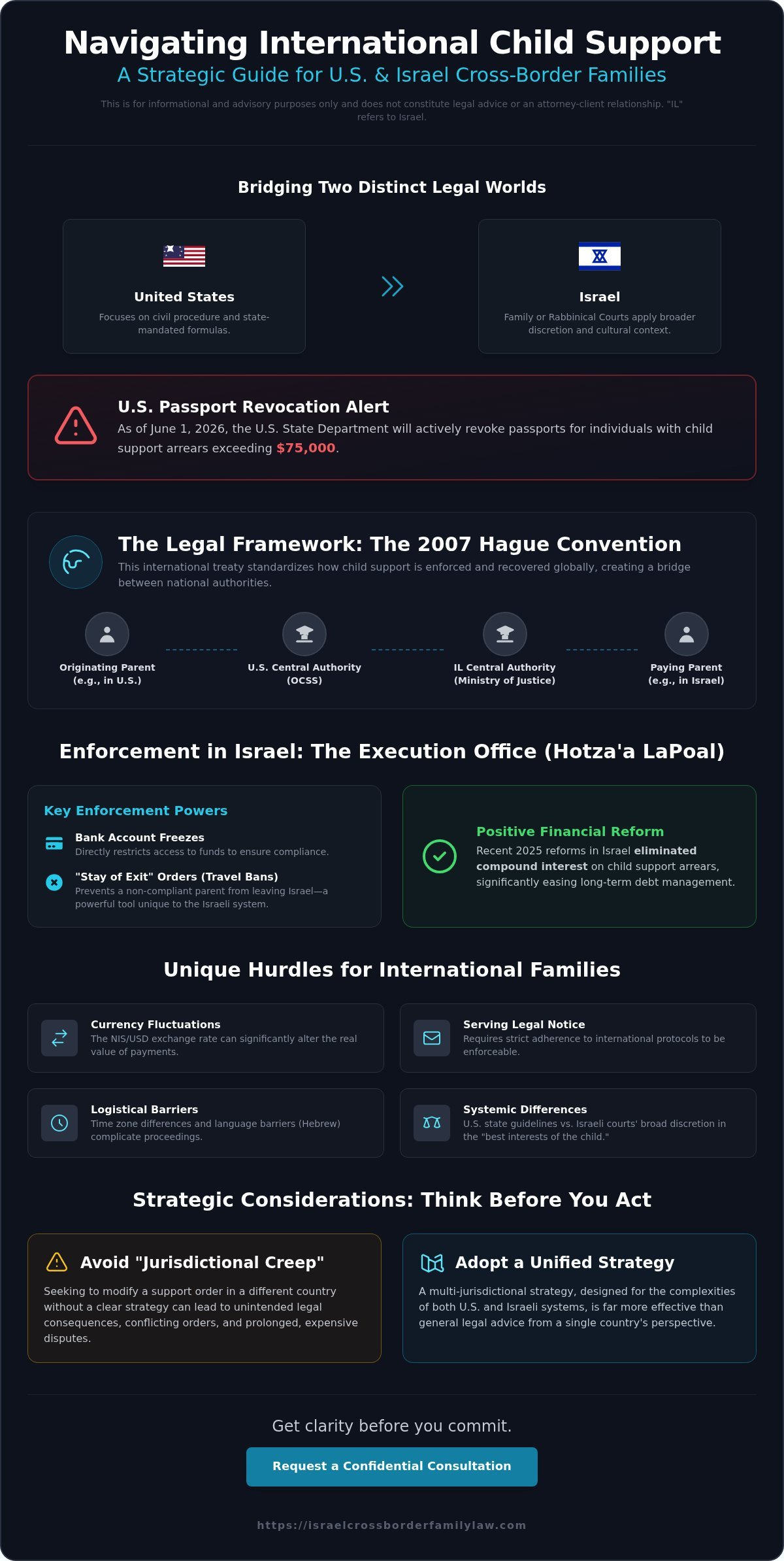
Did you know that as of June 1, 2026, the U.S. State Department began actively revoking passports for individuals with child support arrears exceeding $75,000? It’s natural to feel overwhelmed when managing family obligations across two different legal systems. If you are dealing with International Child Support Enforcement between the U.S. and Israel, much of the stress stems from uncertainty about which country’s laws apply. We believe that gaining a clear understanding of the strategic bridge between these jurisdictions is the first step toward a stable resolution.
This guide provides a comprehensive roadmap for enforcing or managing child support orders across the U.S. and Israeli borders. You will gain a clear understanding of treaty obligations under the Hague Convention and the practical role of the Israeli Execution Office, known as Hotza’a LaPoal. We also examine how recent 2025 reforms that eliminated compound interest on arrears in Israel impact long-term debt management. By focusing on strategy and risk, you can gain the confidence needed to navigate cross-border complexities and make informed choices for your family’s future.
Key Takeaways
- Understand the strategic framework for International Child Support Enforcement to bridge the gap between U.S. central authorities and the Israeli legal system.
- Learn how the 2007 Hague Convention facilitates the recovery of support across borders and what this means for residents in both countries.
- Identify the specific powers of the Israeli Execution Office (Hotza’a LaPoal), including the use of bank account freezes and travel bans to ensure compliance.
- Discover why seeking to modify a support order in a different jurisdiction requires caution to avoid unintended legal consequences or “jurisdictional creep.”
- Explore why a multi-jurisdictional strategy is more effective than general legal advice when managing complex cross-border family law matters.
This article is published on an independent advisory platform and is for informational purposes only. It does not constitute legal representation or an attorney-client relationship.
Understanding International Child Support Enforcement Between the US and Israel
International Child Support Enforcement is the specific legal process used to ensure child support compliance when parents live in different countries. In this guide, “IL” refers specifically to Israel, not Illinois. This process involves more than just sending money. It requires a strategic bridge between two very different legal cultures. Managing support across borders is a complex jurisdictional challenge that often catches families off guard.
While a U.S. court focuses on civil procedure and state-mandated formulas, the Israeli system involves Family Courts or Rabbinical Courts that may apply different standards. Early strategic planning is vital to your success. Without it, you risk facing conflicting orders from two different countries. This often leads to expensive and prolonged legal disputes that could’ve been avoided with a clearer roadmap. You can learn more about the mechanics of this process by exploring our guide on child support cross-border enforcement.
To better understand this concept, watch this helpful video:
The Role of the Central Authority
In both nations, specific government agencies manage these cases. The U.S. Office of Child Support Services (OCSS) works directly with international partners to process applications and track payments. In IL, the Central Authority resides within the Ministry of Justice. These bodies operate under the framework of The Hague Convention, which is a treaty that standardizes how support is recovered globally. Understanding the bureaucratic path through these authorities before you file any paperwork can save you months of administrative delays. These agencies act as administrative bridges, but they don’t replace the need for a personal strategy.
Common Challenges for International Families
International families face hurdles that domestic cases don’t. Currency fluctuations between the Israeli Shekel (NIS) and the U.S. Dollar (USD) can significantly change the actual value of a support payment every month. Serving legal notice to a parent living abroad is another common obstacle that requires adherence to specific international protocols. If notice isn’t served correctly, any resulting order might be unenforceable in the other country. Additionally, differences in time zones and the Hebrew language can make participating in Israeli legal proceedings difficult for those based in the U.S. There are also systemic differences; for example, the Israeli system uses “Stay of Exit” orders to prevent a debtor from leaving the country, a tool that doesn’t exist in the same way in the U.S. legal system.
A major difference between the systems is how they view the “best interests of the child.” U.S. courts often rely on strict state guidelines. In contrast, Israeli Family Courts have broader discretion to consider the specific cultural and religious context of the family. This systemic difference is why a standard U.S. order may need careful translation and adaptation before it’s recognized in IL. Seeking clarity on these differences early on helps prevent the high costs of multi-jurisdictional litigation.
This article is published on an independent advisory platform and is for informational purposes only. It does not constitute legal representation or an attorney-client relationship.
The Hague Convention and Reciprocity: The Legal Framework
The legal landscape of International Child Support Enforcement relies heavily on the 2007 Hague Convention. Israel’s status as a signatory means that U.S. residents have a streamlined path to ensure their orders are recognized across borders. Reciprocity is the engine here. It allows an order issued in a U.S. state court to be treated with the same legal weight as one issued in Tel Aviv. This avoids the need for a brand-new trial to prove the fundamental need for support. It’s a matter of administrative recognition rather than judicial re-evaluation, which helps reduce the high costs of multi-jurisdictional litigation.
There’s a significant difference between enforcing an existing order and establishing a new one internationally. When an order already exists, the focus is on recognition and collection. If no order is in place, the process becomes more complex. It requires the court in the child’s country of residence to establish a financial obligation based on local standards. In IL, these standards are often influenced by specific family law reforms, such as the 2017 Supreme Court ruling on shared custody for children aged 6 to 15.
How the Hague Convention Simplifies the Process
Efficiency comes from standardization. Participating nations use uniform forms and procedures to communicate. You should be aware that the current set of Hague Child Support Convention forms, which are the standard for communication between the U.S. and IL, are set to expire on March 31, 2026. This administrative cooperation ensures that documents don’t get lost in translation between different judicial systems. However, the Convention has limits. It can’t force a parent to find a job or automatically change an order just because one parent moved. If you’re unsure how these rules apply to your specific situation, it’s helpful to reach out for a strategic overview.
Bilateral Agreements Outside the Convention
While the Hague Convention is the primary tool, it’s not the only one. Israel holds “Foreign Reciprocating Country” (FRC) status with the U.S. under a 2009 Memorandum of Understanding. This status is vital. It provides a secondary legal layer that protects your rights even if certain Convention criteria aren’t met. Sometimes, specific state-level agreements might influence the process, though federal treaties generally take precedence. These frameworks are designed to protect both the creditor’s right to receive funds and the debtor’s right to a fair process. They ensure that enforcement is predictable and grounded in established international law rather than arbitrary decisions.
This article is published on an independent advisory platform and is for informational purposes only. It does not constitute legal representation or an attorney-client relationship.
Enforcement Mechanisms in Israel: The Execution Office (Hotza’a LaPoal)
Once a U.S. child support order is recognized by an Israeli Family Court, the actual collection of funds is handled by the Execution Office, known in Hebrew as Hotza’a LaPoal. This agency acts as the administrative arm of the judicial system. It’s responsible for turning a court’s decision into actual payments. For many expats and international families, this is where the theoretical legal process meets practical reality. The Execution Office has broad powers to ensure compliance, making it a central figure in International Child Support Enforcement efforts within IL.
A U.S. support order isn’t automatically active when it arrives in Israel. It must first be “domesticated” or registered. As of January 1, 2026, the fee for filing a claim for the enforcement of a foreign ruling on child support in an Israeli Family Court is 280 NIS. The process of getting a U.S. child support order recognized and enforced in IL typically takes between 6 to 18 months. During this time, the Israeli Family Court oversees the process to ensure the foreign order doesn’t contradict local public policy. Once registered, the order is sent to the Execution Office for active collection.
The ‘Stay of Exit’ Order (Tzav Ikur Yetzia Min Ha’aretz)
One of the most potent tools available in the Israeli system is the “Stay of Exit” order. This legal mechanism can prevent a parent with child support debt from leaving the country. It applies to both Israeli citizens and foreign nationals. If a parent is found to be in arrears, the Execution Office can issue this order to ensure they don’t flee the jurisdiction to avoid their financial obligations. Contesting or lifting this order usually requires the debtor to provide significant financial guarantees or bank-backed guarantors to ensure future payments. It’s a high legal threshold that emphasizes the priority IL places on child maintenance.
Asset Seizure and Income Withholding
The Execution Office can also move against a parent’s financial assets directly. This includes garnishing wages from an Israeli employer or seizing funds from bank accounts and pension funds. Under a significant reform effective January 1, 2025, IL eliminated compound interest on child support arrears. This change prevents the “snowballing” effect of debt, though the principal and linkage to the Consumer Price Index remain. These enforcement actions can have a long-lasting impact on a parent’s credit standing and financial reputation within the Israeli banking system. If you’re managing these complexities, it’s vital to understand the strategy behind Israeli enforcement before assets are frozen.
This article is published on an independent advisory platform and is for informational purposes only. It does not constitute legal representation or an attorney-client relationship.
Strategic Considerations for Modifying Support Orders
Enforcement and modification are often two sides of the same coin in International Child Support Enforcement. When one parent initiates an enforcement action in Israel, the other parent may respond by requesting a modification of the original U.S. order. This creates a strategic crossroads. You must consider whether the Israeli court is the right venue to change a support amount originally set by a U.S. judge. Seeking a modification in a different country carries the risk of “jurisdictional creep.” This happens when a court, initially asked only to adjust support, begins to exert authority over other sensitive issues like custody or visitation rights that you didn’t intend to litigate abroad.
The Israeli legal system offers two distinct paths: Civil Family Courts and Rabbinical Courts. This dual system is a major departure from the U.S. civil court experience. Rabbinical Courts apply religious law (Halakha), which can lead to different outcomes than the civil Family Courts, especially regarding how a father’s obligations are calculated. Choosing the wrong venue or failing to react quickly when a case is filed in one of these courts can have long-term financial consequences. It’s vital to seek clarity on these systemic differences before you commit to a specific legal path.
When to Seek a Modification
A modification requires proving a “substantial change in circumstances.” This is a high legal threshold in both the U.S. and IL. Common reasons include significant changes in income, the child’s evolving needs, or shifts in the cost of living. In Israel, child support payments are typically linked to the Consumer Price Index, known as the “Madad.” These adjustments usually happen every three months to account for inflation. As of 2026, the generally accepted minimum amount for a child’s essential needs in Israel is between 1,400 and 1,600 NIS per month, not including housing costs. If your existing U.S. order falls significantly below these local benchmarks, an Israeli court might view that as a reason to adjust the amount.
The Impact of Relocation on Child Support
Moving across the Atlantic fundamentally changes the financial calculation of a support order. The cost of education, healthcare, and housing in Israel differs greatly from most U.S. states. When a family relocates, the parent seeking a modification must document these expenses meticulously for court review. Relocation also impacts custody arrangements, which in turn influences support obligations. You can find more details on how these issues intersect in our guide on International Custody & Relocation. Strategy is everything when your life is split between two countries. If you’re considering a change to your current arrangement, you should request a confidential consultation to discuss the potential risks and outcomes.
This article is published on an independent advisory platform and is for informational purposes only. It does not constitute legal representation or an attorney-client relationship.
Navigating Cross-Border Complexity with Professional Strategy
Successful International Child Support Enforcement is rarely achieved through a one-size-fits-all legal template. General legal advice often fails in these matters because it lacks the nuanced understanding of how the U.S. and Israeli systems interact. While a local attorney in the U.S. might understand state guidelines, they may not grasp the specific powers of the Israeli Execution Office or the cultural expectations of a Rabbinical Court. Conversely, an Israeli lawyer might not be familiar with the 2026 U.S. passport revocation thresholds. Effective management requires an advisory approach that bridges these two distinct legal landscapes.
Coordinating between U.S. state agencies and Israeli legal counsel is a logistical and strategic challenge. Each system has its own timelines, language, and bureaucratic requirements. A strategy that ignores these differences risks creating administrative deadlocks or conflicting judicial orders. We believe that professional strategy should focus on aligning these systems to ensure that decisions made in one country are respected and enforceable in the other. This content is provided for informational purposes and does not constitute an attorney-client relationship. Legal services are only provided by licensed attorneys under a separate engagement.
Managing the Human Element
International support disputes are often emotionally charged. Reducing conflict through transparent communication and strategic planning is essential for the long-term well-being of the family. Mediation can be a powerful tool in these cases. It allows parents to reach agreements on currency exchange, payment schedules, and indexation without the high costs of multi-jurisdictional litigation. By maintaining a focus on the child’s best interests, parents can often find middle ground that satisfies the legal requirements of both the U.S. and IL without resorting to aggressive enforcement measures.
Next Steps for Families
If you are managing a cross-border family, we encourage you to explore our resources for expats and foreign nationals. For more specific details on how we assist with these matters, please review our Child Support Cross-Border Enforcement page. You can also refer to our YouTube channel for video explainers that break down the complexities of the Israeli legal system in plain English. Strategy and clarity are your best tools for achieving a stable resolution.
Get clarity before you commit. Request a confidential consultation via our Confidential Case Review portal.
This article is published on an independent advisory platform and is for informational purposes only. It does not constitute legal representation or an attorney-client relationship.
Securing Your Family’s Financial Future Across Borders
Managing International Child Support Enforcement requires a nuanced understanding of both U.S. and Israeli legal frameworks. Success in these matters depends on more than just filing paperwork. It requires a deep understanding of the Israeli Execution Office, known as Hotza’a LaPoal, and the specific powers they hold to ensure compliance. By leveraging the reciprocity provided by the Hague Convention, you can ensure that support orders are respected without the need for redundant and costly litigation.
Early decisions regarding where to file or modify an order can have lasting consequences on your financial standing and parental rights. Our authoritative advisory for international families and expats focuses on providing specialized expertise in U.S. and Israeli cross-border family law. We help you bridge the gap between these two complex systems with confidence and clarity. You don’t have to face these multi-jurisdictional challenges alone. With a well-informed strategy, you can protect your child’s interests and achieve a stable, predictable outcome.
Get clarity before you commit. Request a confidential consultation today.
This article is published on an independent advisory platform and is for informational purposes only. It does not constitute legal representation or an attorney-client relationship.
Frequently Asked Questions
Can a US child support order be enforced if the parent moves to Israel?
Yes, a U.S. child support order can be enforced in Israel through the legal process of registration and domestication. Once the Israeli Family Court recognizes the foreign ruling, the Execution Office (Hotza’a LaPoal) takes active steps to collect the payments. This ensures that a parent’s financial obligations follow them across national borders. The process helps maintain stability for the child regardless of where the paying parent resides.
What is the role of the Hague Convention in child support enforcement?
The 2007 Hague Convention provides the primary legal framework for International Child Support Enforcement between the U.S. and Israel. It standardizes the forms and administrative procedures used by government agencies to coordinate the recovery of funds. This treaty ensures that signatory nations work together to recognize and enforce each other’s support orders efficiently. It reduces the need for parents to start new legal proceedings from scratch in a foreign country.
Can I be prevented from leaving Israel if I owe child support?
Yes, the Israeli Execution Office has the authority to issue a “Stay of Exit” order against anyone with child support arrears. This travel ban prevents the debtor from leaving IL until the debt is paid or significant financial guarantees are provided. It is a powerful tool used to ensure that parents don’t evade their maintenance obligations by moving abroad. This order applies to both Israeli citizens and foreign nationals visiting the country.
How do I modify a child support order if I live in a different country than my child?
Modifying an order across borders requires proving a “substantial change in circumstances” in a court that has jurisdiction over the matter. This process is complex because you must determine which country’s laws apply to the modification request. Strategic planning is necessary to avoid “jurisdictional creep” where a court begins deciding on custody or visitation issues unexpectedly. You must provide clear documentation of your current income and the child’s evolving needs.
Does Israel recognize US state court orders for child support?
Yes, Israel recognizes U.S. state court orders because of its status as a “Foreign Reciprocating Country” under a 2009 memorandum. This status allows for reciprocal enforcement even outside the specific mechanisms of the Hague Convention. As of 2026, the filing fee for foreign support order enforcement in an Israeli Family Court is 280 NIS. This recognition ensures that the financial protections established in a U.S. state court remain active and enforceable in IL.
What happens if the exchange rate makes my US support order unaffordable in Israel?
Currency fluctuations between the Shekel and the Dollar can significantly impact the affordability or value of a support order. If the exchange rate causes extreme financial hardship, it might contribute to a claim for modification. However, you must meet a high legal threshold to prove that the change in circumstances is substantial enough to warrant a new court order. It’s often helpful to address currency concerns through mediation before pursuing a formal modification filing.
How long does the international enforcement process typically take?
The process of getting a U.S. child support order recognized and actively enforced in Israel typically takes between 6 to 18 months. This timeframe includes the initial filing in the Family Court and the subsequent administrative setup within the Execution Office. Delays can occur if there are challenges in serving notice to the other parent or if the debtor contests the registration. Patience and a clear strategic roadmap are essential during this administrative period.
Do I need a lawyer in both the US and Israel for child support enforcement?
While you aren’t legally required to have a lawyer in both countries, it’s often beneficial to have a professional strategy that covers both jurisdictions. Coordinating between U.S. state agencies and the Israeli Ministry of Justice is difficult for those unfamiliar with the system. Specialized International Child Support Enforcement advisory can help bridge the gap between these two distinct legal environments. This approach helps you avoid the high costs and risks associated with multi-jurisdictional litigation.

Article by
Gabriel Lior
A Personal Journey That Became a Mission
The advisory was founded by an American father Gabriel Lior, LLB, MBA , global entrepreneur, and cross-border advisor who spent more than a decade navigating the Israeli family court system firsthand and now lives in Singapore with his son.
As a divorced parent in a cross-border family, Gabriel faced nearly every legal challenge a foreign parent can encounter in Israel — including child custody disputes, child support proceedings, property matters in Israel and abroad, false accusations, and complex immigration and relocation proceedings.
Over the years, he learned the hard way how difficult it is for non-Israeli parents to understand the system, identify the right legal strategy, and choose the right legal representation — especially when language, culture, and jurisdictional differences are involved. He also witnessed how foreign parents and new immigrants are often disadvantaged or taken advantage of by service providers and institutions simply because they lack local knowledge or fluency.
From Client to Advisor
To truly understand — and survive — the system, Gabriel pursued formal legal education in Israel, completing two Israeli law degrees, alongside a BA and MBA earned in the United States. This was never about becoming a practicing attorney, but about gaining a deep, structural understanding of how the system works — and where it breaks down for foreign parents.
This rare combination of:
Firsthand client experience
Israeli legal and US business education
International business and negotiation training
Decades of commercial execution
created a unique perspective – one that understands both sides of the table.
After years of litigation, persistence, and at times self-representation, he ultimately succeeded in securing custody of his son and relocating abroad through a rare legal victory in the Israeli Supreme Court — becoming one of the first fathers in Israel to do so under these circumstances.
Disclaimer
Important Disclaimer:
The information provided on this website and in its content is for general informational and educational purposes only and does not constitute legal advice, legal opinion, or legal representation.
Gabriel Lior is not licensed to practice law in Israel (nor is he interested in doing so) and does not provide legal services, despite having completed 2 Law Degrees. The services offered are advisory in nature and are intended to provide general guidance, strategic insight, and information regarding cross-border family law considerations.
No attorney-client relationship is formed by accessing this website, reading its content, or communicating with us.
Any decisions made based on this information are at your own discretion and risk. For legal advice specific to your situation, you should consult a licensed attorney in the relevant jurisdiction.
Where appropriate, we may refer clients to independent, licensed attorneys or professionals. Such referrals do not constitute legal representation and no liability is assumed for services provided by third parties.