This article is published on an independent advisory platform and does not imply an attorney-client relationship.
A single mistranslated word in a Hebrew court order can cause months of delays or even the dismissal of your case in a US court. In cross-border law, a translation isn’t just a change of language. It’s a strategic bridge between two distinct legal systems that can either secure or sink your interests. You’re likely feeling the pressure of managing legal matters in both Israel and the United States, where the stakes are high and the terminology is dense. It’s common to feel overwhelmed by the technical requirements of different jurisdictions.
This guide provides the strategic steps for ensuring court documents are accurately translated and properly certified to protect your interests in cross-border proceedings. We’ll clarify the confusing differences between notarized, certified, and apostilled documents. You’ll also learn how to verify the accuracy of your translations and navigate the Israeli notary system with confidence. By understanding these processes early, you can minimize the risk of procedural errors and keep your international legal strategy on track.
Key Takeaways
- Learn why preserving the legal effect of a document is more important than a literal word-for-word translation in cross-border cases.
- Understand the essential differences between notarized translations and apostilles to ensure your documents are accepted by both Israeli and US authorities.
- Discover the strategic value of ensuring court documents are accurately translated by specialists who understand the specific language of the Israeli Rabbinical Courts.
- Identify how to avoid procedural delays by selecting translators with dual-jurisdiction expertise instead of those with only basic language skills.
- Gain a clear understanding of the verification process to protect your interests before signing or submitting any cross-border legal documents.
This article is published on an independent advisory platform and does not imply an attorney-client relationship.
Why Translation Accuracy is Critical in US-Israel Cross-Border Cases
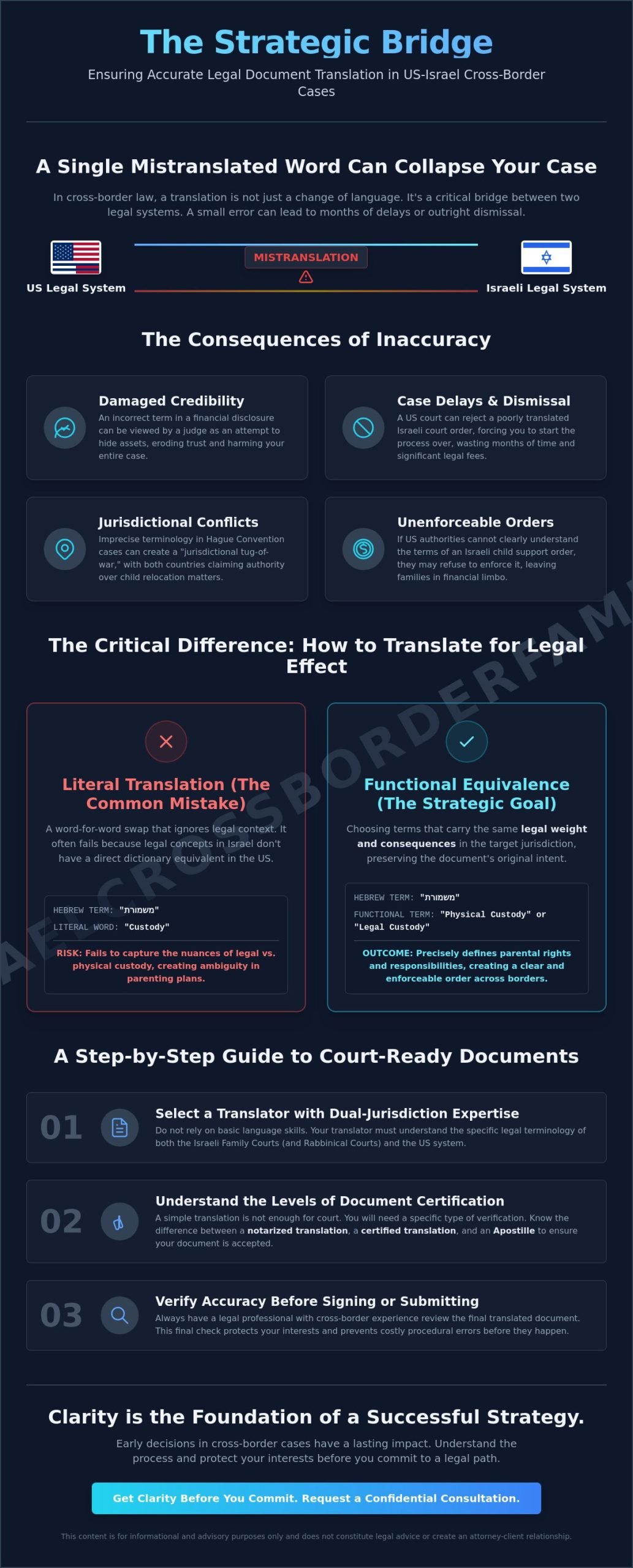
Accuracy in a legal context is often misunderstood. Many believe it simply means a word-for-word swap between Hebrew and English. However, true Legal translation requires preserving the legal effect of the original text. In US-Israel proceedings, ensuring court documents are accurately translated involves more than linguistic fluency; it requires a deep understanding of how specific terms function within two very different judicial frameworks. A mistake here isn’t just a typo. It can change the entire meaning of a court order.
Mistranslations in sensitive documents like affidavits or financial disclosures can lead to disastrous outcomes in a divorce and separation for international families. If an asset is described incorrectly or income is categorized using the wrong terminology, a judge might view the discrepancy as an attempt to hide information. This damages your credibility and can derail your entire case. Precision is the only way to maintain trust with the court.
To better understand this concept, watch this helpful video:
Israeli courts and US courts view foreign language evidence differently. While Israeli judges are often accustomed to seeing documents in multiple languages, US courts generally require strict adherence to certified English versions. This is especially vital when dealing with the Hague Convention. Precise terminology is required for international child relocation cases to avoid a jurisdictional tug-of-war where both countries claim authority over the same matter. Ensuring court documents are accurately translated prevents these conflicts before they start.
The High Stakes of Cross-Border Family Law
When a custody agreement is translated poorly, the resulting ambiguity favors neither parent. This lack of clarity makes enforcing child support orders across borders significantly harder. If US authorities can’t clearly identify the terms of an Israeli order due to linguistic shifts, they may refuse to enforce it. This leaves families in financial limbo. Clear, professional translation acts as a safeguard against these procedural failures.
Literal vs. Functional Equivalence
Word-for-word translation frequently fails because legal concepts in Israel don’t always have a direct twin in the US. Functional equivalence in the context of US-Israel legal systems refers to the practice of choosing terms that carry the same legal weight and consequences in the target jurisdiction as they did in the original text. You aren’t just looking for a dictionary match; you’re looking for a legal match. This approach ensures the document’s intent remains intact across borders.
Get clarity before you commit. Request a confidential consultation via WhatsApp or an advisory call.
This article is published on an independent advisory platform and does not imply an attorney-client relationship.
Understanding the Types of Legal Translation and Certification
The process of ensuring court documents are accurately translated involves several layers of verification. You’ll quickly find that a simple translation is rarely enough for official proceedings. Depending on whether you’re submitting a document to a court in Israel or the United States, you’ll need specific types of certification to prove the text is reliable. Understanding these distinctions early helps you avoid the high costs of re-translating or re-certifying documents that were rejected on a technicality.
A primary distinction exists between translations intended for informational use and those for court-submission use. If you only need to understand the general contents of a Hebrew document for your own knowledge, a standard professional translation suffices. However, if that document is part of a legal filing, the court needs a guarantee of its accuracy. This is where certified and notarized translations become essential. You should determine the end-use of your document before commissioning any work, as the certification process adds both time and expense.
In the United States, courts often require a “Certified Translation.” This is a statement of accuracy provided by a professional translator or a translation agency. According to the American Translators Association, a certified translation includes a signed statement from the translator or a representative of the translation firm. This statement, sometimes called an “Affidavit of Accuracy,” declares that the translation is a true and complete representation of the original document. Many US jurisdictions require this affidavit to be signed in the presence of a notary public to verify the translator’s identity.
Certified vs. Notarized: Which Do You Need?
In Israel, a “Notarized Translation” carries more weight than a standard certified one. An Israeli notary is a lawyer with at least ten years of experience who verifies the translator’s signature or the accuracy of the translation itself. If you’re bringing a foreign document into an Israeli court, the judge will almost always require a notarized translation. The notary’s seal acts as the state’s guarantee that the translation is legally valid. It’s a formal step that provides the court with the security it needs to accept foreign evidence.
The Role of the Apostille in Cross-Border Validation
Even with a notarized translation, your document might still need an Apostille. This is an international certification established by the 1961 Hague Convention to legalize public documents for use in foreign countries. If you have a US birth certificate or court order intended for use in Israel, the Apostille from the US state department confirms the document’s origin. It’s often the final step in ensuring court documents are accurately translated and legally recognized by foreign authorities. Without this stamp, the Israeli court may not even look at your translated papers.
Navigating these requirements can be complex, but getting the right certification the first time saves significant stress. If you’re unsure which level of certification your specific case requires, it’s wise to clarify your strategy before moving forward.
Get clarity before you commit. Request a confidential consultation via WhatsApp or an advisory call.
This article is published on an independent advisory platform and does not imply an attorney-client relationship.
Common Pitfalls in Translating Court Documents Between Hebrew and English
Translating legal text between Hebrew and English presents unique challenges that go far beyond simple grammar. One of the most significant hurdles involves the Israeli Rabbinical Courts. These religious tribunals use terminology rooted in ancient traditions that don’t have direct equivalents in the US legal system. For example, a “Get” isn’t merely a divorce decree; it’s a specific religious act with its own procedural requirements. If a translator simply labels it a “divorce,” a US judge may miss the religious and jurisdictional nuances that could impact the case’s finality or validity abroad. Ensuring court documents are accurately translated requires a professional who can bridge these cultural and systemic gaps.
Hebrew legal writing also tends to favor a very formal, passive voice. In contrast, modern US legal standards increasingly prioritize “plain English” and active sentence structures. A literal translation that preserves the Hebrew passive voice often results in English text that feels clunky, ambiguous, or even suspicious to an American court. Effective translation requires a careful balance; the text must remain faithful to the original meaning while being presented in a way that US legal professionals can actually use. Without this adjustment, your evidence might be viewed as unreliable or confusing.
You also need to watch out for “false friends”—words that look or sound similar in both languages but carry different legal weights. A common example is the Hebrew word “Protocol.” In an Israeli court, this refers to the official minutes or transcript of a hearing. In a US legal context, “protocol” usually refers to a set of rules or a specific procedure. Using the wrong term can lead a US lawyer to look for a rulebook when they should be reading a testimony. This is why using a general translator instead of a legal specialist is a high-risk decision for complex financial or corporate filings.
Systemic Differences: Israeli Law for Foreigners
In IL, the divide between civil and religious courts is a central feature of the legal landscape. This creates a “race for jurisdiction” that often confuses those unfamiliar with the system. You can find more information for expats and foreign nationals regarding how these dual systems interact. When a translation lacks the necessary cultural context, US lawyers may misinterpret the authority of an Israeli court order, leading to costly mistakes in cross-border enforcement.
Formatting and Structural Integrity
A professional translation must mirror the exact layout of the original document. If a signature appears on the bottom left of the Hebrew page, it should be in the same spot in the English version. This visual alignment helps judges and clerks verify the text quickly. Translators must also account for every stamp, seal, and handwritten marginal note. For concepts that simply cannot be translated, the use of “Translator’s Notes” is essential. These notes provide the necessary explanation without altering the source text, which is a critical part of ensuring court documents are accurately translated for official use.
Get clarity before you commit. Request a confidential consultation via WhatsApp or an advisory call.
This article is published on an independent advisory platform and does not imply an attorney-client relationship.
A Step-by-Step Guide to Ensuring Your Documents Meet Court Standards
Managing a cross-border case requires a disciplined approach to paperwork. The first step is to identify the specific requirements of your target jurisdiction. A court in New York may have vastly different certification standards than a family court in Tel Aviv. Once you’ve confirmed the rules, focus on ensuring court documents are accurately translated by selecting a professional with dual-jurisdiction legal expertise. You don’t just need someone who speaks both languages; you need someone who understands the legal mechanics of both the US and IL systems. This expertise ensures that the “legal effect” discussed earlier is preserved across borders.
Before the work begins, provide your translator with a glossary of case-specific terms or previous rulings related to your matter. This context prevents inconsistent terminology that could confuse a judge. After the initial translation is complete, perform a multi-layered review. This should include a linguistic check for grammar and a separate review by a legal expert to confirm the strategy remains intact. Finally, secure all necessary certifications, such as a notary seal or an Apostille, well before your filing deadline. Rushing these steps at the last minute often leads to clerical errors that can stall your proceedings for months.
Vetting Your Translation Partner
When interviewing a potential translator, ask about their specific experience with US-Israel family law matters. A legal background is far more important than native fluency alone. You want to know if they’ve handled Hague Convention cases or complex financial disclosures before. In high-stakes litigation, a second-pair-of-eyes review is not a luxury; it’s a necessity. This extra layer of scrutiny catches subtle nuances that a single translator might overlook, providing you with an additional level of security.
The Verification Process
Your advisory team plays a vital role in reviewing the final translation for strategic alignment. They can cross-reference translated terms with the original Hebrew source to ensure no meaning was lost in the transition. The back-translation method involves translating the English version back into Hebrew to verify that the core legal meaning remains unchanged throughout the process. This rigorous check is particularly useful for critical clauses in custody or asset-division agreements where every word carries significant weight. If the back-translation reveals a different meaning than the original, you know the English version needs adjustment.
Taking these steps early protects your interests and helps you avoid costly procedural dismissals. If you need assistance with your document strategy, you can request a confidential consultation to discuss your specific needs.
Get clarity before you commit. Request a confidential consultation via WhatsApp or an advisory call.
This article is published on an independent advisory platform and does not imply an attorney-client relationship.
Navigating the Strategy Behind Document Preparation
It’s vital to view translation not as a standalone task, but as the final step of a broader cross-border legal strategy. If the underlying legal document is poorly drafted or fails to account for international jurisdictional conflicts, even the most perfect translation cannot fix the core issue. Your strategy in the US and IL must be aligned from the beginning. Ensuring court documents are accurately translated is the mechanism that carries your legal intent from one system to the other. If the wording doesn’t reflect your actual goals, you risk losing the protections you’ve worked hard to establish.
One of the most important principles in cross-border law is maintaining clarity before commitment. You should never sign a Hebrew document that you cannot fully read and understand. Many expats and international families feel pressured to sign agreements in the Israeli court system under the assumption that they can “fix it later” with a translation. However, early decisions on specific wording often have long-lasting impacts on your ability to enforce orders in the US. Once a document is signed and filed, its legal weight is set. You must ensure that the English version you rely on is a true reflection of the commitments you are making.
The Advisory Approach to Cross-Border Law
Working with an advisory platform provides a critical bridge between US and Israeli legal expectations. While a translation agency focuses on the technical swap of words, a strategic advisory understands the “why” behind every clause. You can learn more about how our advisory works to help families manage these complexities. This approach ensures that your documents are prepared with an eye toward future enforcement, rather than just immediate court submission. It moves the focus from simple language to long-term strategic security.
Conclusion and Next Steps
Managing legal matters between two countries is inherently complex, but ensuring court documents are accurately translated makes the process manageable. By following a structured verification process and selecting the right experts, you can significantly reduce the risk of procedural delays or dismissals. Accuracy is not just a linguistic requirement; it’s a strategic necessity that protects your family’s interests and your financial future. When you prioritize clarity and professional certification, you build a stronger foundation for your cross-border case.
To deepen your understanding of these issues, we invite you to watch our guide on navigating US-Israel legal complexities. Seeing the process in action can help demystify the steps required to move your case forward with confidence. Remember that every decision you make today impacts the enforceability of your orders tomorrow.
Get clarity before you commit. Request a confidential consultation via WhatsApp or an advisory call.
This article is published on an independent advisory platform and does not imply an attorney-client relationship.
Securing Your Cross-Border Interests
Managing a legal case across two continents requires attention to detail that goes beyond simple language skills. Success depends on understanding that a document’s legal weight in IL must be preserved when it enters the US system. By prioritizing specialized expertise and the correct certification path, you protect yourself from avoidable procedural delays. Ensuring court documents are accurately translated isn’t just an administrative hurdle; it’s a foundational step in your overall legal strategy.
Our advisory platform provides authoritative guidance for expats and international families who need to bridge the gap between US and Israeli legal expectations. We focus on strategic risk management to help you understand the implications of your documents before you commit to a course of action. With the right approach and specialized expertise in cross-border family law, you can move forward with confidence. Clarity is your best defense against the complexities of a dual-jurisdiction landscape.
Get clarity before you commit. Request a confidential consultation today. You have the ability to safeguard your future through informed decision-making and strategic preparation.
This article is published on an independent advisory platform and does not imply an attorney-client relationship.
Frequently Asked Questions
Do I need a lawyer to translate my court documents for use in Israel?
You don’t strictly need a lawyer to perform the initial translation, but in IL, only a licensed notary can certify a translation for official court use. An Israeli notary is always a lawyer with at least ten years of experience and a clean professional record. This requirement ensures that the person certifying the document understands the legal weight of the terminology being used.
Can I use AI or Google Translate for my court submissions?
No, you should never use AI or automated tools for official court submissions. These tools often miss the “functional equivalence” required for ensuring court documents are accurately translated and can lead to significant legal errors. Courts in both the US and IL require a human certification of accuracy to accept a foreign document as evidence.
What is an Apostille and why is it required for my US divorce decree in Israel?
An Apostille is an international certification that authenticates the origin of a public document under the 1961 Hague Convention. It doesn’t certify the content of your divorce decree; rather, it proves to Israeli authorities that the signature of the US official on the document is genuine. Without this stamp, the Israeli court cannot legally recognize the US document as a valid public record.
How long does it typically take to get a notarized legal translation in Israel?
The timeline depends on the document’s complexity, but most professional services complete the process within two to four business days. Many providers offer express turnaround times of two to four hours for an additional surcharge. It’s best to plan ahead to avoid the 50% surcharge often applied to services requested during late night hours or rest days.
What happens if a US court discovers an error in my translated Israeli document?
A significant error can lead to the court rejecting the document entirely or even dismissing your case. Mistranslations in financial disclosures or custody agreements can also make you appear dishonest to the judge. This causes expensive procedural delays and can permanently damage your legal position in cross-border proceedings.
Is a translation from a US-based translator valid in an Israeli court?
Israeli courts generally require a translation to be certified by a notary licensed in IL to meet local evidentiary standards. While a US-based professional can translate the text, the document usually needs to be reviewed and certified by an Israeli notary to be accepted by the court. This ensures the translation meets specific Israeli legal requirements.
How much should I expect to pay for a certified legal translation between Hebrew and English?
Notary fees for certifying a translation in IL are fixed by the Ministry of Justice and updated annually. As of January 2025, the official rate is 251 NIS for the first 100 words and 197 NIS for each additional 100 words, plus VAT. The cost of the translation itself is separate and varies based on the complexity and urgency of the document.
What is an ‘Affidavit of Accuracy’ and do I always need one?
An Affidavit of Accuracy is a sworn statement by the translator confirming that the translation is a true and complete representation of the original source. You almost always need this for ensuring court documents are accurately translated for US court submissions. It provides the necessary legal foundation for the judge to rely on the translated text as credible evidence.
Get clarity before you commit. Request a confidential consultation.

Article by
Gabriel Lior
A Personal Journey That Became a Mission
The advisory was founded by an American father Gabriel Lior, LLB, MBA , global entrepreneur, and cross-border advisor who spent more than a decade navigating the Israeli family court system firsthand and now lives in Singapore with his son.
As a divorced parent in a cross-border family, Gabriel faced nearly every legal challenge a foreign parent can encounter in Israel — including child custody disputes, child support proceedings, property matters in Israel and abroad, false accusations, and complex immigration and relocation proceedings.
Over the years, he learned the hard way how difficult it is for non-Israeli parents to understand the system, identify the right legal strategy, and choose the right legal representation — especially when language, culture, and jurisdictional differences are involved. He also witnessed how foreign parents and new immigrants are often disadvantaged or taken advantage of by service providers and institutions simply because they lack local knowledge or fluency.
From Client to Advisor
To truly understand — and survive — the system, Gabriel pursued formal legal education in Israel, completing two Israeli law degrees, alongside a BA and MBA earned in the United States. This was never about becoming a practicing attorney, but about gaining a deep, structural understanding of how the system works — and where it breaks down for foreign parents.
This rare combination of:
Firsthand client experience
Israeli legal and US business education
International business and negotiation training
Decades of commercial execution
created a unique perspective – one that understands both sides of the table.
After years of litigation, persistence, and at times self-representation, he ultimately succeeded in securing custody of his son and relocating abroad through a rare legal victory in the Israeli Supreme Court — becoming one of the first fathers in Israel to do so under these circumstances.
Disclaimer
Important Disclaimer:
The information provided on this website and in its content is for general informational and educational purposes only and does not constitute legal advice, legal opinion, or legal representation.
Gabriel Lior is not licensed to practice law in Israel (nor is he interested in doing so) and does not provide legal services, despite having completed 2 Law Degrees. The services offered are advisory in nature and are intended to provide general guidance, strategic insight, and information regarding cross-border family law considerations.
No attorney-client relationship is formed by accessing this website, reading its content, or communicating with us.
Any decisions made based on this information are at your own discretion and risk. For legal advice specific to your situation, you should consult a licensed attorney in the relevant jurisdiction.
Where appropriate, we may refer clients to independent, licensed attorneys or professionals. Such referrals do not constitute legal representation and no liability is assumed for services provided by third parties.