This article is published on an independent advisory platform and does not constitute an attorney-client relationship. The information provided is for educational purposes only and legal services are only provided by licensed attorneys under a separate engagement.
The most aggressive litigator in Manhattan or the most famous practitioner in a Tel Aviv court might actually be the wrong choice for your case. When you are comparing us-israel family lawyers, the real value isn’t found in local reputation alone, but in the ability to act as a strategic bridge between two very different legal worlds. You likely already feel that a single move in a US court can trigger unintended consequences in Israel (IL). The fear of losing a jurisdictional advantage through a “race to the court” is a heavy burden to carry without the right guidance.
It is natural to feel anxious about how your US court orders will be enforced abroad or whether your legal costs will spiral without a clear strategy. In this guide, you will learn how to evaluate and compare legal representation for complex family matters spanning both the United States and Israel. We will examine the essential criteria for choosing an expert who understands cross-border complexity, including multi-jurisdictional licensing and the specific nuances of the Israeli legal landscape.
Key Takeaways
- Understand why multi-qualified practitioners are essential for navigating the complex intersection of US and Israeli legal systems.
- Learn the specific criteria for comparing us-israel family lawyers to ensure your representative understands how a decision in one country impacts your rights in the other.
- Recognize the differences between local-only firms and cross-border specialists who focus on protecting your global interests.
- Identify high-stakes questions to ask potential counsel about international child relocation and the enforcement of foreign court orders.
- Gain clarity on why a strategic advisory approach in the first 30 days of a dispute is more effective than rushing into litigation.
This article is published on an independent advisory platform and does not constitute legal advice or an attorney-client relationship. Legal services are only provided by licensed attorneys under a separate engagement.
The Complexity of US-Israel Family Law: Why Standard Comparisons Fail
Many families assume that a top-rated attorney in one country is enough to handle a dispute that touches both. However, when you are comparing us-israel family lawyers, you quickly realize that standard comparisons often fail because they ignore the friction between two distinct legal systems. A cross-border family lawyer is not just a litigator. They are a strategist who manages cases where parties, children, or assets are split between the United States and Israel (IL).
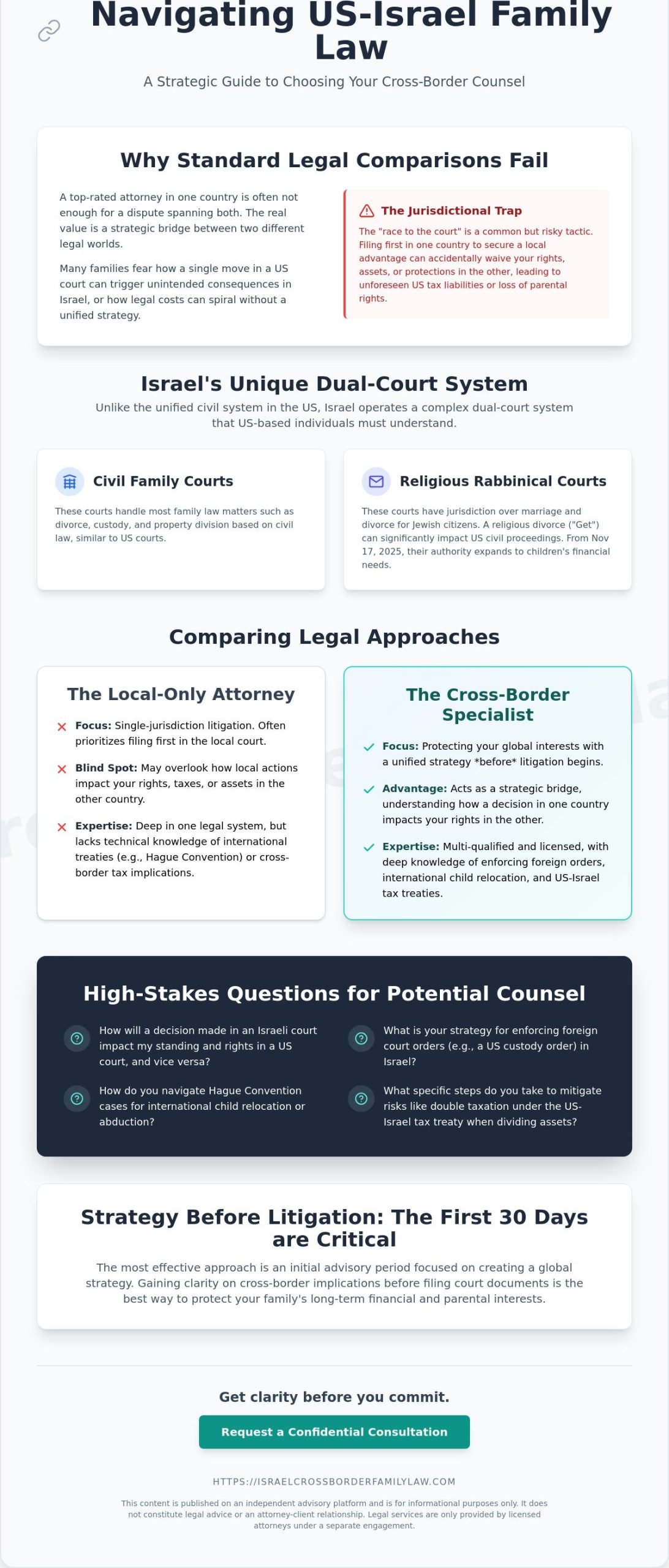
The Israeli legal landscape is uniquely challenging for US citizens. Unlike the unified civil systems in most US states, Israel operates a dual-court system consisting of civil Family Courts and religious Rabbinical Courts. On November 17, 2025, a new law granted Rabbinical Courts temporary authority to rule on the financial needs of children, including upbringing, education, and medical care. This adds a layer of complexity that a standard US lawyer cannot navigate alone. To better understand these systemic differences, watch this helpful video:
The Jurisdictional Trap
One of the biggest risks in divorce and separation for international families is the “race to the court.” While many local lawyers focus on filing first within Israel to secure a specific court, they may overlook how this move impacts your standing in the US. Filing in one country can accidentally waive your rights to certain assets or protections in the other. For instance, the US-Israel tax treaty influences how assets should be divided to avoid double taxation. A local lawyer might secure a property in Tel Aviv but inadvertently trigger a massive US tax liability. When you are comparing us-israel family lawyers, look for those who prioritize this type of global strategy over immediate litigation.
It is a mistake to assume that a bilingual lawyer is automatically a cross-border expert. Fluency in Hebrew and English is helpful for communication, but it doesn’t replace the technical knowledge required to manage the Hague Convention on International Child Abduction or the enforcement of foreign judgments. Strategy must come before the first filing.
Cultural vs. Legal Nuance
The intersection of religious and civil law creates specific hurdles. The Israeli “Get,” or religious divorce decree, can significantly impact US civil proceedings, especially if one party uses it as leverage in financial negotiations. The Israeli Supreme Court often plays a pivotal role in international family disputes, setting precedents that affect how foreign orders are recognized across borders. English-speaking Israelis and expats often require an “Anglo-oriented” advisory approach. This means looking for a professional who understands the cultural expectations of a US-based client while managing the systemic realities of the Israeli courts. Seeking clarity before you commit to a specific jurisdiction is the most effective way to protect your long-term interests.
This article is published on an independent advisory platform and does not constitute an attorney-client relationship. Legal services are only provided by licensed attorneys under a separate engagement.
Evaluating Cross-Border Credentials: Three Pillars of Expertise
When you begin comparing us-israel family lawyers, it’s essential to look beyond a sleek website or a bilingual staff. True cross-border expertise is built on three specific pillars that ensure your strategy remains sound in both countries. Without these pillars, you risk receiving advice that works in one jurisdiction while inadvertently damaging your standing in the other.
Licensing and Professional Standing
The difference between a lawyer who “works with” US counsel and one who is actually licensed in the US is significant. A practitioner who is admitted to the bar in both jurisdictions provides a level of security that a local lawyer cannot match. Dual-qualification means the lawyer understands the ethical obligations and procedural requirements of both the Israel Bar Association and the relevant US State Bar. This reduces the risk of “lost in translation” legal errors where a specific term in New York has a completely different implication in Tel Aviv. You should always verify a lawyer’s standing in both systems to ensure they’re authorized to provide the comprehensive oversight your case requires.
Treaty and Convention Mastery
As of 2026, the Hague Convention remains the foundational legal instrument for resolving international child custody disputes between the United States and Israel by establishing clear protocols for the return of children to their country of habitual residence. Mastery of the Hague Convention on the Civil Aspects of International Child Abduction is non-negotiable for families split between these two nations. You must also evaluate their experience with the US-Israel Child Support Enforcement agreement. This treaty allows for the collection of support across borders, but it requires a practitioner who understands how to navigate the administrative hurdles in both the US and Israel (IL). Gaining a deep understanding of international custody and relocation is the first step toward a successful outcome.
Enforcement Knowledge
Success in a US courtroom is only half the battle if the resulting order cannot be enforced in Israel (IL). A qualified expert must have a proven track record of petitioning Israeli courts to recognize and enforce US alimony or child support orders. This requires more than just knowledge of the law; it requires a practical understanding of how Israeli judges view foreign decrees. If you are unsure where your case stands, speaking with an advisor can help you identify the right path before you commit to a specific firm.
This article is published on an independent advisory platform and does not constitute an attorney-client relationship. Legal services are only provided by licensed attorneys under a separate engagement.
Local-Only vs. Cross-Border Firms: A Comparative Framework
Choosing the right legal representative involves more than just looking at a firm’s success rate in a local courtroom. When you are comparing us-israel family lawyers, it’s helpful to distinguish between those who focus solely on local litigation and those who specialize in multi-jurisdictional strategy. A local-only firm often possesses deep expertise in Israeli litigation. However, they may overlook the US tax or custody implications of an Israeli court order. In contrast, a cross-border specialist focuses on the “Bridge”—how a decision made in Tel Aviv affects a property in New York or a retirement account in California.
The communication styles of these two types of firms also differ significantly. Local firms often employ an “aggressive litigator” model. This approach prioritizes winning the immediate motion or securing a quick tactical advantage. While this can be effective in a vacuum, it often ignores the long-term impact on your global interests. The “strategic advisor” model, characteristic of cross-border practices, prioritizes stability and the protection of your rights in both countries. Understanding pricing and value is also vital in an international context. While coordination across borders requires a different level of investment, a proactive strategy usually prevents expensive errors that are difficult to correct later.
When a Local Lawyer is Sufficient
A local lawyer is often sufficient when all parties and assets are permanently residing in Israel (IL) with no ties to the US. If you have no US citizenship, no US-based property, and no intention of relocating children to America, a local specialist can handle simple, uncontested matters effectively. These cases don’t require the complex “bridge” strategy because the legal effects are contained within a single system. However, the limitations of local counsel become apparent the moment an international element, such as a foreign pension or a dual-national child, is introduced.
When Cross-Border Expertise is Mandatory
Cross-border expertise is mandatory for dual-citizenship families or those with children who may move between countries. High-net-worth cases involving US-based 401ks, IRAs, or corporate interests require a nuanced understanding of how foreign assets are treated under Israeli law. For these complex situations, divorce and separation for international families requires a representative who can look beyond the local horizon. Decisions made in the first 30 days of a dispute often dictate the outcome for years to come. Ensuring your representative understands the impact of early filings on both sides of the ocean is the only way to maintain a position of strength.
This article is published on an independent advisory platform and does not constitute an attorney-client relationship. Legal services are only provided by licensed attorneys under a separate engagement.
Key Questions to Ask When Vetting an International Family Lawyer
When you are comparing us-israel family lawyers, the vetting process must go beyond general litigation experience. You need a professional who understands how the gears of two different legal systems turn together. Start by asking about their specific experience with the US-Israel tax treaty. For example, if you are a US citizen living in Israel (IL), how will the division of a US-based retirement account affect your tax liability in both countries? A lawyer who cannot explain these nuances may leave you with a significant and unexpected financial burden.
Another critical question involves the Israeli stay-of-exit order. You should ask: “Can you explain the immediate impact of an Israeli stay-of-exit order on my US employment?” In Israel (IL), it is common for a court to prevent a party from leaving the country during a legal dispute. If your job requires international travel back to the US, this can be devastating. A strategic advisor will discuss these risks and potential mitigation steps before they become a reality.
Finally, ask if they provide a written strategy before entering the litigation phase. In cross-border cases, the first 30 days are often the most important for your long-term protection. You should avoid lawyers who guarantee specific outcomes or dismiss the complexity of US laws as irrelevant. No one can guarantee a result in a dual-court system, and a lawyer who claims otherwise is a significant red flag.
Assessing Technical Knowledge
Technical knowledge involves understanding specific Israeli instruments like the “Yipuy Koach Mitmashech” (Lasting Power of Attorney) and how it compares to a US Power of Attorney. These documents are not identical and serve different purposes within their respective systems. You also need to know how they handle child support cross-border enforcement. A lawyer must be able to explain how an Israeli court will view a US order and what administrative steps are needed to make it binding in Israel (IL). They should also be prepared to discuss “Race to the Court” scenarios where filing speed in one country affects your rights in the other.
Evaluating the Advisory Relationship
The relationship should be based on strategy, not just speed. Does the lawyer listen to your long-term goals, such as maintaining a relationship with children in both countries, or do they push for an immediate filing? Seeking a confidential case review before signing a retainer allows you to test their advisory style. This ensures they prioritize clarity before commitment. For more guidance on this process, you can find educational resources on our YouTube channel, @IsraelFamilyLaw. To ensure your interests are protected in both jurisdictions, request a strategic consultation today.
This article is published on an independent advisory platform and does not constitute an attorney-client relationship. Legal services are only provided by licensed attorneys under a separate engagement.
Strategy Before Litigation: The Advisory Model for US-Israel Families
When you are comparing us-israel family lawyers, it’s common to focus on who will be the most aggressive in court. However, the most successful outcomes in cross-border cases are rarely the result of aggression alone. They’re the result of a deliberate advisory model that prioritizes strategy over immediate reaction. There is a vital distinction between “legal advice,” which tells you what the law is, and “strategic advisory,” which helps you understand how a move in the US will ripple through the Israeli legal system.
The first 30 days of a cross-border dispute are the most critical for your long-term protection. During this window, decisions about where to file and what to disclose can lock you into a specific jurisdiction. A strategic advisor identifies risks before they become expensive legal battles. For example, under the National Insurance Law changes enacted on February 25, 2026, new immigrants from the US may have specific exemptions from Israeli National Insurance payments. A standard litigator might miss how the timing of a divorce filing impacts these tax-related benefits. An advisory approach ensures these financial nuances are part of your initial plan.
The Role of an Independent Advisor
An independent advisory platform allows you to understand how it works without the immediate pressure of a courtroom. This model focuses on building a unified strategy that your US and Israeli lawyers can both follow. This is especially helpful for expats and foreign nationals who need a steady guide to navigate the cultural and systemic differences in Israel (IL). By focusing on informed decision-making, you can avoid the “jurisdictional trap” where filing in one country accidentally waives your rights in another.
Next Steps for Your Protection
Protecting your interests requires preparation before the litigation phase begins. You should begin by organizing your international documentation to ensure your advisor has a clear picture of your global standing. Key items to gather include:
- Marriage certificates and any prenuptial or postnuptial agreements from both countries.
- A comprehensive list of assets, including US-based 401ks, IRAs, and Israeli real estate.
- Documentation regarding the “habitual residence” of any children involved.
- Records of any previous US court orders that may need enforcement in Israel (IL).
A pre-litigation strategy session is the most effective way to gain clarity. It allows you to weigh your options calmly and choose a path that protects your family and your assets across both borders. Get clarity before you commit. Request a confidential consultation.
This article is published on an independent advisory platform and does not constitute an attorney-client relationship. Legal services are only provided by licensed attorneys under a separate engagement.
Establishing a Secure Foundation Across Borders
Navigating the intersection of US and Israeli systems requires more than just local expertise. When you are comparing us-israel family lawyers, focus on their ability to manage multi-jurisdictional complexities such as the Hague Convention and the US-Israel tax treaty. The most effective protection comes from a strategy that bridges the gap between these two legal worlds. By prioritizing an advisory approach in the critical first 30 days, you can identify risks before they lead to expensive litigation or irreversible jurisdictional errors.
Whether you are managing retirement assets in New York or sensitive custody matters in Tel Aviv, informed decision-making is your strongest asset. A steady, strategic guide can help you maintain stability during a challenging transition. Get clarity before you commit. Request a confidential advisory call to discuss your cross-border strategy. You can move forward with confidence when you have a clear plan in place.
This article is published on an independent advisory platform and does not constitute an attorney-client relationship. The information provided is for educational purposes only and legal services are only provided by licensed attorneys under a separate engagement.
Frequently Asked Questions
Is a US prenuptial agreement enforceable in Israel?
Yes, but it typically requires a formal validation process within the Israeli court system. Israeli judges generally respect foreign prenuptial agreements if they are valid in the jurisdiction where they were signed and don’t conflict with local public policy. To ensure the agreement is recognized during a divorce, you must prove it was signed voluntarily and with a full understanding of the financial terms.
Can an Israeli court change a child support order issued in the United States?
Israeli courts have the authority to modify foreign child support orders if there is a material change in circumstances. While Israel (IL) respects foreign judgments, the primary focus is always the welfare of the child. If a parent moves to Israel and the child’s needs or the cost of living change significantly, the court may adjust the support amount regardless of the original US decree.
What is the ‘race to the court’ in US-Israel divorces?
The “race to the court” is a strategic maneuver where one party files for divorce first to lock in a specific legal system’s jurisdiction. When comparing us-israel family lawyers, it’s essential to find an expert who understands how filing in a US civil court versus an Israeli Rabbinical Court can change the outcome. Filing first often determines which country’s laws will govern property division and custody.
Do I need a lawyer in both the US and Israel for my divorce?
You don’t necessarily need two separate law firms, but you do need a professional who can manage the strategy in both countries. While separate local lawyers can communicate, a cross-border specialist acts as a bridge between the two systems. This integrated approach ensures that a move made in a New York courtroom doesn’t accidentally cause a negative legal consequence in Israel (IL).
How does the Hague Convention protect my children in a cross-border dispute?
The Hague Convention establishes a legal protocol for the prompt return of children who are wrongfully removed or kept in a foreign country. It ensures that custody decisions are made in the child’s country of “habitual residence.” For US-Israel families, this treaty prevents one parent from moving a child to another country to seek a more favorable custody ruling in a different court system.
Can I be prevented from leaving Israel during a family law case?
Yes, Israeli courts frequently issue stay-of-exit orders to prevent a party or child from leaving the country while a case is active. These orders ensure that parents don’t relocate children without consent or avoid their legal responsibilities. For expats and dual citizens, these orders can be particularly disruptive if their employment or family life requires frequent travel back to the United States.
What are the tax implications of dividing US assets in an Israeli divorce?
How do I find a lawyer licensed in both New York and Israel?
You can verify a lawyer’s credentials by checking the public registries of the Israel Bar Association and the New York State Bar. Many practitioners who specialize in cross-border matters will list their multi-jurisdictional admissions on their professional profiles. It’s important to confirm they’re in good standing in both locations to ensure they have the authority to oversee a transnational legal strategy effectively.
Get clarity before you commit. Request a confidential consultation.

Article by
Gabriel Lior
A Personal Journey That Became a Mission
The advisory was founded by an American father Gabriel Lior, LLB, MBA , global entrepreneur, and cross-border advisor who spent more than a decade navigating the Israeli family court system firsthand and now lives in Singapore with his son.
As a divorced parent in a cross-border family, Gabriel faced nearly every legal challenge a foreign parent can encounter in Israel — including child custody disputes, child support proceedings, property matters in Israel and abroad, false accusations, and complex immigration and relocation proceedings.
Over the years, he learned the hard way how difficult it is for non-Israeli parents to understand the system, identify the right legal strategy, and choose the right legal representation — especially when language, culture, and jurisdictional differences are involved. He also witnessed how foreign parents and new immigrants are often disadvantaged or taken advantage of by service providers and institutions simply because they lack local knowledge or fluency.
From Client to Advisor
To truly understand — and survive — the system, Gabriel pursued formal legal education in Israel, completing two Israeli law degrees, alongside a BA and MBA earned in the United States. This was never about becoming a practicing attorney, but about gaining a deep, structural understanding of how the system works — and where it breaks down for foreign parents.
This rare combination of:
Firsthand client experience
Israeli legal and US business education
International business and negotiation training
Decades of commercial execution
created a unique perspective – one that understands both sides of the table.
After years of litigation, persistence, and at times self-representation, he ultimately succeeded in securing custody of his son and relocating abroad through a rare legal victory in the Israeli Supreme Court — becoming one of the first fathers in Israel to do so under these circumstances.
Disclaimer
Important Disclaimer:
The information provided on this website and in its content is for general informational and educational purposes only and does not constitute legal advice, legal opinion, or legal representation.
Gabriel Lior is not licensed to practice law in Israel (nor is he interested in doing so) and does not provide legal services, despite having completed 2 Law Degrees. The services offered are advisory in nature and are intended to provide general guidance, strategic insight, and information regarding cross-border family law considerations.
No attorney-client relationship is formed by accessing this website, reading its content, or communicating with us.
Any decisions made based on this information are at your own discretion and risk. For legal advice specific to your situation, you should consult a licensed attorney in the relevant jurisdiction.
Where appropriate, we may refer clients to independent, licensed attorneys or professionals. Such referrals do not constitute legal representation and no liability is assumed for services provided by third parties.