This content is published on an independent advisory platform, not a law firm, and is focused on strategy, risks, and decision-making guidance. Legal services are only provided by licensed attorneys under a separate engagement.
What if the most significant factor in your Israeli Divorce Lawyer Price isn’t the hourly rate, but the specific court where your case is first filed? Many expats and international families feel a justified sense of anxiety when managing a foreign legal system, especially when billing structures seem opaque or open-ended. Confusion between civil and Rabbinical courts is common, as is the worry that international complexities will lead to spiraling costs. We understand these concerns and believe that financial transparency is the first step toward a stable resolution.
This 2026 guide provides a comprehensive framework for budgeting your divorce while avoiding the hidden costs often associated with cross-border cases. You’ll learn the difference between per-stage billing and hourly fees, as well as how to account for essential extras like professional translations and Apostille certifications. We’ll also explore why seeking value over the cheapest option is a critical strategic decision for your family’s future. For more visual guidance on understanding these complexities, you can view our educational videos at https://www.youtube.com/@IsraelFamilyLaw.
Key Takeaways
- Learn why standard price lists for legal services don’t exist in Israel and how case complexity directly shapes your total budget.
- Compare the advantages of hourly rates versus fixed global fees to find the most predictable billing structure for your family’s specific needs.
- Understand how the Israeli Divorce Lawyer Price is impacted by mandatory dispute settlement sessions and the strategic choice between civil and Rabbinical courts.
- Identify hidden cross-border expenses such as international document service, translations, and Apostille certifications that often surprise expat families.
- Discover practical strategies for managing legal costs, including the importance of a written fee agreement and maintaining organized documentation to reduce billable hours.
Understanding Israeli Divorce Lawyer Pricing in 2026
The Israeli legal market does not operate with a standardized menu of services for matrimonial matters. Standardized price lists don’t exist here. Because every family structure is unique, an Israeli Divorce Lawyer Price is determined by the specific labor required to protect your interests across two distinct legal systems. An amicable proceeding where both parties have already reached a consensus will naturally require fewer billable hours than a contested case involving international asset discovery or complex custody disputes. Your lawyer acts as a strategic guide, ensuring that your financial and parental rights are protected throughout the transition.
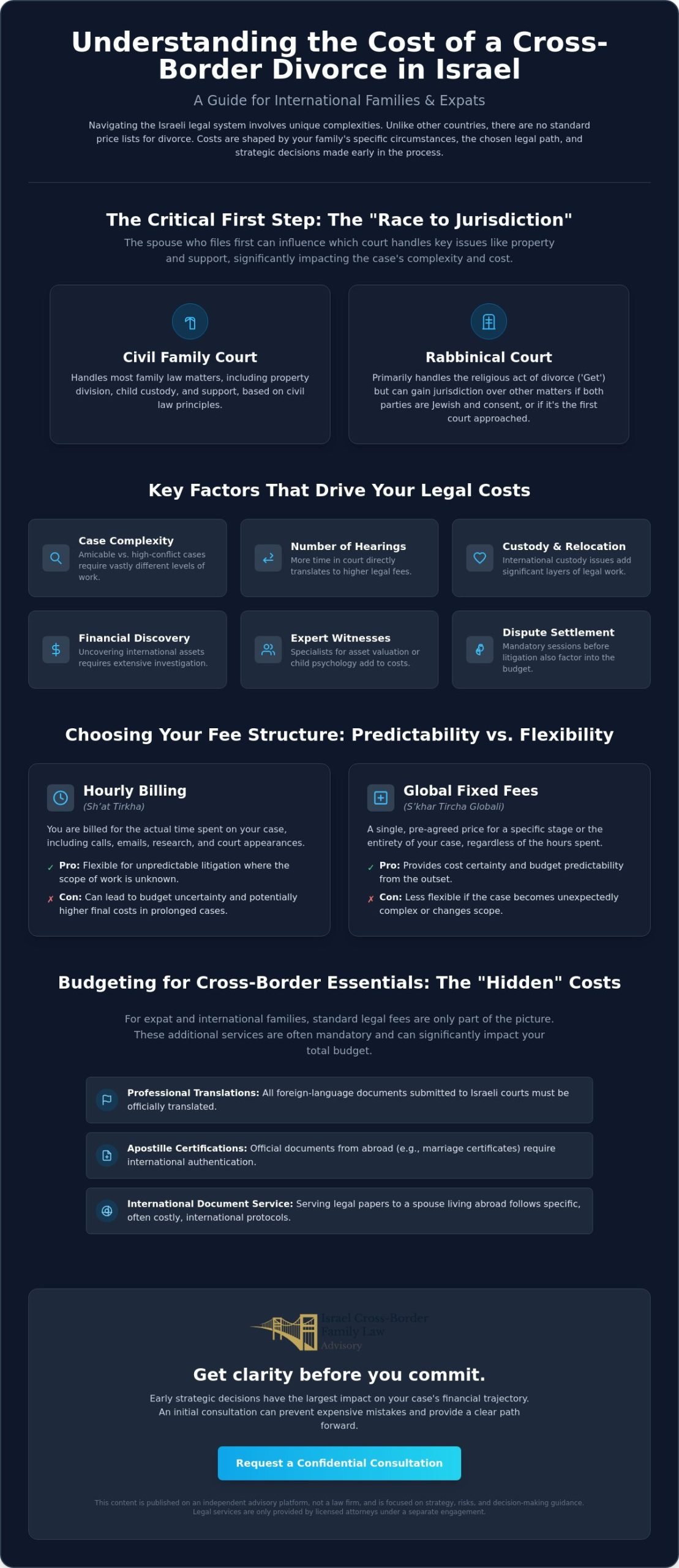
The Divorce Process in Israel is characterized by a dual-court system involving both the civil Family Court and the religious Rabbinical Court. This creates a “race to jurisdiction” where the spouse who files first often influences which court handles specific issues like property division or alimony. Each venue has its own procedural requirements and workloads. A lawyer’s role is to analyze these differences and choose the forum that offers the most favorable framework for your specific goals. This initial strategic decision often dictates the entire financial trajectory of the case.
Factors That Drive Divorce Costs
Several variables influence the final investment required for legal representation. The number of hearings scheduled is a primary driver; more time in court equals higher costs. High-conflict cases requiring extensive financial discovery or the involvement of expert witnesses also increase the workload significantly. For international families, child custody and relocation requests add layers of complexity. These cases necessitate specialized knowledge of cross-border protocols, which requires more intensive preparation and documentation than a standard domestic divorce.
The Value of Early Clarity
Investing in a thorough strategy session at the beginning of the process can prevent significant financial drain later. While it’s tempting to seek the cheapest Israeli Divorce Lawyer Price, doing so in complex cross-border cases often leads to expensive mistakes that are difficult to correct. International families face unique variables, such as the need for multi-jurisdictional coordination and a deep understanding of how Israeli law interacts with foreign legal standards. Early clarity allows you to budget effectively and avoid the “open-ended” billing cycles that occur when a case lacks a clear strategic direction.
Understanding these variables is essential for anyone starting this journey. You can find more detailed information on our pricing page or explore specific guidance for expats and foreign nationals. Seeking professional guidance early ensures you aren’t caught off guard by the inherent complexities of the Israeli system.
Common Fee Structures: Hourly Rates vs. Fixed Fees
Selecting the right billing model is a pivotal step in managing your expectations and your budget. Most firms in Israel offer two primary paths: hourly billing (Sh’at Tirkha) or global fixed fees (S’khar Tircha Globali). Understanding the financial implications of divorce is essential when selecting a fee structure that aligns with your asset profile. While hourly rates provide flexibility for unpredictable litigation, fixed fees offer the security of a known total for specific, well-defined tasks. It’s common for an Israeli Divorce Lawyer Price to involve a combination of these methods depending on the complexity of the cross-border elements involved.
The Hourly Rate Model
Hourly billing is the standard for cases where the timeline is uncertain. Firms typically track time in specific increments, often six or ten minutes. You should expect a detailed monthly statement that breaks down exactly what was performed, from drafting motions to attending hearings. You can manage these costs effectively by consolidating your questions into single emails and being organized with your documentation. If you’re looking for more detail on how these structures apply to your situation, you can review our comprehensive pricing framework.
Fixed Fee Arrangements for Specific Tasks
Fixed fees are highly effective for predictable legal milestones. This model is frequently used for drafting a comprehensive divorce agreement (Heskem Gerushin) or for representation at a single, specific hearing. By agreeing to a set price for these tasks, you eliminate the fear of “open-ended” billing. This is particularly helpful for international families who need to manage Israeli Divorce Lawyer Price variables alongside other relocation or travel expenses. If you’d like to understand which structure is most appropriate for your circumstances, you might consider a confidential case review to gain clarity before you commit.
Estimated Cost Benchmarks for Divorce Matters
Establishing clear expectations is the cornerstone of effective financial planning during a divorce. While an exact Israeli Divorce Lawyer Price depends on the variables mentioned previously, we can categorize cases into tiers of conflict to provide a clearer framework for your budget. The 1973 Balance of Resources Law governs property division in Israel; it provides for an equal division of assets accumulated during the marriage. Understanding how this law applies to your specific international assets is critical for estimating the total workload your case will require.
Mandatory Dispute Settlement (Mahut) sessions are the first procedural hurdle in the Israeli system. These sessions are designed to encourage mediation before litigation begins. They directly impact your initial budget by requiring preparation and attendance before a full claim is even filed. You should also consider the scope of your needs. A “Get” only process, which focuses strictly on the religious divorce document, is a much narrower undertaking than a full civil dissolution that includes child support, custody, and complex asset division.
Amicable Resolutions and Mediation
Mutual agreements represent the most cost-effective path for international families. When both parties agree on the major terms, the legal work focuses on drafting a comprehensive Heskem Gerushin (Divorce Agreement) and validating it in court. This path is significantly faster; it typically concludes in three to six months. Mediation fees are generally shared between the parties, making it a strategic choice for those looking to preserve their marital estate. For a deeper look at the stages of this process, you can explore how it works on our advisory platform.
Contested Litigation and Trial Costs
Litigation is expensive. In a contested divorce, the Israeli Divorce Lawyer Price escalates as multiple hearings are scheduled over two to four years. High-conflict cases often require expert witnesses, such as forensic accountants for asset discovery or psychologists for custody evaluations. Beyond attorney fees, you must account for Official Israeli Family Court Fees, which are mandatory government charges for filing claims. Being organized with your documentation is the most effective way to manage these escalating costs. If you need a more tailored estimate, visit our pricing page to understand the tiers of service available for complex litigation.
The Hidden Costs of International and Cross-Border Divorce
When families move between nations, legal complexity doesn’t just double; it multiplies. The baseline Israeli Divorce Lawyer Price often excludes administrative necessities that are unique to cross-border cases. For example, “Service of Process” across international borders isn’t a simple mailing. It often requires adherence to the Hague Service Convention, involving specialized couriers and sometimes local legal agents in the foreign jurisdiction to ensure the court recognizes the delivery as valid. These procedural requirements are essential for the enforceability of any final judgment.
International families must also budget for multi-jurisdictional coordination. If assets are located in both Israel and the United States, it’s common to require consultation with lawyers in both countries to avoid conflicting rulings or tax penalties. Cases involving the Hague Convention on Child Abduction are among the most resource-intensive. Research indicates these highly complex proceedings can range from ₪75,000 to ₪225,000 or more, reflecting the intense litigation and specialized expertise required to manage international treaty protocols.
Administrative and Out-of-Pocket Expenses
Official translations represent a significant, often overlooked expense. Israeli courts require all foreign evidence, such as US-based financial records, bank statements, or tax returns, to be translated into Hebrew by a certified professional. Furthermore, documents moving between IL and other countries require Apostille certifications to be legally recognized. You should also account for courier fees for original document transmission and, in rare instances, travel expenses for witnesses or legal counsel. Being prepared for these out-of-pocket costs prevents financial surprises during the discovery phase.
Jurisdictional Disputes (Forum Shopping)
The “race to the court” often leads to expensive jurisdictional disputes. Litigating *where* the divorce should happen is a preliminary battle that can significantly impact the final outcome. In many instances, an Israeli court may require an “Expert Opinion” on foreign law to interpret a prenuptial agreement or determine how foreign property should be divided. This requires hiring a qualified expert, often a lawyer from the foreign jurisdiction, to provide a formal written opinion to the court. These strategic maneuvers are common in International Custody & Relocation cases where the choice of venue dictates the legal standards applied. To ensure your strategy accounts for these variables, you can request a confidential review of your case details.
Strategic Ways to Manage Your Legal Expenses
Controlling the financial trajectory of your case requires more than just finding a competitive rate. Strategic management starts with the Heskem S’khar Tircha, which is the formal written fee agreement required by Israeli professional standards. This document acts as your primary safeguard. It should clearly define the scope of work and prevent the “scope creep” that often occurs in complex cross-border matters. By establishing these boundaries early, you ensure that your Israeli Divorce Lawyer Price remains tied to specific legal objectives rather than open-ended litigation.
Efficiency is your most effective tool for cost reduction. Every hour a practitioner spends organizing your bank statements or clarifying basic facts is an hour billed to your account. You can save significant billable time by providing documentation in a structured, chronological format. It’s also vital to distinguish between material issues and emotional ones. While seeking emotional closure is a natural part of the process, litigating for “justice” or “revenge” is rarely a sound financial strategy. Focus your resources on material outcomes like child support, asset division, and parental rights to keep your budget focused on your future stability.
Questions to Ask Before Signing
- Does the quoted fee include the mandatory 17% Value Added Tax (Ma’am)?
- Are government court fees (Agrot) and out-of-pocket expenses like translations billed separately or included in a global fee?
- What is the “exit strategy” or refund policy if the case reaches an amicable settlement earlier than expected?
- Will I be billed for every phone call and email, or is there a communication protocol included in the agreement?
The Cost of Delay vs. The Cost of Action
A “wait and see” approach is often the most expensive strategy an international family can adopt. As discussed in earlier sections, the “Race of Jurisdictions” is a unique feature of the Israeli system. If your spouse files first in a venue that is disadvantageous to your financial profile, the cost to litigate against that choice can far exceed the initial investment of a proactive filing. Taking decisive action allows you to set the procedural tone and potentially choose a more cost-effective court. Testing the waters with an advisory-first approach can provide the clarity you need before committing to full-scale litigation. You can explore our Pricing and Advisory Structure to see how an initial review can help you budget effectively. Get clarity before you commit. Request a confidential consultation.
Securing Your Financial Future Through Strategic Planning
This content is published on an independent advisory platform, not a law firm, and is focused on strategy, risks, and decision-making guidance. Legal services are only provided by licensed attorneys under a separate engagement.
Managing a marriage transition across international borders requires a firm grasp of the financial and legal frameworks at play. You’ve seen how the dual-court system and the nature of your proceedings directly influence your total budget. It’s clear that your Israeli Divorce Lawyer Price isn’t a fixed commodity but a reflection of the strategic labor needed to protect your assets and parental rights. By focusing on material goals and maintaining organized documentation, you can manage expenses while avoiding the hidden costs of cross-border litigation.
Our platform specializes in the unique complexity of US-Israel cross-border matters, offering a calm and educational approach for international families. We work with practitioners who are licensed to practice in multiple jurisdictions, providing the nuanced perspective required for these sensitive cases. You don’t have to face these complexities without a roadmap. Get clarity before you commit. Request a confidential consultation. You can move forward with confidence when you have the right information at your side.
Frequently Asked Questions
This content is published on an independent advisory platform, not a law firm, and is focused on strategy, risks, and decision-making guidance. Legal services are only provided by licensed attorneys under a separate engagement.
Is a divorce lawyer in Israel more expensive than in the US?
Base hourly rates in Israel are often lower than those in major US metropolitan areas like New York or Los Angeles. However, the unique dual-court system in Israel requires intense early strategy and jurisdictional maneuvering that can increase the total hours billed. While the initial rate might seem competitive, the complexity of managing both civil and Rabbinical courts often makes the total investment comparable for international families.
Do I have to pay my spouse’s legal fees in an Israeli divorce?
Israeli courts have the discretion to award legal costs to the prevailing party, but it isn’t a mandatory requirement in every case. If there is a significant wealth gap between spouses, a judge might order the economically stronger party to pay a portion of the other’s fees. This ensures both parties have access to adequate representation, though these awards rarely cover the full cost of a private practitioner.
How much are the standard court filing fees for divorce in Israel?
Court filing fees, known as Agrot, are mandatory government charges paid directly to the Judicial Authority. These fees vary depending on the specific claims you file, such as child support, custody, or property division. It’s important to remember that these administrative costs are separate from your Israeli Divorce Lawyer Price and must be factored into your total budget for the proceedings.
Can I get a fixed price for a cross-border divorce agreement?
Fixed pricing is a standard option for drafting and validating an amicable divorce agreement. This provides predictable budgeting for couples who have already reached a consensus on their major issues. However, you should clarify if the global fee includes the translation of foreign documents or the coordination required with attorneys in other jurisdictions. These international elements are often billed as additional expenses beyond the baseline agreement fee.
Does the Rabbinical court charge different fees than the Family Court?
Yes, the Rabbinical Court and the civil Family Court operate under different fee schedules for filings and administrative actions. While one court may have slightly lower fees for certain motions, your choice of venue should be based on legal strategy rather than administrative costs. The long-term financial impact of a court’s ruling on asset division far outweighs the small difference in initial filing prices.
What happens if I cannot afford the legal fees during the process?
If you face financial hardship during the process, you may be eligible for legal aid through the Ministry of Justice’s Legal Aid Department. Some families also choose “per-stage” billing models to manage their cash flow more effectively. Being transparent with your practitioner about your budget from the start allows you to prioritize material issues and avoid the high costs associated with unnecessary or emotional litigation.
Are legal fees in Israel subject to VAT for foreign residents?
Standard legal services in Israel are subject to a 17% Value Added Tax (Ma’am). In certain cases involving foreign residents, the service might be classified as an “exported service,” which could qualify for a zero-VAT rate. You should always confirm whether the Israeli Divorce Lawyer Price quoted in your fee agreement is inclusive of VAT to avoid an unexpected 17% increase in your final bill.
Can I recover my legal costs if I win the case in Israel?
Israeli judges often award “legal expenses and attorney fees” to the party that succeeds in litigation. These awards are intended to offset the financial burden of the trial, but they are typically based on court-defined scales rather than your actual bill. You should view these awards as a potential partial reimbursement rather than a guarantee that your entire legal investment will be recovered from your spouse.

Article by
Gabriel Lior
A Personal Journey That Became a Mission
The advisory was founded by an American father Gabriel Lior, LLB, MBA , global entrepreneur, and cross-border advisor who spent more than a decade navigating the Israeli family court system firsthand and now lives in Singapore with his son.
As a divorced parent in a cross-border family, Gabriel faced nearly every legal challenge a foreign parent can encounter in Israel — including child custody disputes, child support proceedings, property matters in Israel and abroad, false accusations, and complex immigration and relocation proceedings.
Over the years, he learned the hard way how difficult it is for non-Israeli parents to understand the system, identify the right legal strategy, and choose the right legal representation — especially when language, culture, and jurisdictional differences are involved. He also witnessed how foreign parents and new immigrants are often disadvantaged or taken advantage of by service providers and institutions simply because they lack local knowledge or fluency.
From Client to Advisor
To truly understand — and survive — the system, Gabriel pursued formal legal education in Israel, completing two Israeli law degrees, alongside a BA and MBA earned in the United States. This was never about becoming a practicing attorney, but about gaining a deep, structural understanding of how the system works — and where it breaks down for foreign parents.
This rare combination of:
Firsthand client experience
Israeli legal and US business education
International business and negotiation training
Decades of commercial execution
created a unique perspective – one that understands both sides of the table.
After years of litigation, persistence, and at times self-representation, he ultimately succeeded in securing custody of his son and relocating abroad through a rare legal victory in the Israeli Supreme Court — becoming one of the first fathers in Israel to do so under these circumstances.
Disclaimer
Important Disclaimer:
The information provided on this website and in its content is for general informational and educational purposes only and does not constitute legal advice, legal opinion, or legal representation.
Gabriel Lior is not licensed to practice law in Israel (nor is he interested in doing so) and does not provide legal services, despite having completed 2 Law Degrees. The services offered are advisory in nature and are intended to provide general guidance, strategic insight, and information regarding cross-border family law considerations.
No attorney-client relationship is formed by accessing this website, reading its content, or communicating with us.
Any decisions made based on this information are at your own discretion and risk. For legal advice specific to your situation, you should consult a licensed attorney in the relevant jurisdiction.
Where appropriate, we may refer clients to independent, licensed attorneys or professionals. Such referrals do not constitute legal representation and no liability is assumed for services provided by third parties.