You might find yourself standing before an official at the Israeli Ministry of Interior or a clerk in a U.S. court, only to have your vital paperwork rejected because of a missing stamp or an unrecognized translation format. It’s a common, stressful hurdle for families and businesses managing affairs between the U.S. and Israel. You likely already understand that cross-border legal matters are inherently complex and that a single procedural error can lead to months of unnecessary delays. Learning how to get legal documents translated and certified correctly is the only way to ensure your documents carry the necessary weight in a foreign jurisdiction.
We’ve created this guide to provide a clear path through the requirements for translation, notarization, and authentication. You’ll learn the vital differences between a certified translation for USCIS and the stricter requirements of the Israeli Ministry of Justice. We also cover the Apostille process, including 2026 fee updates and current processing times for both the U.S. Department of State and the Israeli Ministry of Foreign Affairs. By understanding these tiers of authentication now, you can protect your interests in family law or corporate transactions and move forward with clarity.
Key Takeaways
- Distinguish between simple certified translations and the higher tier of notarized certification required by many Israeli authorities.
- Learn how to get legal documents translated and certified using a specific sequence that ensures your paperwork is accepted by both U.S. courts and the Israeli Ministry of Interior.
- Navigate the Apostille process to provide the necessary “legal equivalence” for birth certificates, divorce decrees, and corporate bylaws.
- Identify the common pitfalls in international document authentication that often cause significant delays in Aliyah or cross-border family law cases.
- Understand how the way you prepare documents today can influence the strategy and success of future cross-border litigation or business ventures.
Understanding the Role of Document Certification in US-Israel Legal Matters
This content is published on an independent advisory platform, not a law firm. It focuses on strategy, risks, and decision-making guidance. Legal services are only provided by licensed attorneys under a separate engagement.
Moving legal documents between the United States and Israel requires more than a linguistic conversion; it demands the establishment of “legal equivalence.” This term describes the process where a document issued in one jurisdiction is formally recognized as having the same legal standing in another. Because the U.S. and Israel operate under distinct legal traditions, the path to recognition is often paved with specific bureaucratic requirements. Both nations are signatories to the Apostille Convention, which provides a standardized framework for authenticating public documents. However, understanding how to get legal documents translated and certified involves navigating institutional expectations that go beyond a simple stamp.
Why Precision Matters in Cross-Border Family Law
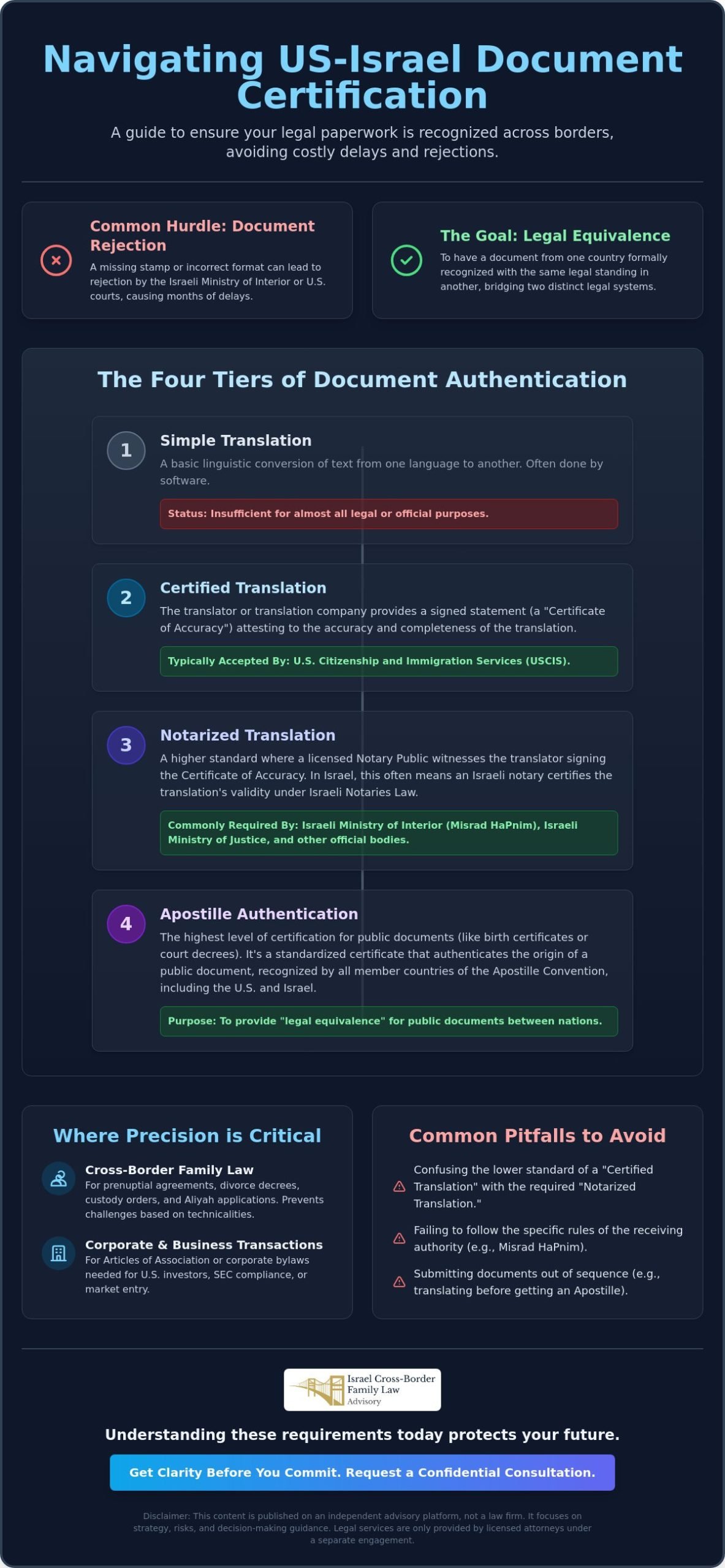
In family law, the weight of a single word can shift the outcome of a case. Handling sensitive documents like prenuptial agreements or custody orders requires a deep understanding of both Hebrew and English legal nuances. There is a real risk of “lost in translation” errors in Rabbinical Court proceedings, where traditional religious terminology might not align perfectly with Western legal concepts. Ensuring documents are compliant for expats and foreign nationals is critical for maintaining consistency across jurisdictions. Clear, accurate certification prevents the opposing party from challenging a document’s validity based on technicalities. It’s a strategic move that protects your long-term interests.
Corporate and Transactional Requirements
Translation vs. Certification vs. Notarization: Defining the Standards
Understanding the hierarchy of document validation is essential for any cross-border matter. People often use “certified” and “notarized” interchangeably, but they represent different levels of legal scrutiny. If you’re researching how to get legal documents translated and certified, you must first identify which standard the receiving authority requires. For example, U.S. Citizenship and Immigration Services (USCIS) usually accepts a “certified translation,” which is a professional statement of accuracy signed by the translator. In contrast, Israeli institutions like the Ministry of Interior typically demand a “notarized translation,” where a licensed notary confirms the translation’s validity under the Israeli Notaries Law. This distinction is a primary reason why documents are frequently rejected at the window.
Machine translation tools, while improving, remain insufficient for these official purposes. Automated systems often miss the nuanced legal distinctions between Hebrew and English terminology, leading to errors that can invalidate a filing. A mistranslated clause in a divorce decree or a corporate bylaw can lead to the immediate rejection of your application, causing months of avoidable delays.
Tier 1: Professional Legal Translation
True legal translation requires more than bilingualism; it requires a deep understanding of two distinct legal systems. A translator must navigate the specific terminology used in both the U.S. and Israeli frameworks to ensure the document’s meaning remains identical. In Israel, the Notary’s Certificate of Translation is considered the gold standard for legal equivalence because it carries the statutory weight of the Israeli Notaries Law. This level of expertise ensures that your strategy remains intact when moving between jurisdictions. Relying on an unqualified translator risks “legal drift,” where the translated document no longer reflects the original intent of the court or the contracting parties.
Tier 2: The Certification Process
The certification process often begins with an “Affidavit of Accuracy.” This document must state that the translator is competent and that the translation is complete and correct. While some U.S. states have flexible requirements for local matters, Israeli districts are strict about the format and language of notarial seals. When handling federal documents, you should also review the U.S. Apostille Requirements to see if additional authentication is needed beyond the notary’s stamp. For instance, the U.S. Department of State charges a $20 fee for each federal apostille, while the fee for an Apostille from the Israeli Ministry of Foreign Affairs is 41 NIS per document as of 2026.
Deciding whether a basic certification is enough or if you need full notarial backing depends entirely on the specific court or agency involved. Making the wrong choice early can result in expensive delays and procedural headaches. If you’re unsure about the requirements for your specific case, you may want to discuss your situation with an advisor to ensure your paperwork meets the necessary standards for international recognition.
The Apostille: Bridging the Gap Between US and Israeli Authorities
This content is published on an independent advisory platform, not a law firm. It focuses on strategy, risks, and decision-making guidance. Legal services are only provided by licensed attorneys under a separate engagement.
When a document moves across international borders, the receiving government needs a way to verify that the signatures and seals on that document are genuine. This is the role of the Apostille. Established by the Hague Convention of 1961, the Apostille is a specialized certificate attached to a public document that simplifies the authentication process between member nations. Since both the United States and Israel are signatories to this treaty, they recognize Apostilles issued by each other’s competent authorities. Without this seal, a U.S. birth certificate or an Israeli court order is often viewed as a mere photocopy with no legal standing in the foreign jurisdiction.
Authenticating US Documents for Use in Israel
For state-issued documents like birth certificates, the Secretary of State in the issuing jurisdiction is the competent authority. However, federal documents such as FBI background checks must be sent to the U.S. Department of State in Washington, D.C. As of June 2026, the federal fee is $20 per document with a standard processing time of 10 to 12 business days. It’s important to account for current mail-in backlogs, which can extend wait times to 10 or 12 weeks. Rejections by Israeli consulates often occur because the original document is too old or the notary’s commission has expired during the process.
Authenticating Israeli Documents for Use in the US
In Israel, the Ministry of Foreign Affairs in Jerusalem handles Apostilles for public documents like marriage certificates, charging a fee of 41 NIS as of 2026. For judicial documents or those involving a notary’s signature, the Registrars of Magistrates’ Courts issue a “judicial apostille” for a fee of 40 NIS. This step is particularly vital when managing international custody and relocation matters. Ensuring that Israeli court orders are properly authenticated allows them to be presented effectively in U.S. courts, minimizing the risk of procedural dismissals. Knowing how to get legal documents translated and certified in the correct sequence is the best way to avoid the high stakes of cross-border delays.
A Step-by-Step Guide to Preparing Your International Documents
This content is published on an independent advisory platform, not a law firm. It focuses on strategy, risks, and decision-making guidance. Legal services are only provided by licensed attorneys under a separate engagement.
Preparing documents for cross-border use is a chronological process where the sequence of events is as important as the accuracy of the content. If you miss a step or perform them out of order, you risk having the entire packet rejected by the receiving authority. Knowing how to get legal documents translated and certified involves more than finding a translator; it requires a strategic approach to authentication that respects the hierarchy of both the U.S. and Israeli legal systems.
- Step 1: Determine Specific Requirements. Before you begin, confirm exactly what the receiving authority needs. A U.S. court may only require a certificate of accuracy, whereas the Israeli Ministry of Interior almost always demands a notarized translation.
- Step 2: Obtain an Original or True Copy. Many authorities require documents issued within the last six months. Ensure you have an original with a “wet” signature or a certified true copy from the issuing agency.
- Step 3: Secure a Professional Translation. Engage a subject-matter expert who understands the legal nuances of both systems. This is the stage where you determine how to get legal documents translated and certified to meet the required standard of legal equivalence.
- Step 4: Execute Certification or Notarization. Depending on the jurisdiction, the translator will sign an affidavit in the presence of a notary, or the notary will certify the translation themselves.
- Step 5: Apply for and Attach the Apostille Seal. This final step authenticates the notary’s or official’s signature for international recognition under the Hague Convention.
Timeline and Logistics
Time management is a critical component of cross-border success. As of June 2026, standard processing for a federal apostille by the U.S. Department of State is approximately 10 to 12 business days. However, a significant backlog for mail-in requests has pushed wait times to 10 or 12 weeks. You should also be aware of the rise of e-Apostilles, which are increasingly accepted in modern legal practice. A vital rule of thumb: never staple or separate the Apostille from the original document. Breaking the physical connection between the certificate and the document often voids its legal validity in the eyes of Israeli officials.
Costs and Resource Allocation
Budgeting for these services requires an understanding of different pricing models. Most professional translators charge based on word count, while notaries and government agencies typically charge per-document fees. In Israel, notarized translation fees are strictly regulated by the Ministry of Justice. For a notarized translation, the fee for the first 100 words is 251 NIS, with a sliding scale for additional word counts. Beyond these costs, you must account for government filing fees and secure courier services. Early planning is the most effective way to avoid expensive “rush fees” from private service providers. If you need help organizing your documentation strategy, you can reach out for a confidential review of your case requirements.
Strategic Considerations for Cross-Border Families and Businesses
This content is published on an independent advisory platform, not a law firm. It focuses on strategy, risks, and decision-making guidance. Legal services are only provided by licensed attorneys under a separate engagement.
There is a fundamental difference between simply “getting a document translated” and “getting it right” for a cross-border legal strategy. In the context of transnational matters, a document is a tool used to achieve a specific outcome, whether that’s securing a visa, enforcing a contract, or navigating divorce and separation for international families. If the translation doesn’t reflect the precise legal intent of the original, the entire strategy can collapse. Seeking clarity on the requirements of both the U.S. and Israeli systems before you commit to a specific translation path is the only way to protect your long-term interests. Decisions made during the document preparation phase often carry significant weight once the matter reaches a judge or a government official.
Cultural and systemic nuances play a major role in how documents are perceived. For example, modern U.S. legal drafting often favors “Plain English” to increase accessibility. However, Israeli legal Hebrew remains highly formal and sometimes archaic, especially within the Rabbinical Courts. A direct, literal translation of a U.S. agreement might appear vague or insufficiently binding to an Israeli Dayan (judge). Knowing how to get legal documents translated and certified means ensuring the final product speaks the “legal language” of the receiving culture, not just the literal vocabulary.
The Advisory Approach to Document Strategy
Our focus is on the strategy behind the paperwork. Understanding how it works when coordinating between U.S. and Israeli professionals is essential for maintaining a unified legal front. A cross-border advisory acts as a bridge, ensuring that the documents prepared in one country don’t inadvertently undermine the legal position in the other. This collaborative approach prevents the “silo effect,” where local attorneys in different jurisdictions work with conflicting versions of the same facts due to poor translation or certification choices.
Mitigating Risks and Ensuring Acceptance
Pre-empting objections from authorities like the Israeli Rabbinical Courts or U.S. Family Courts is a hallmark of a well-prepared case. These institutions are often rigorous about the consistency of names, dates, and specific phrasing across multiple documents. Before you finalize your international filing, use this checklist to ensure your documents are ready:
- Does the name on the translated document match the passport or identity card exactly?
- Is the Apostille seal physically attached and undamaged?
- Has the translation been performed by a subject-matter expert who understands the specific court’s expectations?
- Are there any inconsistencies between the primary document and supporting affidavits?
By addressing these details early, you reduce the inherent complexity of cross-border issues and avoid the procedural delays that plague many international families and businesses. Get clarity before you commit. Request a confidential consultation.
Securing Your Legal Standing Across Borders
Navigating the intersection of the U.S. and Israeli legal systems requires more than just administrative accuracy; it demands a strategic understanding of how each jurisdiction validates foreign documents. You’ve seen that the distinction between a simple certified translation and a full notarial certificate can be the difference between a successful filing and a months-long rejection. By mastering the sequence of the Apostille process and accounting for current backlogs in 2026, you can ensure your vital records carry the necessary legal weight. Understanding how to get legal documents translated and certified is a foundational step in any cross-border family or business matter.
It’s essential to coordinate these efforts with experts who maintain a physical presence and strategic connections in both Tel Aviv and New York. As an advisory platform specialized in US-Israel cross-border complexity, we offer deep expertise in the Hague Convention and international family law. We help you bridge these distinct legal cultures with confidence and precision. Get clarity before you commit. Request a confidential consultation.
Frequently Asked Questions
This content is published on an independent advisory platform, not a law firm. It focuses on strategy, risks, and decision-making guidance rather than an attorney-client relationship. Legal services are only provided by licensed attorneys under a separate engagement.
What is the difference between a certified and a notarized translation?
A certified translation is a statement of accuracy signed by the translator, whereas a notarized translation involves a notary public verifying the translator’s identity or the work itself. In the U.S., USCIS often accepts a simple certification. In Israel, however, the Ministry of Interior usually requires a Notarial Certificate of Translation. This is a higher level of verification where the notary takes statutory responsibility for the accuracy of the translated text.
Does an Israeli notary have the same authority as a US notary?
An Israeli notary holds significantly more legal authority than a typical U.S. notary public. In the United States, a notary is often a layperson authorized to witness signatures. In Israel, a notary must be a licensed attorney with at least 10 years of experience. This professional standing allows the Israeli notary to certify the content of a translation directly, making their stamp a powerful tool in cross-border matters.
How do I get an Apostille for a document issued in the United States?
To get an Apostille for a U.S. document, you must contact the Secretary of State in the jurisdiction where the document originated. For federal records, such as an FBI background check, the U.S. Department of State in Washington, D.C., handles the process. This certificate verifies the official’s signature on the document, ensuring it’s recognized as a valid legal instrument by Israeli authorities under the Hague Convention.
Can I translate my own legal documents if I am fluent in both Hebrew and English?
You cannot translate your own documents for official use, even if you’re perfectly bilingual. Authorities in both the U.S. and Israel require an objective third party to ensure the integrity of the translation. Understanding how to get legal documents translated and certified involves engaging a professional who can provide the necessary affidavit of accuracy or notarial certification required by the receiving government agency or court.
How long is a certified or notarized translation valid in Israel?
There’s no formal expiration date for a translation, but the underlying document often has a limited shelf life. For example, the Israeli Ministry of Interior frequently demands that birth or marriage certificates be issued within the last six months. If the original document is considered too old, the accompanying translation and certification will likely be rejected, regardless of when the translation was actually completed.
What happens if a document is submitted without an Apostille?
Submitting a document without an Apostille usually leads to immediate rejection by foreign authorities. The Apostille is the only standardized way for the Israeli government to verify that a U.S. official’s signature is genuine, and vice versa. Without this seal, your document lacks legal equivalence. This omission can cause significant delays in Aliyah applications, probate cases, or international corporate transactions that involve high stakes.
Are digital or electronic signatures accepted for certified translations?
Acceptance of digital signatures varies significantly between departments and jurisdictions. While some U.S. agencies accept electronic certifications, many Israeli offices, including the Rabbinical Courts, still require physical documents with wet signatures and embossed notarial seals. It’s risky to assume a digital version will be accepted. Always confirm the specific requirements of the receiving office to avoid unnecessary procedural setbacks or expensive re-filing fees.
Do I need to translate my US prenuptial agreement for it to be valid in Israel?
You must translate and certify your U.S. prenuptial agreement if you want it recognized by an Israeli court or religious authority. A professional translation ensures that the specific legal protections you negotiated in the U.S. are accurately expressed in formal Hebrew legal terms. Knowing how to get legal documents translated and certified correctly is the only way to ensure your marital property rights remain protected when moving between these two systems.

Article by
Gabriel Lior
A Personal Journey That Became a Mission
The advisory was founded by an American father Gabriel Lior, LLB, MBA , global entrepreneur, and cross-border advisor who spent more than a decade navigating the Israeli family court system firsthand and now lives in Singapore with his son.
As a divorced parent in a cross-border family, Gabriel faced nearly every legal challenge a foreign parent can encounter in Israel — including child custody disputes, child support proceedings, property matters in Israel and abroad, false accusations, and complex immigration and relocation proceedings.
Over the years, he learned the hard way how difficult it is for non-Israeli parents to understand the system, identify the right legal strategy, and choose the right legal representation — especially when language, culture, and jurisdictional differences are involved. He also witnessed how foreign parents and new immigrants are often disadvantaged or taken advantage of by service providers and institutions simply because they lack local knowledge or fluency.
From Client to Advisor
To truly understand — and survive — the system, Gabriel pursued formal legal education in Israel, completing two Israeli law degrees, alongside a BA and MBA earned in the United States. This was never about becoming a practicing attorney, but about gaining a deep, structural understanding of how the system works — and where it breaks down for foreign parents.
This rare combination of:
Firsthand client experience
Israeli legal and US business education
International business and negotiation training
Decades of commercial execution
created a unique perspective – one that understands both sides of the table.
After years of litigation, persistence, and at times self-representation, he ultimately succeeded in securing custody of his son and relocating abroad through a rare legal victory in the Israeli Supreme Court — becoming one of the first fathers in Israel to do so under these circumstances.
Disclaimer
Important Disclaimer:
The information provided on this website and in its content is for general informational and educational purposes only and does not constitute legal advice, legal opinion, or legal representation.
Gabriel Lior is not licensed to practice law in Israel (nor is he interested in doing so) and does not provide legal services, despite having completed 2 Law Degrees. The services offered are advisory in nature and are intended to provide general guidance, strategic insight, and information regarding cross-border family law considerations.
No attorney-client relationship is formed by accessing this website, reading its content, or communicating with us.
Any decisions made based on this information are at your own discretion and risk. For legal advice specific to your situation, you should consult a licensed attorney in the relevant jurisdiction.
Where appropriate, we may refer clients to independent, licensed attorneys or professionals. Such referrals do not constitute legal representation and no liability is assumed for services provided by third parties.