Moving your family across international borders is far more than a logistical challenge; it’s a permanent shift in your child’s legal “habitual residence” that requires precise judicial or parental authorization. If you are planning a relocation with child from israel, you likely feel the weight of every decision, fearing that a simple move could lead to accusations of international child abduction. It’s common to feel overwhelmed by the interaction between Israeli family courts and the legal systems of other nations, especially when the stakes for your family’s future are so high.
You deserve a clear path forward that prioritizes your child’s well-being and your own peace of mind. This guide will help you understand the legal framework of international moves, explaining how to obtain the necessary consent and what to expect from the Israeli court system. We’ll examine the procedural requirements for a successful relocation, the risks of contested custody, and the best ways to avoid the complexities of Hague Convention litigation. By the end of this article, you’ll have a strategic overview of how to navigate these cross-border challenges with confidence and legal security.
Key Takeaways
- Understand the legal distinction between a temporary visit abroad and a permanent change in your child’s “center of life.”
- Learn how Israeli courts apply the “Best Interests of the Child” standard to evaluate the viability of a cross-border move.
- Identify the necessary procedural steps for a legal relocation with child from israel to prevent allegations of international child abduction.
- Navigate the mandatory “settlement of dispute” period and the typical timelines of the Israeli Family Court system.
- Discover the strategic advantages of a negotiated relocation agreement over a lengthy and uncertain court battle.
What Defines “Relocation” Under Israeli Family Law?
Disclaimer: This content is published on an independent advisory platform, not a law firm. The information provided focuses on strategy, risks, and decision-making guidance. It does not constitute formal legal representation or legal advice. Legal services are only provided by licensed attorneys under a separate engagement.
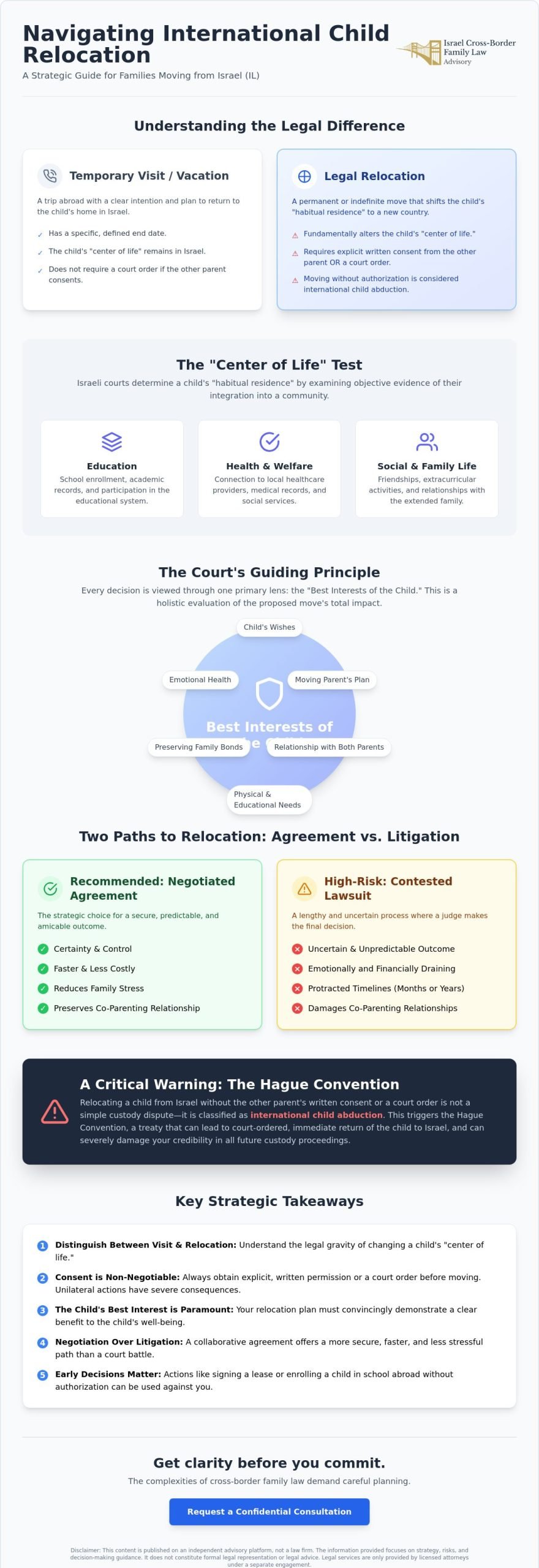
In the context of Israeli law, relocation isn’t simply the act of moving house. It’s defined as a permanent change in a child’s “center of life.” This legal concept goes beyond physical presence; it encompasses the child’s social, educational, and medical environment. When you consider a relocation with child from israel, the court’s primary focus is whether the move fundamentally alters the child’s established routine and their relationship with the parent staying behind.
There’s a significant distinction between a long vacation and a legal relocation. A vacation has a clear end date and the intent to return. Relocation involves an intent to settle permanently or for an extended, indefinite period in a new country. This shift in status triggers the concept of “habitual residence,” which is the most critical term in cross-border family law. It’s the legal “home base” that determines which country’s courts have the right to make decisions about the child’s future. This principle is central to the Hague Convention on the Civil Aspects of International Child Abduction, a treaty designed to protect children from being wrongfully removed or retained away from their home country.
To better understand how these concepts apply in practice, watch this helpful video:
The Role of Parental Consent
Regardless of who has primary physical custody, both parents’ written consent is required for a child to move abroad permanently. Many parents mistakenly believe that their “custodial” status gives them the right to move unilaterally. This isn’t the case in Israel. Moving without a formal court order or the other parent’s explicit, written permission is often viewed as “self-help.” Israeli courts take a very dim view of unilateral moves. Such actions can lead to immediate return orders and can severely damage a parent’s credibility in future international custody and relocation proceedings.
Habitual Residence: The Center of Life Test
Israeli courts use several factors to determine where a child legally “belongs.” This “center of life” test looks at objective evidence of integration. Judges will examine school enrollment, healthcare records, and even the child’s participation in local extracurricular activities. While there’s no fixed number of days that automatically changes a child’s status, a period of one year is often a benchmark. However, the weight of early decisions is immense. Signing a long-term lease or enrolling a child in a permanent school program in a new country before obtaining consent can be seen as an attempt to create a “fait accompli,” which courts may actively work to reverse. Achieving a successful relocation with child from israel requires establishing these facts through the proper legal channels rather than through sudden, unapproved changes.
The “Best Interests of the Child” Standard in Relocation Cases
In the Israeli legal system, the “best interests of the child” is the overriding principle that guides every judicial decision. It’s not a secondary consideration; it’s the primary lens through which a judge views your request. When a parent initiates a relocation with child from israel, the court must determine if the proposed move will truly benefit the child’s overall well-being. This assessment is holistic, looking beyond financial stability to emotional health, social integration, and the preservation of family bonds. Judges are tasked with balancing the moving parent’s right to pursue a new life or career against the child’s fundamental right to maintain a deep, consistent relationship with the parent staying behind.
Because these cases are inherently complex, Israeli courts rarely make a decision based on parental testimony alone. They rely heavily on neutral, professional evaluations. Court-appointed experts, such as social workers (Pkidat Sa’ad) or clinical psychologists, are often tasked with interviewing both parents and the children. Their recommendations carry significant weight. These professionals evaluate the family dynamics and the viability of the proposed move, looking for evidence that the moving parent will actively support the child’s relationship with the other parent across international borders. To ensure your strategy aligns with these expectations, it is often helpful to review your specific situation before filing formal documents.
A well-structured relocation plan is your most effective tool in this process. It must address how the child will transition and how the long-distance relationship will be managed. This is particularly important to avoid any suggestion of “wrongful retention,” a concept detailed in the Hague Abduction Convention. A vague plan often leads to a denial, as the court prefers the certainty of the current environment over an uncertain future abroad.
Criteria for Evaluation
Israeli judges look at several specific factors when evaluating a relocation request. The child’s age is critical; while younger children are often seen as more adaptable, the preferences of older children are given substantial consideration. The court also examines the quality of the proposed environment. This includes the specific school system, the proximity of extended family, and the availability of healthcare. Most importantly, the court assesses the moving parent’s “parental alienation” risk. You must demonstrate a concrete commitment to facilitating regular contact, such as detailed schedules for video calls and holiday visits.
The “Status Quo” vs. The Proposed Change
Israeli family courts are traditionally cautious about disrupting a child’s established routine. This is known as maintaining the “status quo.” To overcome this institutional hesitation, you must demonstrate that the move offers a significant, tangible benefit that outweighs the loss of daily contact with the other parent. This might include a unique educational opportunity or a much stronger support network. Since contested custody cases in Israel can take 12 to 18 months to reach a final judgment, demonstrating the move’s necessity early is vital for a favorable outcome.
The Hague Convention: Preventing Abduction Allegations
The Hague Convention on the Civil Aspects of International Child Abduction is the primary international treaty governing cross-border parenting disputes. Its goal is simple: to ensure that children who are wrongfully removed from their country of “habitual residence” are returned immediately. For parents planning a relocation with child from israel, understanding this treaty is essential for avoiding life-altering legal mistakes. The convention doesn’t decide who should have custody; instead, it determines which country has the jurisdiction to make that decision.
Legal issues typically arise in two ways: wrongful removal or wrongful retention. Wrongful removal occurs when a parent takes a child out of Israel without the other parent’s written consent or a court order. Wrongful retention happens when a child travels abroad with permission, perhaps for a scheduled vacation, but the parent refuses to bring them back to Israel. In both cases, the left-behind parent can file an emergency Hague application. These proceedings are fast-tracked, with most courts aiming to issue a return order within six weeks. The consequences are immediate and severe, often involving the local police or border control to secure the child’s return to Israel.
Safeguarding Your Move
The most effective way to prevent an abduction allegation is through transparent, documented consent. If you’ve reached an agreement with the other parent, don’t rely on verbal promises. You should have a detailed, written agreement that is validated by an Israeli Family Court. For added security, many families seek a “Mirror Order” in their destination country. This is a local court order that mirrors the terms of the Israeli agreement, ensuring your move is recognized as legal by both jurisdictions. You can learn more about the Hague Convention and how it impacts your specific strategy to ensure your transition remains compliant.
When Consent is Refused
If the other parent refuses to sign a relocation agreement, you must not move the child. Taking “self-help” measures by leaving anyway will almost certainly trigger an abduction claim. Instead, you must file a formal relocation lawsuit in the Israeli Family Court. You are legally required to stay in Israel until the court grants you explicit permission to leave. Ignoring a refusal or an existing Issur Yetzia Min Ha’Aretz (exit restriction) can lead to the permanent loss of your right to relocate and may even result in criminal charges. Patience and adherence to the legal timeline are the only ways to ensure a successful relocation with child from israel while protecting your long-term parental rights.
The Relocation Lawsuit: Procedure and Timelines in Israel
When mutual consent cannot be reached, the only legal path for a relocation with child from israel is through a formal lawsuit in the Family Court. This process begins with a mandatory “settlement of dispute” application. Under Israeli law, parents must attend meetings with the court’s Social Services Unit (Yechidat Hasiyu’a) before they can proceed with active litigation. This period lasts approximately 45 to 60 days. It’s designed to give families a final chance to reach a negotiated agreement before a judge takes control of the timeline.
If these meetings don’t result in a settlement, the parent seeking to move must file a formal relocation claim. You should be prepared for a significant time commitment. Contested child custody and relocation cases in Israeli Family Courts typically take 12 to 18 months to reach a final judgment. During this time, the court will appoint an independent expert, usually a clinical psychologist or a social worker, to evaluate the family and provide a formal recommendation. This report serves as the foundation for the court’s final decision.
Because the process is long and complex, it’s essential to have a clear strategy from the start. You can review our international custody and relocation guidance to better understand how these stages connect. If you’re facing a contested move, you should request a confidential consultation to discuss the specific procedural hurdles in your case.
The Role of the Expert Recommendation
The court-appointed expert’s report is often the single most influential document in your case. Judges rarely deviate from these professional recommendations. To prepare, you must be ready to discuss your relocation plan in granular detail. This includes specific school choices, social support networks, and how you’ll facilitate the child’s relationship with the other parent. If an expert’s opinion is unfavorable, your legal team can challenge it by submitting clarifying questions or cross-examining the expert in court. However, preventing a negative report through careful preparation is always the more effective strategy.
Interim Orders and Travel Bans
At the start of almost any relocation case, the court will likely issue a “Stay of Exit” (Issur Yetzia Min Ha’Aretz) order. This prevents the child from leaving Israel until the case is resolved. While this can feel restrictive, it’s a standard protective measure to maintain the status quo. If you need to travel for a vacation or family event during the 12 to 18-month litigation period, you must petition the court for a temporary travel order. This usually requires providing a financial guarantee or a third-party guarantor to ensure the child returns to Israel by the specified date.
Strategic Planning: Seeking Clarity Before You Commit
Disclaimer: This content is published on an independent advisory platform, not a law firm. The information provided focuses on strategy, risks, and decision-making guidance. It does not constitute formal legal representation or legal advice. Legal services are only provided by licensed attorneys under a separate engagement.
A successful relocation with child from israel often depends more on the groundwork laid before filing a claim than on the arguments made in a courtroom. Choosing a negotiated relocation agreement over a protracted court battle offers you a level of control that a judge’s ruling cannot provide. While contested cases can linger for 12 to 18 months, a settlement allows parents to define the terms of their new reality. This approach reduces the emotional strain on the children and the financial burden on the family by avoiding the uncertainty of a trial.
Strategic planning also requires addressing the financial realities of moving between jurisdictions. Child support isn’t a static obligation; it must be adapted to account for different costs of living, travel expenses, and currency fluctuations. Establishing a clear framework for these payments early on prevents future conflicts and ensures the child’s needs are met regardless of where they reside. If you’re concerned about how these payments will be managed once you leave, it’s vital to understand the mechanisms for enforcing child support orders internationally.
Drafting a Cross-Border Agreement
A robust parenting plan for international families must be granular. Vague terms like “reasonable visitation” don’t work across time zones or continents. Your agreement should specify exact flight schedules, which parent bears the travel costs, and how holiday rotations will function. It’s also critical to include a “choice of law” clause. This determines which court system will maintain jurisdiction over any future disputes. This clarity prevents “forum shopping” and provides a stable legal environment for both parents, ensuring that the move doesn’t lead to a jurisdictional vacuum.
The Importance of Strategy
Every action you take in the months leading up to a move impacts your legal standing. Israeli judges are highly sensitive to behaviors that suggest “parental alienation” or an attempt to cut the other parent out of the child’s life. Maintaining a calm, measured approach is essential for your long-term success. Avoid making unilateral commitments to schools or employers abroad before you’ve secured legal permission or the other parent’s consent. These early decisions carry immense weight; they can either demonstrate your commitment to the child’s best interests or be used as evidence of bad faith. Seeking advisory guidance early in the process allows you to navigate these complexities without triggering the risks of a relocation with child from israel that is flagged for legal non-compliance. Get clarity before you commit. Request a confidential consultation.
Securing Your Family’s Future Across Borders
Navigating the complexities of international family law requires a measured and strategic approach. You’ve seen that a successful relocation with child from israel is built on more than just personal preference; it demands a deep understanding of habitual residence, the “best interests” standard, and the strict requirements of the Hague Convention. Early decisions, such as obtaining written consent and drafting a granular parenting plan, serve as your primary defense against future litigation and abduction allegations. Rushing into a move without these protections can lead to immediate return orders and long-term legal complications that disrupt your child’s stability.
Our advisory-first approach provides international families with the clarity needed to make informed commitments before they act. With specialized cross-border expertise and practitioners licensed in both Israel and the US, we bridge the gap between divergent legal systems to protect your parental rights. We understand the unique pressures faced by expats and global families. By prioritizing strategy over late-stage litigation, you can ensure your move is legally sound and emotionally sustainable for everyone involved.
Get clarity before you commit. Request a confidential consultation.
Frequently Asked Questions
Can I move back to the US with my child without the father’s permission if we weren’t married?
No, you cannot move without permission regardless of your marital status. In Israel, a father’s parental rights are established by his registration on the birth certificate or through a paternity claim. Moving a child out of the country permanently without his written consent or a court order is legally defined as international child abduction. You must follow the formal legal process to avoid severe consequences under international treaties.
How long does a relocation lawsuit typically take in the Israeli Family Court?
A contested relocation lawsuit in Israel typically takes between 12 and 18 months to reach a final judgment. This timeline includes the mandatory 45 to 60 day “settlement of dispute” period where parents meet with social services. The duration is largely driven by the time needed for court-appointed experts to conduct interviews and submit their formal recommendations to the judge. Interim orders for travel are handled separately from this main timeline.
What happens if I move with my child from Israel and then the other parent sues for abduction?
If you move without consent, the other parent can file an application under the Hague Convention. Courts in the destination country are generally required to order the child’s immediate return to Israel within six weeks. This process doesn’t decide custody; it simply returns the child to their “habitual residence” so the Israeli courts can resolve the dispute. Such a filing can severely damage your standing in any future relocation with child from israel proceedings.
Does a child’s preference matter in an Israeli relocation case?
Yes, the child’s preference is considered, but its weight depends on their age and maturity. While the “best interests of the child” is the overriding principle, judges often allow older children to express their views through a specialized unit or a court-appointed psychologist. However, a child’s wish to move isn’t the only factor. The court will also evaluate if that preference is being influenced by one parent over the other.
Can I get a temporary order to move while the main trial is ongoing?
It’s extremely rare for Israeli courts to grant a temporary order for permanent relocation before the final trial ends. Judges are committed to maintaining the status quo until all evidence and expert reports are fully reviewed. Because a move is difficult to reverse once a child has settled into a new school and routine, the court almost always requires the child to remain in Israel until a final judgment is issued.
How is child support calculated if I move from Israel to a country with a higher cost of living?
Child support can be adjusted to reflect the actual costs of the child’s needs in their new country. However, the court also balances these costs against the father’s income and the increased travel expenses he’ll incur to maintain a relationship. A relocation with child from israel often requires a complete restructuring of the financial agreement to ensure the child’s standard of living is maintained without placing an impossible burden on the staying parent.
What is a “Stay of Exit” order and how can I get it removed for my child?
A “Stay of Exit” order (Issur Yetzia Min Ha’Aretz) is a common restriction that prevents a child from leaving the country. To remove it, you must either obtain the other parent’s written consent or file a motion with the Family Court. Judges often require the moving parent to provide financial guarantees or third party guarantors. These measures ensure the child returns to Israel after any temporary travel or if a relocation request is eventually denied.
Is it possible to relocate if we have a joint custody agreement in Israel?
Yes, it’s possible, but the legal hurdle is higher because you’re asking to end a functioning joint arrangement. You must demonstrate that the move provides a significant benefit to the child that outweighs the loss of the current equal parenting time. The court will require a very detailed plan showing how the child will maintain a deep, consistent connection with the parent in Israel through extended summer visits and digital communication.

Article by
Gabriel Lior
A Personal Journey That Became a Mission
The advisory was founded by an American father Gabriel Lior, LLB, MBA , global entrepreneur, and cross-border advisor who spent more than a decade navigating the Israeli family court system firsthand and now lives in Singapore with his son.
As a divorced parent in a cross-border family, Gabriel faced nearly every legal challenge a foreign parent can encounter in Israel — including child custody disputes, child support proceedings, property matters in Israel and abroad, false accusations, and complex immigration and relocation proceedings.
Over the years, he learned the hard way how difficult it is for non-Israeli parents to understand the system, identify the right legal strategy, and choose the right legal representation — especially when language, culture, and jurisdictional differences are involved. He also witnessed how foreign parents and new immigrants are often disadvantaged or taken advantage of by service providers and institutions simply because they lack local knowledge or fluency.
From Client to Advisor
To truly understand — and survive — the system, Gabriel pursued formal legal education in Israel, completing two Israeli law degrees, alongside a BA and MBA earned in the United States. This was never about becoming a practicing attorney, but about gaining a deep, structural understanding of how the system works — and where it breaks down for foreign parents.
This rare combination of:
Firsthand client experience
Israeli legal and US business education
International business and negotiation training
Decades of commercial execution
created a unique perspective – one that understands both sides of the table.
After years of litigation, persistence, and at times self-representation, he ultimately succeeded in securing custody of his son and relocating abroad through a rare legal victory in the Israeli Supreme Court — becoming one of the first fathers in Israel to do so under these circumstances.
Disclaimer
Important Disclaimer:
The information provided on this website and in its content is for general informational and educational purposes only and does not constitute legal advice, legal opinion, or legal representation.
Gabriel Lior is not licensed to practice law in Israel (nor is he interested in doing so) and does not provide legal services, despite having completed 2 Law Degrees. The services offered are advisory in nature and are intended to provide general guidance, strategic insight, and information regarding cross-border family law considerations.
No attorney-client relationship is formed by accessing this website, reading its content, or communicating with us.
Any decisions made based on this information are at your own discretion and risk. For legal advice specific to your situation, you should consult a licensed attorney in the relevant jurisdiction.
Where appropriate, we may refer clients to independent, licensed attorneys or professionals. Such referrals do not constitute legal representation and no liability is assumed for services provided by third parties.