This article is published on an independent advisory platform (not a law firm) and does not imply an attorney-client relationship.
What if the most critical decision in your Israeli divorce happens before you even step into a courtroom? You likely recognize it’s a daunting prospect for any expat or international resident in IL to navigate the intersection of the Rabbinical and Family Courts. Uncertainty regarding cross-border assets or custody arrangements is a common concern under local statutes. This guide offers an independent look at the practice of Hagit Halevy and promises a clear framework for evaluating legal representation in the Israeli legal environment.
Since the 2016 “Settlement of Disputes Law” changed procedural requirements in IL, strategy has become as important as statutes. We’ll preview how to assess a lawyer’s understanding of multi-jurisdictional complexities and the nuances of the mandatory mediation phase, as highlighted in the educational resources on the IsraelFamilyLaw YouTube channel. This overview ensures you have the strategy needed before making any long-term commitments. Get clarity before you commit. Request a confidential consultation.
Key Takeaways
- Gain an independent perspective on the practice of Hagit Halevy and the specific role her firm plays in navigating the complexities of the Israeli family court system.
- Understand the unique challenges faced by cross-border families and why international assets require a legal strategy that accounts for both Israeli law and global jurisdictions.
- Learn how the mandatory “Settlement of Dispute” process functions in Israel and how early strategic decisions can significantly impact your case’s timeline and outcome.
- Identify the essential criteria for evaluating legal representation to ensure your advocate possesses the bicultural expertise necessary to bridge the gap between different legal systems.
- Discover how to move from uncertainty to action by prioritizing a confidential case review to clarify your standing before committing to a long-term legal path.
This article is published on an independent advisory platform and does not imply an attorney-client relationship. Legal services are only provided by licensed attorneys under a separate engagement.
Introduction to Hagit Halevy and Family Law in Israel
Navigating the legal landscape in Israel requires a steady hand, especially for international families who find themselves in unfamiliar territory. Adv. Hagit Halevy is a recognized practitioner within the Israel Bar Association, operating a specialized practice based in Modiin. Her work focuses on the sensitive intersections of matrimonial law and dispute resolution. For expats and foreign nationals, finding a professional like Hagit Halevy who understands the local system’s mechanics is often the first step toward achieving legal stability.
The Practice Profile of Hagit Halevy
Adv. Hagit Halevy brings a multifaceted approach to her clients’ needs. She serves as an active member of the family committee at the Israel Bar Association, a position that keeps her at the forefront of legislative changes in 2024. She balances two distinct roles; she acts as both a litigating lawyer and a certified family mediator. This dual capacity allows her to pivot between representation in court and collaborative negotiation. Her membership in professional committees provides a layer of institutional confidence for those managing high-stakes personal matters in a foreign country.
Why the Israeli Legal Context is Unique
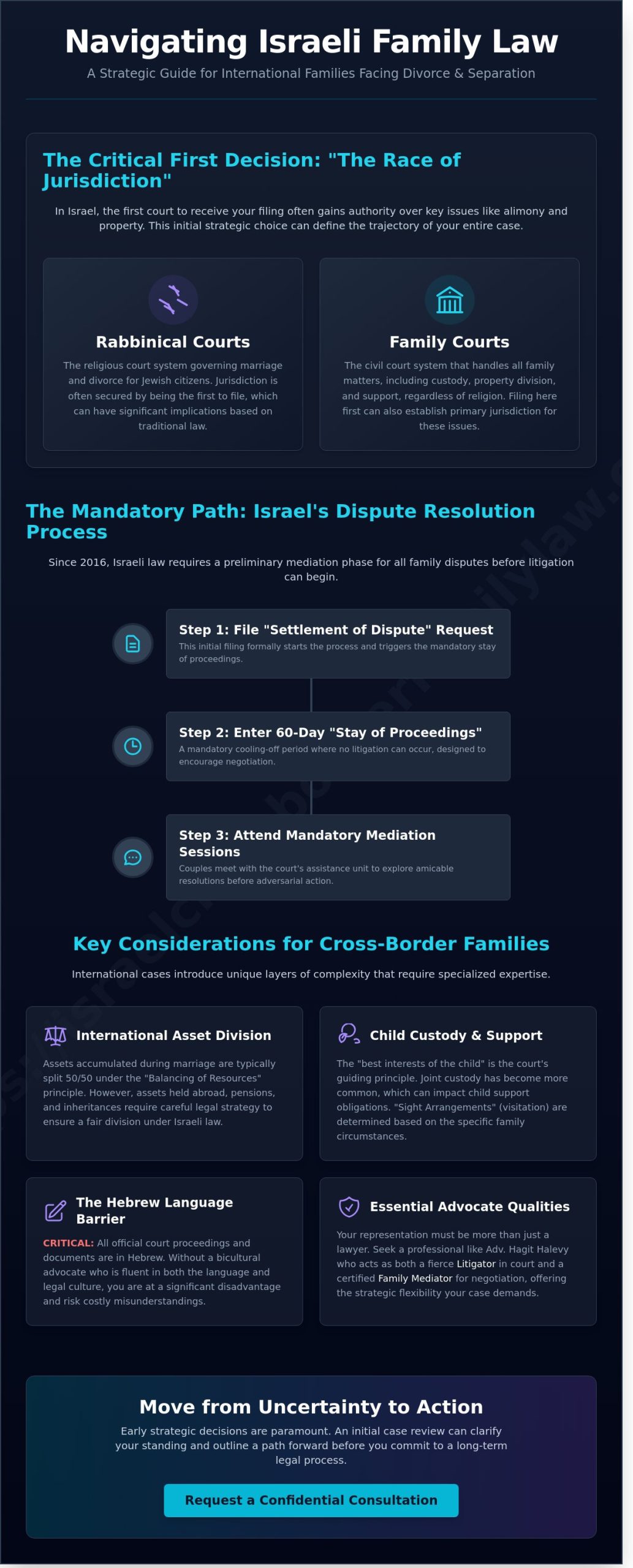
The Israeli system operates under a dual-court structure that often confuses those from Western jurisdictions. A central challenge is the “Race of Jurisdiction” between the civil Family Courts and the religious Rabbinical Courts. The court that receives a filing first often gains the authority to decide on specific issues like alimony or property division. Understanding the nuances of Family Law in Israel is vital because proceedings are conducted entirely in Hebrew. Without an experienced guide, international families risk making errors in documents they cannot fully read or interpret.
There’s also a significant shift toward mandatory mediation in IL family law. This makes the role of a certified arbitrator more central to the process than it was a decade ago. For those dealing with divorce or separation in an international context, the complexity doubles. Early decisions regarding where to file can impact the outcome of a case for years. It’s about strategy and risk-based decision-making, not just paperwork. Get clarity before you commit. Request a confidential consultation.
Core Areas of Practice: From Divorce to Alimony
The legal practice of Hagit Halevy & Co. focuses on the procedural mechanics of the Israeli Family and Rabbinical Court systems. In Israel, the divorce process typically begins with a mandatory “Settlement of Dispute” request. This filing initiates a 60-day stay of proceedings where couples must attend meeting sessions with the court’s social services unit. This stage is designed to explore mediation before litigation starts. Understanding the framework of Dispute Resolution in Israel is essential because the court where you first file often retains jurisdiction over the entire case.
For those managing divorce and separation for international families, the division of property follows the 1973 Financial Relations Law. This statute dictates the “Balancing of Resources,” where assets accumulated during the marriage are generally split 50/50. However, complexities arise with assets held abroad or inheritances received during the union. Hagit Halevy provides guidance on how the Israeli courts view these global interests, ensuring that the “race for jurisdiction” doesn’t disadvantage the client’s financial standing.
Custody and Alimony Arrangements
Israeli courts prioritize the “best interests of the child” when determining “Sight Arrangements,” the local term for visitation schedules. Since a landmark 2017 Supreme Court ruling, joint custody has become more common, often resulting in a reduction of child support payments if both parents earn similar incomes. Child support is calculated based on the child’s specific needs and the parents’ relative financial capacities. In contrast, “Wife Alimony” is a separate entitlement within the Rabbinical system, intended to maintain a woman’s standard of living until the final divorce decree is issued. If your financial situation changes by more than 25%, it’s often possible to petition the court for a formal increase or reduction in these monthly payments.
Financial and Divorce Agreements
Asset protection is a central pillar of the firm’s advisory work. Drafting prenuptial and postnuptial agreements is a practical way to safeguard property owned before the marriage. This is particularly important for foreigners who don’t always realize that Israel doesn’t perform civil marriages. If you were married in a civil ceremony abroad, you’ll still need to navigate a “civil divorce” process through the Israeli Family Court to dissolve the union locally. Additionally, the firm handles the drafting of wills under the 1965 Succession Law. Without a valid Israeli will, local assets like real estate are divided according to strict statutory formulas that might not reflect your actual wishes.
Get clarity before you commit. Request a confidential consultation.
This article is published on an independent advisory platform (not a law firm) and does not imply an attorney-client relationship.
Evaluating Legal Representation for Cross-Border Families
International families and Anglos living in Israel face a unique set of legal hurdles that a local-only practice might overlook. When your life spans two or more countries, a standard approach to divorce or custody can lead to expensive, long-term mistakes. You aren’t just dealing with Israeli law; you’re dealing with the intersection of different legal cultures and tax systems. Professionals like Hagit Halevy operate in a space where understanding these overlaps is essential for protecting a client’s future.
It’s critical to assess whether a lawyer can manage assets located outside of Israel. If you own property in the UK or have a retirement account in the US, the way these are disclosed and divided under Israeli Family Law Regulations requires specific technical knowledge. Bilingual communication is more than just speaking English; it’s about translating Western legal expectations into the Israeli reality. This bridge is vital for expats and foreign nationals who need to feel heard and understood during a high-stakes transition.
Key Questions for a Potential Lawyer
Before hiring any professional, you need to verify their specific experience with international protocols. Don’t settle for generalities. Ask direct questions to gauge their technical proficiency:
- Do they have experience with the Hague Convention? International relocation and child abduction cases require immediate action and deep familiarity with the 1980 treaty.
- How do they handle US-based assets? Managing dual citizenship or 401(k) accounts requires a strategy that respects both Israeli court orders and foreign financial regulations.
- Are they comfortable working with foreign counsel? A cross-border case often requires your Israeli lawyer to work alongside legal teams in other jurisdictions to ensure orders are enforceable abroad.
The Value of an Advisory Perspective
Seeking clarity before you sign a retainer is the most important step you can take. In cross-border disputes, early decisions often have permanent consequences. For example, filing a motion in the wrong court can trigger a jurisdictional battle that lasts years. Using an initial consultation to test for strategic alignment ensures that your lawyer’s vision matches your long-term goals. When considering the role of Hagit Halevy or any senior practitioner, look for a focus on risk-based decision-making rather than just aggressive litigation. This educational approach helps you understand the logic behind every legal move.
Get clarity before you commit. Request a confidential consultation.
This article is published on an independent advisory platform (not a law firm) and does not imply an attorney-client relationship.
The Strategy of Dispute Resolution in Israel
Since the 2016 “Litigation Shifting Law,” the landscape of Israeli family law has moved toward a mandatory pre-litigation phase. This process requires parties to file an “Application for Settlement of Dispute” before they can initiate active lawsuits. It triggers a 45 to 60 day stay of proceedings where neither side can file claims, with few exceptions for urgent temporary relief. This period is designed to lower the temperature and encourage a smart strategy over aggressive litigation. While it adds time to the initial calendar, it often prevents years of costly court battles. For international families, this window is a critical time to assess whether their case belongs in the Family Court or the Rabbinical Court, a choice that fundamentally alters the legal framework of the divorce.
Strategic planning also involves understanding “Shalom Bayit” (domestic peace) requests. In the Rabbinical system, one party might request a period of reconciliation. While sometimes sincere, these requests are often used strategically to delay proceedings or influence child custody and alimony outcomes. You can watch the video “What to expect in Israeli Family Court” on the IsraelFamilyLaw YouTube channel to better understand how these procedural nuances impact your specific timeline.
Mediation vs. Litigation
Choosing a mediator like Hagit Halevy offers a path to a joint agreement that serves the specific needs of bicultural or expat families. The Israeli system actively encourages settlement before trial because the courts are heavily backlogged. A mediated agreement is often more durable for international families because it can be drafted to meet the requirements of multiple jurisdictions simultaneously. When you choose a neutral path with Hagit Halevy, you retain control over the outcome rather than leaving life-altering decisions to a judge who may not understand the nuances of your home culture.
Risk Management in Family Law
Effective risk management requires an honest assessment of the emotional and financial costs. A standard litigation cycle in Israel can last 18 to 36 months, with legal fees often scaling based on the complexity of cross-border assets. Choosing the wrong jurisdiction is a primary risk; the “race to court” determines whether your case is heard under civil law or religious law. A calm, neutral approach helps mitigate these risks by focusing on long-term stability. Statistical data suggests that families who reach a settlement within the first 90 days report significantly higher satisfaction and lower post-divorce conflict than those who proceed to a full trial.
Get clarity before you commit. Request a confidential consultation.
This article is published on an independent advisory platform and does not imply an attorney-client relationship. Legal services are only provided by licensed attorneys under a separate engagement.
Finding the Right Path for Your Case
Moving from the research phase to active legal participation is often the most stressful part of any family dispute. In the IL legal community, Hagit Halevy has become a recognized name by focusing on the complex intersection of local statutes and the unique needs of international families. It’s easy to feel overwhelmed by the “Race of Jurisdiction” between Rabbinical and Civil courts, but clarity comes from structured action. Success in these matters depends on early strategy rather than reactive decisions. A confidential case review serves as the essential first step to understanding your specific standing without the pressure of immediate litigation.
Preparing for Your First Meeting
Efficiency in your initial consultation depends on the quality of information you provide. You should gather comprehensive documentation regarding your global assets and family status before the meeting. This list includes bank statements from both IL and foreign institutions, property deeds, and any existing prenuptial agreements. You must also define your primary objectives clearly. Whether you prioritize the speed of resolution or the specifics of international relocation, your goals will dictate the legal strategy. It’s vital to remember that professional legal services require a specific, signed engagement agreement before any representation begins. Most complex cases in Israel can span 12 to 18 months, so starting with organized records saves both time and financial resources.
Making an Informed Choice
Selecting the right representative involves evaluating different legal styles and practice focuses. Some practitioners lean toward aggressive courtroom litigation, while others, like Hagit Halevy, are often noted for their experience in navigating the nuances of cross-border mediation and settlement. Personal chemistry and trust are non-negotiable factors because you’ll be sharing sensitive personal data over an extended period. You need a guide who understands the bicultural hurdles expats face in the IL system. Navigating these courts with confidence requires a partner who views legal challenges through a lens of risk management and long-term stability. Making an informed choice now prevents the need for costly course corrections later in the process.
Get clarity before you commit. Request a confidential consultation.
Navigating Your Cross-Border Legal Strategy
Managing a family law matter in Israel involves balancing two distinct court systems: the Civil Family Court and the Rabbinical Court. For international families, these jurisdictional nuances are complicated by US-Israel tax treaties and multi-jurisdictional asset structures. Researching the methodology of Hagit Halevy provides a starting point for understanding how local strategy intersects with international needs. Our independent advisory perspective focuses on a calm, strategic risk assessment to help you avoid the common pitfalls of the “race to jurisdiction” that defines many Israeli cases.
Early decisions in these proceedings often carry consequences that last for 15 to 20 years, particularly regarding child support and property distribution. You don’t have to navigate these complexities without a clear map of the potential outcomes. This article is published on an independent advisory platform, not a law firm, and does not create an attorney-client relationship. We provide an educational framework to ensure your choices are based on logic rather than emotion; formal legal services are only provided by licensed attorneys under a separate engagement. Taking the time to understand the landscape now provides the stability your family needs during this transition.
Get clarity before you commit. Request a confidential consultation.
This article is published on an independent advisory platform and does not constitute an attorney-client relationship. Legal services are only provided by licensed attorneys under a separate engagement.
Frequently Asked Questions
Who is Hagit Halevy and where is her office located?
Hagit Halevy is a veteran family law attorney and certified mediator in Israel with over 25 years of experience in the legal field. Her primary office is located in Tel Aviv, where she serves a diverse clientele including many English-speaking expats. She’s built a reputation for handling high-conflict cases through a combination of strategic litigation and alternative dispute resolution methods.
Does Hagit Halevy specialize in international divorce for US citizens?
Yes, Hagit Halevy focuses a significant portion of her practice on cross-border family law matters involving US citizens and international families. Navigating the intersection of Israeli law and American legal expectations requires a specialized understanding of jurisdictional conflicts. Her approach helps clients manage the complexities of being an “Anglo” in the Israeli system while protecting their global interests.
What is the ‘Settlement of Dispute’ process mentioned on her site?
The ‘Settlement of Dispute’ process is a mandatory pre-litigation phase established by the 2016 Law for the Settlement of Disputes in Family Matters. It requires parties to attend up to four meetings with the court’s Unit for the Settlement of Disputes before they can file a traditional lawsuit. This 45-day period is designed to encourage couples to reach an agreement through mediation rather than through adversarial court battles.
Can a lawyer in Israel handle US-based property in a divorce?
An Israeli lawyer can include US-based assets in a global settlement agreement, but they can’t directly transfer title to American real estate. Israeli courts apply the 1973 Spouses Property Relations Law to determine how assets are balanced between parties. You’ll often need a coordinated strategy involving local counsel in the specific US state to ensure the Israeli court’s orders are recognized and enforced abroad.
Is mediation required before going to family court in Israel?
While full mediation isn’t strictly mandatory to finish a case, the law requires you to attempt a dispute resolution process before litigation begins. Since July 2016, almost all family law cases must start with an “Application for Settlement of Dispute.” Data from the Israeli court system shows that about 30 percent of cases find a resolution during this early stage, preventing the need for years of expensive litigation.
What should I bring to an initial consultation with a family lawyer?
You should bring your marriage certificate, your children’s birth certificates, and a summary of your financial situation from the last 12 months. It’s helpful to provide a list of all global assets, including bank accounts, real estate, and pension funds. Having these documents ready during your first 60-minute meeting allows the lawyer to give you a more accurate assessment of your legal position and potential risks.
How does the Rabbinical Court differ from the Family Court in Israel?
The Rabbinical Court operates under religious law and has exclusive authority over the actual act of divorce for Jewish couples in Israel. The Family Court is a civil body that handles matters like property division, child support, and custody. Decisions in the Rabbinical Court are based on Halacha, while the Family Court follows civil statutes, leading to different outcomes depending on which venue hears your case first.
What are the typical costs for a family law case in Israel?
Costs vary based on complexity, but a standard divorce case in Israel typically ranges from 35,000 to 120,000 NIS in legal fees. Hourly rates for senior attorneys often sit between 900 and 1,600 NIS. Mediation is generally more cost-effective, with sessions often priced between 1,200 and 2,800 NIS. Get clarity before you commit. Request a confidential consultation.
For more detailed insights on navigating these legal challenges, you can view educational resources on the Israel Family Law YouTube channel: https://www.youtube.com/@IsraelFamilyLaw

Article by
Gabriel Lior
A Personal Journey That Became a Mission
The advisory was founded by an American father Gabriel Lior, LLB, MBA , global entrepreneur, and cross-border advisor who spent more than a decade navigating the Israeli family court system firsthand and now lives in Singapore with his son.
As a divorced parent in a cross-border family, Gabriel faced nearly every legal challenge a foreign parent can encounter in Israel — including child custody disputes, child support proceedings, property matters in Israel and abroad, false accusations, and complex immigration and relocation proceedings.
Over the years, he learned the hard way how difficult it is for non-Israeli parents to understand the system, identify the right legal strategy, and choose the right legal representation — especially when language, culture, and jurisdictional differences are involved. He also witnessed how foreign parents and new immigrants are often disadvantaged or taken advantage of by service providers and institutions simply because they lack local knowledge or fluency.
From Client to Advisor
To truly understand — and survive — the system, Gabriel pursued formal legal education in Israel, completing two Israeli law degrees, alongside a BA and MBA earned in the United States. This was never about becoming a practicing attorney, but about gaining a deep, structural understanding of how the system works — and where it breaks down for foreign parents.
This rare combination of:
Firsthand client experience
Israeli legal and US business education
International business and negotiation training
Decades of commercial execution
created a unique perspective – one that understands both sides of the table.
After years of litigation, persistence, and at times self-representation, he ultimately succeeded in securing custody of his son and relocating abroad through a rare legal victory in the Israeli Supreme Court — becoming one of the first fathers in Israel to do so under these circumstances.
Disclaimer
Important Disclaimer:
The information provided on this website and in its content is for general informational and educational purposes only and does not constitute legal advice, legal opinion, or legal representation.
Gabriel Lior is not licensed to practice law in Israel (nor is he interested in doing so) and does not provide legal services, despite having completed 2 Law Degrees. The services offered are advisory in nature and are intended to provide general guidance, strategic insight, and information regarding cross-border family law considerations.
No attorney-client relationship is formed by accessing this website, reading its content, or communicating with us.
Any decisions made based on this information are at your own discretion and risk. For legal advice specific to your situation, you should consult a licensed attorney in the relevant jurisdiction.
Where appropriate, we may refer clients to independent, licensed attorneys or professionals. Such referrals do not constitute legal representation and no liability is assumed for services provided by third parties.