This content is published on an independent advisory platform and is intended for informational purposes only; it does not constitute legal representation or formal legal advice. Legal services are only provided by licensed attorneys under a separate engagement. This guide focuses on strategy, risks, and decision-making guidance rather than an attorney-client relationship.
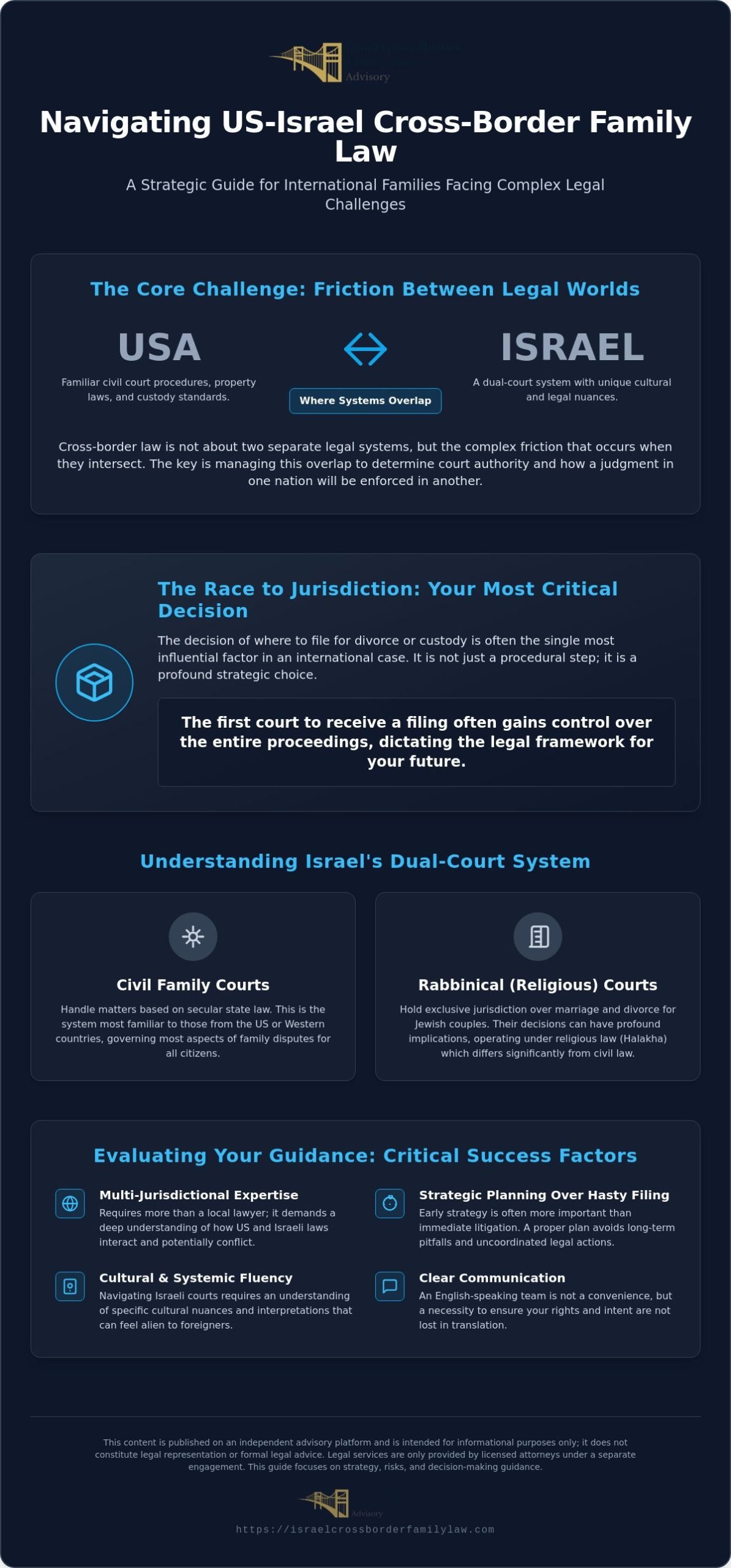
The decision of where to file for divorce or custody is often the single most influential factor in an international case. Many families don’t realize that the “race to jurisdiction” begins the moment a dispute crosses borders. It’s natural to feel a sense of dread when faced with the unfamiliar machinery of the Israeli legal system, especially when your children’s future and your financial security are on the line. Segal Simchauve provides the authoritative guidance needed to manage the friction between US and Israeli law, ensuring that your interests are protected in both jurisdictions.
You likely recognize that international cases require more than just a local lawyer. They demand a strategist who understands the nuances of both secular and religious courts. This guide promises to provide clarity on the specialized world of US-Israel cross-border representation, helping you move from a place of uncertainty to one of informed decision-making. We will examine the critical differences between the Rabbinical and civil systems, the high stakes of Hague Convention proceedings, and the essential steps for protecting your assets across multiple jurisdictions.
Key Takeaways
- Understand why cross-border family law is a highly specialized practice that requires a strategic bridge between the distinct legal frameworks of the United States and Israel.
- Learn how Segal Simchauve provides guidance for international families facing complex challenges such as international divorce and Hague Convention child abduction cases.
- Discover why the “race to jurisdiction” is a pivotal strategic element where the first court to receive a filing often gains control over the entire proceedings.
- Identify critical criteria for evaluating a firm’s capability to handle multi-jurisdictional matters, including their cultural competency and proficiency in the English language.
- Gain clarity on the risks of uncoordinated litigation and learn how to develop a cohesive plan that protects your rights and assets in both jurisdictions.
Who are Segal Simchauve and What is Cross-Border Family Law?
Cross-border family law is a highly specialized legal practice that addresses disputes involving more than one country’s legal system. It isn’t merely about understanding the laws of Israel or the United States in isolation. Instead, it focuses on the complex friction that occurs when these systems overlap. For international families, this often involves determining which court has the authority to rule on a case and how a judgment in one nation will be enforced in another. Segal Simchauve has established a significant presence in this field, representing clients who require a bridge between their Western expectations and the specific realities of the Israeli legal framework.
To better understand how choosing the right representative impacts the trajectory of an international case, watch this helpful video:
It’s vital to understand that the content provided here is published on an independent advisory platform. This is not a law firm, and the information shared does not constitute legal representation or formal legal advice. While Segal Simchauve brings extensive experience to the courtroom, the purpose of this guide is to provide strategic and educational insights for those who are still in the decision-making phase. Having an English-speaking legal team is not just a matter of convenience for expats; it’s a necessity for ensuring that your intent and your rights aren’t lost in translation during a high-stakes dispute.
The Advisory Perspective vs. Legal Representation
There’s a fundamental difference between engaging in courtroom litigation and seeking strategic guidance. Many people rush into filing a case without understanding the long-term consequences of their choice of jurisdiction. Israel Cross Border Law Firm focuses on providing clarity before you commit to a specific path. Early strategy is often more important than immediate filing. By analyzing the unique variables of a cross-border situation, you can avoid common pitfalls that arise when legal teams don’t account for international complexities.
Navigating the Israeli Legal Landscape as a Foreigner
The Israeli legal system can feel alien to those accustomed to US family courts. The primary differentiator is the dual-court system. Jewish couples may find themselves navigating both Rabbinical (religious) courts and Civil family courts. Decisions made in the first few weeks of a dispute often carry immense weight, especially in matters involving the Hague Convention on the Civil Aspects of International Child Abduction. Because Israeli courts interpret international treaties and domestic guardianship laws with specific cultural nuances, understanding these differences early on is essential for protecting your parental rights and financial assets.
Core Specialties in US-Israel Family Disputes
Managing a family dispute across two continents requires a high degree of technical precision. When a case involves both US and Israeli jurisdictions, the legal strategy must account for differences in property laws, custody standards, and enforcement mechanisms. Segal Simchauve focuses on these intersections, providing a structured approach to cases that would otherwise become uncoordinated and high-risk. Whether the issue is a complex divorce or a sensitive relocation, the goal is to create a cohesive plan that respects the requirements of both legal systems.
Beyond divorce and abduction, families often struggle with child support enforcement across borders. Modifications to support orders can be difficult when one parent resides in the US and the other in Israel. Similarly, international relocation disputes require the court to weigh the child’s best interests against the rights of both parents to maintain a meaningful relationship with their children. Segal Simchauve addresses these multi-layered disputes by coordinating the legal requirements of both nations to prevent conflicting judgments.
The Hague Convention and Child Abduction
When a child is removed from their home country without the consent of both parents, the situation often falls under the Hague Convention. This international treaty is designed to ensure the prompt return of children to their country of habitual residence. In Israel, these cases move with significant speed. The Israeli Ministry of Justice outlines strict procedural requirements that must be met to initiate a return petition. Missing a deadline or failing to provide the correct evidence can have permanent consequences for a parent’s rights. For those facing this crisis, understanding the nuances of Hague Convention child abduction proceedings is the first step toward a resolution.
Divorce and Property Division for Expats
Dividing assets in an international divorce is rarely straightforward. Israeli law, specifically the Spouses (Property Relations) Law of 1973, generally mandates a 50/50 split of assets accumulated during the marriage. However, applying this to US-based assets like 401ks, IRAs, or American real estate creates significant hurdles. Israeli courts don’t always have the direct authority to order the division of foreign retirement accounts, necessitating a mirror order or a specific financial agreement. Without a clear strategy, a spouse might find their US-based wealth vulnerable or subject to conflicting court orders. It’s often helpful to clarify your options to see how these laws apply to your specific portfolio. Protecting cross-border wealth requires proactive planning, often through prenuptial or post-nuptial agreements that are enforceable in both countries.
The Strategic Challenge of Multi-Jurisdictional Litigation
The most critical factor in a US-Israel family law case is often the “Race to Jurisdiction.” This concept refers to the reality that the court where a case is first filed typically gains control over the proceedings. Because Israeli and US laws differ significantly on property division and custody, the choice of forum can change the entire outcome of a dispute. If one party files in an Israeli Rabbinical court while the other files in a US civil court, the resulting conflict can lead to years of expensive litigation. Segal Simchauve specializes in managing these jurisdictional tensions, ensuring that clients don’t lose their legal standing simply because they were second to the courthouse.
Many expats ask if a firm based in Israel can truly protect their US legal rights. It’s a valid concern. However, international family law isn’t about choosing one system over the other. It’s about building a strategy where both systems acknowledge each other. Effective representation requires a team that understands how a US 401k is viewed under Israeli property law or how a US custody order might be domesticated in Tel Aviv. Without this dual perspective, you risk having conflicting orders that are impossible to enforce in either country. A coordinated strategy between your US and Israeli legal counsel is the only way to ensure your rights are protected globally.
The Conflict of Laws and Cultural Norms
The “best interests of the child” is a standard used globally, yet its application in Israel carries unique cultural weight. Israeli courts have moved toward a model of shared parental responsibility as of 2026, yet religious norms still influence certain proceedings. For US citizens, maintaining standing in these courts requires a nuanced approach that respects local procedures while asserting international rights. You must understand how religious law might impact a secular divorce proceeding, as the Rabbinical courts often have concurrent jurisdiction over matters like alimony and property if they are filed there first.
Enforcement of Foreign Judgments
Enforcing a foreign judgment isn’t automatic. If you have a US support or custody order, it must undergo a process called “domestication” to be recognized by Israeli authorities. This involves proving the order is final and doesn’t contradict Israeli public policy. For those dealing with financial obligations, understanding child support cross-border enforcement is essential. Coordinating with both US and Israeli counsel ensures that an order issued in one country actually holds weight in the other. This process is complex, but it’s the only way to ensure that a parent cannot simply cross a border to avoid their legal responsibilities.
How to Evaluate an International Family Law Firm
Choosing representation for a cross-border case is a decision that carries significant weight. A standard local firm might understand Israeli statutes but lack the perspective needed to manage US interests effectively. Segal Simchauve is often sought out because they bridge this gap, providing a sophisticated level of service that accounts for the legal requirements of both nations. You need a team that understands not just the law, but the cultural nuances of Anglo families who are navigating a foreign system for the first time.
Language proficiency is the baseline requirement. Cultural competency is the true differentiator. Anglo clients often expect a level of transparency, structured communication, and detailed reporting that differs from the local Israeli legal culture. It’s essential to look for a firm that provides clear pricing models to ensure financial predictability. International litigation is inherently complex, and having a firm that respects your need for clarity regarding costs and timelines is vital for your peace of mind.
A firm’s physical presence within Israel is necessary for active courtroom litigation, but their familiarity with US interests is equally important. This dual focus ensures they can coordinate seamlessly with your American professional teams, such as tax advisors or local counsel, to protect your global footprint. Segal Simchauve operates with this integrated mindset, recognizing that a decision made in a Tel Aviv courtroom can have lasting financial or legal ripples in the United States.
Key Questions to Ask Your Potential Lawyer
Before committing to a representative, ask specific questions to gauge their actual experience with multi-jurisdictional matters. “How many cases involving my specific US state have you handled?” is a critical starting point. Laws vary significantly by state, and a firm familiar with the specific procedures of New York, California, or Florida will have a distinct advantage. You should also ask if they have experience with the US-Israel tax treaty regarding asset division. Finally, confirm their communication protocols for managing clients living in different time zones.
The Importance of a Confidential Case Review
Many firms offer free consultations, but these often lack the technical depth required for complex international issues. A confidential case review is a strategic deep dive into the specifics of your situation. It allows the legal team to identify potential risks before they escalate into legal crises. This is the moment to determine if your case requires a “bridge” approach between two systems rather than a standard courtroom battle. If you’re ready to gain a clear understanding of your legal standing, you can reach out for a review of your circumstances.
Next Steps: Gaining Clarity in Your Cross-Border Case
Uncoordinated litigation is the greatest risk to an international family. When legal actions in the United States and Israel aren’t synchronized, the result is often a series of conflicting orders that create a legal stalemate. This lack of coordination can lead to years of unnecessary conflict and depleted financial resources. Segal Simchauve specializes in preventing these outcomes by developing a unified strategy that addresses the requirements of both jurisdictions simultaneously. Moving forward as an expat or foreign national requires a shift from reactive litigation to proactive, strategic planning.
The role of independent advisory is to reduce the legal anxiety that naturally arises during a cross-border dispute. By seeking a neutral perspective before the pressure of a courtroom filing begins, you can evaluate your options with a clear head. This advisory phase helps you understand which court system offers the most equitable path for your specific circumstances. Specialized cross-border counsel, such as the team at Segal Simchauve, provides the expertise needed to ensure that your decisions today don’t become liabilities tomorrow. Seeking clarity early is the most effective way to protect your children and your assets.
Resources for Expats and Foreign Nationals
Expats facing the Israeli legal system for the first time should access specialized guides for expats and foreign nationals. In 2026, the timeline for Israeli family court proceedings remains rigorous, and the dual-court system continues to present challenges for those unfamiliar with religious law. You should begin preparing your documentation immediately, focusing on asset valuations and existing US custody orders. Understanding the updated court fees as of January 2026 and the temporary expansion of Rabbinical court authority over child support is essential for accurate financial planning.
Preparation involves more than just gathering paperwork; it requires an understanding of how those documents will be interpreted in a foreign context. For example, a US-based prenuptial agreement may need specific modifications to be fully recognized by an Israeli family court. By organizing your documentation with a cross-border lens, you reduce the risk of procedural delays that can stall your case for months.
Final Advisory Note
Seek clarity before you commit to a specific legal path. The weight of early decisions cannot be overstated in family law, as the first court to take jurisdiction often dictates the rules for the entire dispute. If you’re an Anglo parent or a foreign national with interests in both the US and Israel, your strategy must be as global as your life. Don’t let the complexity of two legal systems overwhelm your ability to protect your future.
Get clarity before you commit. Request a confidential consultation.
Securing Your Family’s Future Across Borders
Managing a family dispute that spans the United States and Israel requires more than just local legal knowledge. It demands a strategic bridge between two distinct legal cultures. The initial decisions you make regarding jurisdiction and legal representation will likely define the outcome of your case for years to come. Segal Simchauve provides the specialized focus necessary to navigate these high-stakes complexities, particularly in sensitive matters involving the Hague Convention and the division of international assets.
This independent advisory platform is designed to help international families move from a state of confusion to one of informed confidence. By prioritizing early strategy and seeking a representative who understands the nuances of both secular and religious courts, you can protect your rights and your children’s well-being. Don’t wait for a crisis to force your hand; the most successful resolutions often begin with a quiet, deliberate plan. It’s possible to find stability even in the most complex multi-jurisdictional disputes.
Get clarity before you commit. Request a confidential consultation to discuss your specific circumstances.
This content is published on an independent advisory platform and is intended for informational purposes only; it does not constitute legal representation or formal legal advice. Legal services are only provided by licensed attorneys under a separate engagement. This guide focuses on strategy, risks, and decision-making guidance rather than an attorney-client relationship.
Frequently Asked Questions
Is Segal Simchauve an English-speaking law firm?
Yes, Segal Simchauve specializes in representing English-speaking clients, including Anglos, expats, and international families. Their team focuses on bridge-building between the US and Israeli legal systems, ensuring that every step of the process is explained clearly in English. This linguistic proficiency is essential for navigating the complexities of the Israeli court system without the risk of translation errors or cultural misunderstandings during high-stakes litigation.
Can an Israeli law firm help with a divorce if I live in the US?
An Israeli firm can represent you if your spouse is in Israel or if your marriage has significant jurisdictional ties to the country. Many cross-border cases involve parties living in different nations, and remote representation is a standard part of international practice. It’s vital to determine which country has the authority to hear your case early on, as this choice impacts property division and custody rights.
What is the Hague Convention in the context of Israel-US law?
The Hague Convention is an international treaty designed to ensure the prompt return of children wrongfully removed from their country of habitual residence. Both Israel and the United States are signatories to this agreement. In Israel, these cases are heard in specialized family courts and move much faster than standard custody disputes. The primary goal is to return the child to their home country so that custody can be decided there.
How does the Israeli court system differ for US citizens?
The primary difference is Israel’s dual-court system, which consists of secular family courts and religious Rabbinical courts. While US citizens are accustomed to a strictly secular system, in Israel, religious courts have authority over marriage and divorce for Jewish couples. This creates a “race to jurisdiction” where the first party to file determines which court will hear the case, a factor that can significantly change the outcome of a dispute.
Can US child support orders be enforced in Israel?
Yes, US child support orders can be enforced in Israel through a legal process called domestication. The order must be officially recognized by an Israeli court to be enforceable by local authorities. This requires proving the order is final and doesn’t contradict local laws. Coordinating with counsel familiar with cross-border enforcement is necessary to ensure that a parent cannot avoid their financial obligations by moving between countries.
Do I need a lawyer in both the US and Israel for my case?
It’s often necessary to have legal counsel in both jurisdictions to ensure a coordinated and cohesive strategy. A lawyer in the US protects your domestic assets and rights, while a firm like Segal Simchauve manages the proceedings within the Israeli court system. Without this dual representation, you risk receiving conflicting orders from two different countries, which can lead to expensive and stressful legal stalemates that are difficult to resolve.
What are the risks of filing for divorce in Israel vs. the US?
The primary risk involves the jurisdictional choice, as filing in one country may lead to less favorable laws regarding property division or alimony. Israeli law generally mandates a 50/50 split of marital assets, whereas US state laws vary between community property and equitable distribution. Filing in Israel might also subject you to the Rabbinical court system, which operates under different principles and procedures than US civil courts.
How long does a cross-border family law case usually take?
The timeline for a cross-border case varies significantly based on the complexity of the assets and the level of conflict between parties. Hague Convention cases are designed for speed and are typically resolved in weeks or months. However, complex divorces involving international property division or contested custody can take a year or longer. Seeking clarity on the specific timeline for your situation is a vital part of the initial advisory process.

Article by
Gabriel Lior
A Personal Journey That Became a Mission
The advisory was founded by an American father Gabriel Lior, LLB, MBA , global entrepreneur, and cross-border advisor who spent more than a decade navigating the Israeli family court system firsthand and now lives in Singapore with his son.
As a divorced parent in a cross-border family, Gabriel faced nearly every legal challenge a foreign parent can encounter in Israel — including child custody disputes, child support proceedings, property matters in Israel and abroad, false accusations, and complex immigration and relocation proceedings.
Over the years, he learned the hard way how difficult it is for non-Israeli parents to understand the system, identify the right legal strategy, and choose the right legal representation — especially when language, culture, and jurisdictional differences are involved. He also witnessed how foreign parents and new immigrants are often disadvantaged or taken advantage of by service providers and institutions simply because they lack local knowledge or fluency.
From Client to Advisor
To truly understand — and survive — the system, Gabriel pursued formal legal education in Israel, completing two Israeli law degrees, alongside a BA and MBA earned in the United States. This was never about becoming a practicing attorney, but about gaining a deep, structural understanding of how the system works — and where it breaks down for foreign parents.
This rare combination of:
Firsthand client experience
Israeli legal and US business education
International business and negotiation training
Decades of commercial execution
created a unique perspective – one that understands both sides of the table.
After years of litigation, persistence, and at times self-representation, he ultimately succeeded in securing custody of his son and relocating abroad through a rare legal victory in the Israeli Supreme Court — becoming one of the first fathers in Israel to do so under these circumstances.
Disclaimer
Important Disclaimer:
The information provided on this website and in its content is for general informational and educational purposes only and does not constitute legal advice, legal opinion, or legal representation.
Gabriel Lior is not licensed to practice law in Israel (nor is he interested in doing so) and does not provide legal services, despite having completed 2 Law Degrees. The services offered are advisory in nature and are intended to provide general guidance, strategic insight, and information regarding cross-border family law considerations.
No attorney-client relationship is formed by accessing this website, reading its content, or communicating with us.
Any decisions made based on this information are at your own discretion and risk. For legal advice specific to your situation, you should consult a licensed attorney in the relevant jurisdiction.
Where appropriate, we may refer clients to independent, licensed attorneys or professionals. Such referrals do not constitute legal representation and no liability is assumed for services provided by third parties.