This article is published on an independent advisory platform and does not constitute a law firm, legal representation, or legal advice. An attorney-client relationship is only established through a separate, signed engagement with a licensed attorney.
What if the most significant obstacle to claiming your family legacy isn’t a lack of a will, but the 6,000 miles of procedural distance between US expectations and Israeli reality? Many American families discover that a US-signed document doesn’t automatically grant access to assets in Jerusalem or Tel Aviv, making cross-border inheritance israel a strategic coordination challenge rather than a simple legal filing. It’s natural to feel anxious about double taxation or the prospect of assets falling into state custodianship while you’re stuck deciphering complex Hebrew paperwork.
We believe you deserve a clear path through this complexity. This guide provides a roadmap for navigating the Israeli Succession Law of 1965, validating foreign documents, and managing the 25% capital gains tax on inherited property. You’ll gain the strategies needed to minimize tax exposure and ensure your foreign will is recognized by the Registrar of Inheritance. Get clarity before you commit. Request a confidential consultation. You can also find detailed walkthroughs on our YouTube channel at https://www.youtube.com/@IsraelFamilyLaw.
Key Takeaways
- Navigate the complexities of the Israeli Succession Law (1965) to understand how local regulations impact the cross-border inheritance israel process for non-residents.
- Learn why Israeli courts require a specialized legal opinion on foreign law to validate the formal requirements of a US-drafted will.
- Streamline the probate process by identifying the specific authenticated documents and online filing procedures required by the Registrar of Inheritance Affairs.
- Identify the financial implications of the 25% capital gains tax (Mas Shevach) on inherited real estate, despite the absence of a standard inheritance tax in Israel.
- Develop a risk-based strategy to ensure your foreign documents are recognized and your family’s assets are protected from state custodianship.
This article is published on an independent advisory platform and does not imply an attorney-client relationship. Legal services are only provided by licensed attorneys under a separate engagement. For more information on our process, you can read about how we support expats and foreign nationals.
Understanding the Framework of Cross-Border Inheritance in Israel
The Israeli Succession Law of 1965 serves as the foundational pillar for all inheritance matters within the country. For families living in the United States, this law creates a specific set of obligations whenever assets are physically located in Israel. Dealing with cross-border inheritance israel requires a shift in perspective. You aren’t just following a family’s wishes; you’re engaging with a civil law system that prioritizes its own procedural rules over foreign court orders. This legal framework ensures that assets are distributed correctly while protecting the rights of all potential heirs under Israeli standards.
To better understand how these strategies work for international families, watch this helpful video:
Most uncontested cases begin at the Registrar of Inheritance Affairs. This administrative body handles standard applications, including many involving foreign residents. If a case involves complex foreign legal questions or if someone files a formal objection, the file is transferred to the Family Court. This distinction is vital. The Family Court involves a more formal, judicial process that can extend the timeline and require additional evidence. Recognizing which path your case will take is the first step toward a successful resolution.
When Does Israeli Law Apply to Your Estate?
Israel follows the “situs” rule. If a deceased person owned a residential apartment in Jerusalem, a bank account in Tel Aviv, or pension funds through an Israeli employer, the Israeli legal system claims jurisdiction over those specific assets. This applies even if the individual was a US citizen who lived abroad for decades. The deceased’s last domicile also plays a critical role. It typically determines which local laws apply to movable property like cash or jewelry. Identifying these assets early helps prevent them from falling into state custodianship, where the Administrator General manages unclaimed property.
The Two Keys to the Estate: Probate vs. Succession Orders
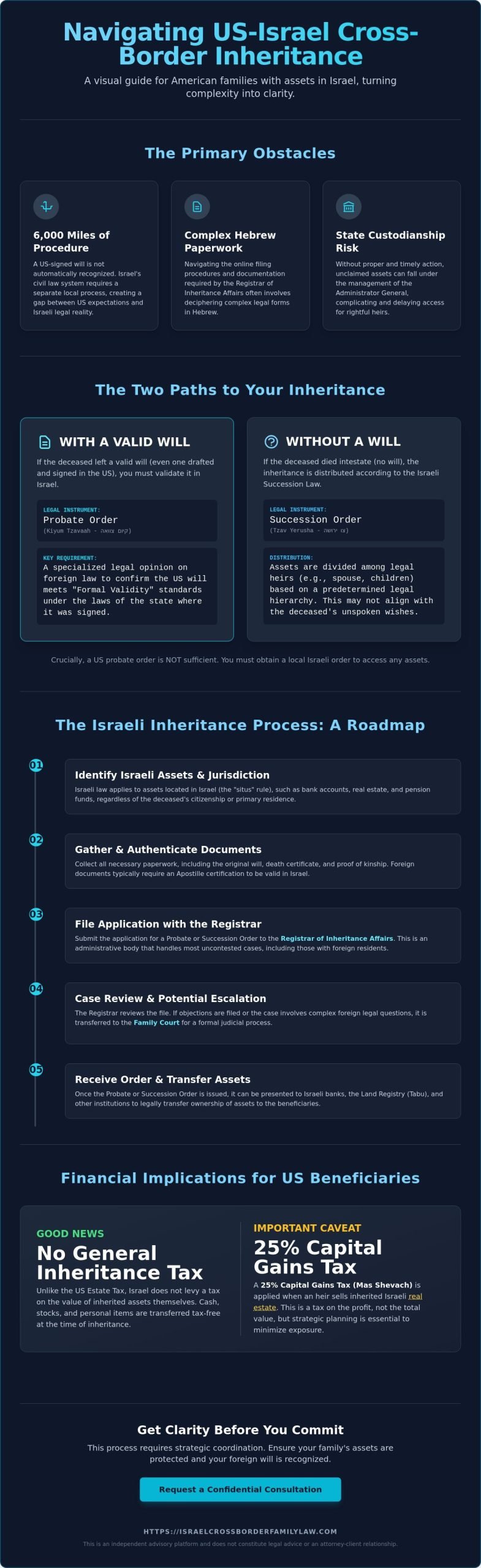
There are two primary legal instruments used to transfer assets in Israel. A Probate Order, known in Hebrew as Kiyum Tzavaah, is required when the deceased left a valid will. If no will exists, the family must apply for a Succession Order, or Yarusha. Don’t assume that a US probate order from a state court will suffice. Israel does not automatically recognize these foreign orders. You must obtain a local Israeli order that validates the foreign will or confirms the legal heirs. This local validation is the only way Israeli banks and the Land Registry can legally transfer ownership to the beneficiaries.
Get clarity before you commit. Request a confidential consultation.
This article is published on an independent advisory platform and does not imply an attorney-client relationship. Legal services are only provided by licensed attorneys under a separate engagement. You can learn more about our approach on our about page.
Enforcing a Foreign Will: How Israeli Courts Validate US Documents
Israel operates under the principle of “Formal Validity.” This means the Israeli Registrar of Inheritance generally recognizes a will signed in New York or California, provided it was valid under the laws of that specific state at the time of signing. For families managing cross-border inheritance israel, this recognition offers a degree of certainty, but the validation isn’t automatic. The process requires proving that the document meets all foreign legal standards before it can be used to distribute assets in Jerusalem or Tel Aviv.
A significant risk arises when families maintain multiple wills across different countries. It’s common for a person to have a US will for domestic assets and an Israeli will for property in Israel. If these documents aren’t perfectly coordinated, they can contradict each other, leading to expensive litigation in the Family Court. If a foreign will is successfully challenged and declared invalid, the estate may fall into “Intestacy.” In this scenario, the Israeli Succession Law of 1965 dictates the distribution, which might not align with your family’s actual intentions or the deceased’s wishes.
Document Authentication and the Apostille Process
Before any US document reaches the Israeli Registrar, it must undergo the Apostille process. An Apostille is a specialized certificate issued under the 1961 Hague Convention that authenticates the signature of the public official on the document. Without this, your US death certificate or original will holds no legal weight in Israel. You’ll also need a notarized translation into Hebrew. A common mistake that causes months of delay is failing to ensure the translator is certified to perform legal translations specifically for the Israeli authorities. Small clerical errors in these translations often result in the Registrar rejecting the entire application.
The Legal Opinion on Foreign Law
Israeli courts do not claim to be experts in US state laws. Therefore, they require a formal “Legal Opinion on Foreign Law” written by a qualified US attorney. This expert explains to the Israeli court why the will is valid under, for example, New Jersey or Florida law. This opinion is a mandatory bridge between the two legal systems. It prevents the Israeli court from defaulting to local distribution rules that might favor different heirs than the ones named in the will. To ensure your documentation meets these rigorous standards, you may want to request a review of your specific situation.
Get clarity before you commit. Request a confidential consultation.
This article is published on an independent advisory platform and does not imply an attorney-client relationship. Legal services are only provided by licensed attorneys under a separate engagement. You can find more details on our pricing page regarding procedural costs.
Navigating the Israeli Probate and Succession Process
The procedural journey of cross-border inheritance israel follows a strictly defined path. While the paperwork may seem daunting, the system is designed to provide a transparent record of asset distribution. The process moves through five key stages, beginning with the collection of authenticated documents. You’ll need the original will and a death certificate, both bearing an Apostille from the issuing US state. Once these are secured, the application is submitted through the online portal of the Registrar of Inheritance Affairs, which carries a standard filing fee of 538 ₪ as of May 2026.
Following the submission, the Registrar mandates a public notice period. This involves publishing the application in a daily newspaper, costing approximately 215 ₪, to allow potential creditors or heirs to file objections. The file then undergoes a review by the Administrator General, also known as the State Custodian. If the documentation is in order and no objections arise within the two-week notice window, the Registrar issues the final Probate or Succession Order. This document is the legal key required to release funds from Israeli banks or update ownership at the Land Registry (Tabu).
Managing the Timeline and Expectations
For uncontested cases involving foreign residents, the timeline typically spans between 3 and 9 months. Straightforward applications often conclude closer to the six-month mark. However, certain factors can trigger a transfer from the Registrar to the Family Court, which significantly extends the duration. These factors include defects in the will’s language, complex disputes between heirs, or cases where the deceased’s last domicile is unclear. To help you prepare for these logistics, you can explore our services for expats and foreign nationals.
Protecting Assets from the Administrator General
A unique risk in Israel involves the role of the State Custodian regarding “abandoned” property. If assets remain unclaimed for extended periods and the heirs don’t maintain active management, the Administrator General has the authority to seize and manage the estate. This often happens with dormant bank accounts or neglected real estate owned by non-residents. Proving active management through regular communication with financial institutions or the payment of local property taxes is essential. Taking early action to secure a succession order prevents the state from intervening in your family’s private legacy.
Get clarity before you commit. Request a confidential consultation.
This article is published on an independent advisory platform and does not imply an attorney-client relationship. Legal services are only provided by licensed attorneys under a separate engagement. You can learn more about how we facilitate these transitions on our how it works page.
Taxes and Financial Logistics for US Beneficiaries
Israel does not impose a standard estate or inheritance tax; this tax was abolished on April 1, 1981. This policy simplifies many cross-border inheritance israel matters, but it doesn’t mean the process is tax-free. The primary financial hurdle for beneficiaries is the capital gains tax, known locally as Mas Shevach. When you sell inherited real estate, the Israeli Tax Authority (ITA) levies a 25% tax on the real gain. A critical difference exists between the two systems: while the US generally offers a “step-up in basis” to the property’s value at the time of death, Israel does not provide this if the deceased was an Israeli resident. This can lead to a significantly higher tax bill when the asset is eventually sold.
US citizens must also account for the Internal Revenue Service (IRS). Even if the estate is in Israel, the IRS taxes US citizens on their worldwide assets. For 2026, the federal estate tax exemption is $15 million per individual. While fewer than 1 in 1,000 estates meet this threshold, reporting requirements are still mandatory. You must file Form 3520 if you receive a foreign inheritance exceeding $100,000. Additionally, if the inheritance includes an Israeli bank account with more than $10,000 at any point, you must file an FBAR (Foreign Bank and Financial Accounts Report).
The US-Israel Tax Treaty and Double Taxation
The tax treaty between the US and Israel, originally signed in 1975 and updated in 2017, serves to prevent double taxation. It allows you to claim credits in the US for certain taxes paid in Israel. However, the coordination between these two jurisdictions is complex. Early tax planning is often more important than the legal probate itself. Decisions made during the initial filing can impact your final tax liability. You should request a review of your specific situation to align your strategy with both the IRS and the ITA.
Transferring Funds and Closing Israeli Bank Accounts
Moving funds from an Israeli bank to a US account involves significant Anti-Money Laundering (AML) hurdles. Israeli banks are increasingly cautious and often hesitant to release funds to foreign residents. They require the final Probate Order and proof of tax compliance before authorizing a transfer. To understand the costs associated with managing these financial logistics, you can review our guide on understanding pricing for cross-border legal support. Preparing your documentation correctly from the start reduces the risk of funds being frozen during the transfer process.
Get clarity before you commit. Request a confidential consultation.
This article is published on an independent advisory platform and does not imply an attorney-client relationship. Legal services are only provided by licensed attorneys under a separate engagement. We recommend reviewing how our process works before initiating any legal filings.
Strategic Planning: Securing Clarity Before You Commit
Success in cross-border inheritance israel depends on a comprehensive risk-based assessment conducted before any documents are filed with the Registrar. This is not merely a clerical task. Every decision made in the early stages regarding jurisdiction and document presentation can fundamentally alter the final distribution of assets. A “team on the ground” in Israel provides the bicultural context necessary to bridge the gap between US estate planning expectations and Israeli procedural requirements. This established presence ensures that your family’s objectives are met without the friction of cultural or linguistic misunderstandings.
The value of this strategic approach lies in anticipating hurdles before they become expensive delays. Knowing when to push for an administrative registrar’s order versus preparing for a formal Family Court hearing can save your family months of administrative limbo. Strategic planning also involves coordinating with US-based tax professionals to ensure that the Israeli probate order is drafted in a way that facilitates the necessary tax reporting for the IRS. Decisions made today regarding the “situs” of assets and the domicile of the deceased will echo through the entire probate process.
Evaluating the Need for a Dual-Country Strategy
Families often struggle with the choice between a single “International Will” and separate wills for each country. While a single document might seem simpler, separate wills often expedite the process by isolating assets within their respective legal systems. This isolation prevents a defect in a US document from freezing assets in Israel. Incorporating trusts into your plan adds another layer of sophistication. While US trusts are standard for tax mitigation, they must be structured carefully to be recognized by Israeli financial institutions and the Land Registry. You can request a confidential case review to determine which path best fits your family’s specific asset profile.
Next Steps for International Families
For those beginning this journey today, a structured approach is essential. You can watch our educational videos on Israel Family Law to gain a deeper understanding of the specific hurdles involved. Use this actionable checklist to start the process:
- Identify all Israeli assets, including bank accounts, real estate, and forgotten pension funds.
- Locate the original will and secure an Apostille from the Secretary of State in the issuing jurisdiction.
- Obtain a Hebrew translation from a certified legal professional recognized by the Israeli Registrar.
- Consult with a US legal expert to prepare the mandatory Legal Opinion on Foreign Law.
- Confirm with an accountant that all FBAR and Form 3520 reporting requirements are being met.
Get clarity before you commit. Request a confidential consultation.
This article is published on an independent advisory platform and does not imply an attorney-client relationship. Legal services are only provided by licensed attorneys under a separate engagement.
Securing Your Family Legacy Across Borders
Managing cross-border inheritance israel involves more than just filing paperwork; it requires a deep understanding of the Israeli/US professional home. You now have a clearer view of how the 25% capital gains tax on real estate and the requirements for US legal opinions impact your distribution strategy. Success relies on bridging the gap between two distinct legal cultures through precise documentation and early tax coordination. With a dedicated team on the ground in Tel Aviv and New York, you can move forward with specialized expertise in cross-border family and estate law.
Your family’s Israeli assets represent a significant legacy that deserves protection from state custodianship and administrative delays. By adopting a risk-based strategy before you file, you ensure that your US will is recognized and your beneficiaries are protected. Get clarity before you commit. Request a confidential consultation. We are here to provide the steady, authoritative guidance you need to navigate this journey with confidence.
This article is published on an independent advisory platform and does not imply an attorney-client relationship. Legal services are only provided by licensed attorneys under a separate engagement.
Frequently Asked Questions
Does Israel have an inheritance tax for foreign residents?
Israel does not impose an inheritance or estate tax; the government abolished this tax on April 1, 1981. This exemption applies to all assets located in Israel, regardless of the beneficiary’s residency or citizenship. You should account for the 25% capital gains tax (Mas Shevach) that applies if you decide to sell inherited real estate at a later date.
Is a US-drafted will valid for property located in Israel?
A US-drafted will is generally recognized as valid in Israel if it meets the formal legal requirements of the state where it was signed. Under the Israeli Succession Law of 1965, the Registrar of Inheritance can validate foreign documents once they are authenticated and translated. You must provide a specialized legal opinion to confirm the document’s validity under US state law.
How long does the probate process take in Israel for US citizens?
Straightforward probate cases for foreign residents typically take between 3 and 6 months to reach a final order. If the case is contested or involves complex legal defects, the timeline can extend beyond 12 months. Correctly filing the online application and paying the 538 ₪ fee at the start of the cross-border inheritance israel process helps minimize these delays.
What is an Apostille and why do I need one for my inheritance?
An Apostille is an international certification issued under the 1961 Hague Convention that authenticates the signatures on your US documents. You need this stamp for your original will and death certificate to prove their legitimacy to Israeli authorities. Without an Apostille from the issuing US state, the Israeli Registrar of Inheritance cannot legally accept or process your foreign documents.
Can I manage the Israeli inheritance process without traveling to Israel?
You can manage the entire process remotely by granting a Power of Attorney to a local representative in Israel. This allows your team on the ground to file applications, attend court hearings, and manage bank communications on your behalf. Most necessary documents can be signed at an Israeli consulate or authenticated via the Apostille process in your home state.
What happens if a person dies in the US without a will but owns an apartment in Tel Aviv?
If no valid will exists, the Israeli Succession Law of 1965 dictates how the assets are distributed among the heirs. For property like a Tel Aviv apartment, the law typically grants the surviving spouse 50% of the estate, while the children share the remaining 50%. This default distribution applies to all Israeli “situs” assets unless a valid probate order states otherwise.
Do I need to report my Israeli inheritance to the IRS?
US citizens must report any foreign inheritance exceeding $100,000 to the IRS using Form 3520. If the inheritance includes an Israeli bank account that held more than $10,000 at any point in the year, you must also file an FBAR. These are informational filings, but failing to submit them can lead to significant penalties even when no US tax is due.
What is a “Legal Opinion on Foreign Law” in the context of Israeli probate?
A Legal Opinion on Foreign Law is a formal expert report that explains US state statutes to the Israeli court or Registrar. It is a mandatory requirement for cross-border inheritance israel cases involving a foreign will. The report proves the will was executed correctly under the laws of the deceased’s last domicile, ensuring the Israeli authorities respect the document’s specific instructions.

Article by
Gabriel Lior
A Personal Journey That Became a Mission
The advisory was founded by an American father Gabriel Lior, LLB, MBA , global entrepreneur, and cross-border advisor who spent more than a decade navigating the Israeli family court system firsthand and now lives in Singapore with his son.
As a divorced parent in a cross-border family, Gabriel faced nearly every legal challenge a foreign parent can encounter in Israel — including child custody disputes, child support proceedings, property matters in Israel and abroad, false accusations, and complex immigration and relocation proceedings.
Over the years, he learned the hard way how difficult it is for non-Israeli parents to understand the system, identify the right legal strategy, and choose the right legal representation — especially when language, culture, and jurisdictional differences are involved. He also witnessed how foreign parents and new immigrants are often disadvantaged or taken advantage of by service providers and institutions simply because they lack local knowledge or fluency.
From Client to Advisor
To truly understand — and survive — the system, Gabriel pursued formal legal education in Israel, completing two Israeli law degrees, alongside a BA and MBA earned in the United States. This was never about becoming a practicing attorney, but about gaining a deep, structural understanding of how the system works — and where it breaks down for foreign parents.
This rare combination of:
Firsthand client experience
Israeli legal and US business education
International business and negotiation training
Decades of commercial execution
created a unique perspective – one that understands both sides of the table.
After years of litigation, persistence, and at times self-representation, he ultimately succeeded in securing custody of his son and relocating abroad through a rare legal victory in the Israeli Supreme Court — becoming one of the first fathers in Israel to do so under these circumstances.
Disclaimer
Important Disclaimer:
The information provided on this website and in its content is for general informational and educational purposes only and does not constitute legal advice, legal opinion, or legal representation.
Gabriel Lior is not licensed to practice law in Israel (nor is he interested in doing so) and does not provide legal services, despite having completed 2 Law Degrees. The services offered are advisory in nature and are intended to provide general guidance, strategic insight, and information regarding cross-border family law considerations.
No attorney-client relationship is formed by accessing this website, reading its content, or communicating with us.
Any decisions made based on this information are at your own discretion and risk. For legal advice specific to your situation, you should consult a licensed attorney in the relevant jurisdiction.
Where appropriate, we may refer clients to independent, licensed attorneys or professionals. Such referrals do not constitute legal representation and no liability is assumed for services provided by third parties.