Most people believe that an inheritance dispute in Israel is won in a courtroom. The reality is that these conflicts are often decided months before a judge ever hears the case. If you’re managing an estate from abroad, the combination of family tension and an unfamiliar legal system can feel overwhelming. It’s natural to worry about your rights when you’re far from the assets. When dealing with inheritance disputes in Israel, the lack of a “step-up in basis” for capital gains tax and the requirement for foreign law expert opinions can complicate even simple estates.
We understand that the emotional stakes are high and the cross-border logistics are complex. This guide is published on an independent advisory platform and does not constitute legal advice or an attorney-client relationship. It provides a strategic roadmap for handling these challenges with authoritative clarity. You’ll learn how to protect your share of the estate and understand the specific risks of international probate. We also explore strategies to resolve disputes without the exhaustion of unnecessary litigation. By focusing on early strategy, you can secure your family’s legacy while maintaining your peace of mind.
Key Takeaways
- Identify whether your situation requires an Inheritance Order or a Probate Order under the 1965 Succession Law to properly secure Israeli assets.
- Recognize the specific legal grounds for contesting a will, including lack of testamentary capacity and undue influence, within the Israeli Family Court system.
- Navigate the complexities of inheritance disputes in Israel by understanding how foreign domicile and US Living Trusts are treated by the Registrar of Inheritance.
- Explore how mandatory mediation, known as Mahut, serves as a strategic alternative to litigation for international families looking to avoid high travel costs.
- Understand the risks of informal family agreements and learn why early correspondence like WhatsApp messages can significantly impact your legal standing.
Understanding the Legal Framework of Israeli Succession Law
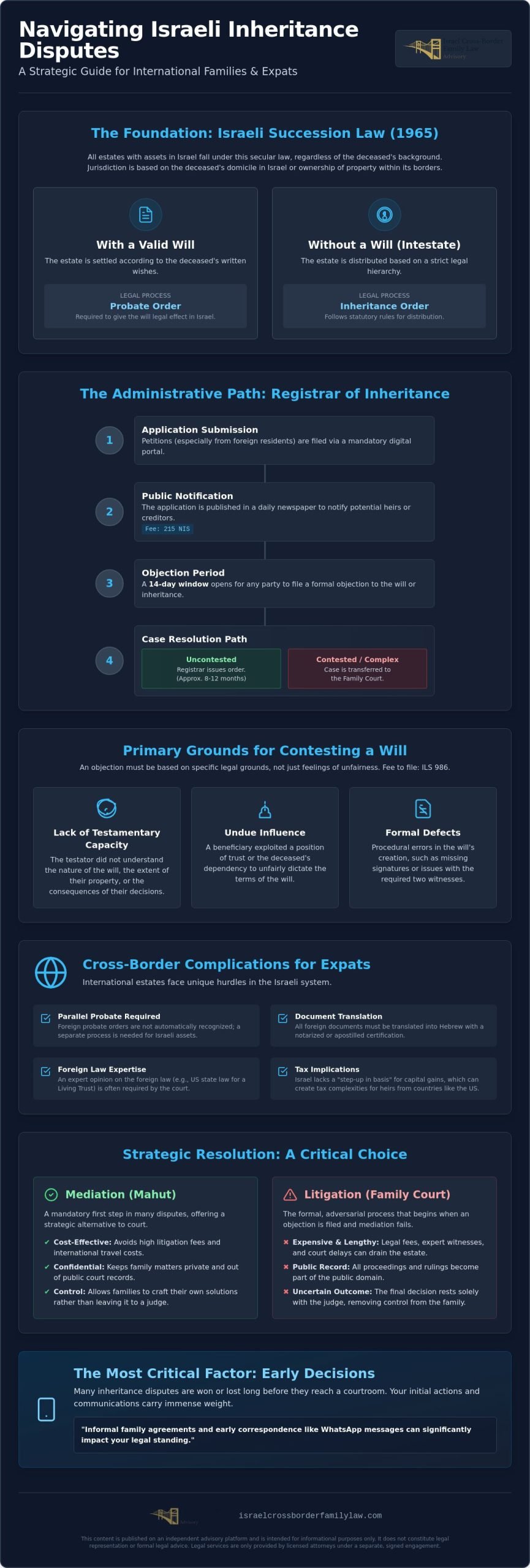
The foundation of all estate matters in the country is the Israeli Succession Law of 1965. This statute provides a secular framework that applies to all residents and assets within the borders, regardless of the deceased’s religious background. Understanding the Legal Framework is the first step for any international family facing potential inheritance disputes in Israel. Jurisdiction is established if the deceased was domiciled in Israel at the time of death or owned property there, such as real estate, business interests, or bank accounts. This means even if a person lived in New York or London for decades, their Israeli apartment remains subject to these local regulations.
There are two primary paths to settling an estate. If a valid will exists, the family must apply for a Probate Order to give the document legal effect. Without a will, the process requires an Inheritance Order, which follows the statutory distribution rules. It’s vital to recognize that foreign probate orders are not automatically recognized. An estate settled in another country must undergo a separate, parallel process here to manage the Israeli assets. This often involves providing notarized or apostilled translations of all foreign documents into Hebrew to satisfy local requirements.
The Role of the Registrar of Inheritance Affairs
The Registrar acts as the administrative entry point for all estate applications. Since 2026, petitions involving foreign residents must be submitted through a mandatory digital portal. The Registrar serves as a gatekeeper, ensuring that every application is published in a daily newspaper to allow potential heirs or creditors to come forward. There is a standard 215 NIS fee for this publication, which triggers a 14-day window for filing objections. While the Registrar handles straightforward cases, matters involving foreign wills or complex cross-border elements are typically transferred to the Family Court for judicial review. For an uncontested foreign will, the timeline usually ranges from 8 to 12 months. Any formal objection immediately shifts the case into a litigation track, which requires a more robust strategy for expats and foreign nationals.
Succession Without a Will: Intestate Rules in Israel
When someone dies without a will, Israeli law dictates a strict distribution hierarchy. Generally, the surviving spouse receives 50% of the estate and all movable household items, while the children share the remaining 50%. If there are no children, the spouse’s share may increase, and the deceased’s parents or siblings might enter the distribution pool. The law also recognizes the rights of a common-law spouse, known as Yadu’a BaZibur, provided they lived as a family unit in a joint household. It’s a common misconception that Israel has forced heirship laws like those found in parts of Europe. In reality, Israeli law grants individuals significant freedom to distribute their assets as they see fit through a valid will, provided it meets the formal requirements of the 1965 Act.
This content is published on an independent advisory platform and is intended for informational purposes only. It does not constitute legal representation or formal legal advice. Legal services are only provided by licensed attorneys under a separate, signed engagement.
Primary Grounds for Contesting a Will in Israel
Challenging a testamentary document requires more than just a sense of unfairness. To succeed in inheritance disputes in Israel, an objector must provide clear evidence that the will does not reflect the true wishes of the deceased. According to the Inheritance Registrar, the fee for filing a formal objection is ILS 986, and the standard window for filing is just 14 days from the date the probate application is published. Common grounds for these challenges include:
- Lack of Testamentary Capacity: This occurs when the testator was unable to understand the nature of the will, the extent of their property, or the consequences of the distribution.
- Undue Influence: This is a frequent claim where a beneficiary exploited a position of trust or the deceased’s dependency to dictate the terms of the estate.
- Formal Defects: Procedural errors, such as missing signatures or issues with the two required witnesses, can lead to a document being declared invalid.
- Forged Wills: While rare, proving a document is a forgery carries a high burden of proof and often requires forensic handwriting analysis.
The ‘Involvement’ Rule: A Critical Israeli Legal Nuance
Section 35 of the Israeli Succession Law introduces a unique and powerful concept known as the involvement rule. It strictly prohibits a beneficiary from taking an active part in the drafting or preparation of the will. Unlike many other jurisdictions where a child might help a parent organize their affairs, Israeli courts are very cautious. If a beneficiary is found to have “interfered” by communicating directly with the lawyer or driving the testator to the office specifically for the signing, the entire gift to that person might be disqualified. Case law shows that even seemingly minor acts, such as paying the lawyer’s fee or providing the specific wording for a clause, can trigger this rule. It’s often wise to seek professional clarity on these nuances before a dispute escalates.
Medical Capacity and Post-Mortem Assessments
When mental capacity is questioned, the court relies heavily on expert medical opinions. For international families, this often involves retrieving medical records from the US or UK. Israeli courts accept these foreign records, but they must be properly translated and reviewed by a local geriatric or psychiatric expert. A post-mortem assessment evaluates the deceased’s mental state at the exact moment they signed the document. Contemporaneous evidence, such as notes from a treating physician written on the day of the signing, carries far more weight than retrospective opinions formed years later. This is especially relevant in 2026, as courts apply increased scrutiny to the validity of foreign digital signatures and electronic records, where the testator’s physical presence at the time of signing isn’t easily verified.
This content is published on an independent advisory platform and is intended for informational purposes only. It does not constitute legal representation or formal legal advice. Legal services are only provided by licensed attorneys under a separate, signed engagement.
Cross-Border Complications: The US-Israel Inheritance Connection
Managing assets across continents introduces a specific set of legal frictions. When a person passes away in the US while owning property in Tel Aviv or Jerusalem, the central question is which country’s law applies. While the US focuses on domicile, Israel asserts jurisdiction over any local assets. This conflict often fuels inheritance disputes in Israel, especially when a US Living Trust is involved. In many American states, these trusts bypass probate entirely. However, the Israeli Registrar of Inheritance Affairs often views these trusts as foreign contracts rather than testamentary documents. This can lead to significant delays if the trust isn’t properly aligned with Israeli succession requirements for expats and foreign nationals.
For beneficiaries living in New York or London, managing Israeli real estate requires a ‘Foreign Law Opinion’. This is a formal document provided by a legal expert in the deceased’s home jurisdiction to prove the will is valid under those local laws. According to Comparative Inheritance Law Perspectives, these cross-border differences are foundational to how estates are settled in multi-jurisdictional contexts. Typically, this opinion is a mandatory requirement for validating a foreign will in the Israeli system. Without it, the court cannot confirm that the document meets the legal standards of the place where it was signed.
Validating Foreign Wills in Israeli Courts
Under the Hague Convention, all US probate documents must be apostilled to be recognized in Israel. You’ll also need certified Hebrew translations of all English documents. These administrative steps are where many families lose time. You can find visual guides on these procedural risks and strategies at the Israel Family Law YouTube channel. Understanding these requirements early helps prevent the Registrar from rejecting your application due to technical errors.
Taxation and Reporting for US Beneficiaries
Israel currently has no inheritance or estate tax, a policy in place since 1981. However, US citizens must still account for the US Federal Estate Tax, which in 2026 has an exemption of approximately $13.99 million per individual. Even if no tax is due in Israel, you must report inherited Israeli bank accounts via FBAR and other IRS filings. As of January 1, 2026, Israeli resident trustees of foreign trusts must also report controlling persons to the Israeli Tax Authority. Early planning is vital to avoid penalties in either jurisdiction before the Israeli probate order is finalized.
This content is published on an independent advisory platform and is intended for informational purposes only. It does not constitute legal representation or formal legal advice. Legal services are only provided by licensed attorneys under a separate, signed engagement.
Strategic Resolution: Mediation vs. Litigation in the Family Court
Israeli law prioritizes settlement over conflict. Under the 2016 Family Dispute Resolution Law, parties are required to attend a mandatory ‘Dispute Resolution’ meeting, known as Mahut, before they can proceed with a full lawsuit. This meeting is held with a court-affiliated unit of professionals who help families assess whether they can reach an agreement outside of the courtroom. For those involved in inheritance disputes in Israel, this is a pivotal moment to decide between a long, public trial and a private, negotiated settlement. Choosing the right path early can save years of legal fees and emotional exhaustion.
The Family Court judge only takes a central role if the Mahut process fails to produce a resolution. Once an inheritance objection is filed and the case moves to litigation, the judge oversees the gathering of evidence in inheritance disputes in Israel. For international families, the court often allows testimony from foreign witnesses to be delivered via video conference. This modern approach significantly reduces the logistical burden of flying to Israel for every hearing, making the process more accessible for those living in the US or UK.
The Benefits of Mediation for International Disputes
Mediation is often the most practical choice for families spread across different time zones. It allows for structured negotiation that preserves fragile family relationships, which are often strained by the complexities of cross-border estates. Unlike court proceedings, which are part of the public record, mediation is entirely confidential. This privacy is a major advantage for families who wish to keep their financial affairs and internal disagreements out of the public eye. Understanding how the advisory process works can help you decide if this path is right for your specific situation.
The Litigation Path: What to Expect in an Israeli Trial
If a settlement isn’t possible, the case enters the litigation track. This process includes preliminary hearings, the filing of affidavits, and cross-examination. The ‘burden of proof’ is a critical element here. Usually, the person objecting to a will must prove it is invalid. However, if the will has formal defects, the burden may shift to the person defending the will to prove its authenticity. Israeli courts also apply the principle of ‘estoppel’. If a beneficiary has already accepted the validity of a will by taking certain actions, they may be barred from later contesting it in court. To handle these procedural hurdles effectively, you should request a confidential strategy review before filing formal papers.
This content is published on an independent advisory platform and is intended for informational purposes only. It does not constitute legal representation or formal legal advice. Legal services are only provided by licensed attorneys under a separate, signed engagement.
Minimizing Risk: The Importance of Early Decisions
Many families make the mistake of attempting to resolve inheritance disputes in Israel through informal understandings before they fully grasp their legal position. While these conversations might seem like a way to keep the peace, they can inadvertently create binding admissions or waived rights. In the Israeli legal system, your early actions carry significant weight. Before you send that email or agree to a verbal compromise, you must understand how those choices will be viewed by a Family Court judge. The danger is not just in what you say, but in when you say it.
It’s a common surprise for international families to find that informal correspondence is frequently admitted as evidence. WhatsApp messages, casual emails, and even recordings of family meetings are regularly used in Israeli courts to establish intent or prove undue influence. A message sent in a moment of frustration or a tentative agreement to split an apartment can be used to establish a “fact on the ground” that is difficult to reverse later. This makes it essential to maintain a disciplined communication strategy from the very beginning of a dispute.
Another critical step is obtaining the full ‘Registrar File’ from the Registrar of Inheritance Affairs. This file contains the actual documents submitted by other parties, including the original petition, the will, and any supporting affidavits. You shouldn’t decide to file a formal objection until you’ve reviewed the exact evidence the other side is using. This allows for a realistic evaluation of the case’s strengths and weaknesses rather than reacting to family rumors. Evaluating inheritance disputes in Israel requires looking at the hard data before making a move that triggers expensive litigation.
Why Seeking Clarity Matters Before You Commit
A cost-benefit analysis is essential before entering a legal battle. You must weigh the potential gain against the high emotional and financial costs of a trial. Understanding the impact of Israeli law on your specific family dynamic helps you make a decision based on logic rather than legacy. You can learn more about how it works for international families to ensure you aren’t walking into a process you don’t fully understand.
How a Cross-Border Advisory Assists in Decision-Making
An advisory platform provides a neutral, strategic perspective that bridges the gap between US expectations and Israeli legal reality. This guidance helps you identify risks that a local Israeli lawyer might take for granted or that a US attorney might not recognize. To evaluate your specific circumstances, you can request a confidential case review to assess your situation. Having a roadmap before you commit to a course of action is the best way to protect your share of the estate.
This content is published on an independent advisory platform and is intended for informational purposes only. It does not constitute legal representation or formal legal advice. Legal services are only provided by licensed attorneys under a separate, signed engagement.
Get clarity before you commit. Request a confidential consultation.
Securing Your Family Legacy Through Informed Strategy
Resolving inheritance disputes in Israel requires more than just an understanding of the law; it demands a clear-eyed approach to the unique frictions between different legal systems. We’ve explored how early decisions, from communication on WhatsApp to obtaining the full Registrar file, can dictate the outcome of an estate. Families who prioritize mediation and strategic risk assessment often find themselves in a much stronger position than those who rush into the Family Court without a roadmap.
This advisory platform focuses on high-level strategy and risk mitigation for international families. Our expertise is specialized in the complexities of US-Israel family and estate matters, ensuring that you have a neutral perspective on both jurisdictions. While this content is strictly informational and doesn’t create an attorney-client relationship, we’re here to help you navigate these challenging landscapes with confidence. Licensed cross-border expertise is the key to bridging the gap between your expectations and the reality of the Israeli legal system.
Get clarity before you commit. Request a confidential consultation to discuss your situation. You don’t have to face these complexities alone.
Frequently Asked Questions
How long do I have to contest a will in Israel?
The standard period for filing an objection is 14 days from the date the probate application is published in an Israeli daily newspaper. However, the court often allows objections to be filed at any time before the final probate order is granted. Since 2026, all petitions involving foreign residents must be tracked through the mandatory digital portal to ensure you don’t miss these critical deadlines. The fee for filing a formal objection to a will is currently ILS 986.
Can I contest an Israeli will if I live in the United States?
Yes, you can initiate a challenge from abroad if the deceased owned assets in Israel or was domiciled there at the time of death. Israeli courts maintain jurisdiction over local property, such as apartments in Jerusalem or Tel Aviv, regardless of where the heirs reside. Managing inheritance disputes in Israel from the US is common. You’ll typically need to provide apostilled documents and Hebrew translations to the Registrar of Inheritance Affairs to establish your standing.
What are the most common reasons an Israeli court will invalidate a will?
Courts primarily invalidate wills based on undue influence, lack of testamentary capacity, or procedural defects. A unique feature of Israeli law is Section 35, known as the “Involvement Rule,” which can disqualify a beneficiary if they took an active part in drafting the document. Courts also apply increased scrutiny to digital signatures on electronic wills, a trend that has seen a 15% increase in disputes during 2026. Proving these grounds requires clear evidence rather than just family suspicion.
How much does it cost to handle an inheritance dispute in Israel?
Filing a formal objection carries a court fee of ILS 986, while the mandatory newspaper publication fee is 215 NIS. If the case involves a foreign will, you must also obtain a foreign law expert opinion, which typically costs between 3,000 and 7,000 ILS. While these are the standard administrative costs, the total financial commitment depends on the complexity of the assets and whether the case moves from the Registrar to the Family Court for full litigation.
Do I need to travel to Israel to participate in an inheritance court case?
Physical travel is often unnecessary because Israeli courts frequently allow international parties to participate via video conference. This includes attending the mandatory Mahut mediation meetings and providing witness testimony. This modern approach helps international families manage inheritance disputes in Israel without the logistical burden of frequent cross-border travel. Most procedural filings are now handled through digital portals, allowing your representatives to manage the case locally while you remain in your home country.
What happens if there are two different wills, one in the US and one in Israel?
Israeli law generally recognizes the most recent valid will as the document that revokes previous versions, unless the wills are drafted to cover specific assets in different jurisdictions. If a US will is presented, the court will require a foreign law expert opinion to verify its validity under the laws of the specific US state where it was signed. Conflict of laws is a complex area, and the court will carefully examine the testator’s intent to determine which document governs the Israeli assets.
Can a common-law partner claim a share of an inheritance in Israel?
Yes, a common-law spouse, known as Yadu’a BaZibur, has significant rights under the Israeli Succession Law of 1965. If the couple lived as a family unit in a joint household at the time of death, the surviving partner may be entitled to the same share as a legal spouse. This applies even in the absence of a will. However, the claimant must provide substantial proof of the relationship’s nature to the court, which can be a point of contention among other heirs.
Is there an inheritance tax in Israel for foreign beneficiaries?
Israel does not have an inheritance or estate tax, as it was abolished in 1981. This applies to both local and foreign beneficiaries. However, you should be aware of the 25% capital gains tax, known as Mas Shevach, which is triggered when an inherited Israeli property is sold. Since there is no “step-up in basis,” the tax is calculated from the original price the deceased paid for the asset. US beneficiaries must also comply with IRS reporting requirements for foreign bank accounts.
This content is published on an independent advisory platform and is intended for informational purposes only. It does not constitute legal representation or formal legal advice. Legal services are only provided by licensed attorneys under a separate, signed engagement.
Get clarity before you commit. Request a confidential consultation.

Article by
Gabriel Lior
A Personal Journey That Became a Mission
The advisory was founded by an American father Gabriel Lior, LLB, MBA , global entrepreneur, and cross-border advisor who spent more than a decade navigating the Israeli family court system firsthand and now lives in Singapore with his son.
As a divorced parent in a cross-border family, Gabriel faced nearly every legal challenge a foreign parent can encounter in Israel — including child custody disputes, child support proceedings, property matters in Israel and abroad, false accusations, and complex immigration and relocation proceedings.
Over the years, he learned the hard way how difficult it is for non-Israeli parents to understand the system, identify the right legal strategy, and choose the right legal representation — especially when language, culture, and jurisdictional differences are involved. He also witnessed how foreign parents and new immigrants are often disadvantaged or taken advantage of by service providers and institutions simply because they lack local knowledge or fluency.
From Client to Advisor
To truly understand — and survive — the system, Gabriel pursued formal legal education in Israel, completing two Israeli law degrees, alongside a BA and MBA earned in the United States. This was never about becoming a practicing attorney, but about gaining a deep, structural understanding of how the system works — and where it breaks down for foreign parents.
This rare combination of:
Firsthand client experience
Israeli legal and US business education
International business and negotiation training
Decades of commercial execution
created a unique perspective – one that understands both sides of the table.
After years of litigation, persistence, and at times self-representation, he ultimately succeeded in securing custody of his son and relocating abroad through a rare legal victory in the Israeli Supreme Court — becoming one of the first fathers in Israel to do so under these circumstances.
Disclaimer
Important Disclaimer:
The information provided on this website and in its content is for general informational and educational purposes only and does not constitute legal advice, legal opinion, or legal representation.
Gabriel Lior is not licensed to practice law in Israel (nor is he interested in doing so) and does not provide legal services, despite having completed 2 Law Degrees. The services offered are advisory in nature and are intended to provide general guidance, strategic insight, and information regarding cross-border family law considerations.
No attorney-client relationship is formed by accessing this website, reading its content, or communicating with us.
Any decisions made based on this information are at your own discretion and risk. For legal advice specific to your situation, you should consult a licensed attorney in the relevant jurisdiction.
Where appropriate, we may refer clients to independent, licensed attorneys or professionals. Such referrals do not constitute legal representation and no liability is assumed for services provided by third parties.