Last year, an American expat living in Rehavia discovered that a single filing in the Rabbinical Court could suddenly jeopardize the retirement accounts he spent decades building in New York. It’s a common realization for many Anglos and international families who find themselves caught between two very different legal systems. You likely feel a sense of confusion regarding the “race for jurisdiction” or fear that language barriers in the Jerusalem courts will lead to a loss of control over your assets and your children’s future.
Finding a family lawyer Jerusalem families can rely on for cross-border expertise is about more than just filing paperwork; it’s about understanding how Israeli law interacts with your home country’s regulations. This article provides an educational overview of the unique interplay between the civil Family Courts and the Rabbinical Courts, especially following the March 2026 expansion of religious court authority. We’ll examine how to protect international assets and achieve fair custody outcomes through strategic planning. Please note that this information is published on an independent advisory platform for informational purposes. It focuses on strategy and risk guidance rather than formal legal representation, which is only provided by licensed attorneys under a separate engagement.
Key Takeaways
- Understand the “dual-track” legal system in Jerusalem, where religious and civil courts often have overlapping authority over divorce, property, and inheritance matters.
- Identify how cross-border status and US-based assets are treated under Israeli law to prevent the unexpected loss of international retirement accounts or real estate.
- Gain clarity on how the Jerusalem legal system manages child custody, including the application of the Hague Convention for families with ties to multiple countries.
- Learn why selecting a family lawyer Jerusalem expert with specific experience in US-Israel legal strategy is essential for protecting your family’s future.
- Discover the importance of early strategic planning to navigate the “race for jurisdiction” and secure a fair legal standing in the most appropriate court system.
Understanding the Family Law Landscape in Jerusalem
Jerusalem’s legal landscape is defined by “Personal Status,” a framework that places family matters like marriage, divorce, and inheritance under the jurisdiction of specific religious communities. This makes the city unique; its diverse population often finds their most intimate life events governed by religious law rather than purely secular codes. For an international family, understanding Marriage and divorce in Israel involves navigating these religious mandates alongside modern civil statutes.
The stakes are significantly higher for expats because decisions made in Jerusalem can have a ripple effect on their legal standing in their home country. A family lawyer Jerusalem specialist often highlights that failing to account for these overlaps early on can lead to long-term complications with US-based assets or citizenship status. It’s vital to recognize that the Jerusalem legal system operates on a logic that may feel foreign to those raised in common law jurisdictions like the United States.
To better understand how these laws affect your ability to move or travel with children, watch this helpful video:
The Role of the Jerusalem District Court
While most family disputes begin in the local Family Court, the Jerusalem District Court serves as the appellate body for these cases. It handles complex legal questions, such as those involving significant international property or disputes over which court system has the authority to hear a case. Having representation that is proficient in English is vital here. The legal nuances discussed at the district level often require precise translation to ensure your intent and international rights are clearly understood by the bench. Finding a family lawyer Jerusalem families can rely on means finding a practitioner who can articulate complex cross-border strategies in this higher venue.
Why English Speakers Need a Cross-Border Perspective
Fairness isn’t a universal legal term. What an Israeli court considers a fair division of property might differ sharply from the expectations of someone used to US laws. International families often face the risk of conflicting orders, where a Jerusalem court issues a ruling that a US court cannot or will not enforce. Seeking clarity before making any legal commitments is the only way to avoid these jurisdictional traps. This content is published on an independent advisory platform, not a law firm. We focus on providing strategic guidance and identifying risks to help you make informed decisions. Legal services are only provided by licensed attorneys under a separate engagement.
Navigating Jerusalem’s Dual Court System: Family vs. Rabbinical
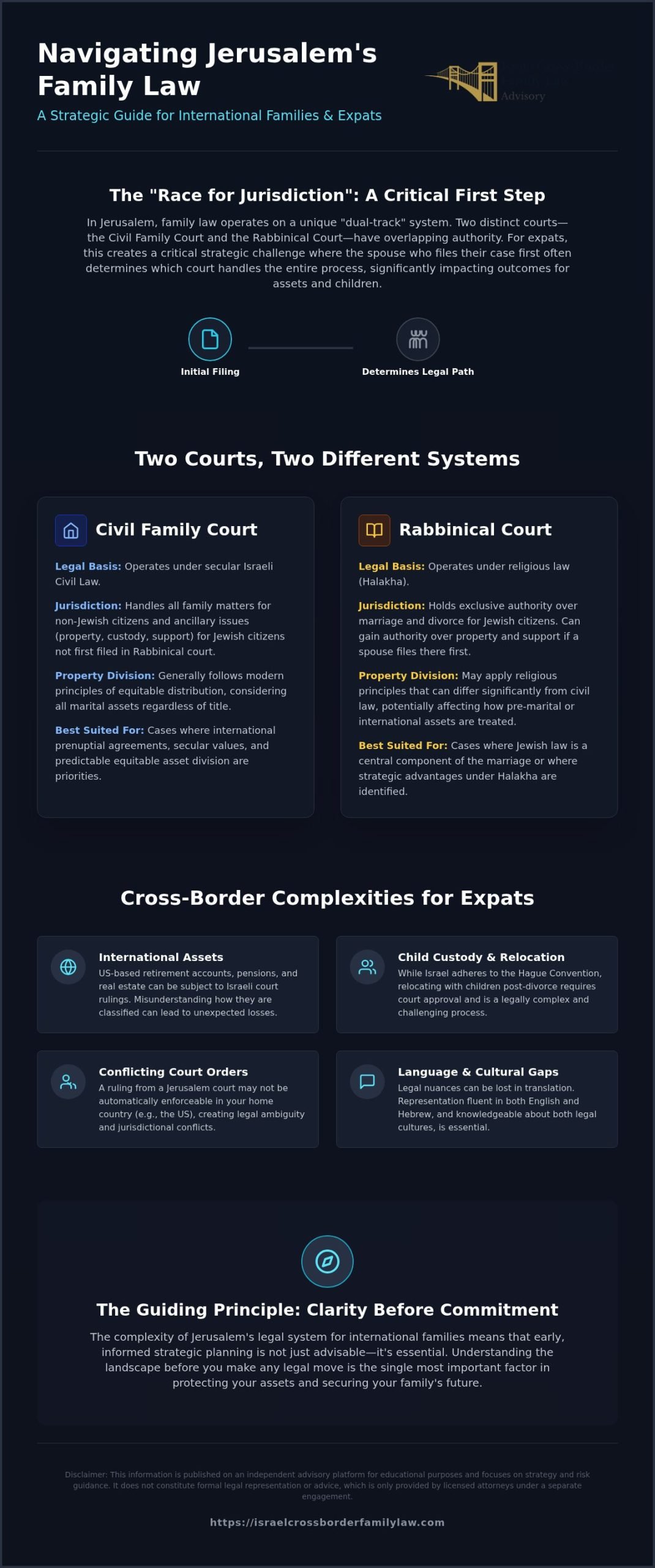
Israel’s legal structure for personal status is unique, utilizing a parallel jurisdiction model. This means that while civil Family Courts handle many aspects of domestic law, the Rabbinical Courts maintain exclusive authority over the marriage and divorce of Jewish citizens. This “dual-track” system creates what is commonly known as the “race of jurisdiction.” In Jerusalem, where the Rabbinical court is particularly active, the spouse who files first often determines which court handles the ancillary issues of the divorce, such as property division and child support. As detailed in various Family Laws and Regulations guides, the choice of court can significantly impact the final outcome of your case.
The strategic implications of this race are profound for Anglos and international families. A filing in one court might prioritize secular equitable distribution, while the other might apply religious principles that treat assets differently. Because Jerusalem handles a high volume of these cases, the speed and precision of your initial filing are critical. It’s often the difference between a predictable civil process and a complex religious litigation. If you’re unsure which track fits your needs, it’s wise to speak with a consultant to map out your options before taking any formal steps.
The Jerusalem Family Court (Civil)
The civil courts focus on modern legal standards and prioritize the “best interests of the child.” They generally favor joint parental responsibility and an equitable split of marital property. For expats used to Western litigation, this venue offers more procedural transparency and follows familiar judicial patterns. While timelines vary, an uncontested divorce here can be concluded in 3 to 6 months, whereas contested litigation can extend for several years. A family lawyer Jerusalem expert can help you navigate these civil procedures while ensuring your international rights remain protected.
The Jerusalem Rabbinical Court (Religious)
For Jewish couples, the “Get” (religious divorce decree) must be obtained through this court. Even if property matters are handled in the civil track, the Rabbinical court remains the only venue that can legally dissolve a Jewish marriage in Israel. They view property and support through the lens of Halacha (Jewish law), which may create different outcomes for non-observant or foreign citizens. Navigating this system requires a nuanced understanding of how religious rulings interact with civil law. This content is published on an independent advisory platform for informational purposes and is not formal legal advice. Legal services are only provided by licensed attorneys under a separate engagement.
The Impact of Cross-Border Status on Jerusalem Legal Proceedings
For families with ties to both the United States and Israel, legal proceedings in Jerusalem carry a layer of multi-jurisdictional complexity that local families rarely face. US citizenship significantly influences how an Israeli court evaluates your “center of life,” a determination that dictates whether Jerusalem has the authority to rule on your case at all. This evaluation is particularly sensitive in matters of International Custody and Relocation, where the court must decide if a child’s habitual residence has shifted from one country to another.
The Hague Convention plays a critical role in these disputes. In 2026, Israeli courts continue to prioritize international child abduction cases, often requiring an initial hearing within 15 days of a petition being filed. Additionally, the division of assets is not just a matter of Israeli property law; the US-Israel tax treaty must be considered. This treaty helps prevent double taxation on retirement accounts, pensions, and real estate located in the US, but only if the legal strategy accounts for these protections from the outset. A family lawyer Jerusalem expert with a cross-border focus ensures that these international protections are not overlooked during local litigation.
Center of Life and Jurisdictional Claims
Defining your “center of life” in the Jerusalem District is a factual inquiry involving your housing, employment, and social ties. It’s a common risk for expats to find that a temporary residence in Jerusalem has evolved into a permanent legal obligation under Israeli law. This shift can complicate your right to return to the US with your children. Recent events, such as the authorized departure of certain US personnel in February 2026, have shifted how courts view the stability of residence in the region. Seeking clarity on these jurisdictional claims early is essential to maintaining your mobility and protecting your long-term interests.
Enforcing Foreign Orders in Jerusalem
If you already have a US divorce decree or a support order, you may need to validate it in Israel to ensure compliance. The process involves a formal request for enforcement in the Jerusalem court district, which requires the order to be final and not contradictory to Israeli public policy. Common obstacles include disputes over Child Support Cross-Border Enforcement, especially when the original order doesn’t align with Israeli cost-of-living standards. This content is published on an independent advisory platform for informational purposes. It focuses on strategy and risk guidance rather than formal legal advice. Legal services are only provided by licensed attorneys under a separate engagement.
Strategic Considerations for Divorce, Custody, and Inheritance
Strategic planning in Jerusalem requires a nuanced approach to asset management and family dynamics. With Jerusalem recording 692 divorces in 2024, the highest absolute number in the country, the courts are well-versed in complex domestic disputes. However, for international families, the process is rarely standard. Managing assets located in both Jerusalem and the US requires a plan that respects both jurisdictions. For those seeking visual guides on these topics, the Israel Family Law YouTube channel offers detailed explanations on how these personal status issues are handled.
Protecting International Assets
One of the most significant risks for expats is the “commingling” of assets. If you inherit funds in the US but use them to renovate a home in Jerusalem or deposit them into a joint Israeli bank account, those funds may lose their status as separate property. Jerusalem courts generally view marital assets as subject to equitable distribution, but foreign retirement accounts and 401(k)s present a unique challenge. While Israeli law might recognize these as marital property, the practical mechanics of dividing a US-based tax-deferred account require a strategy that avoids heavy penalties or tax liabilities. Shielding pre-marital property requires clear documentation and a proactive legal stance.
Child Custody and the “Tender Years” Presumption
In Jerusalem, the “Tender Years Presumption” traditionally suggests that children under the age of six should remain in the primary custody of their mother. While this remains part of the legal framework, the courts are increasingly favoring “Joint Parental Responsibility.” This shift prioritizes the best interests of the child and encourages both parents to remain active in the child’s upbringing. In high-conflict cases, the court may appoint a Parenting Coordinator to help manage daily disputes. A family lawyer Jerusalem expert can help you draft travel protocols that detail how and when children can travel to the US, ensuring that both parents feel secure in the child’s eventual return to Israel.
Inheritance matters also require local attention. Even if you have a valid US will, it may not be sufficient to transfer Jerusalem real estate. Israeli law often requires a local probate process or an Israeli-specific will to manage property within the country. This content is published on an independent advisory platform for informational purposes and is not formal legal advice. Legal services are only provided by licensed attorneys under a separate engagement. To ensure your assets and family rights are fully protected, you should request a confidential consultation to discuss your specific circumstances.
Choosing the Right Legal Path in Jerusalem
Selecting the appropriate representation in Jerusalem is a strategic decision that extends far beyond city limits. For international families, a family lawyer Jerusalem professional must offer more than a presence in the local court; they must possess a deep understanding of how US and Israeli legal systems intersect. Prioritizing practitioners with dual-qualification or extensive experience in US-Israel cross-border matters is essential. These specialists are equipped to handle the nuances of both the Jerusalem Family Court and the Rabbinical system, ensuring your rights are protected regardless of which track your case follows.
While aggressive litigation is sometimes necessary, there’s a significant trend in 2026 toward mediation and alternative dispute resolution. This approach often leads to more sustainable outcomes for families, especially when managing the split of international assets or complex custody arrangements. Mediation can drastically reduce the typical contested divorce timeline, which can otherwise stretch between 2 to 4 years in the Jerusalem district. Choosing a path that prioritizes long-term stability over short-term conflict is often the most effective way to protect your family’s future.
Questions to Ask a Potential Jerusalem Family Lawyer
When interviewing potential representation, clarity is your most valuable asset. You should feel confident that your advocate understands the transnational nature of your life. Consider asking the following questions to gauge their proficiency in cross-border matters:
- How many US-Israel cross-border cases have you handled specifically within the Jerusalem district?
- What is your specific strategy for managing the “Race of Jurisdiction” between the civil and religious courts?
- How do you maintain seamless communication with US-based legal teams to ensure consistency across jurisdictions?
The Importance of a Confidential Review
Early strategic decisions carry immense weight in the Israeli legal system, particularly because the first court to receive a filing often retains jurisdiction over the entire case. Engaging in a Confidential Case Review allows you to identify potential risks before they become permanent legal obligations. Understanding How It Works when navigating a cross-border dispute can save significant time and emotional distress by providing a clear roadmap from the outset.
This content is published on an independent advisory platform and does not constitute an attorney-client relationship. It’s intended for informational and advisory purposes only. Legal services are only provided by licensed attorneys under a separate engagement. Focusing on strategy and risk management ensures you’re prepared for the complexities of the Jerusalem legal landscape. Get clarity before you commit. Request a confidential consultation.
Securing Your Family’s Future in Jerusalem
Navigating the intersection of US and Israeli legal systems requires a proactive approach that prioritizes long-term security over immediate emotional responses. You’ve seen how the “race for jurisdiction” and the unique dual-track court system in Jerusalem can fundamentally alter the trajectory of your divorce, custody, or inheritance case. Protecting international assets like 401(k)s or US real estate isn’t just about local filings; it’s about a comprehensive strategy that respects the legal requirements of both nations.
When you seek a family lawyer Jerusalem expert, you’re looking for a bridge between cultures and legal frameworks. This article was published on an independent advisory platform to help you identify risks and evaluate your options with professional clarity. We focus on strategy and decision-making guidance rather than formal legal representation, which is only provided by licensed attorneys under a separate engagement. Early decisions carry the most weight in cross-border disputes.
Get clarity before you commit. Request a confidential consultation to discuss your specific US-Israel legal strategy. You can move forward with confidence when you have a clear roadmap.
Frequently Asked Questions
Do I need a separate lawyer for Jerusalem and the US?
You typically need local representation in each jurisdiction because legal licenses are geographically limited. An Israeli attorney cannot appear in a US court; similarly, a US lawyer cannot represent you in Jerusalem. However, maintaining separate teams without a unified strategy often leads to conflicting orders. A cross-border consultant serves as the bridge, ensuring your US and Israeli legal paths don’t contradict each other. This unified approach protects your global assets and long-term standing.
Can a US prenuptial agreement be enforced in a Jerusalem court?
Enforcement is possible but depends on the agreement’s alignment with Israeli law. Jerusalem courts will review the document to ensure it was entered into fairly and without coercion. If the prenuptial agreement was drafted solely under US law, it might lack specific clauses required by the Israeli “Personal Status” framework. To ensure your assets are protected, it’s often advisable to have the agreement validated by an Israeli court through a formal approval process.
How does the Jerusalem Rabbinical Court treat US citizens?
The Rabbinical Court’s authority is based on religious affiliation rather than nationality. If you’re Jewish, this court has jurisdiction over the religious dissolution of your marriage, regardless of your US passport. US citizens often find that religious law treats property and support differently than secular US courts. Navigating this system requires understanding how Halachic rulings interact with your international status. This content is published on an independent advisory platform and does not constitute legal advice.
What happens if my spouse files for divorce in Jerusalem before I file in the US?
Filing first in Jerusalem can trigger the “race for jurisdiction,” potentially locking your case into the Israeli legal system. This move allows the court to rule on ancillary issues like property division and child custody before a US court can intervene. It’s a critical strategic moment that requires immediate attention to protect your US-based assets. A family lawyer Jerusalem professional can help you evaluate the risks of an Israeli filing on your international interests.
How is child support calculated for expats living in Jerusalem?
Calculations are based on the child’s specific needs and both parents’ global income. For expats, the court considers Jerusalem’s cost of living while also accounting for US-based salaries and investments. The process is distinct from the formula-based approaches used in many US states. Because child support orders often need to be enforced across borders, the strategy must account for international treaties. Clarity on these financial obligations is essential before making any legal commitments in Israel.
Can I relocate back to the US with my children after a Jerusalem divorce?
Can I relocate back to the US with my children after a Jerusalem divorce?
While the official language of the court is Hebrew, Jerusalem’s legal community is well-accustomed to English-speaking clients. All formal documents and proceedings occur in Hebrew, so having a family lawyer Jerusalem expert who is fluent in both languages is vital. They ensure your testimony is accurately represented and that you fully understand every court order. Clear communication is the only way to navigate the cultural and procedural differences between the US and Israeli legal systems.
How long does a typical cross-border divorce take in Jerusalem?
An amicable, uncontested divorce in Jerusalem typically concludes within 3 to 6 months. In contrast, contested cases involving international property or complex custody disputes can realistically take 2 to 4 years. The duration depends on the court’s schedule and the complexity of your cross-border assets. Utilizing mediation can often shorten this timeline significantly. Seeking strategic guidance early helps you manage expectations and prepare for the potential length of the legal process in Israel.

Article by
Gabriel Lior
A Personal Journey That Became a Mission
The advisory was founded by an American father Gabriel Lior, LLB, MBA , global entrepreneur, and cross-border advisor who spent more than a decade navigating the Israeli family court system firsthand and now lives in Singapore with his son.
As a divorced parent in a cross-border family, Gabriel faced nearly every legal challenge a foreign parent can encounter in Israel — including child custody disputes, child support proceedings, property matters in Israel and abroad, false accusations, and complex immigration and relocation proceedings.
Over the years, he learned the hard way how difficult it is for non-Israeli parents to understand the system, identify the right legal strategy, and choose the right legal representation — especially when language, culture, and jurisdictional differences are involved. He also witnessed how foreign parents and new immigrants are often disadvantaged or taken advantage of by service providers and institutions simply because they lack local knowledge or fluency.
From Client to Advisor
To truly understand — and survive — the system, Gabriel pursued formal legal education in Israel, completing two Israeli law degrees, alongside a BA and MBA earned in the United States. This was never about becoming a practicing attorney, but about gaining a deep, structural understanding of how the system works — and where it breaks down for foreign parents.
This rare combination of:
Firsthand client experience
Israeli legal and US business education
International business and negotiation training
Decades of commercial execution
created a unique perspective – one that understands both sides of the table.
After years of litigation, persistence, and at times self-representation, he ultimately succeeded in securing custody of his son and relocating abroad through a rare legal victory in the Israeli Supreme Court — becoming one of the first fathers in Israel to do so under these circumstances.
Disclaimer
Important Disclaimer:
The information provided on this website and in its content is for general informational and educational purposes only and does not constitute legal advice, legal opinion, or legal representation.
Gabriel Lior is not licensed to practice law in Israel (nor is he interested in doing so) and does not provide legal services, despite having completed 2 Law Degrees. The services offered are advisory in nature and are intended to provide general guidance, strategic insight, and information regarding cross-border family law considerations.
No attorney-client relationship is formed by accessing this website, reading its content, or communicating with us.
Any decisions made based on this information are at your own discretion and risk. For legal advice specific to your situation, you should consult a licensed attorney in the relevant jurisdiction.
Where appropriate, we may refer clients to independent, licensed attorneys or professionals. Such referrals do not constitute legal representation and no liability is assumed for services provided by third parties.