Filing for divorce in Israel is not just a local event; it is a complex cross-border strategic challenge that begins the moment a separation is considered. It’s understandable to feel vulnerable when navigating an unfamiliar legal system while still adjusting to life as a new immigrant. This guide is designed to help you understand the unique divorce issues for olim hadashim, specifically the jurisdictional conflicts and financial complexities that arise when your life spans two countries. You will gain clarity on the dual-court system, the division of international assets, and the mandatory dispute resolution process required by Israeli law. This content is published on an independent advisory platform (not a law firm) and is intended for informational and strategy-focused purposes. This information does not constitute legal representation or formal legal advice; legal services are only provided by licensed attorneys under a separate engagement. To better understand these concepts through visual guides, you may visit the Israel Family Law YouTube channel.
Key Takeaways
- Learn how the “Race for Jurisdiction” determines whether the Rabbinical or Family Court systems will preside over your financial and custody matters.
- Understand the complex treatment of US-based real estate and business interests under the Israeli “Balancing of Resources” legal framework.
- Navigate the significant legal risks associated with international child relocation and the strict enforcement of the Hague Convention in Israel-US cases.
- Gain strategic insight into the mandatory dispute resolution process to effectively manage divorce issues for olim hadashim before formal litigation begins.
- Access this independent advisory overview to bridge the gap between divergent legal systems and protect your global interests through informed decision-making.
Navigating Divorce as an Oleh Hadash: The Initial Legal Landscape
Aliyah is a profound life transition that tests the resilience of any relationship. When the pressures of relocation, language barriers, and cultural adjustment lead to a breakdown in a marriage, new immigrants face a unique set of legal vulnerabilities. You should be aware that residency in Israel, even for a short period, often grants Israeli courts the authority to decide your family’s future. This transition happens faster than many realize; simply establishing a home and a routine can be enough to trigger local jurisdiction.
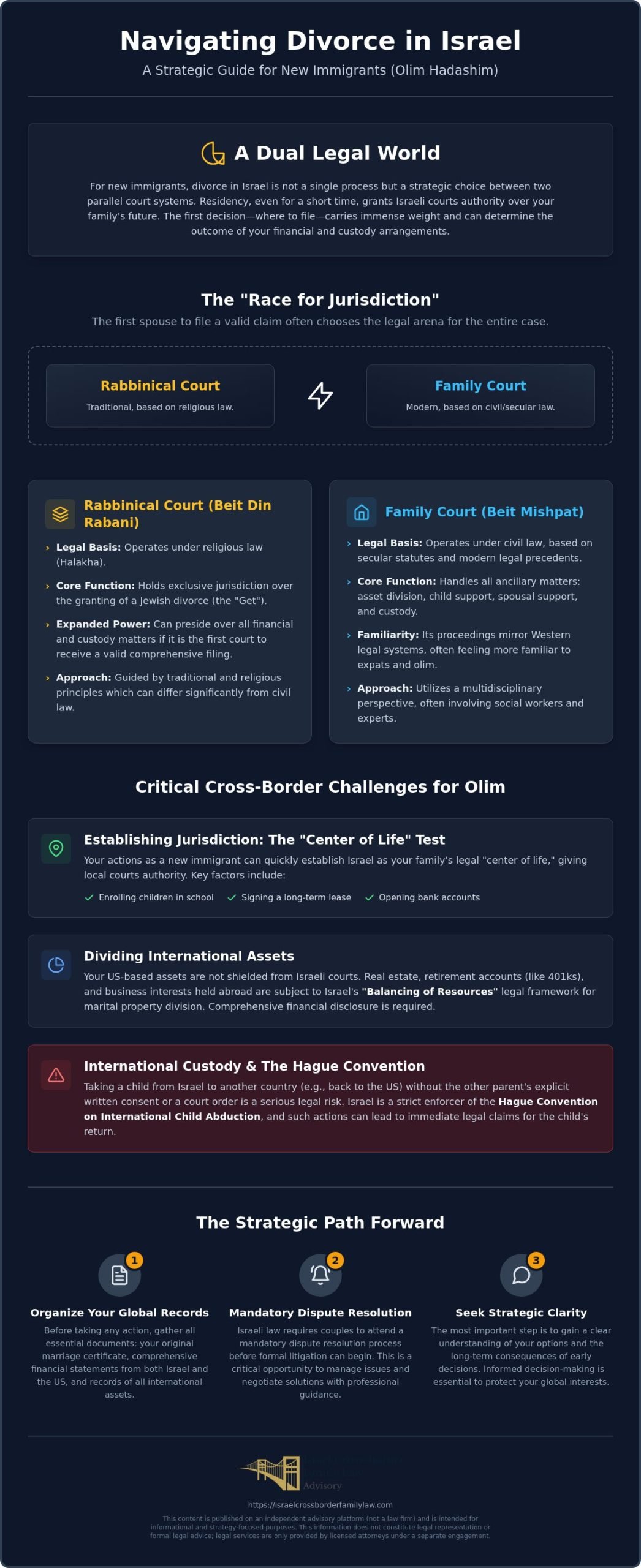
From the earliest stages of a separation, the “Race for Jurisdiction” becomes a primary strategic concern. This is a defining factor in divorce issues for olim hadashim. Because the first person to file can choose between two different court systems, your initial decisions carry immense weight. To protect your interests, start organizing your US-based records immediately. You’ll need your original marriage certificate, comprehensive financial statements, and documentation of any assets held outside of Israel.
To better understand the complexities of the religious divorce process in Israel, watch this helpful video:
The Impact of Aliyah on Your Legal Standing
The Israeli legal system uses the “center of life” test to determine if it has the right to hear your case. This is a foundational concept when managing divorce issues for olim hadashim. As a new immigrant, your actions during your first year in Israel are viewed through this lens. Enrolling children in local schools or signing a long-term lease signals a commitment to the country that courts take seriously. You must exercise caution regarding travel. If you decide to return to the US temporarily during a dispute, don’t do so without a clear legal strategy. Without the other parent’s written consent, taking children abroad can lead to abduction claims under the Hague Convention.
Religious vs. Civil Marriage Considerations
A frequent point of confusion for American expats is the belief that a US civil marriage license keeps them outside the reach of religious courts. In reality, for Jewish couples, the Rabbinical Court has exclusive jurisdiction over the granting of the divorce itself. This applies even if your wedding took place in a courthouse in the United States. The tension between Rabbinical vs. Family Courts means that your religious status is a central part of your legal profile in Israel. For couples of other faiths or mixed-religion backgrounds, the “Dissolution of Marriage” process provides a civil alternative, yet the strategic need to file in the correct venue remains paramount.
The Dual Court System: Rabbinical vs. Family Courts
Israel’s legal framework for ending a marriage is unique; it relies on a parallel system of religious and civil courts. For Jewish couples, this means navigating both the Rabbinical Court (Beit Din Rabani) and the Family Court (Beit Mishpat Le’inyanei Mishpacha). This dual system creates the “Race for Jurisdiction,” a critical strategic element where the court that receives the first valid filing often gains the authority to decide all related matters, including property division and custody. The choice of venue isn’t merely procedural. It fundamentally changes the legal principles applied to your case.
In 2026, the legal landscape shifted slightly with the Religious Courts Arbitration Bill, which allows Rabbinical courts to act as arbitrators in certain civil matters if both parties provide consent. However, the core tension between the two systems remains. Understanding how these courts interact is one of the most vital divorce issues for olim hadashim. Strategic planning is required before any documents are signed or filed.
The Family Court: A Civil Approach
The Family Court operates under civil law. It handles matters like asset division, child support, and custody arrangements based on secular statutes and modern legal precedents. For many expats, this environment feels more familiar because it mirrors Western legal proceedings. The court utilizes a multidisciplinary approach, often involving social workers from the Assistance Unit and court-appointed financial experts to assess the family’s needs. While it feels Western, it’s distinct from US courts in its specific procedural rules and the mandatory nature of its initial dispute resolution meetings.
The Rabbinical Court: Jurisdiction and the Get
The Rabbinical Court holds exclusive authority over the “status” of a Jewish marriage. No civil court in Israel can grant a Jewish divorce; only the Rabbinical Court can oversee the delivery of the “Get,” which is the religious divorce document. This remains a central point in divorce issues for olim hadashim who may not realize that their US civil marriage still requires a religious dissolution in Israel. A significant risk involves “linkage.” This occurs when a spouse files for divorce in the Rabbinical Court and links civil issues like child support or property division to that claim. Once linked, those matters are pulled into the religious system.
There’s a common misconception that the Rabbinical Court is inherently unfavorable to women or universally better for men. In reality, the outcome depends on the specific facts of the case and the cross-border strategy employed. The court applies different rules regarding pre-marital property and marital conduct that can impact financial settlements. You should request a confidential case review to clarify which venue best aligns with your long-term goals before the “race” begins.
Cross-Border Asset Division and Financial Complexity
Financial division in an Israeli divorce follows the principle of Izun Mashabim, or the “Balancing of Resources,” as dictated by the Spouses’ Property Relations Law of 1973. This framework generally mandates an equal 50/50 split of all assets accumulated during the marriage. While pre-marital assets, inheritances, and gifts are typically excluded from this calculation, the court’s reach is global. Israeli judges frequently assert jurisdiction over assets located in the United States, including real estate, bank accounts, and business interests. For many, these cross-border financial entanglements are among the most taxing divorce issues for olim hadashim.
The discovery process in Israel is robust. Courts possess the authority to order the full disclosure of international financial records to ensure an equitable balance. When high-value business interests or complex equity structures are involved, the process often requires the expertise of international forensic accountants. These specialists bridge the gap between divergent accounting standards to provide a clear valuation of transnational holdings. You should prioritize gathering comprehensive records early to avoid the complications of court-ordered discovery. Understanding these cross-border financial strategies is essential before entering the mandatory mediation phase.
Handling US Pensions, 401ks, and IRAs
Dividing US-based retirement accounts presents significant logistical hurdles. US financial institutions typically require a Qualified Domestic Relations Order (QDRO) issued by a US court to split a pension or 401k. An Israeli court order, on its own, is rarely sufficient to compel a US plan administrator to act. To resolve this, many couples utilize an “offsetting” strategy. This involves one spouse retaining the full value of the US retirement account while the other receives a larger share of Israeli assets, such as the family home or liquid savings. This approach simplifies the settlement and avoids the high costs of dual-jurisdiction litigation.
US Tax Implications of Israeli Divorce Settlements
International Custody and the Hague Convention
For many families, the most distressing divorce issues for olim hadashim involve the future and residence of their children. If you’re considering returning to the United States with your children following a marital breakdown, you must understand the Hague Convention on the Civil Aspects of International Child Abduction. Israel is a committed signatory to this treaty. The law is designed to ensure that children are promptly returned to their country of “habitual residence” if they’ve been wrongfully removed. Taking a child out of Israel without the other parent’s formal, written consent can be legally classified as abduction. This is true even if you’re the primary caregiver or believe the move is a return to a more stable environment.
The concept of habitual residence is the pivot point in these cases. Israeli courts examine where the child has established the center of their life. For new immigrants, this status often triggers faster than parents realize. Enrolling a child in a local school, establishing a medical routine, and the simple passage of several months can shift the child’s legal residence from the US to Israel. Once this shift occurs, the Israeli court gains exclusive jurisdiction over custody matters. You can find a detailed analysis of these risks in our guide to international custody and relocation.
Parenting Plans for International Families
Designing a functional long-distance parenting plan requires a strategic approach that accounts for the geographic reality of a US-Israel split. If one parent intends to return to the US, they must file a relocation claim, known in Israel as Hagira. The burden of proof for these claims is exceptionally high. The court’s sole focus is the best interests of the child, not the parent’s desire to return to their country of origin. To prevent a child from being removed while a case is pending, courts often issue a “stay-of-exit” order, or Tsav Ikur Yetzia Min Ha’aretz. These orders are common in cross-border disputes and effectively ground the child in Israel until a final decision is reached.
Enforcing Support Orders Across Borders
Financial support is another area where international treaties and the Israeli Central Authority play a vital role. You can enforce US child support in Israel through the Attorney General’s Office, which manages these claims under reciprocal enforcement agreements. While the legal framework exists to bridge the gap between US and Israeli orders, practical challenges remain. Collecting payments from a parent who has left Israel requires coordinated legal effort between jurisdictions. If you’re facing these challenges, it’s advisable to reach out for a strategic consultation to understand your enforcement options and protect your family’s financial stability.
Strategic Steps: The Mandatory Dispute Resolution Process
In Israel, the path to divorce begins with a mandatory procedural step designed to encourage mediation over litigation. Under the Law for the Settlement of Disputes in Family Matters, couples are required to attend a series of meetings at the Assistance Unit, known as Yechidat Hasiyuah. These sessions, often called “Mahut” meetings, serve as a gateway to the legal system. One of the most critical divorce issues for olim hadashim is understanding that the “Race for Jurisdiction” is temporarily frozen once the initial application for dispute resolution is filed. This creates a 45-day “cooling off” period, which can be extended to 60 days, during which neither spouse can file active lawsuits regarding child support, custody, or the division of assets.
While the meetings are confidential and intended to be therapeutic, they carry significant strategic weight. The decisions you make during this period will set the tone for your entire case. As an independent advisory platform, we emphasize a “Clarity Before Commitment” philosophy. You shouldn’t sign any agreements or make formal concessions during these meetings without first obtaining independent cross-border advice. The goal of the Assistance Unit is to reach a settlement, but that settlement must account for your international interests, including US-based pensions and property.
What to Expect at the Assistance Unit (Yechidat Hasiyuah)
The sessions are led by social workers rather than judges or lawyers. Their role is to assess whether the couple can reach a consensual agreement through mediation or if the case must proceed to court. For many Anglos, the language barrier can be a significant hurdle. You have the right to request an English-speaking social worker or bring a qualified translator to ensure you fully understand the nuances of the conversation. It’s vital to distinguish between the “therapeutic” approach of the unit and the “legal” reality of your situation. The social worker’s focus is on conflict reduction, but they aren’t there to protect your specific legal rights or analyze cross-border tax implications.
Preparing Your Cross-Border Strategy
Success in the Israeli system requires preparation long before you step into the Assistance Unit. You should consult a cross-border family lawyer to build a comprehensive strategy before your first Mahut meeting. This preparation allows you to identify “emergency” issues that might allow you to bypass the mandatory waiting period, such as a high risk of international child abduction or the immediate concealment of assets. Without a clear plan, you risk entering the mediation phase at a disadvantage. Each decision made during this initial stage has long-term consequences for your financial and parental future. Get clarity before you commit. Request a confidential case review to understand how these 2026 regulations apply to your specific family and assets.
Securing Your Future Through Strategic Cross-Border Planning
Navigating the end of a marriage while building a new life in Israel requires a measured, strategic approach that acknowledges the significant differences between Western and Israeli legal cultures. As we’ve explored, the weight of early decisions, from the initial choice of filing venue to the comprehensive organization of international financial records, cannot be overstated. By prioritizing strategic planning before entering the mandatory dispute resolution phase, you can better protect your global interests and ensure a more stable transition for your family.
This content is published on an independent advisory platform (not a law firm) and is designed for informational and strategy-focused guidance. It’s important to understand that this does not constitute legal representation; legal services are only provided by licensed attorneys under a separate engagement. Our role is to act as a bridge between legal systems, helping you address the unique divorce issues for olim hadashim with confidence and foresight. Get clarity before you commit. Request a confidential consultation.
Frequently Asked Questions
Can I divorce in the US if I am currently living in Israel as an Oleh?
You may be able to file in the US, but it depends on the residency requirements of your specific state. If you’ve established Israel as your “center of life,” an Israeli court might claim jurisdiction over your family matters first. This is a common point of confusion among divorce issues for olim hadashim because filing in the US while living abroad requires precise timing to avoid conflicting court orders. You should assess your residency status in both countries before taking any formal action.
What is the ‘Race for Jurisdiction’ and why does it matter for Olim?
The “Race for Jurisdiction” refers to the strategic advantage gained by the spouse who files first in either the Rabbinical or Family Court. This matters because the court that receives the first valid claim often decides all “linked” issues, such as property division and support. For Olim, this choice is vital. Each court system applies different legal standards to international assets and marital conduct, which can significantly alter the final outcome of your settlement.
Does Israel recognize my US prenuptial agreement?
Israeli courts generally recognize foreign prenuptial agreements, but they must be validated to be fully enforceable. If your agreement wasn’t signed before a notary or a court in a way that satisfies Israeli legal standards, its validity could be challenged during a dispute. You should have your US agreement reviewed by a professional who understands the Spouses’ Property Relations Law to ensure it provides the protection you expect within the Israeli system.
How is child support (Mezonot) calculated in Israel compared to the US?
Unlike the formulaic “income shares” models used in many US states, Israeli child support is based on the specific needs of the child and the religious obligations of the parents. While 2026 legal trends show a move toward more equitable cost-sharing in joint custody cases, the calculation remains distinct from US child support tables. It’s essential to understand these differences early, as Israeli orders can be enforced internationally through reciprocal treaties.
Can I take my children back to the US for a visit during the divorce process?
You cannot take children out of Israel without the other parent’s written consent or a specific court order while a divorce is pending. If a “stay-of-exit” order is in place, border police will prevent the children from leaving the country. Attempting to leave without proper authorization can lead to a Hague Convention abduction claim. It’s always best to secure a formal travel agreement before booking any international flights.
What happens if my spouse refuses to give me a ‘Get’?
If a spouse refuses to grant a religious divorce, the Rabbinical Court has the authority to impose various sanctions. These can include financial penalties, the revocation of a driver’s license, or even imprisonment in extreme cases of refusal. Because the Rabbinate has exclusive power over the status of a Jewish marriage, navigating this process requires a specific strategy to ensure the “Get” is delivered and the marriage is legally dissolved.
Are my US-based assets like a 401k safe from division in an Israeli divorce?
US-based assets are generally not exempt from division if you’re an Israeli resident. Israeli law follows the “Balancing of Resources” principle, which views your global financial portfolio as a single entity. While an Israeli court can’t directly compel a US bank to split a 401k, it can offset the value of those US assets by awarding your spouse a larger share of your Israeli holdings, such as real estate or liquid savings.
Do I need a lawyer who is licensed in both Israel and the US?
While not a strict requirement, working with practitioners who understand both legal systems is a significant advantage. This dual perspective ensures that your Israeli settlement doesn’t trigger unintended US tax liabilities or violate US pension laws. Managing the multi-jurisdictional complexity of your case requires an advisory approach that acts as a bridge between the two systems, protecting your interests in both Israel and the United States.

Article by
Gabriel Lior
A Personal Journey That Became a Mission
The advisory was founded by an American father Gabriel Lior, LLB, MBA , global entrepreneur, and cross-border advisor who spent more than a decade navigating the Israeli family court system firsthand and now lives in Singapore with his son.
As a divorced parent in a cross-border family, Gabriel faced nearly every legal challenge a foreign parent can encounter in Israel — including child custody disputes, child support proceedings, property matters in Israel and abroad, false accusations, and complex immigration and relocation proceedings.
Over the years, he learned the hard way how difficult it is for non-Israeli parents to understand the system, identify the right legal strategy, and choose the right legal representation — especially when language, culture, and jurisdictional differences are involved. He also witnessed how foreign parents and new immigrants are often disadvantaged or taken advantage of by service providers and institutions simply because they lack local knowledge or fluency.
From Client to Advisor
To truly understand — and survive — the system, Gabriel pursued formal legal education in Israel, completing two Israeli law degrees, alongside a BA and MBA earned in the United States. This was never about becoming a practicing attorney, but about gaining a deep, structural understanding of how the system works — and where it breaks down for foreign parents.
This rare combination of:
Firsthand client experience
Israeli legal and US business education
International business and negotiation training
Decades of commercial execution
created a unique perspective – one that understands both sides of the table.
After years of litigation, persistence, and at times self-representation, he ultimately succeeded in securing custody of his son and relocating abroad through a rare legal victory in the Israeli Supreme Court — becoming one of the first fathers in Israel to do so under these circumstances.
Disclaimer
Important Disclaimer:
The information provided on this website and in its content is for general informational and educational purposes only and does not constitute legal advice, legal opinion, or legal representation.
Gabriel Lior is not licensed to practice law in Israel (nor is he interested in doing so) and does not provide legal services, despite having completed 2 Law Degrees. The services offered are advisory in nature and are intended to provide general guidance, strategic insight, and information regarding cross-border family law considerations.
No attorney-client relationship is formed by accessing this website, reading its content, or communicating with us.
Any decisions made based on this information are at your own discretion and risk. For legal advice specific to your situation, you should consult a licensed attorney in the relevant jurisdiction.
Where appropriate, we may refer clients to independent, licensed attorneys or professionals. Such referrals do not constitute legal representation and no liability is assumed for services provided by third parties.