Could a standard one-year professional sabbatical or an extended family visit inadvertently trigger a multi-year legal battle over your child’s habitual residence? Many parents operate under the misconception that labeling a move as “temporary” in a private conversation or email is sufficient to protect their status, but international courts prioritize objective evidence of a “Center of Life” over subjective intent. Understanding the legal nuances of Temporary vs Permanent Relocation is not merely a matter of logistics; it’s a vital exercise in proactive risk mitigation for families moving between Israel and the United States.
You likely feel that your intentions are clear, yet the fear of being accused of international child abduction or losing the protection of your home court is a heavy burden to carry. We will provide a comprehensive analysis of the legal definitions and documentation strategies required to navigate these complex cross-border transitions safely. This guide details how to avoid an unintended jurisdictional shift, how to utilize “mirror orders” to ensure enforceability, and what specific evidence Israeli Family Courts demand to prove that a child’s roots remain firmly planted in their home country despite a period spent abroad.
Key Takeaways
- Understand the fundamental legal distinctions between Temporary vs Permanent Relocation to ensure a planned stay does not inadvertently shift your child’s habitual residence.
- Gain clarity on the “Merkaz HaChayim” (Center of Life) test used by Israeli courts and how it interfaces with the US legal framework for jurisdiction.
- Learn the specific steps to document a temporary move safely, including the drafting of formal Travel and Relocation Agreements that are recognized across borders.
- Identify the risks associated with the Hague Convention, specifically how to avoid claims of wrongful retention when a return date is delayed.
- Discover why the initial 90-day period of any international move is the most critical window for protecting your parental rights and court access.
Defining Temporary vs. Permanent Relocation in International Family Law
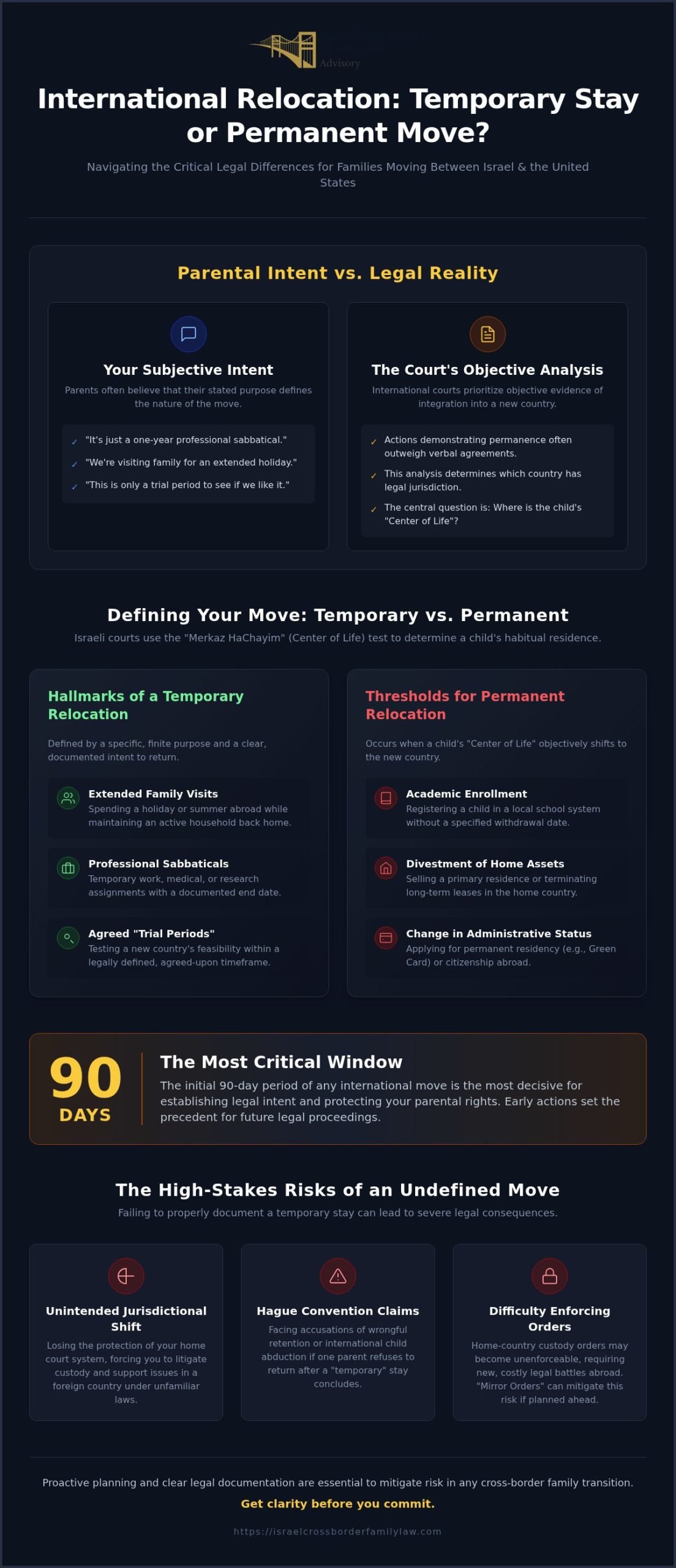
The legal distinction between Temporary vs Permanent Relocation serves as the primary jurisdictional anchor in cross-border family law. While a parent might view a six-month stay in the United States as a mere sabbatical, an Israeli court may interpret the same period as a fundamental shift in the child’s “Merkaz HaChayim” or Center of Life. This classification is vital because it dictates which nation’s legal system retains the authority to issue orders regarding custody, visitation, and child support. When parents don’t align on these definitions, a simple trip can quickly escalate into a high-stakes jurisdictional battle.
Courts analyze two distinct layers of evidence when determining the nature of a move: the subjective intent of the parents at the time of departure and the objective facts established during the stay. If a move is deemed permanent, the child’s habitual residence changes, potentially triggering complex litigation under the framework of International Child Abduction protocols if one parent eventually demands a return to Israel. Maintaining clarity during the transition is the only way to ensure that your parental rights remain protected in your preferred jurisdiction.
To better understand the logistical and legal considerations involved in moving abroad, watch this helpful video:
Common Scenarios for Temporary Relocation
Temporary relocation is typically defined by a specific, finite purpose and a verifiable intent to return to the home jurisdiction. These arrangements are common among the expat community and often include:
- Extended family visits: Spending a summer or a holiday season with relatives in the US while maintaining an active household in Israel.
- Professional sabbaticals: Temporary work assignments, medical treatments, or research projects that have a documented end date and a guaranteed return to a local position.
- Trial periods: Agreed-upon windows where parents test the feasibility of living in a new country before making a final commitment to international custody relocation.
These scenarios require precise documentation to prove that the stay was never intended to be an indefinite departure from the child’s original home. Without a clear exit strategy, what began as a temporary arrangement can be used as evidence of a permanent move in future litigation.
The Threshold for Permanent Relocation
A move transitions from temporary to permanent when the child’s objective “Center of Life” shifts to the new jurisdiction. Israeli and US courts look for specific markers that indicate a long-term integration into the new society, often overriding the parents’ initial verbal agreements.
- Academic enrollment: Registering a child in a local school system with no specified withdrawal date or intent to re-enroll in their Israeli school.
- Divestment of local assets: Selling a primary residence in Israel or terminating long-term lease agreements, which suggests the abandonment of the previous habitual residence.
- Administrative status: Applying for permanent residency (Green Cards) or citizenship, which provides a clear legal signal of an intent to remain indefinitely.
Once these thresholds are crossed, reclaiming jurisdiction in Israel becomes significantly more difficult. Even if the original move was labeled as “temporary” in private correspondence, the objective reality of the child’s new life often carries more weight in the eyes of the court.
The ‘Center of Life’ Test: How Israeli and US Courts Distinguish Intent
Distinguishing between Temporary vs Permanent Relocation requires more than a simple review of a parent’s stated goals; it demands an analysis of where a child’s life has actually taken root. Center of Life is the sum of a child’s social, educational, and familial ties. While you might view a stay in the United States as a transient phase, the legal reality often hinges on objective markers of stability. Under the Israeli Law on Child Abduction, the courts prioritize the “Merkaz HaChayim” (Center of Life) standard to determine if they should retain jurisdiction or defer to a foreign court.
The United States legal system approaches this through the lens of “Habitual Residence” under the Hague Convention framework. While the terminology differs, both systems investigate whether a move intended as temporary has legally ripened into a permanent change. This transition occurs when a child becomes “settled” in the new environment, a status that can be achieved in as little as six months depending on the depth of their local integration. If a child’s daily routine, healthcare, and social circle are fully established in a new country, a parent’s original “intent” to return may lose its legal weight.
Factors That Shift the Center of Life
Courts do not rely on verbal promises; they examine the tangible connections a family maintains or severs. The shift from a temporary stay to a permanent relocation is often evidenced by:
- Duration and Consistency: A stay exceeding one year without regular, documented return trips to Israel often signals a shift in residency.
- Community Integration: Enrollment in long-term extracurricular activities, local religious affiliations, and the child’s fluency in the local language.
- Economic Footprint: Whether parents have secured long-term employment contracts or opened local bank accounts, suggesting a financial commitment to the new jurisdiction.
Jurisdictional ‘Tug-of-War’ Between Israel and the US
The tension between Israeli and US courts often stems from how each system defines the “best interests of the child” in a relocation context. Israeli Family Courts and Rabbinical Courts may maintain a strong “home-court” bias, viewing any extended absence as a threat to the child’s connection to their heritage. Conversely, US state courts, operating under the UCCJEA, may claim jurisdiction simply because the child has resided in that state for six months.
This discrepancy creates a risk of “forum shopping,” where one parent attempts to litigate in the country they believe will offer a more favorable outcome. Strategic early intervention is vital to prevent a foreign court from assuming jurisdiction over a move that was meant to be fleeting. If you are concerned about how your current living arrangement might be perceived by the court, it’s wise to discuss your specific circumstances with a practitioner licensed in both systems.
When Temporary Becomes Permanent: The Risks of International Child Abduction
The legal boundary between Temporary vs Permanent Relocation is often crossed not through a sudden decision, but through the passage of time and the erosion of documented boundaries. Wrongful retention occurs when a child is kept in a foreign country past the specific date or event agreed upon by both parents. It’s a sobering reality that a parent can be accused of international child abduction even if they initially departed with the full, written consent of the other party. The Hague Convention on the Civil Aspects of International Child Abduction is the primary legal instrument governing these disputes, designed to return children to their habitual residence so that custody matters can be decided by the proper authorities.
In these high-stakes proceedings, the documented intent established at the start of the trip serves as the primary line of defense. Courts look for clear evidence that the move was never meant to be permanent. If you’re navigating a situation where a return is being contested, the strength of your initial agreement will likely determine the outcome. Proactive measures are the only way to ensure a visit doesn’t escalate into a federal legal crisis.
The Danger of Verbal Agreements
Relying on informal “he said, she said” arrangements regarding a return date is a frequent catalyst for legal disaster. In the absence of a formal contract, courts are forced to interpret vague text messages or conflicting recollections, which rarely provides the security a parent needs. A significant risk in these scenarios is the legal concept of “acquiescence,” where a court may interpret a parent’s silence or a lack of immediate protest as an implied agreement to a permanent change in residency. Understanding the nuances of the Hague Convention and Child Abduction is essential to preventing a temporary visit from being recharacterized as a permanent move by a foreign court.
Defending Against Abduction Allegations
To successfully defend against an allegation of wrongful retention, a parent must present a trail of objective evidence that supports the temporary nature of the stay. This includes maintaining an active lease or mortgage in the home country, keeping utility accounts open, and purchasing round-trip airfare before departure. These actions demonstrate a clear lack of intent to abandon the original habitual residence. Maintaining professional ties or a leave of absence from an Israeli employer can also serve as powerful evidence of an intent to return.
Strategic parents often utilize “mirror orders,” which are court orders issued in the second country that reflect the terms of the original custody agreement. This ensures that the return conditions are enforceable in both jurisdictions. Seeking a formal advisory opinion or a court-approved travel plan before the return date expires can also mitigate the risk of being blindsided by an abduction claim. Managing the complexities of Temporary vs Permanent Relocation requires a rigorous approach to documentation that leaves no room for judicial interpretation.
Securing Legal Consent: Steps for Parents Moving Between the US and Israel
Securing the legal right to move requires a rigorous, multi-layered approach to documentation that leaves no room for judicial interpretation. A formal Travel and Relocation Agreement acts as the primary evidence of your intent, clearly differentiating between Temporary vs Permanent Relocation. This document should detail the specific purpose of the move, such as a one-year professional contract or a finite educational program, to serve as a baseline for future jurisdictional arguments. Without this paper trail, you’re vulnerable to the “Center of Life” shift discussed in previous sections.
Once you’ve drafted the agreement, you must obtain a court-approved Consent Order in your current country of residence. This order transforms a private contract into an enforceable judicial decree that both Israeli and US courts are bound to respect. Including a “Choice of Law” clause is essential; it ensures that the home court retains jurisdiction over the child regardless of where they physically reside during the stay. You must verify that the agreement is legally enforceable in both the US and Israel before the child boards the plane.
What to Include in a Temporary Relocation Agreement
A comprehensive agreement must go beyond a simple return date. It needs to address the logistical realities of the child’s life abroad to prove the move isn’t a permanent abandonment of their home country. Ensure your document includes:
- Specific Milestones: Clearly defined dates for departure and return, tied to the specific purpose of the move.
- Visitation Protocols: A detailed schedule for the non-relocating parent, including physical visits and digital communication.
- Financial Logistics: Explicit arrangements for travel costs, housing expenses, and child support adjustments during the temporary period.
The Role of Mirror Orders
Filing your agreement in one country is rarely sufficient to protect your rights in a cross-border context. Mirror orders are court orders issued in the second country that reflect the exact terms of the original custody agreement. These orders prevent a parent from using a new jurisdiction to change custody or visitation terms once the child is physically present in that state. By securing these orders, you create a legal “bridge” that ensures enforceability across both legal systems. This is a critical step in managing International Custody and Relocation without risking a jurisdictional “tug-of-war.”
The first 90 days of an international move are often the most legally sensitive period for establishing or maintaining jurisdiction. If you’re currently preparing for a transition, you should consult with a practitioner who understands the specific filing requirements in both the Israeli and US court systems.
Navigating Relocation Disputes with Cross-Border Expertise
Managing the transition of a family between the United States and Israel demands a sophisticated understanding of two vastly different legal cultures and regulatory frameworks. Success in these high-stakes matters relies on technical proficiency in transnational litigation and a proactive approach to jurisdictional defense. The distinction between Temporary vs Permanent Relocation isn’t merely a point of discussion for parents; it’s a legal boundary that requires constant monitoring by practitioners who understand the nuances of both the Israeli Family Court system and US state laws. Our firm serves as a strategic bridge, employing multi-qualified practitioners licensed to practice in multiple jurisdictions to ensure that your parental rights are protected on both sides of the ocean.
The first 90 days of any international move represent the most critical window for maintaining legal control over your child’s habitual residence. During this timeframe, the child’s “Center of Life” hasn’t yet fully shifted, and the original court’s authority remains at its most robust. We prioritize strategy over emotion, helping families navigate the multi-jurisdictional complexity of relocation without falling into the common traps of “forum shopping” or unintended acquiescence. By establishing a clear legal roadmap before the child ever boards a plane, we mitigate the risk of a visit being recharacterized as a permanent move by a foreign court.
Clarity Before Commitment
Assessment of risk is essential before any physical move occurs, as the consequences of a misstep in international family law can be permanent. Whether you’re considering a professional sabbatical from Tel Aviv to New York or a family-related move from Jerusalem to Los Angeles, you must assess how local courts will view your departure. A confidential case review allows you to map out your legal standing and identify potential vulnerabilities in your current travel plans. Understanding the specific standards for Temporary vs Permanent Relocation in your target city is the only way to prevent a jurisdictional “tug-of-war” that could last for years.
Get Clarity Before You Commit
Our structured advisory approach prioritizes long-term stability and commercial awareness, providing families with the strategic direction needed to navigate international family law with confidence. We emphasize the value of collaborative planning, working seamlessly with your existing local professional teams to achieve your objectives. For those seeking additional visual guides and expert commentary on these complex topics, we recommend visiting our YouTube channel for detailed breakdowns of cross-border legal scenarios. To secure your future and protect your child’s jurisdictional status, get clarity before you commit. Request a confidential consultation.
Securing Your Family’s Global Future
Navigating the intricate landscape of international family law requires a shift from emotional decision-making to rigorous legal strategy. You’ve learned that the distinction between Temporary vs Permanent Relocation is defined by the child’s objective “Center of Life” and the documented intent established before departure. Relying on verbal agreements or informal arrangements creates unnecessary exposure to Hague Convention disputes and jurisdictional shifts that can take years to resolve. By prioritizing formal Consent Orders and mirror orders, you ensure that your parental rights remain protected in both the Israeli and United States legal systems.
Our firm provides specialized US-Israel cross-border expertise to families facing these multi-jurisdictional complexities. We focus on proactive risk mitigation and strategic planning for expats, drawing on decades of experience with the Hague Convention and high-stakes relocation litigation. You don’t have to navigate these challenging landscapes alone; our practitioners serve as a steady guide to help you achieve long-term stability for your children. Get clarity before you commit. Request a confidential consultation. Your family’s security depends on the steps you take today, and we’re here to ensure your transition is legally sound and strategically optimized.
Frequently Asked Questions
Can a temporary move to the US become permanent without my consent?
Yes, a move initially agreed upon as temporary can legally transition into a permanent relocation if the child’s objective habitual residence shifts. US courts often apply a six-month residency threshold under the UCCJEA to assume jurisdiction. If the child is integrated into a local school and social circle without a documented return plan, a court may determine that the original intent has been superseded by the current reality of the child’s life.
What happens if I refuse to return to Israel after a temporary relocation?
Refusing to return to Israel after an agreed-upon stay constitutes “wrongful retention” under the Hague Convention. This action can trigger immediate legal proceedings in the foreign court to secure the child’s return to their habitual residence. In the US, such retention can also lead to federal charges under the International Parental Kidnapping Crime Act, carrying penalties of up to three years in prison and significant financial fines.
Do I need a lawyer for a 6-month trial relocation with my child?
Consulting a specialized practitioner is essential even for trial periods to prevent unintended jurisdictional shifts. A lawyer ensures that the distinction between Temporary vs Permanent Relocation is clearly documented in a court-approved Consent Order. Without professional guidance, a six-month trial can inadvertently establish a new habitual residence, making it difficult to return the child to Israel if the trial period proves unsuccessful for the family.
Is a notarized letter enough to prove a move is temporary?
A notarized letter is insufficient on its own because it lacks the enforceability of a court-approved Consent Order. While it provides some evidence of intent, international courts prioritize the child’s objective “Center of Life” over private documents. To protect your rights, you must secure a formal agreement that is filed and recognized by the Family Court in Israel or the relevant state court in the US.
How do Israeli courts define the ‘Center of Life’ for a child?
Israeli courts define “Merkaz HaChayim” (Center of Life) as the location where the child’s social, educational, and familial ties are most concentrated. They examine objective factors like school attendance, healthcare providers, and the frequency of contact with extended family. If these connections are stronger in a new country than in Israel, the court may conclude that the child’s habitual residence has permanently changed despite any previous verbal agreements.
Can my spouse use the Hague Convention to force me back to the US?
The Hague Convention can be utilized by your spouse if you wrongfully remove or retain the child away from their habitual residence in the US. If the US courts have already established jurisdiction, they can demand the child’s prompt return to ensure custody matters are decided in the proper forum. This process is highly structured and requires immediate legal intervention to address the specific defenses allowed under the Convention.
What is a mirror order and why is it necessary for international moves?
A mirror order is a judicial decree issued in a second country that reflects the exact terms of an original custody or relocation order. It is necessary because a court in the US may not automatically enforce an Israeli order without local confirmation. By securing a mirror order, you ensure that the return dates and visitation schedules are legally binding and enforceable in both jurisdictions, providing a critical layer of security.
How long does it take for a child’s habitual residence to change?
Habitual residence can change in as little as six months, though courts may recognize a shift sooner if the integration is exceptionally deep. The timeframe depends on when the child becomes “settled” in the new environment. Factors like enrolling in a long-term academic program or the parents selling their primary residence in the home country can accelerate the legal recognition of a shift from Temporary vs Permanent Relocation.

Article by
Gabriel Lior
A Personal Journey That Became a Mission
The advisory was founded by an American father Gabriel Lior, LLB, MBA , global entrepreneur, and cross-border advisor who spent more than a decade navigating the Israeli family court system firsthand and now lives in Singapore with his son.
As a divorced parent in a cross-border family, Gabriel faced nearly every legal challenge a foreign parent can encounter in Israel — including child custody disputes, child support proceedings, property matters in Israel and abroad, false accusations, and complex immigration and relocation proceedings.
Over the years, he learned the hard way how difficult it is for non-Israeli parents to understand the system, identify the right legal strategy, and choose the right legal representation — especially when language, culture, and jurisdictional differences are involved. He also witnessed how foreign parents and new immigrants are often disadvantaged or taken advantage of by service providers and institutions simply because they lack local knowledge or fluency.
From Client to Advisor
To truly understand — and survive — the system, Gabriel pursued formal legal education in Israel, completing two Israeli law degrees, alongside a BA and MBA earned in the United States. This was never about becoming a practicing attorney, but about gaining a deep, structural understanding of how the system works — and where it breaks down for foreign parents.
This rare combination of:
Firsthand client experience
Israeli legal and US business education
International business and negotiation training
Decades of commercial execution
created a unique perspective – one that understands both sides of the table.
After years of litigation, persistence, and at times self-representation, he ultimately succeeded in securing custody of his son and relocating abroad through a rare legal victory in the Israeli Supreme Court — becoming one of the first fathers in Israel to do so under these circumstances.
Disclaimer
Important Disclaimer:
The information provided on this website and in its content is for general informational and educational purposes only and does not constitute legal advice, legal opinion, or legal representation.
Gabriel Lior is not licensed to practice law in Israel (nor is he interested in doing so) and does not provide legal services, despite having completed 2 Law Degrees. The services offered are advisory in nature and are intended to provide general guidance, strategic insight, and information regarding cross-border family law considerations.
No attorney-client relationship is formed by accessing this website, reading its content, or communicating with us.
Any decisions made based on this information are at your own discretion and risk. For legal advice specific to your situation, you should consult a licensed attorney in the relevant jurisdiction.
Where appropriate, we may refer clients to independent, licensed attorneys or professionals. Such referrals do not constitute legal representation and no liability is assumed for services provided by third parties.