Most international families believe that because they weren’t married in Israel or don’t hold local citizenship, the religious legal system has no authority over their personal affairs. This assumption can be a costly mistake. In reality, navigating the rabbinical court as a foreigner is a common necessity for many people residing in the country, as the court’s jurisdiction often extends to any Jewish resident regardless of their passport. It’s understandable to feel overwhelmed by a system that seems rooted in a different era, especially when your financial future and parental rights are at stake.
This article provides a strategic roadmap to help you understand how these religious tribunals function alongside civil family courts. You’ll learn how to manage the critical “race for jurisdiction” and gain clarity on whether you’re legally required to appear. We also examine the impact of the March 2026 law that expanded the court’s power to include civil arbitration with the consent of both parties. By the end of this guide, you’ll have a clear strategy for protecting your interests while managing the complexities of the Gett process and the dual legal system.
Key Takeaways
- Understand that the Rabbinical Court’s jurisdiction often extends to foreign residents and those with minimal ties to Israel, regardless of where they were married.
- Learn how the “jurisdictional race” works and why the timing of your filing determines which court system manages your property and custody rights.
- Discover the strategic steps for navigating the rabbinical court as a foreigner, including how the religious “Gett” process affects those with civil marriages.
- Identify the practical challenges of Hebrew-language hearings and service of process for defendants currently living outside of Israel.
- Gain a framework for evaluating the financial risks and cross-border implications of filing in the religious system versus the civil Family Court.
Understanding the Authority of the Rabbinical Court in Israel
For many expats, the first encounter with the Israeli legal system is a surprise. The Rabbinical Court, or Beth Din (rabbinical court), isn’t just a religious body for the ultra-orthodox. It’s a formal state institution. It holds exclusive legal authority over the marriage and divorce of all Jewish residents in the country. This means that even if you never stepped foot in a synagogue, the state recognizes the Rabbinical Court as the only venue for ending a Jewish marriage. Understanding this distinction is the first step for any foreigner facing family law issues in Israel.
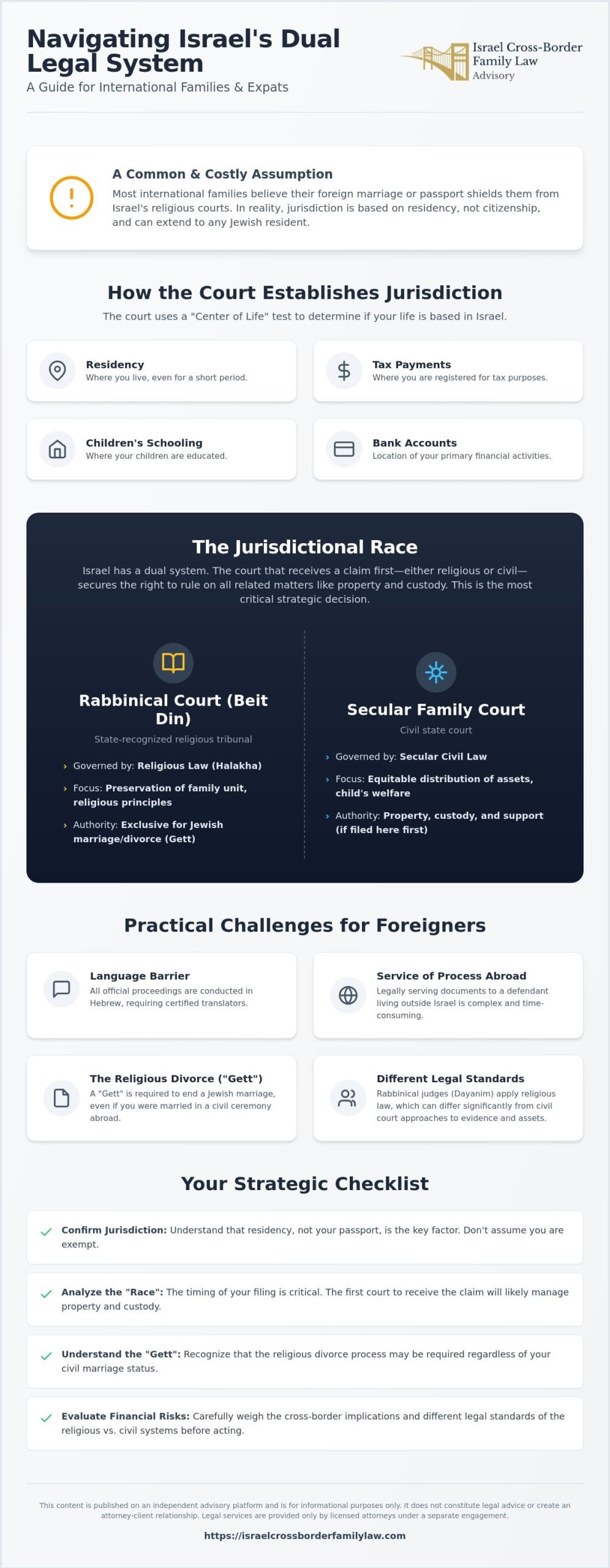
Navigating the rabbinical court as a foreigner requires understanding that your passport isn’t a shield. Jurisdiction is frequently based on residency or the “Center of Life” test. This test examines where your daily activities occur. Judges look at where you pay taxes, where your children attend school, and where your primary bank accounts are located. If these factors point to Israel, the court may claim authority over your personal status. For international families, this creates an intricate legal framework where religious laws and civil rights often intersect.
To better understand this concept, watch this helpful video:
How the Court Establishes Jurisdiction Over Foreigners
A common misconception is that a civil marriage performed abroad prevents the Rabbinical Court from intervening. This is incorrect. If both parties are Jewish, the court maintains jurisdiction over the divorce itself. A 2005 amendment further expanded this reach. It allows the court to hear cases involving Jews who don’t live in Israel if certain conditions are met, such as one spouse being a resident or the couple having lived in Israel previously. Even a short period of residency can sometimes trigger this jurisdiction. You can learn more about how this applies specifically to expats and foreign nationals through our advisory resources. Seeking clarity before filing any documents is essential to avoid unintended jurisdictional traps.
The Role of the Dayanim (Rabbinical Judges)
Cases are heard by a panel of three Dayanim, or rabbinical judges. Unlike civil judges who follow the secular Code of Civil Procedure, Dayanim operate under religious law. They are highly trained experts in Halakha. Their approach to evidence and testimony differs from the secular Family Court. When navigating the rabbinical court as a foreigner, it’s vital to recognize that the panel’s focus is often on the preservation of the family unit under religious principles. While civil courts prioritize equitable distribution of assets, the Rabbinical Court’s view on international prenuptial agreements depends on whether the document meets specific religious requirements. These procedural nuances can significantly impact the outcome of a cross-border case.
The ‘Jurisdictional Race’: Rabbinical Court vs. Family Court
In Israel, the legal system operates under a unique “dual jurisdiction” model. While the Rabbinical Court handles the divorce decree itself, matters like asset division and child support can be heard in either the religious court or the secular Family Court. This creates what professionals call the “jurisdictional race.” The court that receives a formal claim first generally secures the right to rule on all ancillary issues. For those navigating the rabbinical court as a foreigner, this race is often the most critical phase of the entire process. You can view the structure of these institutions on the Official Rabbinical Courts Portal.
The concept of “binding” is central to this race. If a spouse files for divorce in the Rabbinical Court, they can legally attach property and custody claims to that file. Once these issues are bound to the religious claim, the secular Family Court is usually barred from hearing them. This choice isn’t just about venue; it’s about which set of legal principles will govern your future. The Rabbinical Court applies religious law, while the Family Court applies secular civil law, leading to potentially different outcomes for the same case.
Strategic Advantages and Risks for Foreign Nationals
Foreign nationals often hold complex assets like US-based 401ks, IRAs, or property in multiple countries. The Rabbinical Court may handle these differently than a secular judge. For instance, religious judges might not always apply the same actuarial valuations to foreign pensions that a secular court would. Additionally, the Rabbinical Court still considers “fault” in certain contexts. If a spouse is found to be at fault for the breakdown of the marriage, it could impact their right to the Ketubah (marriage contract) payment or spousal support. International relocation is another area of divergence. While the secular court focuses on the “best interests of the child” through a modern psychological lens, the Rabbinical Court may place a different weight on the father’s rights or traditional family structures.
The Weight of Early Decisions
Many expats make the mistake of filing a preliminary document “just to see” how the system works. In Israel, this is a dangerous gamble. An early filing can create a permanent jurisdictional trap that you cannot easily undo. Once the Rabbinical Court has established its authority over your property, moving the case back to the Family Court is exceptionally difficult. This is why a strategic assessment is vital before any papers are served. You should understand the financial and custodial implications of each court before making a move. If you are unsure where your case stands, it may be helpful to speak with an advisor about your specific situation.
The complexity of cross-border issues means there is no “one-size-fits-all” answer. Every asset, every child, and every residency status changes the calculation. You can request a Confidential Case Review to evaluate which forum aligns best with your long-term goals.
The Divorce Process (Gett) for Foreign Nationals
The “Gett” is the formal religious document that terminates a Jewish marriage. In Israel, this is not just a religious ritual; it is a legal requirement for the state to recognize you as single. For those navigating the rabbinical court as a foreigner, the process can feel alien, especially if your marriage originally took place in a civil ceremony in the United States or Europe. The Rabbinical Court views the religious status of Jewish couples as its primary concern, regardless of where the wedding license was issued. This content is published on an independent advisory platform, not a law firm, and is intended for informational purposes regarding strategy and risk management.
The Israel Family Law Guide details how these proceedings apply to international residents. While a civil divorce from your home country might dissolve the legal contract in that jurisdiction, it does not satisfy the requirements of the Israeli state for Jewish residents. Without a Gett, you remain legally married in Israel, which prevents remarriage and can complicate your future legal status. It’s a critical step that requires careful planning to ensure your rights are protected throughout the transition.
Step-by-Step Breakdown of the Gett Ceremony
The process begins with a “Clarification of Names” to ensure the document is perfectly accurate. The court must verify the Jewish status of both parties and the validity of the marriage. Once cleared, a scribe writes the Gett by hand on parchment using a quill. This is done in the presence of two witnesses. The husband then physically drops the document into the wife’s hands. This ceremony is highly structured and must be performed willingly. If the court suspects coercion, the Gett may be invalidated, which is why professional guidance is often sought to manage expectations.
Divorce for Couples Married Abroad
Many foreigners assume a US civil divorce is sufficient. In many cases, the Rabbinical Court will still require a “Gett l’Chumra.” This is a divorce performed out of “strictness” to ensure there are no lingering religious doubts about the couple’s status. Even if you only had a civil ceremony, the court often recommends this to protect both parties’ future rights in Israel. The handling of the “Ketubah” (marriage contract) also changes in cross-border cases. If you were married abroad with a traditional Ketubah, the court will evaluate its financial provisions as part of the settlement.
Refusal to cooperate with the Gett process carries significant weight. In 2025, the Rabbinical Courts imposed 156 sanctions on 36 men and 41 sanctions on 12 women who refused to grant or accept a divorce. These sanctions can include travel bans or financial penalties. Understanding these risks is part of a sound strategy for expats and foreign nationals who need to resolve their marital status within the Israeli system.
Practical Challenges for Foreigners in the Beit Din
Navigating the rabbinical court as a foreigner involves more than just understanding religious law; it requires a grasp of the practical and logistical hurdles that define the Israeli system. While the secular Family Court often mirrors Western legal norms, the Rabbinical Court maintains a unique atmosphere rooted in tradition and Hebrew-language proceedings. For those accustomed to the structured protocols of US or UK courts, the informal yet intense nature of a rabbinical hearing can be jarring. This content is published on an independent advisory platform and does not constitute formal legal representation.
Navigating the Language and Cultural Gap
Language remains a primary barrier. All official hearings are conducted in Hebrew. While the court allows translators, the nuances of your testimony or a judge’s line of questioning can easily be lost in translation. This is particularly critical when discussing sensitive matters like child custody or alimony. The Dayanim may view certain “secular” lifestyle choices through a different lens than a civil judge might. For example, a parent’s level of religious observance can occasionally become a point of discussion in custody cases. Maintaining a respectful presence is essential; the court expects a level of decorum that aligns with the institution’s religious character. Having an advisor who understands both the English-speaking expat experience and the internal culture of the Beit Din is often the difference between a clear proceeding and a misunderstood one.
Remote Participation and Travel Risks
A significant concern for international families is whether they must be physically present in Israel. Recent modernization efforts, including a July 2026 government allocation of NIS 18 million to upgrade computer systems, have made remote participation via video link more common. However, the court still prefers physical attendance for the actual Gett ceremony. If you are a defendant living abroad, the court follows specific service of process rules to ensure you have been properly notified. Managing a case from a distance requires a high degree of coordination with local professionals to ensure deadlines are met.
Perhaps the most critical risk for any foreigner visiting Israel during a legal dispute is the “Stay of Exit” order (Tzav Ikur Yetzia min Ha’aretz). This order can be issued to prevent a party from leaving the country until they provide a financial guarantee or resolve their legal obligations. For an expat visiting on a short trip, being barred from returning to their job or home abroad can be catastrophic. These orders are often issued quickly and can be difficult to lift without immediate strategic action. If you are planning a trip to Israel while a file is open, you should discuss these risks with an advisor before you arrive. Understanding these logistical traps is a vital part of protecting your rights while navigating the rabbinical court as a foreigner.
Strategic Decision-Making: Protecting Your Interests
Success in a cross-border divorce depends on the weight of early decisions. When you’re navigating the rabbinical court as a foreigner, your first priority is to determine if the court actually holds jurisdiction over your case. You shouldn’t assume that residency or your Jewish heritage automatically grants the court authority over your global assets. A thorough assessment of where your primary assets are located, such as US-based retirement accounts or European real estate, will dictate whether the religious system is the most advantageous forum for your specific situation. This content is published on an independent advisory platform and is not legal advice; legal services are only provided by licensed attorneys under a separate engagement.
The international enforceability of a Rabbinical Court ruling is a critical factor for expats. While a “Gett” is essential for your religious status in Israel, a financial ruling from the Beit Din may face challenges in foreign jurisdictions. US courts, for instance, may scrutinize whether the religious proceeding met secular standards of due process before enforcing a judgment. Evaluating these risks before you commit to a specific court helps prevent future legal deadlocks in multiple countries. Mediation is often a viable alternative, especially given the mandatory pre-litigation process designed to reduce contentious litigation in the dual-court system.
The Role of an International Family Law Advisory
Managing a case that spans two continents requires more than just a local lawyer. You need a bridge between two divergent legal systems. An advisory provides the strategic oversight necessary to coordinate between your US and Israeli legal teams. This ensures that a move made in Jerusalem doesn’t negatively impact your standing in a New York or London court. You can learn more about this specialized approach by visiting our About the Advisory page. We focus on risk assessment and strategic decision-making to help you maintain control over the process.
Next Steps for Foreign Residents
If you’re considering filing for divorce or have been served with papers, your immediate steps should be methodical. Gather all marriage and identity documents, including your Ketubah and any civil marriage certificates from abroad. You must also assess the risk of “Gett” refusal, which remains a significant concern in the religious system. In 2025, the Rabbinical Courts secured divorces for 198 women whose husbands’ whereabouts were unknown, demonstrating the system’s focus on resolving “chained” cases. However, proactive strategy is always better than reactive litigation.
- Verify the Rabbinical Court’s jurisdiction before making any formal statements or filings.
- Evaluate the financial impact of the jurisdictional race on your specific international asset portfolio.
- Assess the risk of a stay-of-exit order if you are currently visiting Israel.
The complexity of these issues is significant, but clarity is possible. Get clarity before you commit. If you need assistance evaluating your strategy, you may request a confidential consultation to discuss your options.
Securing Your Global Interests
Success in a cross-border divorce depends on the weight of your initial decisions. You now understand that residency often establishes jurisdiction and that the court system you choose first dictates the rules for your property and children. Successfully navigating the rabbinical court as a foreigner requires a clear-eyed assessment of how religious law interacts with your international assets and civil status. Protecting your future means looking beyond the immediate conflict to see the long-term impact on your global rights.
This platform provides authoritative guidance for the expat community, focusing on the specialized strategy needed for the dual court system. We act as a bridge between divergent legal frameworks to ensure your rights are protected in both Israel and your home country. This content is published on an independent advisory platform and is not a law firm; legal services are only provided by licensed attorneys under a separate engagement. Expert strategy and a deep understanding of the jurisdictional race are your best tools for a successful resolution.
Get clarity before you commit. Request a confidential consultation to evaluate your strategy. With the right information, you can manage these complexities with confidence and secure a stable path forward for your family.
Frequently Asked Questions
Can the Rabbinical Court force me to get divorced if I am a foreigner?
The Rabbinical Court cannot physically force a foreigner to divorce, but it can issue a legal ruling that the divorce must occur. If you’re a Jewish resident, the court’s authority is binding within Israel. While it doesn’t use physical force, it employs a system of legal pressures to ensure both parties comply with religious law and the finality of the marriage.
What happens if I refuse to give a ‘Gett’ in the Israeli Rabbinical Court?
Refusal to grant or accept a Gett can trigger severe legal sanctions. In 2025, the Rabbinical Courts Administration issued 156 sanctions against 36 men and 41 sanctions against 12 women to resolve these cases. These measures include stay-of-exit orders that prevent you from leaving Israel, suspension of driver’s licenses, and the freezing of local bank accounts.
Does the Rabbinical Court have jurisdiction over my assets located in the US?
The court may attempt to rule on US-based assets if they’re bound to a divorce claim filed in Israel. However, international enforcement is difficult. US civil courts often require that religious rulings meet specific secular standards of due process before they’ll recognize or enforce them regarding American property, 401k accounts, or other retirement assets.
How long does a typical divorce process take in the Rabbinical Court for a foreigner?
The timeline depends on whether the case is contested. A mutual consent divorce might conclude in a few weeks. Contested cases involving international service of process or jurisdictional disputes often take 12 to 24 months. The government’s 2026 NIS 18 million investment in infrastructure aims to streamline these timelines through modernized computer systems and reinforced operations.
Can I use the Family Court instead of the Rabbinical Court?
You can use the secular Family Court for ancillary matters like property division and child custody if you file there first. However, the Rabbinical Court maintains exclusive authority over the actual religious divorce decree for Jewish couples. Winning the jurisdictional race is the only way to keep civil matters within the Family Court system.
Do I need to be physically present in Israel for Rabbinical Court hearings?
Physical presence is generally required for the final Gett ceremony, though preliminary hearings may allow for remote participation. Following the July 2026 funding for modernization, the courts have increased their capacity for video hearings via secure links. You should still plan for at least one trip to Israel to finalize the religious document in person.
Is a Rabbinical Court divorce recognized in my home country?
Most Western nations recognize a divorce decree issued by the Israeli Rabbinical Court because it’s an official state institution. You’ll typically need to provide an apostilled and translated copy of the decree to your home country’s authorities. Navigating the rabbinical court as a foreigner ensures your status is recognized both religiously and civilly within Israel.
What is the cost of navigating the Rabbinical Court as an expat?
Expenses include state court filing fees and professional strategy costs. While magistrates’ court fees for fixed sum claims were updated in January 2026 to 2.5% of the claim, Rabbinical Court fees for foreign residents follow a different schedule. You should seek a clear breakdown of administrative fees before opening a file to understand the financial commitments involved.

Article by
Gabriel Lior
A Personal Journey That Became a Mission
The advisory was founded by an American father Gabriel Lior, LLB, MBA , global entrepreneur, and cross-border advisor who spent more than a decade navigating the Israeli family court system firsthand and now lives in Singapore with his son.
As a divorced parent in a cross-border family, Gabriel faced nearly every legal challenge a foreign parent can encounter in Israel — including child custody disputes, child support proceedings, property matters in Israel and abroad, false accusations, and complex immigration and relocation proceedings.
Over the years, he learned the hard way how difficult it is for non-Israeli parents to understand the system, identify the right legal strategy, and choose the right legal representation — especially when language, culture, and jurisdictional differences are involved. He also witnessed how foreign parents and new immigrants are often disadvantaged or taken advantage of by service providers and institutions simply because they lack local knowledge or fluency.
From Client to Advisor
To truly understand — and survive — the system, Gabriel pursued formal legal education in Israel, completing two Israeli law degrees, alongside a BA and MBA earned in the United States. This was never about becoming a practicing attorney, but about gaining a deep, structural understanding of how the system works — and where it breaks down for foreign parents.
This rare combination of:
Firsthand client experience
Israeli legal and US business education
International business and negotiation training
Decades of commercial execution
created a unique perspective – one that understands both sides of the table.
After years of litigation, persistence, and at times self-representation, he ultimately succeeded in securing custody of his son and relocating abroad through a rare legal victory in the Israeli Supreme Court — becoming one of the first fathers in Israel to do so under these circumstances.
Disclaimer
Important Disclaimer:
The information provided on this website and in its content is for general informational and educational purposes only and does not constitute legal advice, legal opinion, or legal representation.
Gabriel Lior is not licensed to practice law in Israel (nor is he interested in doing so) and does not provide legal services, despite having completed 2 Law Degrees. The services offered are advisory in nature and are intended to provide general guidance, strategic insight, and information regarding cross-border family law considerations.
No attorney-client relationship is formed by accessing this website, reading its content, or communicating with us.
Any decisions made based on this information are at your own discretion and risk. For legal advice specific to your situation, you should consult a licensed attorney in the relevant jurisdiction.
Where appropriate, we may refer clients to independent, licensed attorneys or professionals. Such referrals do not constitute legal representation and no liability is assumed for services provided by third parties.