Navigating the complexities of a cross-border inheritance can be a formidable task, particularly when it involves assets located in Israel. For heirs and executors residing abroad, understanding how to probate a foreign will in Israel is the critical first step in a multi-jurisdictional legal process that can often feel opaque and overwhelming. Concerns over procedural errors, potential delays, and the significant costs involved are valid, yet they can be effectively mitigated with precise, expert guidance. This complete guide is structured to provide that authoritative direction. We will demystify the Israeli probate system, offering a definitive, step-by-step roadmap for successfully validating a foreign will and securing the transfer of Israeli assets to their rightful heirs. You will gain a clear understanding of all required documentation, the procedural nuances of the Inheritance Registrar, and the strategic considerations needed to navigate this complex legal landscape efficiently, ensuring the process is managed with the diligence and confidence it demands.
Understanding Probate for a Foreign Will in Israel: The Fundamentals
When an individual with assets in Israel passes away, their foreign-drafted will is not automatically recognized by Israeli financial and governmental institutions. The legal mechanism to validate such a document is known as probate, or in Hebrew, Tzav Kiyum Tzav’a (Order for the Execution of a Will). This is a formal judicial decree issued by an Israeli court or the Registrar of Inheritance that confirms the will’s authenticity and grants the executor the legal authority to manage and distribute the deceased’s Israeli estate. For a foundational overview, Understanding Probate provides a general framework, but the specifics of Israeli law present unique, cross-border complexities. To better understand the nuances of this multi-jurisdictional process, we recommend the following overview:
The principle of jurisdiction is paramount: Israeli courts maintain exclusive authority over assets located within Israel’s borders, such as real estate, bank accounts, or securities. Consequently, a probate order from another country, while valid there, holds no legal power over these Israeli assets. This stands in stark contrast to situations of intestacy (dying without a will), where the deceased’s assets are distributed according to the rigid default rules of Israeli succession law, which may not align with their final wishes. Therefore, successfully navigating how to probate a foreign will in Israel is essential to ensure the testator’s intentions are honored.
Why is an Israeli Probate Order Necessary?
Obtaining a Tzav Kiyum Tzav’a is not a mere formality but a critical legal requirement. Israeli entities holding the deceased’s assets, including banks and the Israel Land Registry (Tabu), are legally prohibited from transferring ownership to heirs without this court-sanctioned order. The order serves three primary functions:
- Legal Validation: It officially recognizes the foreign will as valid and enforceable under the framework of Israeli law.
- Asset Transfer: It empowers the executor to access accounts, sell property, and legally distribute the assets to the designated beneficiaries.
- Liability Protection: It provides the executor with legal protection, confirming they are acting in accordance with a court-validated directive and mitigating the risk of future claims.
Which Law Governs a Foreign Will in Israel?
The process involves a sophisticated interplay between foreign and domestic law, primarily governed by Israel’s Succession Law of 1965. A key principle is the ‘domicile’ rule, which dictates that the substantive validity of the will (e.g., whether it was executed correctly) is determined by the law of the country where the deceased was domiciled when the will was made. However, while foreign law assesses the will’s validity, the procedural aspects of how to probate a foreign will in Israel-the application, the court filings, and the issuance of the order-are governed exclusively by Israeli law and court procedures.
The Step-by-Step Process for Probating a Foreign Will
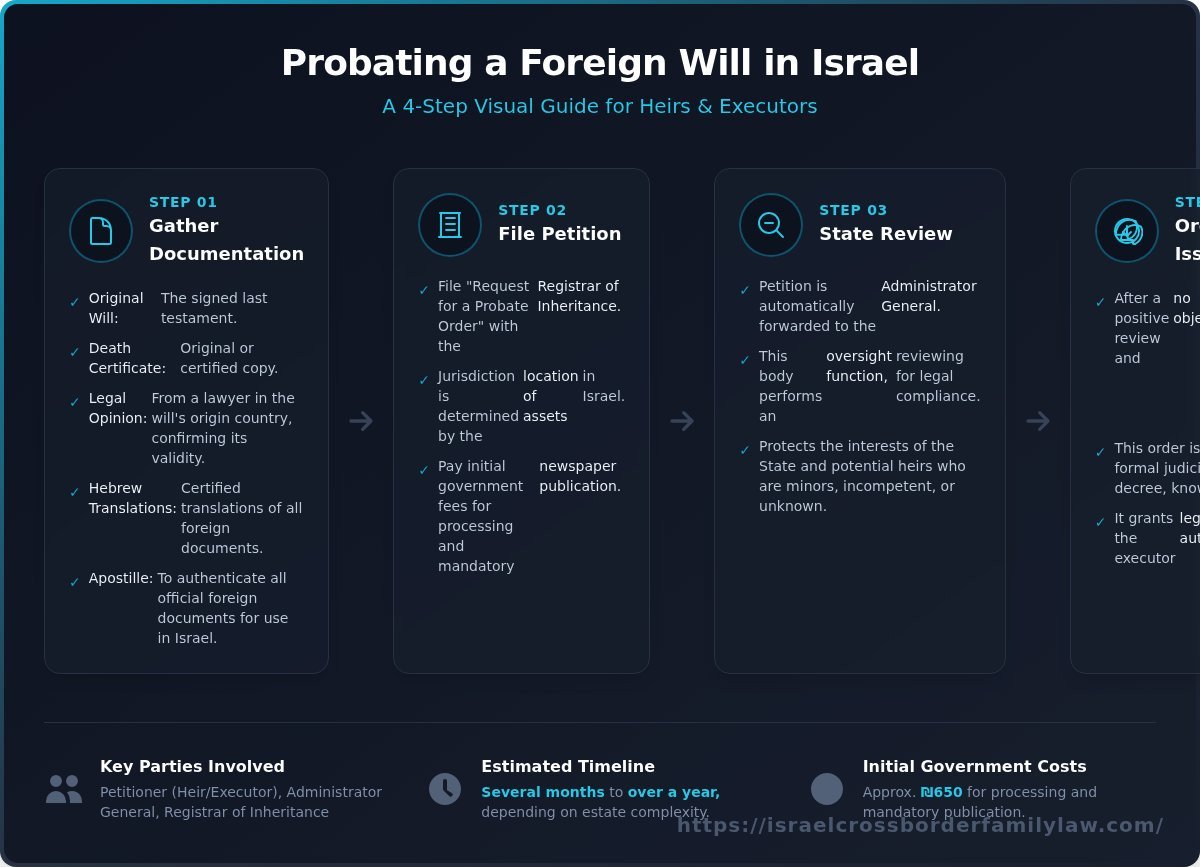
Navigating the probate of a foreign will in Israel is a structured, multi-stage legal procedure. The process is formally initiated when a petitioner, typically an heir or the will’s executor, files a “Request for a Probate Order” with the appropriate Israeli authority. Understanding how to probate a foreign will in Israel involves recognizing the distinct roles of the petitioner, the heirs, and the Administrator General (Apoptropos HaKlali), who represents the state’s interest. While a straightforward case may conclude in several months, complex multi-jurisdictional estates can extend the timeline to over a year, making expert legal guidance essential for an efficient resolution.
Step 1: Gathering Essential Documentation
Before any petition is filed, a comprehensive dossier of documents must be meticulously compiled. This preparatory phase is critical to avoid delays. The cornerstone of this collection is the original, signed last will and testament. Alongside the will, the petitioner must secure:
- An original or certified copy of the deceased’s death certificate.
- A formal legal opinion from a qualified attorney in the jurisdiction where the will was executed, confirming its validity under that country’s laws.
- Certified Hebrew translations of all non-Hebrew documents.
- An Apostille certification for all foreign official documents to authenticate them for use in Israel.
Step 2: Filing the Petition with the Registrar of Inheritance
With all documentation in order, the formal “Request for a Probate Order” (Bakasha leTzav Kiyum Tzava’a) is filed with Israel’s Registrar of Inheritance. The correct jurisdiction for filing is determined by the location of the deceased’s assets within Israel. The petition must be submitted with all supporting documents. Upon filing, the petitioner is required to pay initial government fees for processing and for the mandatory publication of the application in a daily newspaper, which typically amount to several hundred shekels (e.g., ~₪650).
Step 3: Review by the Administrator General
Once the petition is filed and published, a copy is automatically forwarded to the office of the Administrator General. This governmental body serves a crucial oversight function, reviewing the application to protect the interests of the State of Israel and any potential heirs who may be minors, legally incompetent, or whose whereabouts are unknown. The Administrator General assesses the will’s validity and the petition’s compliance with Israeli law. Their formal response, or lack of objection within a prescribed period, is a key milestone that allows the process to advance.
Step 4: Issuance of the Probate Order
Following a positive review and the passing of the objection period without any challenges, the Registrar of Inheritance will issue the final Probate Order (Tzav Kiyum Tzava’a). This legally binding decree validates the foreign will in the eyes of Israeli law. The order officially empowers the executor or heirs to act, providing them with the legal authority required to approach Israeli banks, the Israel Land Registry (Tabu), and other institutions to access, manage, and distribute the deceased’s Israeli assets according to the will’s provisions.
A Comprehensive Checklist of Required Documents
Successfully navigating the process of how to probate a foreign will in Israel hinges on the meticulous preparation and submission of a complete and accurately certified set of documents. The Israeli Registrar of Inheritance maintains rigorous standards, and any omission or error can lead to significant delays. This checklist provides a definitive guide to the essential paperwork required for your application.
Core Legal Documents
These foundational documents establish the death of the testator and the validity of the will. Accuracy and official certification are paramount.
- The Original Will: The original, signed document must be submitted. If the original is lost or held by a foreign court, a court-certified copy may be accepted, though this requires a separate, more complex petition to the court to approve the will’s contents.
- Official Death Certificate: The certificate must be an original or a certified copy. Crucially, if issued by a country that is a signatory to the Hague Convention, it must be authenticated with an Apostille stamp to be recognized in Israel.
- Proof of Identity: Clear, valid copies of passports or national identity cards are required for the deceased and for every heir and beneficiary named in the will.
Supporting Legal Opinions and Forms
This category includes documents that bridge the gap between the foreign legal system where the will was created and Israeli inheritance law.
- Legal Opinion on Foreign Law: This is a critical document. An expert legal opinion from a lawyer licensed in the will’s jurisdiction must be provided. This opinion must confirm that the will was executed in accordance with that jurisdiction’s laws and is considered valid there.
- Completed ‘Request for a Probate Order’ Application: This is the official Israeli application form, which must be filled out accurately in Hebrew.
- Power of Attorney: If you are retaining an Israeli law firm to manage the probate process, a signed and notarized Power of Attorney is required.
Notices and Translations
These documents ensure all parties are notified and that the Israeli Registrar can understand all submitted materials.
- Proof of Notice to Heirs: You must provide evidence that all heirs listed in the will have been formally notified of the application. This is typically done via registered mail receipts or a signed confirmation from each heir.
- Certified Hebrew Translations: Any document not originally in Hebrew or English must be translated into Hebrew. This translation must be performed and certified by a licensed Israeli notary. Standard translations are not sufficient.
The complexity and multi-jurisdictional nature of these requirements can be challenging. For guidance on assembling your application and ensuring compliance, you may wish to consult with experienced legal counsel specializing in cross-border inheritance matters.
Navigating Common Challenges and Pitfalls
While the process for how to probate a foreign will in Israel is well-defined, cross-border inheritance matters can present sophisticated challenges that require experienced legal guidance. Anticipating these potential issues is the first step in ensuring a smooth and efficient administration of the estate. These complexities underscore the critical importance of engaging counsel with deep expertise in Israeli inheritance law.
What if the Original Will is Missing?
The absence of the original testamentary document presents a significant procedural hurdle. Israeli law requires a separate, specific petition to the court to approve a copy or a draft of the will. The burden of proof is substantially higher, demanding compelling evidence and sworn affidavits that meticulously explain the circumstances surrounding the loss or destruction of the original document and verify the authenticity of the copy presented.
Handling Objections to the Will
Any interested party, such as a disinherited family member, may file a formal objection (hitnagdut) to the probate application. The filing of an objection immediately transfers the case from the administrative authority of the Inheritance Registrar to the jurisdiction of the Family Court for a full hearing. This transforms the process into a more complex, and often contentious, legal dispute. Common grounds for such challenges include:
- Allegations of undue influence or coercion exerted on the testator.
- Claims that the testator lacked the required mental capacity when signing the will.
- Assertions of forgery, fraud, or improper execution of the document.
Dealing with Israeli Inheritance Tax and Other Costs
A frequent concern for international heirs is taxation. It is important to note that Israel does not currently levy an inheritance or estate tax. However, heirs who later sell inherited Israeli real estate may be subject to Capital Gains Tax (Mas Shevach). The primary costs associated with the probate process itself are generally predictable and include court filing fees (typically several hundred shekels), newspaper publication fees, and professional legal fees, which vary based on the complexity of the estate. Navigating these financial aspects is a key part of understanding how to probate a foreign will in Israel effectively. These potential complications highlight the value of strategic legal support. Facing a complex situation? Schedule a consultation to discuss your case.
Finalizing Cross-Border Inheritance: Your Path Forward in Israel
The process of executing an international estate within Israel presents a unique set of legal and administrative hurdles. As this guide has detailed, successfully navigating how to probate a foreign will in Israel hinges on a precise understanding of the legal framework, meticulous preparation of all required documentation, and the strategic anticipation of common procedural pitfalls. This multi-jurisdictional complexity demands more than just diligence; it requires specialized expertise. Our firm is uniquely positioned to provide that expertise. With decades of dedicated experience in US-Israel cross-border inheritance law and a proven track record in handling the most complex international probate cases, we offer unparalleled guidance. Our team of bilingual attorneys, qualified to practice in both jurisdictions, ensures seamless communication and a nuanced understanding of both legal cultures. Don’t navigate this intricate process alone. Contact our expert cross-border attorneys to ensure a smooth probate process. Let us secure your family’s inheritance with the professionalism and authority it deserves.
Frequently Asked Questions
How long does it typically take to probate a foreign will in Israel?
The timeline for probating a foreign will in Israel generally ranges from three to six months, contingent upon the complexity of the estate and the caseload of the Inheritance Registrar. This process can be extended if objections are filed or if required documentation is incomplete. Our firm possesses the requisite experience to navigate these multi-jurisdictional complexities efficiently, guiding clients through each procedural stage to mitigate potential delays and ensure a streamlined execution of the probate order.
Do I need to travel to Israel to complete the probate process?
No, it is generally not necessary for beneficiaries or executors to travel to Israel. These complex cross-border proceedings can be managed remotely by engaging qualified Israeli legal counsel. Through a notarized and apostilled Power of Attorney, our attorneys are empowered to act on your behalf, handling all submissions, communications with the Inheritance Registrar, and other necessary legal actions in Israel. This ensures a seamless process without the need for international travel.
What are the estimated costs involved in probating a will in Israel?
The costs for probating a will in Israel comprise two primary components: governmental fees and legal fees. The government filing fee with the Inheritance Registrar is a fixed amount, currently approximately ₪503 for online applications. Legal fees are typically structured as either a percentage of the estate’s value, in accordance with the Israel Bar Association’s recommended tariff, or a pre-agreed fixed fee. We provide transparent, comprehensive fee structures tailored to the specific complexities of each case.
What happens to Israeli bank accounts after the owner passes away?
Upon notification of a client’s passing, Israeli financial institutions are legally obligated to freeze the deceased’s bank accounts to safeguard the assets. Access to these funds is restricted until a legally recognized heir presents a valid Israeli Probate Order (Tzav Kiyum Will) to the bank. This order officially validates the will and designates the legal beneficiaries, authorizing the bank to transfer the assets according to the court’s directive, thus ensuring a secure and orderly distribution.
Can I sell an inherited property in Israel as a foreign resident?
Yes, a foreign resident who inherits property in Israel is entitled to sell it. The initial step requires obtaining an Israeli Probate Order, which is then used to formally register the property in the heir’s name at the Israel Land Registry (Tabu). Once ownership is officially transferred, the heir can proceed with the sale. It is critical to note that the transaction may be subject to Israeli capital gains tax (Mas Shevach), and we advise clients on potential exemptions and tax liabilities.
What is an Apostille and why do I need it for the death certificate?
An Apostille is an international certification that authenticates the signature and seal on a public document, such as a death certificate, for use in another country. Under the 1961 Hague Convention, of which Israel is a signatory, an Apostille is required to validate a foreign-issued death certificate for official use in Israeli legal proceedings. Without this certification, the Israeli Inheritance Registrar will not accept the document, which is essential for initiating the process of how to probate a foreign will in Israel.

Article by
Gabriel Lior
A Personal Journey That Became a Mission The advisory was founded by an American father Gabriel Lior, LLB, MBA , global entrepreneur, and cross-border advisor who spent more than a decade navigating the Israeli family court system firsthand and now lives in Singapore with his son.
As a divorced parent in a cross-border family, Gabriel faced nearly every legal challenge a foreign parent can encounter in Israel — including child custody disputes, child support proceedings, property matters in Israel and abroad, false accusations, and complex immigration and relocation proceedings. Over the years, he learned the hard way how difficult it is for non-Israeli parents to understand the system, identify the right legal strategy, and choose the right legal representation — especially when language, culture, and jurisdictional differences are involved. He also witnessed how foreign parents and new immigrants are often disadvantaged or taken advantage of by service providers and institutions simply because they lack local knowledge or fluency. From Client to Advisor To truly understand — and survive — the system, Gabriel pursued formal legal education in Israel, completing two Israeli law degrees, alongside a BA and MBA earned in the United States. This was never about becoming a practicing attorney, but about gaining a deep, structural understanding of how the system works — and where it breaks down for foreign parents. This rare combination of: Firsthand client experience Israeli legal and US business education International business and negotiation training Decades of commercial execution created a unique perspective – one that understands both sides of the table. After years of litigation, persistence, and at times self-representation, he ultimately succeeded in securing custody of his son and relocating abroad through a rare legal victory in the Israeli Supreme Court — becoming one of the first fathers in Israel to do so under these circumstances.
Disclaimer
Important Disclaimer: The information provided on this website and in its content is for general informational and educational purposes only and does not constitute legal advice, legal opinion, or legal representation. Gabriel Lior is not licensed to practice law in Israel (nor is he interested in doing so) and does not provide legal services, despite having completed 2 Law Degrees. The services offered are advisory in nature and are intended to provide general guidance, strategic insight, and information regarding cross-border family law considerations. No attorney-client relationship is formed by accessing this website, reading its content, or communicating with us. Any decisions made based on this information are at your own discretion and risk. For legal advice specific to your situation, you should consult a licensed attorney in the relevant jurisdiction. Where appropriate, we may refer clients to independent, licensed attorneys or professionals. Such referrals do not constitute legal representation and no liability is assumed for services provided by third parties.