Imagine the scheduled date for your child’s return flight from Tel Aviv has passed, but the other parent suddenly refuses to board the plane. This situation is legally defined as wrongful retention; it’s a high-stakes crisis that leaves many international families feeling paralyzed by the fear of permanent separation. You likely feel a deep sense of confusion over which country has jurisdiction and whether this qualifies as a form of legal kidnapping.
We understand the immense stress of navigating a foreign legal system while your child is thousands of miles away. Acting quickly is the most critical factor in securing a child’s return to their home country, yet many parents lose precious time because they don’t know where to start. There are established international frameworks designed specifically to resolve these cross-border disputes with clarity and precision.
In this guide, you’ll learn the precise legal definitions, the risks involved in delayed action, and the strategic steps you must take to protect your family. We’ll provide a clear roadmap for navigating the Hague Convention in 2026. This includes explaining the difference between civil and criminal options and helping you understand how to establish habitual residence to protect your parental rights.
Key Takeaways
- Define the legal boundaries of wrongful retention and understand how it differs from wrongful removal in international custody disputes.
- Navigate the Hague Convention framework to see how US and Israeli courts coordinate the return of a child to their country of habitual residence.
- Identify critical legal defenses, such as the “Grave Risk” exception, that can complicate or prevent a court-ordered return.
- Learn why immediate action is essential to prevent a child from becoming legally “settled” in a new jurisdiction, which can weaken your case.
- Compare the strategic advantages of fast-tracked litigation against the collaborative potential of mediation to find the best path for your family.
What is Wrongful Retention? Defining the Legal Boundary
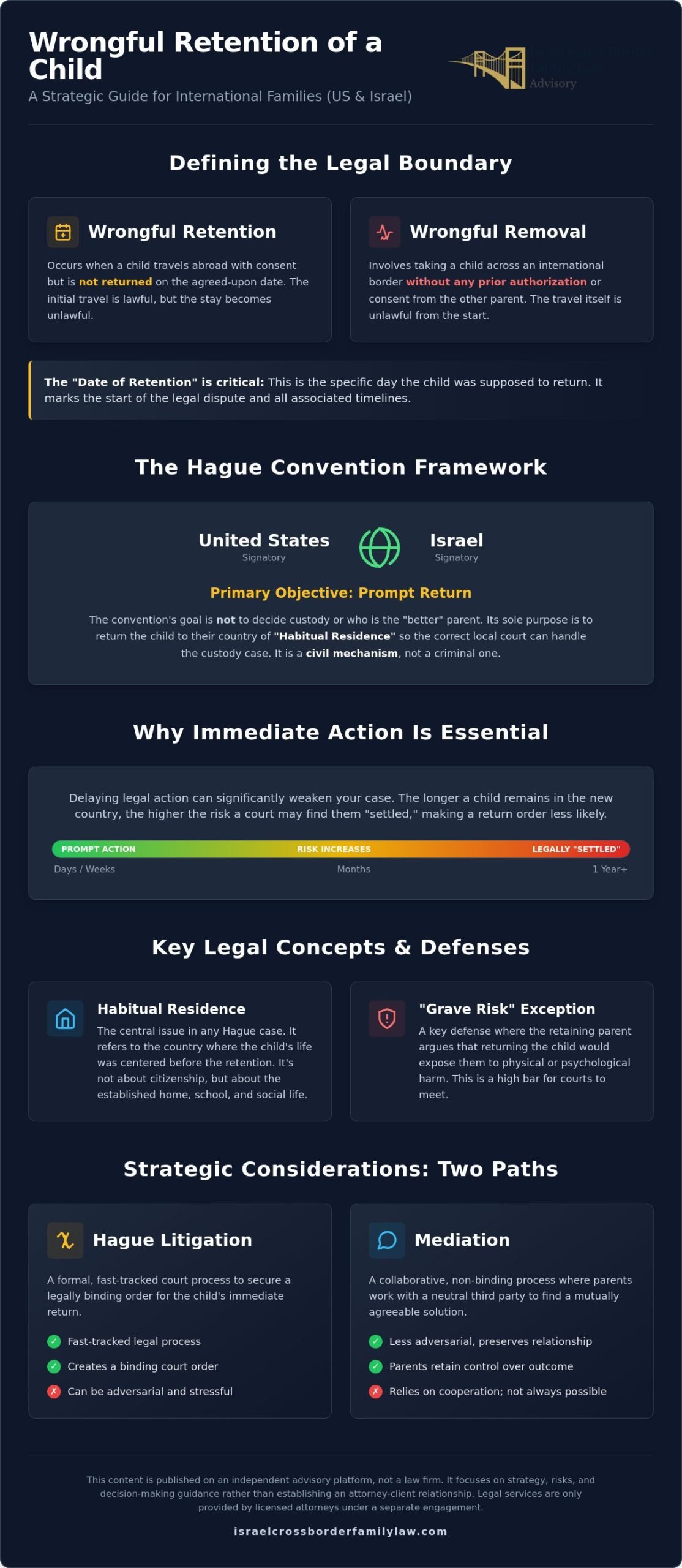
In the context of international families, wrongful retention occurs when a child, who is legally traveling with the consent of both parents, is not returned to their home country at the conclusion of the agreed-upon period. This is distinct from “wrongful removal,” which involves taking a child across an international border without any prior authorization. For many families moving between the United States and Israel, this situation often manifests at the end of a summer vacation or a religious holiday visit. The parent in the destination country simply decides the child will stay, effectively changing the child’s life without the other parent’s agreement.
The most vital piece of information in these cases is the “date of retention.” This is the specific day the child was supposed to return but did not. This date serves as the starting point for legal timelines and jurisdictional arguments in both Israeli and American courts. It marks the transition from a lawful visit to a legal dispute. Because the clock starts ticking the moment a return is missed, identifying this date with precision is the first step in any recovery strategy.
Retention vs. Removal: Why the Distinction Matters
While the terms sound different, they carry equal weight under the Hague Convention on the Civil Aspects of International Child Abduction. A retention case is unique because it begins with a lawful departure. The child left the U.S. or Israel with everyone’s blessing. However, the legal nature of the stay transforms the moment the agreed return date passes. Our focus is often on proving that the initial departure was strictly conditional and temporary. Establishing this intent is the cornerstone of a successful return petition. Strategy often hinges on demonstrating that the child’s residence never actually changed, regardless of how long the visit lasted.
The Role of Consent in Cross-Border Travel
Clear documentation is your strongest asset. We consistently see that notarized travel consent forms are the best evidence of a parent’s original intent. Without these, cases often devolve into arguments over “implied consent.” If one parent claims they agreed to a permanent move during a phone call or through vague text messages, the case becomes significantly more complex. Open-ended return tickets or travel plans without fixed dates are particularly dangerous. They can be interpreted by a court as a lack of fixed intent to return the child to their original home. Protecting your rights requires clarity before the child ever leaves the country.
This content is published on an independent advisory platform, not a law firm, and focuses on strategy, risks, and decision-making guidance rather than an attorney-client relationship. Understanding these definitions is the first step in protecting your relationship with your child. For more detailed guidance on the treaty itself, you can review our resources on the Hague Convention and child abduction.
The Hague Convention Framework: How Israel and the US Respond
Both Israel and the United States are long-standing signatories to the 1980 Hague Convention. This treaty provides a specialized legal framework for addressing cases of wrongful retention across international borders. Its primary objective is to ensure that children are promptly returned to their country of “habitual residence” so that custody matters can be decided by the appropriate local courts. It’s vital to understand that the Hague Convention is a civil mechanism rather than a criminal one. The proceedings don’t seek to imprison a parent; instead, they focus on restoring the jurisdictional status quo that existed before the retention occurred.
In these cases, the court’s role isn’t to determine which parent is “better” or to conduct a full best-interests-of-the-child analysis. Those complex evaluations are reserved for the courts in the child’s home country. The Hague court simply asks whether the child was taken or kept away from their home without permission and if they should be sent back immediately. Because these cases are fast-tracked, the initial decisions you make regarding where to file and what evidence to present carry significant weight.
Determining “Habitual Residence”
The concept of habitual residence is the pivot point of any Hague case. Courts in both countries examine where the child’s life was centered before the retention occurred. They look at objective evidence such as school enrollment, medical records, and the child’s social ties. In Israel, this often includes looking at registrations with health funds (Kupat Holim) or local community centers. A common pitfall occurs when families move back and forth between the US and Israel without a clear, documented intent of where “home” is. If a child has spent enough time in Israel to become “acclimatized,” usually evidenced by language acquisition and social integration, the court may find that their residence has shifted. This makes a return to the US much harder to secure.
Rights of Custody vs. Rights of Access
To successfully file a claim, you must prove you held “rights of custody” at the exact moment the wrongful retention began. It’s a common misconception that you need a formal court order to prove this. Under Israeli law, parents are generally considered natural guardians with inherent custody rights unless a court has specifically removed them. This often differs from certain US state laws where rights might be more strictly defined by written agreements. If you only have “rights of access,” which essentially means visitation rights, the Hague Convention may not provide the same power to compel a return. Understanding your standing under both legal systems is essential before filing any paperwork. If you are unsure of your current legal status, it may be helpful to reach out for a confidential review of your situation.
This content is published on an independent advisory platform, not a law firm, and focuses on strategy, risks, and decision-making guidance rather than an attorney-client relationship. Legal services are only provided by licensed attorneys under a separate engagement. For more information on how these treaties are applied in practice, you can explore our guidance on Hague Convention child abduction.
Key Defenses and Exceptions in Retention Cases
While the Hague Convention prioritizes the prompt return of a child, it isn’t an absolute mandate. Courts in both the United States and Israel recognize specific, narrowly defined exceptions where a return order may be denied. These defenses are designed to protect the child’s safety and respect their developing autonomy, but they carry a very high legal threshold. It’s vital to understand that an Israeli court won’t refuse a return simply because one parent believes the child has a better lifestyle or better schools in Israel. The focus remains strictly on whether a legal exception applies to the wrongful retention.
Beyond safety risks, a court may also consider “acquiescence.” This occurs if the left-behind parent seemingly agreed to the child staying in the new country, either through written messages or long-term inaction. If you’ve sent emails suggesting the child can stay for the school year, you may inadvertently weaken your case for a mandatory return. Similarly, the “Child’s Objection” exception allows a court to refuse return if a child of sufficient age and maturity firmly objects to going back. In Israeli courts, there is no fixed age for this, but the views of children aged 10 to 12 are often given significant weight by court-appointed professionals.
The Grave Risk Exception (Article 13b)
The “Grave Risk” defense is perhaps the most frequently cited exception in US-Israel cases. To succeed, the taking parent must prove that returning the child would expose them to physical or psychological harm or otherwise place them in an intolerable situation. Ordinary adjustment issues, such as missing friends or changing schools, don’t meet this standard. In cases involving domestic violence allegations, courts may use “undertakings.” These are specific, enforceable conditions, such as supervised visitation or financial support, designed to ensure the child’s safety upon their return to the home country.
The One-Year Rule and “Settled” Status
Timing is the most critical strategic factor in these disputes. If a parent waits more than one year from the date of the wrongful retention to file a Hague petition, the court is no longer strictly required to order a return. At this point, the taking parent can argue the child is “now settled” in their new environment. Being “settled” involves more than just living in a house; the court looks for deep roots, such as fluency in Hebrew, active participation in youth movements, and strong social ties. You can learn more about how these factors impact international custody and relocation on our advisory platform.
This content is published on an independent advisory platform, not a law firm, and focuses on strategy, risks, and decision-making guidance rather than an attorney-client relationship. Legal services are only provided by licensed attorneys under a separate engagement. Each case is unique, and early strategic clarity is essential for protecting your parental rights.
Immediate Steps to Take When a Child is Not Returned
Speed is the most critical factor when a parent refuses to return a child after an authorized visit. In cases of wrongful retention, the passage of time is a primary legal risk. Every day the child remains in the destination country, whether it is Israel or the US, strengthens the other parent’s ability to argue that the child is now “settled” in their new environment. This can create a significant hurdle to a successful return petition under the Hague Convention. It’s vital to remain calm and avoid “self-help” measures. Attempting to physically take a child back can lead to criminal charges and will likely damage your standing in the civil court system.
Your first priority is to secure professional guidance to map out a clear strategy. You can request a confidential case review to understand your immediate options before taking any irreversible steps.
Documenting the Breach
Success in court often depends on the quality of your paper trail. You must prove there was a clear, mutual agreement regarding the child’s return date. Collect and organize all relevant communication, including:
- WhatsApp messages and emails discussing travel dates and expectations.
- Notarized travel consent forms or signed parenting plans.
- Original flight itineraries and return tickets.
- Any messages where the other parent explicitly refuses to return the child.
In some complex scenarios, you may need a “declaration of wrongfulness” from your local court. This document confirms that the retention violates your custody rights under the laws of your home country. To understand how we help families organize this evidence and prepare for the next steps, you can review how the advisory process works on our platform.
Engaging the Central Authorities
The 1980 Hague Convention established “Central Authorities” in every member nation to facilitate the return of children. If your child is being held in Israel, you should contact the U.S. Department of State’s Office of Children’s Issues. If your child is being held in the US and their home is Israel, the Israeli Central Authority within the Ministry of Justice, Office of the State Attorney, is your primary point of contact. These agencies handle the initial administrative phase of your claim. They verify that the application meets the treaty’s requirements and communicate with the authority in the other country. While they provide essential administrative support, they don’t act as your personal legal counsel in court proceedings.
This content is published on an independent advisory platform, not a law firm, and focuses on strategy, risks, and decision-making guidance rather than an attorney-client relationship. Legal services are only provided by licensed attorneys under a separate engagement. Acting with precision in these early stages is the best way to protect your long-term relationship with your child.
Strategic Considerations: Mediation vs. Hague Litigation
Choosing between litigation and mediation is the most significant strategic decision a parent faces following a wrongful retention. Litigation under the Hague Convention is designed to be a fast-tracked process, yet it’s inherently adversarial. It focuses on the strict application of treaty rules to return the child to their home country. As emphasized on the @IsraelFamilyLaw channel, the weight of early decisions in a cross-border dispute cannot be overstated; a single misstep can alter the jurisdictional landscape for years. While the court provides a clear resolution, the process can often strain parental relationships beyond repair.
Mediation offers a different path, focusing on collaborative problem-solving rather than legal combat. However, it requires mutual good faith to be effective. A primary risk in US-Israel cases is that mediation can sometimes be used as a stalling tactic. If the process drags on, it may trigger the “one-year rule” discussed earlier, making it easier for the taking parent to argue the child is now settled in Israel. We often recommend a “Mirror Order” strategy for mediated agreements. This ensures that any settlement reached is legally registered and enforceable in both the Israeli and U.S. court systems, providing security for both parents.
The Benefits of International Family Mediation
Mediation allows parents to maintain a functional co-parenting relationship, which is often lost in high-conflict litigation. It provides the flexibility to craft a “soft landing” return plan. This might include specific travel arrangements, temporary housing, or phased visitation schedules that a judge may not have the authority to order. You can use mediation to resolve the dispute without waiving your Hague Convention rights. By setting strict timelines for the mediation process, you protect your ability to return to court if the other parent doesn’t follow through on their commitments.
Navigating the Israeli Family Court System
The Israeli Family Court system handles Hague cases with a high degree of specialization. Judges in these courts are well-versed in international law and focus heavily on the speed of the proceedings. In Israel, a hearing for a Hague Convention case will be set within 15 days of the petition being filed. If a decision is reached, the deadline to file an appeal is strictly limited to 7 days. Because of these tight windows, it’s essential to work with a practitioner who is licensed in multiple jurisdictions and understands the nuances of both systems. You can find more details in our Hague Convention child abduction overview.
This content is published on an independent advisory platform, not a law firm, and focuses on strategy, risks, and decision-making guidance rather than an attorney-client relationship. Legal services are only provided by licensed attorneys under a separate engagement. Get clarity before you commit. Request a confidential consultation.
Securing Your Family’s Future Across Borders
Navigating the complexities of international custody requires a blend of speed, precision, and strategic foresight. As we’ve explored, the legal boundaries of wrongful retention are strictly enforced by both U.S. and Israeli courts through the Hague Convention. Success in these high-stakes cases depends on your ability to document the original intent of travel and act before the one-year “settled” threshold is reached. Whether you choose the adversarial path of litigation or the collaborative route of mediation, your early decisions will define the jurisdictional future for your child.
This advisory is published on an independent platform focused on cross-border strategy and the unique dynamics of US-Israel families. We focus on providing the clarity you need to make informed decisions during a time of immense stress. It’s vital to remember that these materials are for informational purposes and don’t constitute an attorney-client relationship. Legal services are only provided by licensed attorneys under a separate engagement.
Get clarity before you commit. Request a confidential case review today to begin mapping out your next steps. You don’t have to navigate this complex international landscape alone; expert guidance is available to help you find a stable resolution.
Frequently Asked Questions
What is the primary difference between wrongful removal and wrongful retention?
Wrongful removal involves taking a child across an international border without any prior consent from the other parent. In contrast, wrongful retention occurs when a child travels legally with consent, but the parent in the destination country refuses to return them on the agreed-upon date. Both situations are treated as international child abduction under the Hague Convention, though the evidence required to prove the breach of custody rights differs between the two.
Does the Hague Convention apply if we never had a formal custody order?
Yes, the Hague Convention can be invoked even without a formal court order. Under Israeli law, parents are considered natural guardians with inherent rights of custody unless a court has explicitly removed those rights. If you were actually exercising your parental responsibilities at the time the child was kept away, you generally have the standing to file for a return based on these inherent legal rights.
How long does a Hague Convention case typically take in Israel?
Israeli courts are required to handle these cases with extreme urgency to minimize the time a child spends away from their home environment. By law, a hearing for a Hague petition must be scheduled within 15 days of the application being filed. While the total time to reach a final decision varies, the process is significantly faster than standard family law litigation, and any appeal must be filed within 7 days.
Can I stop my child from being returned if I can prove they want to stay in Israel?
A court may refuse to return a child if they are of “sufficient age and maturity” and firmly object to going back. There’s no fixed age for this in Israel, but judges often give weight to the views of children aged 10 to 12 after an evaluation by a court professional. However, this exception is interpreted very narrowly and won’t be granted if the court believes the child has been influenced or “coached” by the parent in Israel.
What happens if the one-year filing deadline has already passed?
If you wait more than one year from the date of the wrongful retention to file your petition, the court is no longer mandated to order an immediate return. At this point, the taking parent can raise the “now settled” defense. This requires proving the child has developed deep roots in Israel, such as Hebrew fluency and strong social ties, which gives the judge more discretion to allow the child to stay.
Is wrongful retention considered a crime in the United States or Israel?
The Hague Convention is a civil mechanism focused on the child’s return rather than criminal punishment. While the treaty itself isn’t criminal, both the US and Israel have separate domestic laws regarding international parental kidnapping that can carry criminal penalties. It’s important to distinguish between the civil goal of bringing a child home and the criminal consequences that may arise from their retention.
Can I file for a Hague return if I only have visitation rights?
Generally, you cannot compel a return under the Hague Convention if you only hold “rights of access,” which are commonly known as visitation rights. The treaty is specifically designed to protect “rights of custody.” If your legal status only allows for visits rather than decision-making authority over the child’s residence, your options under the Convention are more limited, though other legal remedies may still be available.
Do I need a lawyer in both the US and Israel for a retention case?
While the legal case is heard in the country where the child is currently located, having a coordinated strategy across both jurisdictions is highly recommended. You must prove your custody rights based on the laws of the child’s home country while navigating the procedural rules of the destination country. Working with a practitioner who understands the bridge between the US and Israeli systems ensures your evidence is presented effectively in both legal environments.

Article by
Gabriel Lior
A Personal Journey That Became a Mission
The advisory was founded by an American father Gabriel Lior, LLB, MBA , global entrepreneur, and cross-border advisor who spent more than a decade navigating the Israeli family court system firsthand and now lives in Singapore with his son.
As a divorced parent in a cross-border family, Gabriel faced nearly every legal challenge a foreign parent can encounter in Israel — including child custody disputes, child support proceedings, property matters in Israel and abroad, false accusations, and complex immigration and relocation proceedings.
Over the years, he learned the hard way how difficult it is for non-Israeli parents to understand the system, identify the right legal strategy, and choose the right legal representation — especially when language, culture, and jurisdictional differences are involved. He also witnessed how foreign parents and new immigrants are often disadvantaged or taken advantage of by service providers and institutions simply because they lack local knowledge or fluency.
From Client to Advisor
To truly understand — and survive — the system, Gabriel pursued formal legal education in Israel, completing two Israeli law degrees, alongside a BA and MBA earned in the United States. This was never about becoming a practicing attorney, but about gaining a deep, structural understanding of how the system works — and where it breaks down for foreign parents.
This rare combination of:
Firsthand client experience
Israeli legal and US business education
International business and negotiation training
Decades of commercial execution
created a unique perspective – one that understands both sides of the table.
After years of litigation, persistence, and at times self-representation, he ultimately succeeded in securing custody of his son and relocating abroad through a rare legal victory in the Israeli Supreme Court — becoming one of the first fathers in Israel to do so under these circumstances.
Disclaimer
Important Disclaimer:
The information provided on this website and in its content is for general informational and educational purposes only and does not constitute legal advice, legal opinion, or legal representation.
Gabriel Lior is not licensed to practice law in Israel (nor is he interested in doing so) and does not provide legal services, despite having completed 2 Law Degrees. The services offered are advisory in nature and are intended to provide general guidance, strategic insight, and information regarding cross-border family law considerations.
No attorney-client relationship is formed by accessing this website, reading its content, or communicating with us.
Any decisions made based on this information are at your own discretion and risk. For legal advice specific to your situation, you should consult a licensed attorney in the relevant jurisdiction.
Where appropriate, we may refer clients to independent, licensed attorneys or professionals. Such referrals do not constitute legal representation and no liability is assumed for services provided by third parties.