This article is published on an independent advisory platform and does not constitute legal representation or an attorney-client relationship. Legal services are only provided by licensed attorneys under a separate engagement.
What if the foreign will you’ve relied on for years carries no weight when it comes to your property in Tel Aviv? Many international families discover too late that inheritance laws in israel operate under a distinct set of rules that don’t always align with Western probate standards. It’s natural to feel anxious about the complexities of multi-jurisdictional assets or the potential for procedural delays within the Israeli system. You might even worry about how the Rabbinical court system could impact your family’s future.
We agree that the intersection of different legal cultures creates significant uncertainty for expats and their heirs. This guide promises to demystify the Israeli Succession Law, offering you a strategic roadmap to navigate cross-border estate matters with confidence. You’ll learn how the probate process works, how to protect your Israeli assets from unnecessary complications, and how to avoid family disputes through proactive planning. Get clarity before you commit. Request a confidential consultation. For additional insights, you can view expert discussions on the Israel Family Law YouTube channel.
Key Takeaways
- Understand how the Succession Law of 1965 governs inheritance laws in israel, specifically how jurisdiction is determined by residency and asset location.
- Learn the strict formal requirements for the four recognized types of Israeli wills to ensure your cross-border estate plan is legally enforceable.
- Discover how the default legal hierarchy and the 50% spousal rule function under intestate succession if no valid will is in place.
- Navigate the step-by-step probate process, including filing with the Inheritance Registrar and managing mandatory public notice requirements.
- Evaluate strategic asset protection to balance the current absence of inheritance tax against potential capital gains liabilities (Mas Shevach) on real estate.
This article is published on an independent advisory platform and does not constitute a law firm. The information provided is for educational purposes only and does not imply or create an attorney-client relationship.
Understanding the Israeli Succession Law of 1965
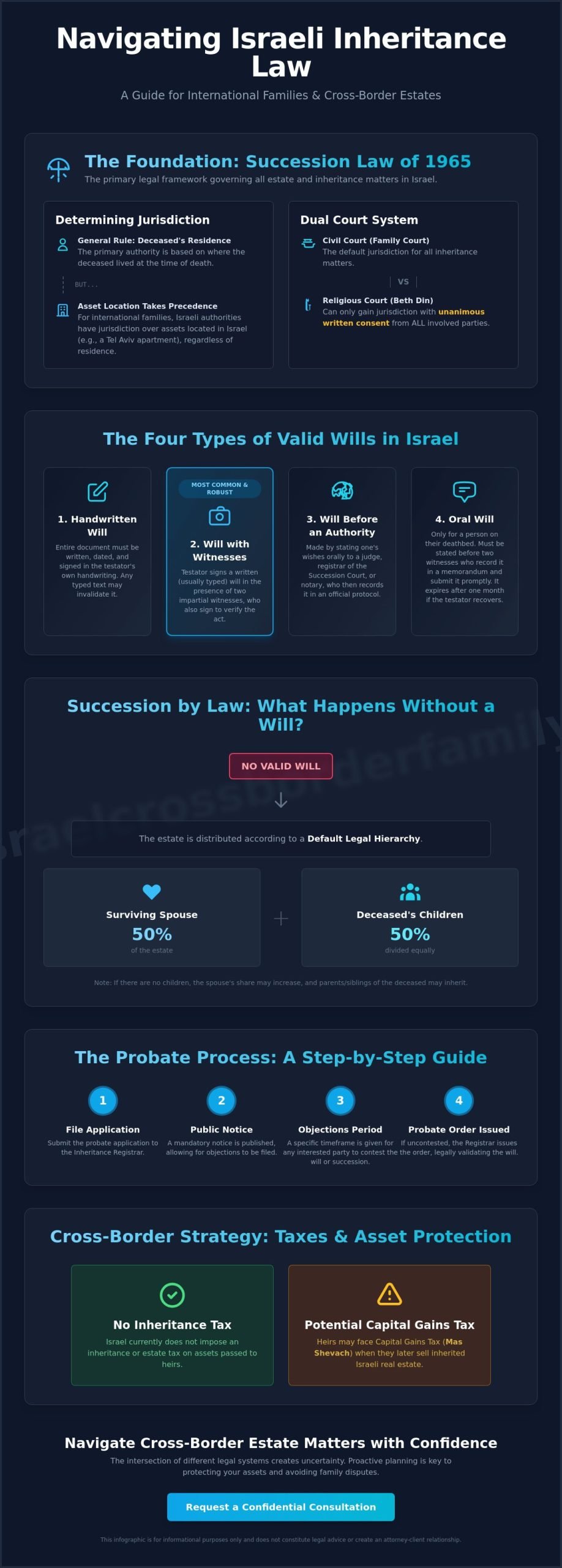
The Succession Law of 1965 serves as the primary framework for all matters concerning estates and inheritance laws in israel. It’s a comprehensive statute that dictates how assets are distributed when an individual passes away, regardless of whether they left a formal will or died intestate. This law is a central component of the Israeli legal system, blending elements of continental civil law with local historical traditions to address the needs of a modern, global population.
Determining jurisdiction is the first hurdle in any estate matter. Generally, the authority to manage an estate depends on the deceased’s place of residence at the time of death. However, for international families, the location of assets often takes precedence. If a person lived in London but owned an apartment in Tel Aviv, the Israeli authorities maintain jurisdiction over that specific property. Early decisions regarding where to file an application can impact the entire timeline and cost of the process, often saving families from unnecessary bureaucratic loops.
To better understand this concept, watch this helpful video:
The Civil vs. Religious Court Jurisdiction
Israel operates a dual-track system where both the Family Court (civil) and the Beth Din (religious) have authority over inheritance. While the Inheritance Registrar handles routine, uncontested applications, the religious courts can only intervene if every heir provides written “mutual consent.” Without this unanimous agreement, the case stays within the civil system. This often leads to a “race to the court” in contested estates, where parties rush to file in the jurisdiction they believe will be more favorable to their specific situation.
Who Does the Law Apply To?
The reach of the 1965 Law is broad. It applies to Israeli citizens residing abroad who maintain local bank accounts or real estate, as well as foreign nationals who inherit property within Israel. Navigating inheritance laws in israel becomes complex when foreign residents are involved, as the court must often harmonize Israeli statutes with the laws of the deceased’s home country. Seeking clarity for expats and foreign nationals at the start of the process is vital. In 2023 alone, the Registrar processed thousands of orders involving international beneficiaries, illustrating the high volume of cross-border estate activity in the region.
Get clarity before you commit. Request a confidential consultation.
This article is published on an independent advisory platform and does not constitute an attorney-client relationship. The information provided is for educational purposes and does not substitute for professional legal advice from a licensed attorney.
The Four Types of Valid Wills in Israel
The Succession Law of 1965 establishes strict formal requirements for a will to be recognized. If a document fails to meet these procedural standards, The Inheritance Registrar may refuse to issue a probate order, leading to costly litigation. Understanding these formats is the first step in mastering inheritance laws in israel.
- Handwritten Wills: This is the simplest but most fragile format. For it to be valid, the entire document must be written in the testator’s own handwriting. It must include a date and a signature. Any typed portions will likely invalidate the entire document.
- Wills in the Presence of Witnesses: This is the most common and robust format for international families. It requires the testator to sign the document in front of two witnesses who have no personal interest in the estate. The witnesses must sign a declaration confirming the testator signed freely.
- Wills Before an Authority: A testator can state their wishes or submit a written document to a judge, a member of a Rabbinical Court, or a notary. These carry significant weight because the official verifies the testator’s identity and state of mind.
- Oral Wills: Known as the “deathbed” exception, this is only valid if the testator is on the verge of death or believes they are facing an immediate life-threatening situation. It requires two witnesses to record the instructions and deposit them with the court. This format expires 30 days after the life-threatening circumstances pass if the testator survives.
Formalities and Common Pitfalls
Procedural mistakes are the primary cause for contesting a will in Israel. Courts look closely at “testator capacity,” which refers to the person’s mental state and cognitive ability to understand the consequences of their instructions at the time of signing. Undue influence occurs when a beneficiary uses unfair pressure or manipulation to override the testator’s free will. To avoid these issues, many families seek a professional review to ensure the document stands up to scrutiny.
Does a US Will Work in Israel?
While Israel often recognizes foreign wills under the principle of “lex loci” (the law of the place where the document was signed), practical challenges remain. Real estate located in Israel is governed by local law. Validating a US probate order involves complex translations and an “opinion on foreign law” submitted to the Israeli court. This process can be slow and expensive. There are strategic benefits to having a separate Israeli will specifically for local assets. It allows for a faster distribution of property and avoids the friction between two different legal cultures. You can learn more about how inheritance laws in israel affect expats to decide if a local document is right for your situation.
Get clarity before you commit. Request a confidential consultation.
Succession by Law: What Happens if There Is No Will?
Israel’s legal system follows a rigid structure when an individual passes away without leaving a valid will. This situation, known as intestacy, triggers the default provisions of the 1965 Inheritance Law. These inheritance laws in israel operate on a “circular” hierarchy designed to keep assets within the immediate family unit. If you don’t have a plan in place, the state applies a one-size-fits-all formula that may not align with your specific family dynamics or cross-border financial interests.
The default rule generally grants the surviving spouse 50% of the entire estate. This includes the deceased’s share of the family car and household goods. The remaining 50% is divided equally among the children. If the couple lived in a shared apartment, the surviving spouse may have specific rights to continue living in the home, but the ownership title itself will be split with the children. This often creates a situation where a widow or widower must seek permission from their children to sell the property or refinance a mortgage.
The Order of Inheritance
The law organizes heirs into three distinct circles. The first circle consists of the spouse and children, including adopted children and those born outside of marriage. Under the 1965 Law, adopted children possess the same inheritance rights as biological children. If no first-circle heirs exist, the estate moves to the second circle; this includes parents and their descendants, such as siblings, nieces, and nephews.
- Common-law Spouses: Israel recognizes Yeduim BeTzibur (couples living together as a family unit without marriage). Under Section 55 of the law, a common-law partner may inherit as a legal spouse if neither party was married to someone else at the time of death.
- The State as Heir: If the authorities cannot locate any legal heirs within the three circles after a diligent search, the estate transfers to the State of Israel. These funds are managed by the Administrator General and are typically earmarked for educational or social welfare purposes after a statutory waiting period.
Risks of Intestacy for International Families
For Anglo expats, relying on default law is a high-risk strategy. Israeli law does not automatically recognize the “Right of Survivorship” common in US or UK joint tenancies. If a husband dies, his 50% of the Israeli home doesn’t necessarily pass entirely to his wife; it is split with the children. This can be particularly distressing if there are complications regarding divorce and separation for international families where previous marriage obligations or children from prior relationships are involved.
Cross-border property often falls into legal limbo when no will exists. An Israeli court might apply Israeli law to local real estate while a foreign court applies different rules to bank accounts in London or New York. This fragmentation leads to increased legal fees, often exceeding ₪35,000 for complex probate applications, and years of administrative delays. Without a clear strategy, your heirs may face significant tax exposure and procedural hurdles in multiple jurisdictions.
Get clarity before you commit. Request a confidential consultation.
This article is published on an independent advisory platform and does not constitute legal representation or an attorney-client relationship. Legal services are only provided by licensed attorneys under a separate engagement.
The Probate Process in Israel: A Step-by-Step Guide
The transition of assets after a death involves a structured administrative and legal sequence. It begins with filing an application with the Inheritance Registrar, known in Hebrew as Rasham HaYerusha. This office handles the majority of uncontested cases. If a person died with a valid will, the family applies for a Probate Order (Tzav Kiyum Tzava-ah). If there’s no will, the application is for a Succession Order (Tzav Yerusha), which follows the default distribution rules set by inheritance laws in israel.
Once the application is submitted, the Registrar mandates a public notice period. This involves publishing a notice in daily newspapers and the Official Gazette. This requirement serves a specific purpose: it gives potential creditors or unknown heirs a window, typically 14 days, to file an objection. If the process remains uncontested, the file is transferred to the Administrator General for a technical review. This state official ensures the application meets all regulatory standards and checks the national database for any other registered wills that might contradict the current filing.
Requirements for Non-Israeli Residents
Expats and international heirs face unique hurdles that don’t apply to local residents. Because the Registrar requires a local address for all official correspondence, you must appoint a local representative to manage the file. This ensures that legal notices are received and handled promptly. Foreign heirs who don’t hold an Israeli citizenship must also obtain a specific Israeli tax ID, known as a Mispar Atzma-i, to facilitate the eventual distribution of funds or the registration of property.
Documentation is another area where international families often encounter delays. Any foreign document, such as a death certificate or a foreign probate decree, must be authenticated with an Apostille stamp from the issuing country. If the documents aren’t in Hebrew or English, a notarized translation is required. These steps are essential for the Registrar to recognize the validity of foreign records within the Israeli system.
Transferring Assets and Real Estate
Obtaining the final court order is a significant milestone, but it doesn’t automatically move assets into the names of the heirs. For real estate, the Probate Order must be registered with the Land Registry, commonly called the Tabu. This administrative step updates the title deed to reflect the new owners. Without this registration, the property cannot be sold or mortgaged by the heirs.
Dealing with Israeli banks presents its own set of challenges. Banks often view a probate order as just the first step in their compliance process. They may require additional documentation regarding the source of funds or the tax status of foreign beneficiaries. Many families utilize confidential case reviews to map out these steps before they begin, ensuring they understand the timeline and requirements of each specific institution. Proper strategy prevents assets from being frozen in bureaucratic limbo for months.
Get clarity before you commit. Request a confidential consultation.
This article is published on an independent advisory platform and does not constitute a law firm or an attorney-client relationship. Legal services are only provided by licensed attorneys under a separate engagement.
Cross-Border Strategy: Taxes and Asset Protection
Israel currently imposes no direct inheritance or estate tax on its residents or their heirs. This policy makes the jurisdiction attractive for wealth transfer. However, families shouldn’t mistake the lack of a formal estate tax for a total tax exemption. While the state doesn’t take a percentage of the total estate value, other levies can significantly erode the inheritance if not managed correctly.
Real estate remains the primary area where heirs face financial surprises. Under inheritance laws in israel, the tax basis for a property often rolls over from the original owner. If a parent purchased an apartment in Jerusalem in 1985 for ₪250,000 and the heirs sell it in 2024 for ₪3,500,000, the capital gains tax, known as Mas Shevach, is calculated based on that original 1985 purchase price. Heirs don’t receive a step-up in basis to the current market value at the time of death for Israeli tax purposes. This can result in a tax bill reaching 25% of the inflationary and real gain.
Tax Considerations for US Beneficiaries
Managing inheritance laws in israel requires a dual-lens approach for Americans. The US government taxes its citizens on their worldwide assets regardless of where the assets are located. For 2024, the federal estate tax exemption is $13.61 million, but assets in Israel count toward this lifetime limit. US beneficiaries must also comply with strict reporting requirements. Any foreign bank account exceeding a value of approximately ₪37,000 at any point during the year must be disclosed via FBAR and FATCA filings.
The tax treatment of the basis is a major point of friction. The US generally allows a step-up in basis to the fair market value at the date of death, but this does not negate the Israeli Mas Shevach liability when the property is sold. Regarding the legal framework, the 1975 tax treaty between Israel and the US primarily addresses income tax and does not provide comprehensive relief from the overlap of US estate taxes and Israeli capital gains taxes.
Practical Next Steps
Early intervention prevents procedural friction. Mismatched legal documents often lead to frozen accounts and years of expensive litigation. It’s vital to review existing estate plans to ensure they meet the specific formal requirements of both jurisdictions. Utilizing the Advisory platform approach allows families to identify these risks before they become crises.
For those who prefer visual explainers, the Israel Family Law YouTube channel provides detailed breakdowns of how these regulations function in practice. Strategy-based decision-making is the only way to protect international assets across generations. Get clarity before you commit. Request a confidential consultation.
Securing Your Family’s Future Across Borders
Navigating the friction between the US and IL legal systems requires more than just a basic understanding of the Succession Law of 1965. Whether you’re managing property in Tel Aviv or coordinating assets across the Atlantic, the decisions you make today dictate the ease of the probate process for your heirs. Most international families find that waiting until a crisis occurs leads to unnecessary complications and administrative burdens. Early strategy is the most effective way to manage the inherent complexity of multi-jurisdictional estates. This guide is published on an independent advisory platform, and while it provides educational insights, it isn’t a substitute for legal representation.
This overview helps you identify potential risks within the inheritance laws in israel before they manifest into legal disputes. We focus on helping expats and international families bridge the gap between different legal cultures, especially when tax thresholds and reporting requirements don’t align. Taking the time to coordinate your international estate plan ensures your legacy remains protected and your family avoids the stress of navigating the Israeli Registrar of Inheritance Affairs without a clear roadmap. For more visual guides on these topics, you can explore the resources available on our YouTube channel.
Get clarity before you commit. Request a confidential consultation.
Protecting your global assets is a significant responsibility, and with a strategic approach, you can move forward with confidence.
This article is published on an independent advisory platform (not a law firm) and does not imply an attorney-client relationship. Legal services are only provided by licensed attorneys under a separate engagement.
Frequently Asked Questions
Is there inheritance tax in Israel for US citizens?
Israel does not currently impose an inheritance or estate tax on assets located within its borders as of 2024. However, US citizens remain subject to US federal estate tax on their global assets if the total estate value exceeds the 13.61 million dollar exemption threshold for the 2024 tax year. You’ll need to navigate the interaction between Israeli property transfers and US tax reporting requirements to avoid unforeseen liabilities.
Can I contest a will in Israel if I live in the US?
You can contest a will in Israel from the US by appointing a local representative through a power of attorney. The Israeli legal system allows for remote participation in many Family Court proceedings, though you must act quickly. Objections are typically filed within 14 days of the probate application’s publication, making it essential to monitor the Inheritance Registrar’s notices if you suspect a conflict regarding inheritance laws in israel.
How long does the probate process take in Israel?
The probate process in Israel generally takes between 3 to 9 months for standard, uncontested applications. If the estate involves complex cross-border assets or if an heir files an objection, the timeline often extends beyond 12 months. Delays frequently arise from the mandatory 14 day public notice period or the time required to retrieve historical records from the Land Registry, known as the Tabu.
Do I need a separate Israeli will if I already have a US will?
While Israel recognizes valid foreign wills under the Hague Convention, maintaining a separate Israeli will for local assets significantly streamlines the probate process. A local document removes the need for expensive expert opinions on foreign law and official translations required by the Inheritance Registrar. This strategy ensures your Israeli apartment or bank accounts are managed efficiently without the friction of multi-jurisdictional legal hurdles.
What happens to my Israeli apartment if I die without a will?
If you die without a will, your Israeli apartment is distributed according to the default rules established in the Inheritance Law of 1965. Under these regulations, a surviving spouse typically receives 50 percent of the estate, while the children share the remaining 50 percent equally. This statutory distribution can lead to complex co-ownership situations among family members, which often complicates future sales or management of the property.
Can a US lawyer handle my inheritance case in Israel?
A US lawyer cannot represent you in Israeli courts or before the Inheritance Registrar unless they’re also a licensed member of the Israel Bar Association. Cross-border cases require a professional who understands the procedural nuances of inheritance laws in israel and the specific requirements for registering foreign documents. Working with a bicultural team ensures that your US-based objectives are correctly translated into the Israeli legal framework.
Is a handwritten will legally binding in Israel?
A handwritten will is legally binding in Israel under Section 19 of the Inheritance Law of 1965 if it’s written entirely by the testator. The document must include a handwritten date and signature to be considered valid by the Inheritance Registrar. While these wills are recognized, they’re often more susceptible to legal challenges regarding the testator’s mental capacity or claims of undue influence compared to wills signed before witnesses.
What is the role of the Rabbinical court in inheritance?
The Rabbinical court holds concurrent jurisdiction with the civil Family Court over inheritance matters, but it can only preside if all heirs provide written consent. If a single heir objects to the religious forum, the case must be transferred to the civil Inheritance Registrar or Family Court. Many international families choose the civil system to ensure that proceedings follow statutory law rather than specific religious interpretations of asset distribution.
For more information on navigating family legal matters in Israel, you can view resources on the Israel Family Law YouTube channel.
Get clarity before you commit. Request a confidential consultation.

Article by
Gabriel Lior
A Personal Journey That Became a Mission
The advisory was founded by an American father Gabriel Lior, LLB, MBA , global entrepreneur, and cross-border advisor who spent more than a decade navigating the Israeli family court system firsthand and now lives in Singapore with his son.
As a divorced parent in a cross-border family, Gabriel faced nearly every legal challenge a foreign parent can encounter in Israel — including child custody disputes, child support proceedings, property matters in Israel and abroad, false accusations, and complex immigration and relocation proceedings.
Over the years, he learned the hard way how difficult it is for non-Israeli parents to understand the system, identify the right legal strategy, and choose the right legal representation — especially when language, culture, and jurisdictional differences are involved. He also witnessed how foreign parents and new immigrants are often disadvantaged or taken advantage of by service providers and institutions simply because they lack local knowledge or fluency.
From Client to Advisor
To truly understand — and survive — the system, Gabriel pursued formal legal education in Israel, completing two Israeli law degrees, alongside a BA and MBA earned in the United States. This was never about becoming a practicing attorney, but about gaining a deep, structural understanding of how the system works — and where it breaks down for foreign parents.
This rare combination of:
Firsthand client experience
Israeli legal and US business education
International business and negotiation training
Decades of commercial execution
created a unique perspective – one that understands both sides of the table.
After years of litigation, persistence, and at times self-representation, he ultimately succeeded in securing custody of his son and relocating abroad through a rare legal victory in the Israeli Supreme Court — becoming one of the first fathers in Israel to do so under these circumstances.
Disclaimer
Important Disclaimer:
The information provided on this website and in its content is for general informational and educational purposes only and does not constitute legal advice, legal opinion, or legal representation.
Gabriel Lior is not licensed to practice law in Israel (nor is he interested in doing so) and does not provide legal services, despite having completed 2 Law Degrees. The services offered are advisory in nature and are intended to provide general guidance, strategic insight, and information regarding cross-border family law considerations.
No attorney-client relationship is formed by accessing this website, reading its content, or communicating with us.
Any decisions made based on this information are at your own discretion and risk. For legal advice specific to your situation, you should consult a licensed attorney in the relevant jurisdiction.
Where appropriate, we may refer clients to independent, licensed attorneys or professionals. Such referrals do not constitute legal representation and no liability is assumed for services provided by third parties.