What if the legal decision you make today in New York inadvertently triggers a jurisdictional crisis in Israel tomorrow? You likely already feel that managing family or corporate matters across two countries is inherently complex, and it’s understandable that the fear of making a high-stakes mistake feels heavy. Navigating the divide between US and Israeli legal systems requires more than just a local attorney; it demands a strategic bridge between two very different cultures. Finding the right Law Offices to manage these sensitivities is the first step toward reclaiming control over your international legal standing.
This article provides the clarity you need to understand the critical differences between US and Israeli legal practices. We’ll explore jurisdictional risks, the nuances of cross-border enforcement, and a framework for choosing specialized practitioners who can handle both family and corporate matters. This content is published on an independent advisory platform, not a law firm, and is intended for informational and strategic guidance rather than formal legal representation or advice. By the end of this guide, you’ll have a strategic path forward to make decisions with confidence.
Key Takeaways
- Learn why effective cross-border representation requires practitioners licensed in both Israel and the US to manage multi-jurisdictional complexities.
- Understand the fundamental differences between US common law and the Israeli legal framework to avoid high-stakes jurisdictional errors.
- Identify specialized Law Offices that maintain a physical presence in both markets and prioritize clear, advisory-style communication.
- Determine whether your cross-border family or corporate matter is best served by a specialized boutique or a large multi-practice firm.
- Acquire a strategic framework for making informed decisions before committing to a specific legal path in a foreign jurisdiction.
What Defines a Cross-Border Law Office in the US-Israel Context?
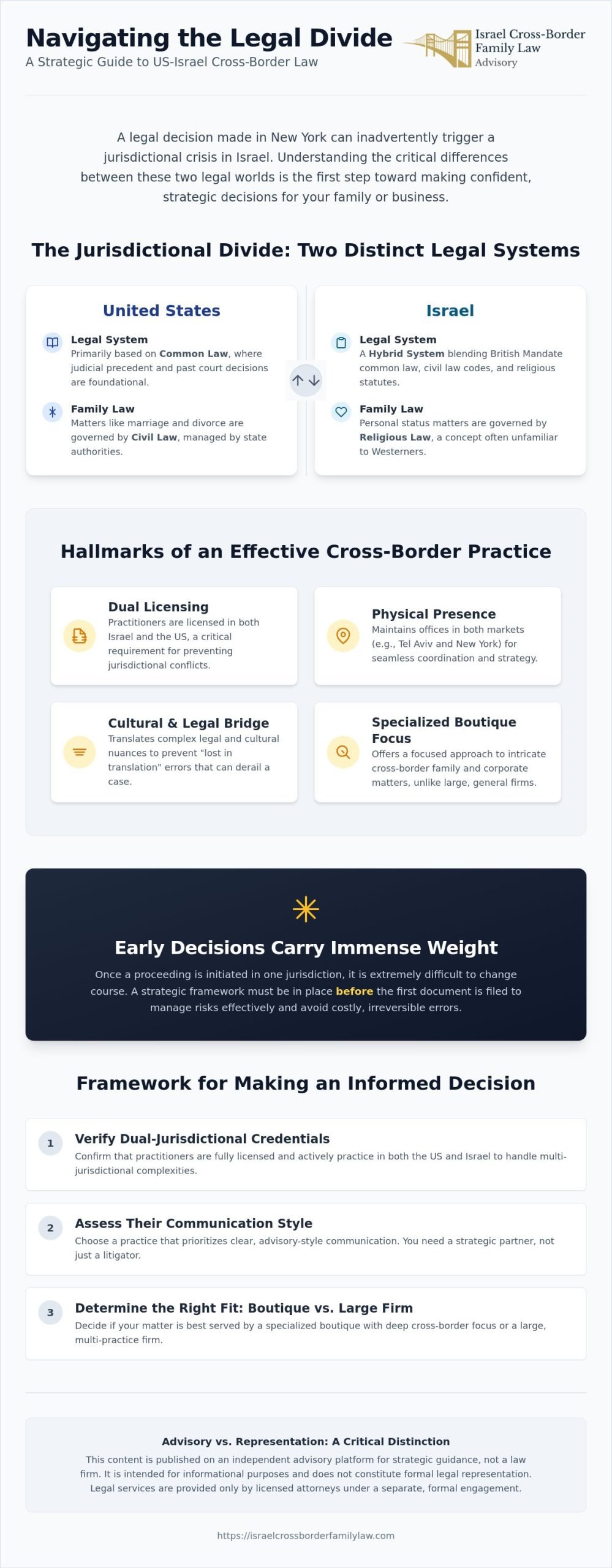
A cross-border legal practice is more than just a local firm that happens to accept international clients. In the specific context of the United States and Israel, it represents a specialized infrastructure designed to manage the friction between two distinct legal cultures. While many Law Offices in Israel focus solely on domestic litigation, a true cross-border office employs multi-qualified practitioners who are licensed to practice in both jurisdictions. This dual-licensing isn’t just a credential; it’s a tool for preventing jurisdictional conflicts before they arise.
Operating Law Offices across these borders requires a physical presence in both Tel Aviv and New York. This ensures that coordination is seamless and that legal strategies aren’t lost in translation or time-zone gaps. Unlike the massive, multi-practice firms often found in the US, Israeli offices frequently operate as specialized boutiques. This structure allows for a more focused approach to the intricate details of Israeli civil and religious law, providing a steady hand for clients who are often overwhelmed by the high stakes of international family or corporate matters.
The Bridge Between Two Legal Systems
Israeli legal practices differ significantly from those in the US. For example, Marriage laws in Israel are governed by religious authorities rather than civil ones, a concept that is often jarring for Anglos and expats. A cross-border firm acts as a bridge, translating these complex religious and civil frameworks into terms that make sense within a US legal mindset. Understanding the “IL” landscape requires more than linguistic translation; it requires a deep grasp of the cultural nuances that influence how courts in Israel perceive family dynamics and corporate governance. For those living abroad, this bridge is essential for expats and foreign nationals who need to ensure their interests are protected in both countries. This cultural alignment prevents the “lost in translation” errors that can derail a case before it even reaches a judge.
Advisory vs. Representation: Knowing the Difference
It’s vital to distinguish between a traditional law firm and an independent advisory platform. This content is published by an independent advisory platform, not a law firm, and focuses on strategy, risks, and decision-making guidance. We don’t provide formal legal representation or create attorney-client relationships through this site. Instead, we help you find clarity before you commit to any specific legal action. Seeking this neutral, risk-based guidance is often the most critical first step. It allows you to understand the weight of early decisions without the pressure of immediate litigation. Legal services are only provided by licensed attorneys under a separate, formal engagement. By focusing on strategy first, you can navigate the inherent complexity of cross-border issues with a clear framework for your next steps.
Navigating the Jurisdictional Divide: Israel vs. US Legal Systems
The gap between US common law and the Israeli legal framework is wider than many people expect. In the United States, legal systems are built on judicial precedent. Israel, however, operates on a hybrid system that blends British Mandate common law, civil law codes, and religious statutes for personal status matters. This friction often leads to confusion for those accustomed to Western legal norms. Specialized Law Offices help bridge this gap by identifying how these divergent rules impact where a case should be filed or where a company should be incorporated. When selecting between different Law Offices, it’s important to ask how they handle the procedural friction between these two systems.
Early decisions carry immense weight in cross-border litigation. Once a proceeding is initiated in one jurisdiction, it’s often extremely difficult to change course. A “one-size-fits-all” approach that works for a local domestic case often fails when international assets or family members are involved. Strategic planning must happen before the first document is filed to manage these risks effectively. This content is published on an independent advisory platform and is intended for informational purposes; it doesn’t constitute legal representation.
Cross-Border Family Law Challenges
International disputes involving children are among the most sensitive matters. Addressing the complexities of international custody and relocation requires a deep understanding of the 1980 Hague Convention on the Civil Aspects of International Child Abduction. Both the US and Israel are signatories, but their courts may interpret “habitual residence” differently. Additionally, a US prenuptial agreement isn’t always automatically valid in Israel. Under the Spouses’ Property Relations Law of 1973, agreements often require specific ratification by an Israeli court or a marriage registrar to be enforceable during a divorce.
Corporate and Transactional Nuances
For Israeli startups, moving into the US market involves more than just a business plan. It requires meeting a complex web of regulatory compliance that spans multiple jurisdictions. The US-Israel tax treaty plays a critical role here, helping businesses avoid double taxation on income earned across borders. However, compliance with the SEC in the US and the Israel Securities Authority (ISA) requires meticulous coordination. Whether you’re handling a merger or a family estate, you can reach out for a strategic overview of your situation. Understanding these nuances is the difference between a successful outcome and years of expensive litigation. By seeking clarity early, you ensure that your strategy aligns with the realities of both legal systems.
Identifying Your Specific Needs: Corporate vs. Family Law Offices
Business owners frequently encounter “family” legal issues that directly impact their commercial interests. A divorce or an inheritance dispute can jeopardize corporate assets if the legal strategy doesn’t account for cross-border enforcement from the outset. Evaluating a firm’s experience in multi-jurisdictional investigations and litigation is essential for protecting your livelihood. You need practitioners who understand how to trace assets across borders and protect business continuity during personal transitions. The weight of these early decisions cannot be overstated, as a single misstep in filing can lead to years of jurisdictional conflict.
Specialized Family Law Services
For expats and foreign nationals, navigating a divorce in Israel involves coordinating between civil courts and religious tribunals. This complexity extends to the mechanics of child support cross-border enforcement, which requires deep knowledge of international treaties. Effective estate planning for dual-citizens must also address assets in both countries to prevent probate delays. Strategic clarity is vital for protecting your global interests and ensuring your family’s future is secure.
Strategic Corporate Guidance
Handling complex deals in the technology sector requires a bridge between Israel’s innovation hub and US capital markets. Corporate Law Offices manage these moving parts, from SEC filings to Israeli tax approvals. This content is provided by an independent advisory platform and does not constitute legal representation. Always seek neutral, risk-based guidance before committing to a specific corporate structure or cross-border merger. Identifying your specific needs early allows for a more collaborative approach with your existing professional teams.
How to Choose the Right US-Israel Law Office
Selecting the right legal partner from the various Law Offices in Israel requires looking beyond local rankings or generic marketing. You need a practitioner who functions as a strategic bridge between two distinct legal systems. It’s essential to verify that the firm holds active multi-jurisdictional licensing. This ensures they can navigate the procedural requirements of both the US and Israel without relying on third-party translations that may miss critical nuances. A physical presence in both Tel Aviv and New York is equally vital; it facilitates real-time coordination and ensures that your legal team is accessible in the markets where your assets or family interests reside.
Communication style is another critical factor. A firm’s ability to explain the Israeli legal framework in plain English, without relying on excessive jargon, indicates a deep understanding of the “Anglo” expat experience. You should also look for a collaborative mindset. The best cross-border practitioners don’t seek to replace your existing local professional teams in the US; instead, they work alongside them as partners. Transparency regarding pricing and engagement models is also a non-negotiable requirement. Prioritize firms that emphasize strategy and risk assessment over aggressive promises. In the complex world of international law, clarity and honesty about potential risks are far more valuable than unverified guarantees of success. Finding the right Law Offices means choosing a team that values your long-term stability over a quick win.
Key Questions for Your Initial Consultation
Preparing the right questions for your first meeting can save you months of confusion. Ask specifically how they handle the conflict between US and Israeli law in your particular case. Inquire about their direct experience with the specific court or regulatory body involved, as the Israeli family court system operates differently than the rabbinical courts. Finally, ask how they plan to coordinate with your advisors in the other jurisdiction to prevent conflicting legal strategies. These answers will reveal whether the firm has the multi-jurisdictional depth your case requires.
The Value of an Advisory-First Approach
This platform operates as an independent advisory service, focusing on strategy and decision-making rather than formal legal representation. We believe a confidential case review provides significantly more value than a generic sales pitch. Early strategic planning allows you to identify jurisdictional risks before they become insurmountable obstacles, often leading to substantial long-term cost savings. Choosing a guide who understands the innovation culture of both Israel and the US ensures your legal strategy aligns with your commercial or personal goals. If you are seeking clarity on your cross-border matters, contact us to schedule a strategic consultation and begin your path toward an informed decision.
Conclusion: Seeking Clarity Before Commitment
Managing legal affairs across the US-Israel divide is not merely a matter of doubling your efforts. It’s a task that requires navigating the deep procedural and cultural friction between two fundamentally different systems. As we’ve explored, the weight of early decisions in these matters is immense. Whether you’re dealing with the division of global assets in a divorce or the regulatory hurdles of a corporate merger, the rules change significantly once you cross the Atlantic. Specialized Law Offices that maintain a physical presence in both Tel Aviv and New York provide the essential bridge needed to manage these complexities without losing strategic ground.
The structural differences between the legal frameworks in the US and Israel mean that a “standard” approach often fails. Israel’s hybrid system requires a nuanced understanding of how religious and civil laws intersect, a concept that can be jarring for those accustomed to US common law. Acting without a clear, multi-jurisdictional strategy often leads to jurisdictional traps that are both expensive and difficult to reverse. Seeking neutral, expert guidance is the most effective way to identify these risks before they become insurmountable obstacles. By prioritizing strategy over immediate action, you ensure that your path forward is built on a foundation of clarity rather than guesswork.
Ultimately, the goal of a cross-border practitioner is to act as a steady guide through a challenging landscape. Choosing Law Offices that value collaboration and transparent communication allows you to maintain control over your international interests. This advisory-led approach ensures that your legal decisions align with your long-term commercial and personal objectives in both nations. Before you commit to a specific course of action, take the time to understand the full scope of your jurisdictional risks.
Resources for Further Learning
- Explore educational videos on the Israel Family Law YouTube channel to see these concepts in practice.
- Understand how the advisory process works and how it differs from traditional representation.
- Review the importance of Hague Convention clarity for international family disputes.
Disclaimer and Next Steps
The content provided in this article is for informational and educational purposes only. It is published on an independent advisory platform and does not constitute legal advice or formal legal representation. A professional attorney-client relationship is only established through a separate, formal engagement with a licensed attorney. We focus on providing the strategy and risk assessment you need to make informed decisions in a complex global market. Get clarity before you commit. Request a confidential consultation.
Securing Your Future Across Borders
Navigating the legal divide between the US and Israel is a high-stakes endeavor that demands a proactive strategy. You now understand that jurisdictional risks aren’t just theoretical; they’re practical obstacles that can derail international assets or family stability if they aren’t managed by practitioners licensed in both regions. Identifying specialized Law Offices that maintain a physical presence in both Tel Aviv and New York is the most effective way to ensure your interests are protected without cultural or procedural confusion.
This platform provides authoritative, neutral guidance designed to help you make informed decisions before you engage in formal representation. By prioritizing strategy and risk assessment, you avoid the common pitfalls of a one-size-fits-all approach. We focus on providing the clarity you need to handle complex family and corporate matters with confidence. Your path toward a successful cross-border resolution begins with understanding the weight of your early choices. We’re here to help you bridge the gap between these two legal worlds.
Get clarity before you commit. Request a confidential consultation.
Frequently Asked Questions
What is the difference between a US law office and an Israeli law office?
The primary difference lies in the legal framework each office follows. US offices operate within a common law system based on judicial precedent. Israeli offices navigate a hybrid system that includes civil law codes and religious statutes for personal status matters. This means that issues like marriage and divorce in Israel are often handled by religious courts, a concept that doesn’t exist in the US civil system.
Can an Israeli lawyer represent me in a US court?
An Israeli lawyer can only represent you in a US court if they are also admitted to the bar in that specific US state. Many cross-border Law Offices prioritize hiring practitioners with dual-licensing. This ensures they can manage filings and litigation in both jurisdictions without the need to engage separate local counsel for every procedural step.
How do cross-border law offices handle fees in two different currencies?
Most international firms utilize multi-currency accounts to process payments in both US Dollars and Israeli Shekels. It’s standard practice to define the currency and exchange rate expectations within the engagement agreement. This transparency helps avoid confusion regarding currency fluctuations during long-term family or corporate matters.
Is a US prenuptial agreement valid in the Israeli family court system?
A US prenuptial agreement isn’t automatically valid in Israel. Under the Spouses’ Property Relations Law of 1973, foreign agreements often require formal ratification by an Israeli court or marriage registrar to be enforceable. Without this specific legal step, the agreement may not be recognized during the division of assets in an Israeli jurisdiction.
What should I look for in a lawyer if I have assets in both Israel and the US?
You should prioritize a lawyer who understands the US-Israel tax treaty and has experience managing multi-jurisdictional estates. It’s essential to find a practitioner who can coordinate with your existing financial teams to ensure asset transfers don’t trigger unexpected tax liabilities. A physical presence in both markets is often a sign of the necessary regional proficiency.
How does the US-Israel tax treaty affect my corporate legal strategy?
The treaty is designed to prevent double taxation on income earned in both countries, which is a cornerstone of any cross-border business plan. Your legal strategy must align with these provisions to ensure that your corporate governance remains compliant with both Israeli regulations and US standards. This coordination is vital for startups looking to enter the US market successfully.
Can a law office in Tel Aviv help with US SEC compliance for my startup?
Yes, provided the firm employs attorneys licensed in the US with specific expertise in securities law. These Law Offices act as a bridge, helping Israeli innovation hubs meet the rigorous reporting and compliance requirements of the US capital markets. This specialized support is critical for maintaining regulatory standing during international expansions.
What happens if a child support order from the US needs to be enforced in Israel?
The US order must be formally recognized by an Israeli Family Court through a process defined by the Foreign Judgments Enforcement Law of 1958. This isn’t an automatic transfer of authority. The Israeli court must verify that the order was issued by a competent court and that the defendant received a fair opportunity to present their case before the order is enforced locally.

Article by
Gabriel Lior
A Personal Journey That Became a Mission
The advisory was founded by an American father Gabriel Lior, LLB, MBA , global entrepreneur, and cross-border advisor who spent more than a decade navigating the Israeli family court system firsthand and now lives in Singapore with his son.
As a divorced parent in a cross-border family, Gabriel faced nearly every legal challenge a foreign parent can encounter in Israel — including child custody disputes, child support proceedings, property matters in Israel and abroad, false accusations, and complex immigration and relocation proceedings.
Over the years, he learned the hard way how difficult it is for non-Israeli parents to understand the system, identify the right legal strategy, and choose the right legal representation — especially when language, culture, and jurisdictional differences are involved. He also witnessed how foreign parents and new immigrants are often disadvantaged or taken advantage of by service providers and institutions simply because they lack local knowledge or fluency.
From Client to Advisor
To truly understand — and survive — the system, Gabriel pursued formal legal education in Israel, completing two Israeli law degrees, alongside a BA and MBA earned in the United States. This was never about becoming a practicing attorney, but about gaining a deep, structural understanding of how the system works — and where it breaks down for foreign parents.
This rare combination of:
Firsthand client experience
Israeli legal and US business education
International business and negotiation training
Decades of commercial execution
created a unique perspective – one that understands both sides of the table.
After years of litigation, persistence, and at times self-representation, he ultimately succeeded in securing custody of his son and relocating abroad through a rare legal victory in the Israeli Supreme Court — becoming one of the first fathers in Israel to do so under these circumstances.
Disclaimer
Important Disclaimer:
The information provided on this website and in its content is for general informational and educational purposes only and does not constitute legal advice, legal opinion, or legal representation.
Gabriel Lior is not licensed to practice law in Israel (nor is he interested in doing so) and does not provide legal services, despite having completed 2 Law Degrees. The services offered are advisory in nature and are intended to provide general guidance, strategic insight, and information regarding cross-border family law considerations.
No attorney-client relationship is formed by accessing this website, reading its content, or communicating with us.
Any decisions made based on this information are at your own discretion and risk. For legal advice specific to your situation, you should consult a licensed attorney in the relevant jurisdiction.
Where appropriate, we may refer clients to independent, licensed attorneys or professionals. Such referrals do not constitute legal representation and no liability is assumed for services provided by third parties.