This content is published on an independent advisory platform and does not constitute formal legal representation or an attorney-client relationship. It is intended for informational and advisory purposes regarding strategy, risks, and decision-making guidance.
What if the legal standing of a bastard child shifted dramatically the moment they crossed an international border? For many expats and international families, the term carries a specific civil meaning in the US, yet it triggers a completely different set of religious and legal consequences in Israel. You likely feel a sense of uncertainty when trying to reconcile Western legal standards with the unique, multi-jurisdictional requirements of the Israeli family court system.
This article provides the clarity you need to understand the legal distinctions, rights, and cross-border complexities for children born outside of marriage. We will examine how Israeli law handles paternity and support differently than the US, while addressing the specific fears surrounding the Mamzer label and the Rabbinical courts. By the end of this guide, you will have a clear preview of inheritance rights, the weight of early legal decisions, and the actionable steps necessary to establish paternity in a transnational context.
Key Takeaways
- Understand why the term bastard child is legally obsolete in the US while the “Mamzer” label remains a complex religious reality in Israel.
- Discover how Israeli law protects the inheritance and financial support rights of children born outside of marriage, regardless of their parents’ marital status.
- Learn the critical distinction between a child born to single parents and the specific, high-risk religious status of “Mamzer” under Jewish law.
- Identify the mandatory legal requirements for DNA paternity testing in Israel and why private tests are inadmissible in court.
- Gain strategic insight into why a civil-first legal approach is often the safest path for international families navigating these complex systems.
Defining “Bastard Child” in Modern US and Israeli Law
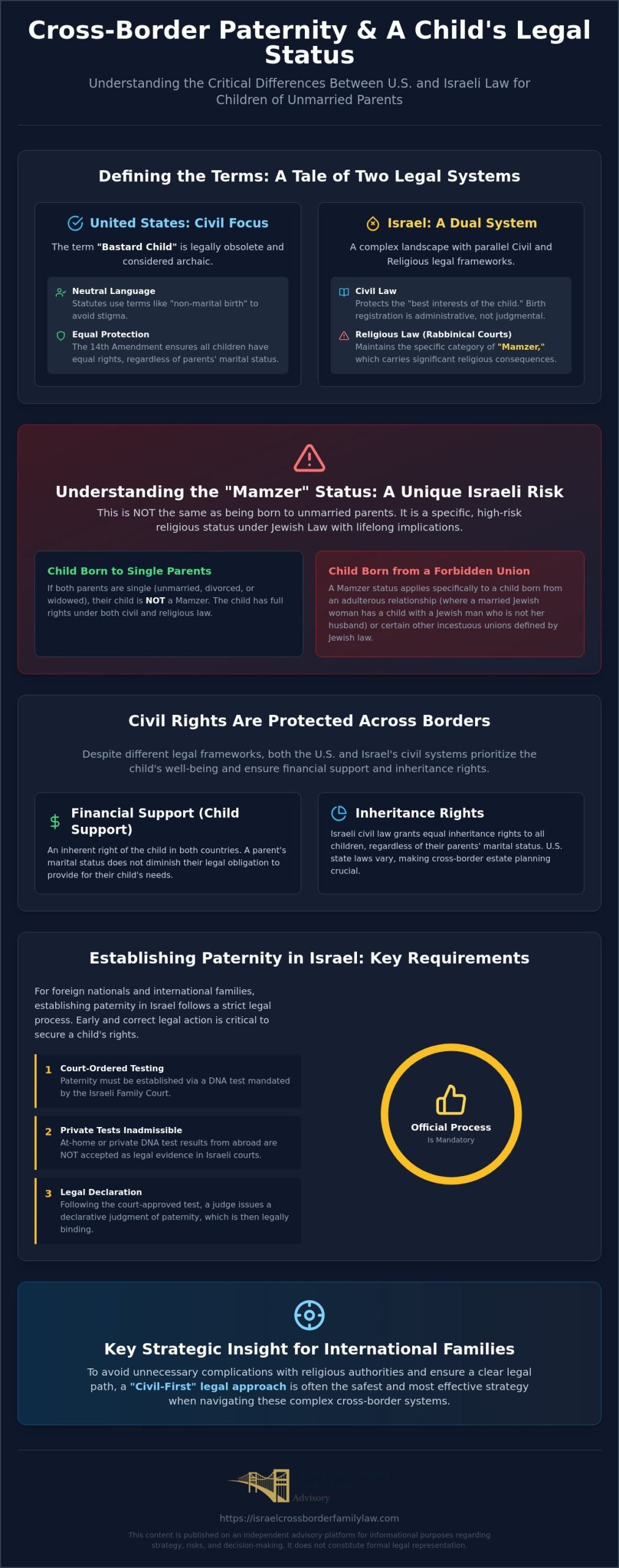
The term bastard child has largely vanished from modern American legal statutes, replaced by neutral descriptors like “non-marital birth.” This shift reflects a broader legal evolution toward protecting children from the stigma of their parents’ marital status. In the United States, the focus remains entirely on the child’s civil rights, ensuring that birth circumstances don’t dictate legal standing. However, when dealing with cross-border matters between the US and Israel, terminology becomes a critical factor in how documents are interpreted by various authorities.
Israel presents a more complex landscape where civil registration and religious status exist in parallel. While the state’s civil authorities provide equal protections, the Rabbinical courts maintain a specific category known as Mamzer for children born from specific forbidden unions. Understanding these distinctions is vital for expats and foreign nationals moving between jurisdictions, as terminology used in one country can have unintended consequences in the other.
To better understand the historical context of this concept, watch this helpful video:
The US Perspective on Non-Marital Births
American courts operate under the principle that all children deserve equal protection under the law, a right rooted in the 14th Amendment. The Uniform Parentage Act has been adopted by many states to streamline how paternity is established. This ensures that a child’s rights to support and inheritance are not tied to a marriage certificate. In this framework, the term “illegitimate” is legally dead; the focus is solely on the biological or legal link between parent and child. This civil-first approach prioritizes the child’s financial and social stability above the parents’ relationship status.
The Israeli Civil Framework for Children
In Israel, the civil legal system is governed by the principle of the “best interests of the child.” This standard often overrides other considerations in family court proceedings. The Ministry of Interior registers children born to unmarried parents without using derogatory labels, focusing on the administrative reality of the birth. It’s essential to recognize that “illegitimacy” is a social term rather than a civil legal category in Israel. However, the registration of a bastard child in a foreign document can occasionally prompt inquiries from Israeli religious authorities if the parents are Jewish. This highlights the need for strategic planning in cross-border documentation to avoid unnecessary scrutiny from religious tribunals that may view the child’s status through a different lens.
Civil Rights: Support and Inheritance Across Borders
Civil rights for children born outside of marriage are robust in both the United States and Israel, though the mechanisms for enforcing these rights differ. While the social label of a bastard child may still carry weight in certain communities, the legal systems in both nations prioritize the child’s financial well-being. The right to financial support is an inherent right of the child, not a privilege of the parents. This distinction ensures that a parent’s marital status doesn’t diminish their obligation to provide for their offspring’s needs, regardless of where the child resides. In the transition from the definitions discussed in the previous section to tangible protections, the law focuses on biological and legal parentage rather than the parents’ relationship status.
For international families, the intersection of US state laws and Israeli national law creates a layer of complexity that requires careful strategy. US state laws vary significantly regarding how non-marital children are treated in estate planning, which can lead to unexpected results when assets are held in Israel. If you are managing assets across these borders, it’s helpful to seek a strategic review of your current estate plans to ensure all heirs are protected.
Enforcing Child Support Between the US and Israel
Enforcement of support orders across borders relies heavily on international treaties. The Hague Convention on the International Recovery of Child Support provides a streamlined process for recognizing and enforcing US orders in Israeli courts. Israeli family courts generally respect US child support orders for children born out of wedlock, provided the orders meet specific procedural requirements. You can learn more about these processes by reviewing the guidelines for child support cross-border enforcement. This treaty-based approach reduces the need for relitigating support amounts in a second country, saving families time and legal expenses.
Inheritance Rights and Estate Complexity
The Israeli Succession Law of 1965 establishes a clear baseline: all biological children have equal inheritance rights. Unlike some jurisdictions that may historically differentiate based on birth circumstances, Israeli law protects the rights of a child even if they were historically labeled a bastard child. However, conflicts often arise when an expat dies with a US-based will that doesn’t account for Israeli property. The tension between religious definitions and modern civil rights is explored in depth in research regarding The Fate of a Mamzer, which highlights how Israeli courts often lean toward civil protections. To prevent costly litigation, international families should maintain a dual-jurisdiction estate plan. This ensures that the biological child’s rights are recognized by both the local probate court in the US and the Registrar of Inheritance Affairs in Israel.
The Mamzer Status: A Unique Israeli Legal Risk
While a bastard child in the United States simply refers to a child born out of wedlock, Israel’s legal system introduces a far more restrictive and high-stakes category: the Mamzer. This status is not a generic term for all non-marital births. In Jewish law, a Mamzer is specifically a child born from an adulterous union between a married woman and a man who is not her husband, or from an incestuous relationship. It’s vital to understand that a child born to two single parents is not a Mamzer; they are legally equivalent to any other child in the eyes of both civil and religious authorities.
The primary consequence of this status is a severe restriction on the right to marry. Because Israel does not have a system for civil marriage for Jewish citizens, all marriages are governed by the Chief Rabbinate. An individual designated as a Mamzer is prohibited from marrying most other Jews, creating a lifelong legal and social barrier. The intersection of religious law and civil rights creates significant modern problems of mamzer status in Israel, particularly when paternity is questioned in a way that might expose an adulterous origin.
Why Religious Status Matters for Expats
Expats often assume that their foreign citizenship or secular lifestyle shields them from religious jurisdiction. However, the Rabbinical Court holds exclusive authority over the personal status of Jewish residents in Israel. If a child’s lineage is questioned, the court may place their name on a “delayed marriage” list, which functions as a restrictive database. This isn’t just a religious formality; it has profound emotional and social implications for families who find their children’s future options limited by a status they didn’t choose.
Mitigating the Risk of a Mamzer Label
Strategy is paramount when navigating these risks. Israeli law includes a “300-day rule,” which presumes a child born within 300 days of a divorce is the offspring of the ex-husband. While this may seem counterintuitive, it’s a protective legal maneuver designed to prevent the child from being labeled a bastard child of an adulterous union. Before initiating any paternity claim or DNA test in Israel, you must seek clarity on how the Rabbinical courts might interpret the results. Legal practitioners often employ specific strategies, such as challenging the validity of the mother’s original marriage, to bypass the Mamzer designation entirely and protect the child’s future rights.
Establishing Paternity in Israel for Foreign Nationals
Establishing paternity in Israel involves a rigorous legal process that differs significantly from the administrative procedures common in the United States. While a US citizen might use a voluntary acknowledgment of paternity to secure rights for a bastard child, Israeli authorities require a formal judicial decree. This requirement is rooted in the Genetic Information Law, which mandates that any DNA paternity test must be authorized by a court order. This law serves as a safeguard to ensure that genetic testing is conducted ethically and with full consideration of the child’s future legal standing.
The Israeli Family Court must strike a delicate balance between a child’s right to know their biological heritage and the potential religious risks involved. Building on our previous discussion of the Mamzer status, the court is legally obligated to protect children from lifelong marriage restrictions. Israeli courts may refuse a paternity test if it risks labeling a child as a Mamzer. This protective stance often surprises foreign nationals who expect the court to prioritize biological truth over religious implications. In the US, the status of a bastard child is primarily a civil matter of support, but in Israel, the paternity process is the gateway to both civil rights and religious identity.
The Legal Process for a Paternity Claim
To begin, a party must file a lawsuit for paternity within the Israeli Family Court. The Attorney General’s office is automatically involved in these cases to represent the public interest and ensure the child’s welfare is protected. This involvement often includes a review of the parents’ marital history to assess the risk of “Mamzerut” before any testing is approved. If you are navigating these requirements as an expat, reviewing the specific guidelines for expats and foreign nationals can help you understand the procedural timeline and state involvement.
Cross-Border Paternity Challenges
Foreign nationals often face hurdles when trying to reconcile US legal documents with Israeli requirements. A US birth certificate or a state-issued acknowledgment of paternity may not be sufficient for the Israeli Ministry of Interior to grant citizenship or residency. For US citizens seeking to establish their child’s Israeli citizenship, the court may require a “social worker” evaluation, known as a tazkir, to assess the family’s situation. This evaluation, combined with the mandatory court-ordered DNA test, ensures that the legal link is indisputable across both jurisdictions. Because these cases involve multiple legal systems and conflicting philosophies, it is essential to request a confidential consultation to discuss your specific circumstances.
Strategy and Decisions: Navigating Cross-Border Complexity
The legal trajectory of a bastard child in a cross-border context is often determined by the very first steps taken by the parents. Decisions made in a US state court regarding paternity or child support can have significant downstream effects when those documents reach Israeli authorities. Because the Israeli legal system operates with parallel civil and religious tracks, a proactive strategy is required to ensure that a child’s civil rights are secured without inadvertently triggering religious complications. Anglo families often find that a “civil-first” strategy, which prioritizes the Israeli Family Court over religious tribunals, provides the most predictable environment for resolving these sensitive matters.
Choosing the correct forum is perhaps the most critical decision in any US-Israel family law case. While the Rabbinical Court has jurisdiction over marriage and divorce, the Family Court offers a civil framework that is generally more aligned with Western legal expectations. By initiating proceedings in the Family Court, parents can often lock in support and inheritance rights while maintaining a degree of separation from the religious scrutiny that could lead to a Mamzer designation. This strategic choice helps protect a child’s future marriage and inheritance rights simultaneously, ensuring that their status as a bastard child in one jurisdiction does not become a permanent legal barrier in the other.
The Role of International Advisory
Effective strategy must always precede legal action. For international families, this means understanding the multi-jurisdictional implications of every filing before a single document is submitted to a court. A cross-border perspective allows families to anticipate how the Ministry of Interior or the Rabbinate will interpret US divorce decrees or paternity acknowledgments. You can explore the details of this strategic approach by reviewing how it works within a professional advisory framework. This level of planning is essential for navigating the inherent complexity of divergent legal cultures.
Next Steps for Families
If you are managing a family matter that spans the US and Israel, gathering the correct documentation is the first practical step. This typically includes:
- Certified copies of divorce decrees and settlement agreements.
- Birth certificates and any voluntary acknowledgments of paternity from the US.
- Documentation regarding the timing of births relative to previous marriages.
- Records of any existing child support orders or inheritance claims.
It is helpful to consult with practitioners who are licensed in multiple legal systems and understand the nuances of both US state laws and Israeli national statutes. This ensures that your legal strategy is cohesive and accounts for the weight of early decisions. Get clarity before you commit. Request a confidential consultation to discuss the risks and strategic options for your family.
This content is published on an independent advisory platform and does not constitute formal legal representation or an attorney-client relationship. Legal services are only provided by licensed attorneys under a separate engagement.
Securing Your Family’s Future Across Borders
Navigating the intersection of US and Israeli law requires more than just an understanding of separate legal codes; it demands a cohesive strategy that accounts for the multi-jurisdictional risks inherent in international family life. While the civil rights of a bastard child regarding support and inheritance are robustly protected in both nations, the unique religious implications of the Mamzer status in Israel necessitate a careful, “civil-first” approach. By prioritizing the Israeli Family Court and seeking clarity before initiating paternity claims, you can safeguard your child’s future marriage and legal standing.
As an independent advisory platform specializing in multi-jurisdictional risks, we focus on protecting the best interests of Anglo and expat families through established expertise in US-Israel cross-border family law strategy. This content is provided for informational purposes and does not constitute formal legal representation. Every family situation is unique, and the weight of early decisions cannot be overstated. Get clarity before you commit. Request a confidential consultation. You don’t have to navigate these complex legal landscapes alone.
Frequently Asked Questions
Is a child born out of wedlock considered a “bastard” in Israel?
No, Israeli civil law doesn’t use the term bastard child or recognize “illegitimacy” as a legal category. Children born to unmarried parents are registered neutrally by the Ministry of Interior without any discriminatory labels. The only restrictive status is “Mamzer,” which applies only to specific prohibited unions rather than simple non-marital births. Most children born out of wedlock in Israel enjoy full legal standing and civil rights.
Can a child born out of wedlock inherit from their father in Israel?
Yes, biological children born out of wedlock have the same inheritance rights as those born within a marriage. The Israeli Succession Law of 1965 ensures equality among all biological heirs regardless of the parents’ marital status. To claim these rights, you must first secure a legal declaration of paternity through the Family Court. Once paternity is established, the child is legally entitled to their share of the father’s estate.
What is a Mamzer and how is it different from being born out of wedlock?
A Mamzer is a child born specifically from an adulterous or incestuous union, whereas a child born to single parents is not. This is a critical distinction in the Israeli legal system. While a bastard child in Western culture often refers to any non-marital birth, the Mamzer status is a specific religious designation. It primarily affects the individual’s ability to marry within the Jewish community in Israel due to Rabbinical restrictions.
Can I use a US DNA test to prove paternity in an Israeli court?
No, Israeli courts don’t accept private or foreign DNA tests for legal paternity purposes. Under the Genetic Information Law, you must obtain a specific court order from an Israeli Family Court to conduct testing. The procedure is performed at one of the authorized laboratories in Israel, such as those at major hospitals. The court oversees this process to protect the child’s welfare and ensure results meet strict evidentiary standards.
Will my child have US citizenship if they are born out of wedlock in Israel?
US citizenship isn’t automatic but can be transmitted if the US parent meets specific legal requirements. The US citizen parent must have been physically present in the US for a required period before the birth. They must also legally acknowledge paternity and agree in writing to provide financial support until the child reaches age 18. You should apply for a Consular Report of Birth Abroad (CRBA) to formalize this status.
What happens if the father refuses to acknowledge a child born out of wedlock?
You can file a paternity lawsuit in the Family Court to compel legal recognition. The court holds the authority to order a DNA test even without the father’s consent or cooperation. If the father refuses to comply with the court-ordered test, the judge can interpret that refusal as a legal presumption of paternity. This mechanism ensures the child’s right to support and inheritance is protected despite a parent’s resistance.
Does the Rabbinical Court have authority over children of non-Jewish expats?
The Rabbinical Court generally only has jurisdiction over individuals who are recognized as Jewish according to religious law. For non-Jewish expats, personal status matters like paternity and support are handled by the civil Family Court or the relevant religious tribunal of their own faith. Most international families find that the civil Family Court provides a more predictable and neutral forum for resolving these cross-border disputes.
How can I enforce child support from a father living in the US?
You can enforce support through the Hague Convention on the International Recovery of Child Support. This international treaty provides a streamlined framework for recognizing and enforcing Israeli support orders in the US. The process involves coordinating with the Israeli Ministry of Justice and the relevant US state enforcement agency. This multi-jurisdictional cooperation ensures that financial obligations are met even when the parents reside in different countries.

Article by
Gabriel Lior
A Personal Journey That Became a Mission
The advisory was founded by an American father Gabriel Lior, LLB, MBA , global entrepreneur, and cross-border advisor who spent more than a decade navigating the Israeli family court system firsthand and now lives in Singapore with his son.
As a divorced parent in a cross-border family, Gabriel faced nearly every legal challenge a foreign parent can encounter in Israel — including child custody disputes, child support proceedings, property matters in Israel and abroad, false accusations, and complex immigration and relocation proceedings.
Over the years, he learned the hard way how difficult it is for non-Israeli parents to understand the system, identify the right legal strategy, and choose the right legal representation — especially when language, culture, and jurisdictional differences are involved. He also witnessed how foreign parents and new immigrants are often disadvantaged or taken advantage of by service providers and institutions simply because they lack local knowledge or fluency.
From Client to Advisor
To truly understand — and survive — the system, Gabriel pursued formal legal education in Israel, completing two Israeli law degrees, alongside a BA and MBA earned in the United States. This was never about becoming a practicing attorney, but about gaining a deep, structural understanding of how the system works — and where it breaks down for foreign parents.
This rare combination of:
Firsthand client experience
Israeli legal and US business education
International business and negotiation training
Decades of commercial execution
created a unique perspective – one that understands both sides of the table.
After years of litigation, persistence, and at times self-representation, he ultimately succeeded in securing custody of his son and relocating abroad through a rare legal victory in the Israeli Supreme Court — becoming one of the first fathers in Israel to do so under these circumstances.
Disclaimer
Important Disclaimer:
The information provided on this website and in its content is for general informational and educational purposes only and does not constitute legal advice, legal opinion, or legal representation.
Gabriel Lior is not licensed to practice law in Israel (nor is he interested in doing so) and does not provide legal services, despite having completed 2 Law Degrees. The services offered are advisory in nature and are intended to provide general guidance, strategic insight, and information regarding cross-border family law considerations.
No attorney-client relationship is formed by accessing this website, reading its content, or communicating with us.
Any decisions made based on this information are at your own discretion and risk. For legal advice specific to your situation, you should consult a licensed attorney in the relevant jurisdiction.
Where appropriate, we may refer clients to independent, licensed attorneys or professionals. Such referrals do not constitute legal representation and no liability is assumed for services provided by third parties.