A remote court hearing isn’t just a high-definition video call; it’s a formal legal proceeding where a single technical glitch or a misunderstanding of local etiquette can jeopardize your entire case. When you’re navigating a US-Israel cross-border matter, the stakes are even higher due to significant time zone differences and the unique procedural demands of each jurisdiction. You’re likely concerned about technical failures during your testimony or how to communicate privately with your lawyer while on camera. It’s natural to feel uneasy when the weight of early legal decisions depends on a stable internet connection and your ability to follow foreign court protocols.
We’re here to help you gain the confidence needed for a successful virtual appearance. This guide explains exactly how to prepare for a remote court hearing by mastering the technical, procedural, and strategic requirements of international litigation. You’ll learn how to navigate the current “special state of emergency” in Israeli courts, select the right platform like Zoom for Government or Microsoft Teams, and manage the cultural nuances of cross-border testimony. We’ll provide a clear roadmap to ensure your setup is flawless and your legal strategy remains the primary focus throughout the proceedings.
Key Takeaways
- Learn why using a laptop and a hardwired internet connection is essential for maintaining a stable and professional presence during international proceedings.
- Understand the subtle differences between US and Israeli judicial styles to better anticipate questioning and manage your delivery while on camera.
- Discover how to prepare for a remote court hearing by organizing digital evidence and establishing clear communication protocols with your legal team.
- Maintain professional courtroom etiquette, including full business attire and controlled body language, to signal respect for the court regardless of your physical location.
- Recognize the weight of early procedural decisions in cross-border cases and why strategic planning should begin long before you receive the virtual meeting link.
The Shift to Virtual: Why Remote Hearings are Standard in US-Israel Cases
Remote hearings have evolved from a temporary necessity into a permanent fixture of cross-border litigation. For families and businesses operating between the United States and Israel, the ability to appear via video link eliminates the significant financial burden of transcontinental travel and the logistical delays of securing international flights. This shift is part of a broader global trend toward Online Dispute Resolution (ODR), where technology streamlines the delivery of justice across borders. In 2026, both the US Supreme Court and Israeli judicial authorities have issued guidelines confirming that remote hearings are legally equivalent to in-person proceedings. However, the decision to request a virtual appearance should be made strategically, weighing the convenience of your location against the specific needs of your case.
To gain a practical perspective on the environment you will encounter, watch this helpful video:
It’s a common misconception that a virtual setting allows for a more relaxed atmosphere. On the contrary, a screen does not diminish the authority of the bench. Judges expect the same level of decorum, procedural adherence, and punctuality as they would in a physical courtroom. When considering how to prepare for a remote court hearing, you must treat your home or office as an extension of the court itself. While remote testimony saves time, certain high-stakes cross-examination scenarios might still benefit from a physical presence, depending on the judge’s preference and the complexity of the evidence involved.
Navigating the Time Zone Challenge
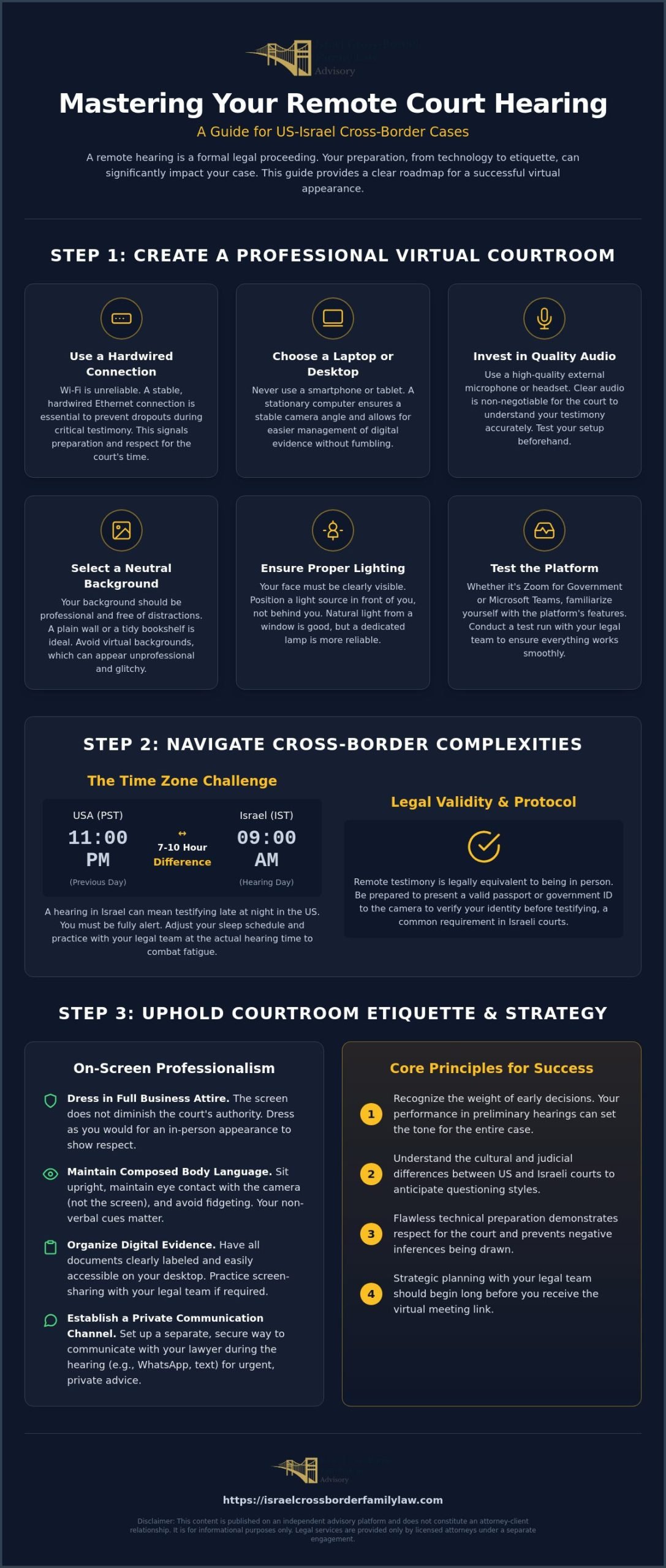
The 7 to 10-hour difference between Israel and the US poses a unique challenge for international litigants. A hearing scheduled for 9:00 AM in Jerusalem may require a participant in California to be fully alert at 11:00 PM the night before. Staying alert during ‘after-hours’ testimony is critical; late-night fatigue can lead to imprecise answers or a lapse in composure. We advise scheduling preparation sessions with your multi-jurisdictional legal team that mimic the actual hearing time to help your body adjust to the unconventional hours. Managing these logistical hurdles is a central part of how to prepare for a remote court hearing effectively.
Legal Validity of Remote Testimony
Cross-border evidence rules are applied strictly to video testimony to ensure the integrity of the record. In 2026, Israeli courts operating under a “special state of emergency” have expanded the use of video conferencing, but they maintain rigorous standards for verifying the identity of remote participants. You’ll often be required to present a valid passport or government ID directly to the camera before testimony begins. For those navigating these systems as expats and foreign nationals, understanding these procedural hurdles is the first step toward a successful outcome.
Disclaimer: This content is published on an independent advisory platform and does not constitute an attorney-client relationship. Legal services are only provided by licensed attorneys under a separate engagement.
Technical Readiness: Creating a Professional Virtual Courtroom
Technical failure during testimony is more than just a minor inconvenience. It can lead to the court drawing negative inferences about your preparation or, worse, result in significant delays that stall your case for months. Understanding how to prepare for a remote court hearing involves transforming your physical space into a professional extension of the courtroom. This requires a shift in mindset; you aren’t just joining a call, you are appearing before a judicial officer where every detail of your presentation impacts your credibility.
Your hardware choice is the foundation of this professional presence. A laptop or desktop computer is vastly superior to a mobile phone or tablet. Computers provide the necessary stability and screen real estate to view shared digital exhibits while simultaneously keeping the video feed of the judge and counsel active. Handheld devices often lead to “camera shake” and limited functionality, which can appear unprofessional and distracting to the bench. For audio, we recommend using a dedicated headset with a microphone rather than built-in computer speakers. This setup prevents echo and ensures that the court reporter can capture every word of your testimony clearly for the official record.
Internet stability is equally critical, especially when crossing transatlantic servers. While Wi-Fi is convenient, it is prone to interference. The US Court of International Trade specifically recommends using a hardwired ethernet connection to ensure a consistent, high-quality stream. If you are unsure whether your current technical setup meets the requirements for an upcoming cross-border matter, you may want to request a review of your procedural strategy to identify potential risks early.
The ‘Dry Run’ Protocol
Success in a virtual hearing is often determined 48 hours before the link is even clicked. You must test the specific platform required by the court, whether it is Zoom for Government, Microsoft Teams, or a specific Israeli court interface. During this test, verify your camera angle; your eyes should be level with the lens, not the screen. This ensures that when you speak, you are making “eye contact” with the judge. Additionally, ensure all operating system and software updates are completed well in advance to avoid an untimely reboot on the morning of the hearing.
Redundancy Planning
In international litigation, you must plan for the unexpected. We advise having a redundancy plan that includes a secondary device, such as a fully charged tablet, and a secondary internet source like a mobile hotspot. If your primary connection drops, you should have a pre-arranged emergency protocol with your legal team. This usually involves a quick transition to the backup device or a specific phone number to call into the audio portion of the hearing immediately. Maintaining composure during a technical glitch is part of demonstrating your readiness for the complexities of a cross-border case.
This content is published on an independent advisory platform for informational purposes and does not constitute legal representation or formal legal advice.
Remote Courtroom Etiquette: Professionalism from Your Screen
The transition from a physical courtroom to a digital one doesn’t lower the standards of conduct expected by the bench. In fact, because a camera lens magnifies facial expressions and posture, your non-verbal cues are often more scrutinized than they would be in person. Understanding how to prepare for a remote court hearing requires a commitment to maintaining a high level of decorum, even if you are participating from your home office. This professionalism signals to the judge that you respect the legal process and the weight of the decisions being made, regardless of your geographic location.
Your attire should reflect this respect. We advise wearing full professional business clothing, just as you would for an in-person appearance in Jerusalem or New York. While it’s tempting to dress formally only from the waist up, appearing in full professional attire helps you maintain a psychological state of readiness. If you must stand up for any reason, such as to show a document to the camera, you don’t want to compromise your credibility with casual clothing. Consistency in your presentation reinforces your position as a serious participant in the proceedings.
Managing your environment is equally vital. Notification sounds, incoming emails, and household distractions like pets or children can disrupt the flow of a hearing and frustrate a judge. You should disable all digital alerts and ensure you are in a quiet, lockable space. If you are looking for visual examples of appropriate conduct and setup, you can reference the Israel Family Law YouTube channel for guidance on navigating these cross-border environments.
Addressing the Bench
Interaction protocols in a virtual setting require discipline. In US courts, the standard address is “Your Honor,” while in Israeli courts, English speakers typically use the same term, though the Hebrew equivalent is Kavod HaShofet (male) or HaShofetet (female). You should remain on mute at all times until you are called upon to speak. This prevents audio feedback and ensures that the judge’s instructions are heard by everyone. If you need to speak with your counsel privately, do not do so on the main call; ensure you have a pre-arranged secondary channel, such as a secure messaging app, for these confidential communications.
Managing the Record
Digital lag is an inherent part of transnational litigation. To ensure an accurate transcript, you must speak slowly and clearly for the court reporter and any potential translators. We recommend a “two-second rule”: wait two seconds after a question is asked before you begin your answer. This allows the audio to catch up and prevents you from accidentally talking over the judge or opposing counsel. If you are unsure about the specific expectations for your upcoming appearance, you may want to request a consultation to clarify the procedural nuances of your case.
This content is published on an independent advisory platform for informational purposes and does not constitute legal representation or formal legal advice. Legal services are only provided by licensed attorneys under a separate engagement.
Managing Cross-Border Evidence and Communication Digitally
The transition from physical binders to digital folders is one of the most significant shifts in modern litigation. When you’re learning how to prepare for a remote court hearing, you must recognize that your ability to navigate documents quickly is directly tied to your credibility. In a US-Israel case, you are often dealing with evidence in two languages and across different legal formats. If the judge asks you to look at “Exhibit B,” and it takes you three minutes to find the file, you disrupt the momentum of the hearing and test the court’s patience. We recommend organizing all digital exhibits into a single, paginated PDF that matches the set held by the judge and opposing counsel. This ensures everyone is literally on the same page.
The “Shared Screen” protocol is another area where preparation is vital. You should clarify with your legal team who will manage the presentation of evidence. In many virtual courtrooms, counsel will share their screen to highlight specific clauses or photos. However, you should still have your own copy open on a secondary monitor or printed out. This is especially important in sensitive matters like international custody and relocation, where the evidence may include detailed travel logs or school records that require careful scrutiny. Having identical, paginated sets of documents across all parties is the only way to avoid procedural confusion.
Private Communication with Counsel
Maintaining the attorney-client privilege is more complex in a virtual setting. You must establish a secure “back-channel” for private notes, such as a dedicated WhatsApp or Signal thread on a separate device. This allows you to ask questions or provide clarifications without interrupting the flow of the hearing. You must also be hyper-aware of “hot mics.” Many participants have accidentally broadcast private conversations during short breaks because they forgot to mute their audio or turn off their camera. Establishing a clear “stop” signal, such as a specific hand gesture or a typed code in your private chat, helps you signal a need to consult with your lawyer privately before answering a complex question.
Working with Interpreters Remotely
Working with interpreters in a remote environment presents unique challenges, particularly with the nuances of Hebrew-English legal terminology. In a virtual courtroom, sequential translation, where you speak and then the interpreter translates, is generally more effective than simultaneous translation. Lag and audio clipping make it difficult for an interpreter to speak at the same time as you without losing clarity. You should speak in short, punchy sentences and allow the interpreter time to finish before moving on. This pace ensures an accurate cross-border record and prevents misunderstandings that could impact the outcome of your case. If you have concerns about these technical hurdles, you can discuss your digital strategy with an advisor to ensure your testimony remains clear and impactful.
This content is published on an independent advisory platform for informational purposes and does not constitute legal representation or formal legal advice. Legal services are only provided by licensed attorneys under a separate engagement.
Beyond the Screen: Strategic Planning for International Litigation
Strategic planning for a cross-border case doesn’t begin when you click the meeting link; it starts months earlier with the first procedural decisions you make. Every choice, from the platform you use to the way you organize your digital testimony, carries significant weight in how the court perceives your case. When considering how to prepare for a remote court hearing, you must look beyond the technical setup and analyze how the virtual format influences judicial questioning and your overall credibility. In international litigation, the “credibility score” is often won or lost in the small details of your presentation and your ability to adapt to the judge’s specific style.
Cultural differences in judicial questioning styles can catch unprepared litigants off guard. In the United States, hearings often follow a strictly adversarial structure with formal rules of evidence and cross-examination. In contrast, Israeli judges may take a more interventionist role, frequently asking their own questions from the bench to clarify facts or push for a resolution. Understanding these nuances is a critical part of how to prepare for a remote court hearing. If you expect a passive observer but encounter an active inquisitor, your composure could suffer, potentially impacting the weight the court gives to your testimony.
To ensure you are fully prepared on the morning of your appearance, we recommend following this 10-point final checklist:
- Verify your hardwired ethernet connection is active and stable.
- Ensure your laptop is connected to a reliable power source.
- Test front-facing lighting to avoid shadows on your face.
- Confirm your background is neutral and free of personal items.
- Check your headset for clear audio and lack of echo.
- Open your digital exhibits in a single, paginated PDF.
- Activate your secure back-channel for private communication with counsel.
- Place your government-issued ID or passport on your desk.
- Keep a glass of water and a physical notepad within reach.
- Disable all digital notifications and alerts on all devices.
Seeking Clarity Before You Commit
The complexity of US-Israel legal matters means that early decisions often dictate the final outcome. We strongly recommend an advisory session to map out your hearing strategy and evaluate whether a remote appearance is truly the best risk-management choice for your specific case. This strategic review allows you to identify potential hurdles before they become procedural errors. You can request a confidential case review to gain clarity on your options and the risks involved in your international matter.
Disclaimer and Advisory Platform
This content is published on an independent advisory platform and does not constitute a law firm or an attorney-client relationship. Our focus is strictly on providing high-level strategy and decision-making guidance for those navigating the differences between US and Israeli legal systems. Formal legal representation and services are only provided by licensed attorneys under a separate, formal engagement. Get clarity before you commit. Request a confidential consultation.
Securing Your Success in the Virtual Courtroom
Navigating a legal matter across two different systems requires more than just technical proficiency; it demands a strategic understanding of how your presence on screen translates to a judge in another country. By integrating the technical redundancies, professional etiquette, and digital evidence protocols discussed in this guide, you can ensure that your testimony remains the primary focus of the proceedings. Mastering how to prepare for a remote court hearing is ultimately about managing the inherent complexity of US-Israel litigation with composure and precision.
We provide reassuring, authoritative guidance for expats and international families who need to bridge the gap between divergent legal cultures. Understanding the weight of early decisions is vital for protecting your long-term interests in cross-border family or estate matters. This content is published on an independent advisory platform to help you make informed strategic choices before you enter the virtual courtroom. You don’t have to face these multi-jurisdictional challenges alone.
Get clarity before you commit. Request a confidential consultation.
Frequently Asked Questions
Can I use my smartphone for a remote court hearing?
You should avoid using a smartphone for a formal legal proceeding. A laptop or desktop provides the stability needed for a professional appearance and allows you to view digital exhibits while keeping the video feed active. Handheld devices often lead to camera shake and limited functionality; this can detract from your credibility in the eyes of the judge.
What should I do if my internet connection fails during the hearing?
You must immediately switch to your backup internet source, such as a mobile hotspot, if your primary connection fails. It’s vital to have a pre-arranged emergency protocol with your legal team to notify the court of the technical issue. Part of knowing how to prepare for a remote court hearing is having these redundancy plans ready to avoid being marked as absent.
Do I need to stand up when the judge enters the virtual courtroom?
You typically don’t need to stand when a judge enters a virtual courtroom unless specifically instructed by the court clerk. Decorum is maintained through your professional attire, posture, and attentiveness. You should remain seated and focused on the camera to ensure you’re ready to respond immediately when the judge begins the session.
Can I have a family member in the room with me during my testimony?
You are generally required to be alone in the room during your testimony to ensure the integrity of the evidence. Judges must be certain that no one is coaching you or providing off-camera cues. If the court discovers another person is present without prior permission, it could lead to your testimony being disregarded or other legal sanctions.
How do I show a physical document to the judge over video link?
You should rely on digital exhibits rather than holding physical papers up to your camera lens. Physical documents are often difficult to read over video and don’t become part of the official digital record easily. Ensure all documents are scanned and shared with all parties in a paginated format well before the hearing begins.
What happens if there is a time zone error and I miss the hearing start?
You risk a default judgment or a finding of contempt if you miss the start of a hearing due to a time zone error. The 7 to 10-hour difference between Israel and the US requires careful scheduling. Double-check the exact time in the court’s jurisdiction and log in at least 15 minutes early to account for any technical delays.
Is a remote hearing recorded the same way as an in-person one?
Yes, a remote hearing is recorded and transcribed to serve as the official record of the case. Everything you say and do on camera is captured just as it would be in a physical courtroom in Jerusalem or New York. This record is used for future rulings and any potential appeals; therefore, clarity in your speech is essential.
Can I use a virtual background to hide my home office?
You should avoid using virtual backgrounds as they often cause visual glitching around your head and shoulders, which is distracting to the judge. It’s better to find a neutral, real-life background, such as a plain wall or a tidy office space. A clean, physical environment reinforces the fact that you’re taking the proceedings seriously.

Article by
Gabriel Lior
A Personal Journey That Became a Mission
The advisory was founded by an American father Gabriel Lior, LLB, MBA , global entrepreneur, and cross-border advisor who spent more than a decade navigating the Israeli family court system firsthand and now lives in Singapore with his son.
As a divorced parent in a cross-border family, Gabriel faced nearly every legal challenge a foreign parent can encounter in Israel — including child custody disputes, child support proceedings, property matters in Israel and abroad, false accusations, and complex immigration and relocation proceedings.
Over the years, he learned the hard way how difficult it is for non-Israeli parents to understand the system, identify the right legal strategy, and choose the right legal representation — especially when language, culture, and jurisdictional differences are involved. He also witnessed how foreign parents and new immigrants are often disadvantaged or taken advantage of by service providers and institutions simply because they lack local knowledge or fluency.
From Client to Advisor
To truly understand — and survive — the system, Gabriel pursued formal legal education in Israel, completing two Israeli law degrees, alongside a BA and MBA earned in the United States. This was never about becoming a practicing attorney, but about gaining a deep, structural understanding of how the system works — and where it breaks down for foreign parents.
This rare combination of:
Firsthand client experience
Israeli legal and US business education
International business and negotiation training
Decades of commercial execution
created a unique perspective – one that understands both sides of the table.
After years of litigation, persistence, and at times self-representation, he ultimately succeeded in securing custody of his son and relocating abroad through a rare legal victory in the Israeli Supreme Court — becoming one of the first fathers in Israel to do so under these circumstances.
Disclaimer
Important Disclaimer:
The information provided on this website and in its content is for general informational and educational purposes only and does not constitute legal advice, legal opinion, or legal representation.
Gabriel Lior is not licensed to practice law in Israel (nor is he interested in doing so) and does not provide legal services, despite having completed 2 Law Degrees. The services offered are advisory in nature and are intended to provide general guidance, strategic insight, and information regarding cross-border family law considerations.
No attorney-client relationship is formed by accessing this website, reading its content, or communicating with us.
Any decisions made based on this information are at your own discretion and risk. For legal advice specific to your situation, you should consult a licensed attorney in the relevant jurisdiction.
Where appropriate, we may refer clients to independent, licensed attorneys or professionals. Such referrals do not constitute legal representation and no liability is assumed for services provided by third parties.