If you assume your foreign divorce decree is automatically valid the moment you land at Ben Gurion Airport, you may be facing a costly legal wake-up call. Many expats and international families understandably believe that a final judgment from a US or UK court marks the definitive end of their legal journey. However, the Israeli system operates on its own distinct set of rules, and failing to formalize your status can lead to significant bureaucratic hurdles or unexpected litigation. Effectively enforcing a foreign divorce decree in Israel is not just a clerical task; it is a strategic process of bridging two very different legal cultures.
You likely want to move forward with your life without the anxiety of double litigation costs or the fear that your financial obligations won’t be recognized. This guide provides the clarity you need by outlining the specific legal requirements and procedural steps to ensure your decree is enforceable within the Israeli system. We will walk through the four mandatory conditions of the 1958 Foreign Judgments Enforcement Law, the essential role of the Population Registry, and how to navigate the five-year statute of limitations to protect your custodial and financial rights in 2026.
Key Takeaways
- Learn why a foreign judgment doesn’t automatically grant you rights in the Israeli system and how to distinguish recognition from enforcement.
- Understand the four mandatory conditions under the 1958 Law for enforcing foreign divorce decree in israel.
- Identify how to handle the parallel jurisdiction of Civil and Rabbinical courts to ensure your marital status is updated correctly.
- Prepare for strict procedural requirements, including the necessity of apostilled documents and certified Hebrew translations.
- Recognize how strategic decisions made during your initial proceedings abroad can dictate your legal success and costs in Israel.
Disclaimer: This content is published on an independent advisory platform (not a law firm) and provides strategy and decision-making guidance rather than legal representation.
Understanding Recognition vs. Enforcing a Foreign Divorce Decree in Israel
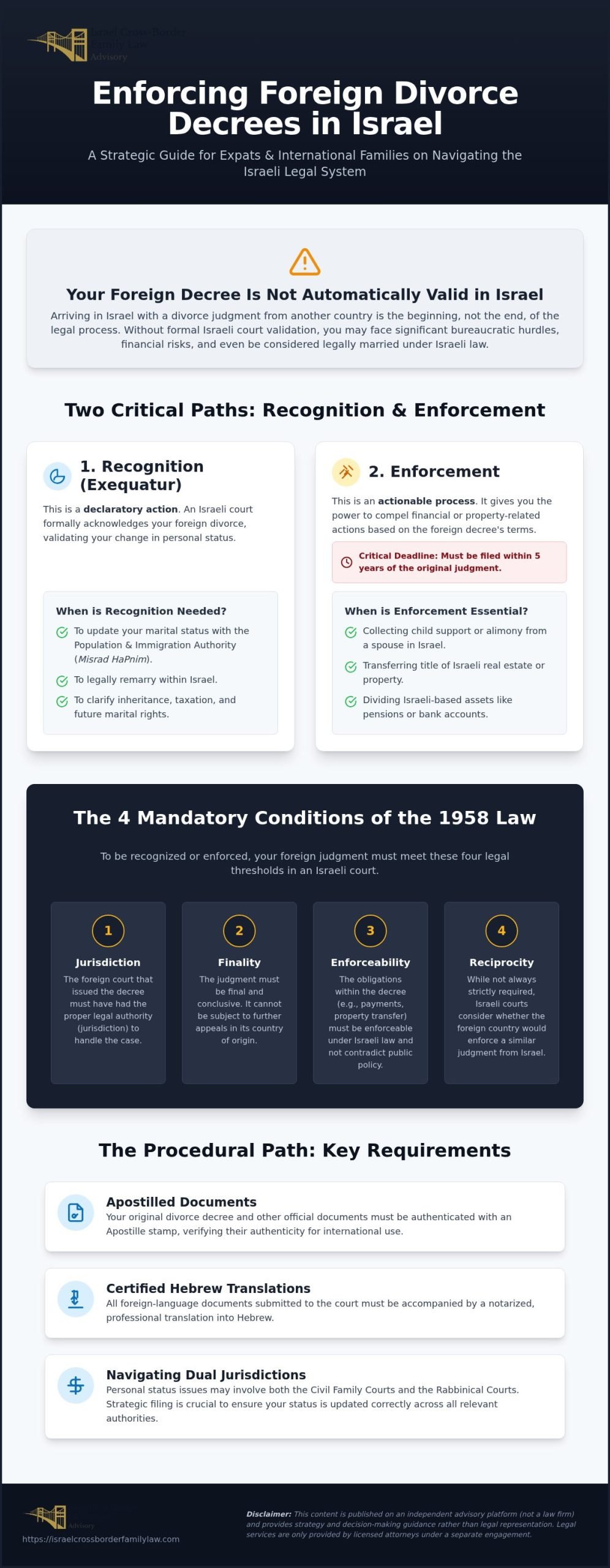
Many expats are surprised to find that a legal judgment from their home country doesn’t simply “cross the border” with them. In Israel, a foreign divorce decree remains a piece of foreign paper until an Israeli court grants it local standing. This process, specifically the act of enforcing foreign divorce decree in israel, is governed by the Foreign Judgments Enforcement Law, 1958. This law creates a critical distinction between recognition and enforcement. Recognition is declaratory; it confirms your status as a divorced individual. Enforcement is actionable; it allows you to collect money, seize assets, or transfer property based on the foreign order’s terms.
These procedures are rooted in the complex principles of private international law. Because Israel has signed but not yet ratified the 2019 Hague Judgments Convention as of mid-2026, you must still rely on the 1958 domestic law framework. Without an Israeli court order, you may find yourself legally “married” in Israel while being legally “divorced” in New York or London. This discrepancy can create significant risks regarding inheritance, taxation, and future marital rights, making it essential to seek clarity early in the process.
To better understand how the Israeli system views the end of a marriage and the role of religious courts, watch this helpful video:
When do you need Recognition (Exequatur)?
Recognition is primarily about your legal identity. Exequatur is the formal court process for validating a foreign order. You typically need this when your primary goal is to update your personal status within the Israeli Population and Immigration Authority (Misrad HaPnim). If you plan to remarry within Israel, the state requires proof that your previous marriage was dissolved by a competent authority recognized by Israeli law. Recognition serves as the official “bridge” that allows the Israeli government to accept your foreign status as a fact without re-examining the merits of the original divorce case.
When do you need Enforcement?
Enforcement is required when there’s a “doing” component to your decree. If your ex-spouse lives in Israel and owes child support, you cannot simply hand a US court order to the local police or a bank. You must first go through the process of enforcing foreign divorce decree in israel to make that order actionable by the Israeli Enforcement and Collection Authority. You must also act quickly; a motion to enforce a foreign judgment must generally be filed within five years of the original judgment being rendered. This path is essential for:
- Collecting monthly child support or alimony payments from a resident in Israel.
- Transferring the title of Israeli real estate based on a foreign property settlement.
- Compelling the division of Israeli-based pension funds or bank accounts.
For specific financial guidance, you should review our resources on cross-border child support enforcement. Taking these steps ensures that the financial obligations established abroad are respected and liquidated within the Israeli jurisdiction.
Disclaimer: This content is published on an independent advisory platform (not a law firm) and focuses on strategy, risks, and decision-making guidance rather than an attorney-client relationship. Legal services are only provided by licensed attorneys under a separate engagement.
The Four Mandatory Conditions Under the 1958 Enforcement Law
For an Israeli court to grant local standing to a judgment from abroad, the petitioner must prove that the case meets four specific thresholds. These criteria, established under the Foreign Judgments Enforcement Law, act as a safeguard to ensure that the foreign proceedings were fair and that the outcome doesn’t clash with local legal standards. Successfully enforcing foreign divorce decree in israel requires a meticulous review of these conditions before you file your motion, as the court won’t simply rubber-stamp a foreign document without verifying its legitimacy.
The four mandatory conditions are as follows:
- Jurisdiction: The foreign court must have possessed the authority to issue the judgment according to both its own local laws and the principles of Israeli private international law.
- Finality: The judgment must be final and no longer subject to appeal in the country where it was issued.
- Enforceability: The obligation must be enforceable in the country of origin and must not contradict Israeli public policy.
- Reciprocity: The foreign state, such as the US or UK, must generally recognize and enforce judgments issued by Israeli courts.
The ‘Public Policy’ and Due Process Test
Israeli courts won’t enforce a decree if the underlying process was fundamentally unfair. This is often referred to as the due process test. You must demonstrate that the other party was properly served with the legal papers and had a genuine opportunity to present their case in the US. If a judgment was obtained through fraud or if the defendant wasn’t given notice, the Israeli court will likely reject the enforcement request. Additionally, Israeli courts prioritize the ‘best interests of the child’ even in foreign enforcement, meaning they may review custody or support arrangements to ensure they align with local protections for minors. Protecting fundamental local values is a cornerstone of the Israeli judicial approach.
The Finality of the Decree
A common hurdle in enforcing foreign divorce decree in israel is the issue of finality. Israeli law requires that the judgment be final, meaning it’s no longer subject to ordinary appeals. This can be complex with US orders where a court might retain jurisdiction to modify support or custody as circumstances change. While the divorce status itself is usually final, specific financial orders must be clearly settled. You’ll need to provide a certified copy of the decree, often accompanied by a statement from the US court clerk confirming that no appeals are pending. Differentiating between interlocutory, or temporary, orders and final decrees is a critical first step in your strategy.
Understanding how these conditions apply to your specific case can save months of frustration and unnecessary costs. You can request a confidential case review to gain a clearer picture of your legal standing before moving forward.
Disclaimer: This content is published on an independent advisory platform (not a law firm) and focuses on strategy, risks, and decision-making guidance rather than an attorney-client relationship. Legal services are only provided by licensed attorneys under a separate engagement.
Personal Status and the Role of Israeli Religious Courts
One of the most common misconceptions for expats is that a US civil divorce decree is the final word on their marital status in Israel. While the 1958 Law provides a path for recognition of the civil aspects, Israel maintains a dual legal system where matters of personal status, specifically marriage and divorce, fall under the jurisdiction of religious courts. For Jewish citizens and residents, this means that even after enforcing foreign divorce decree in israel through the civil system, you aren’t considered religiously divorced until a “Get” (a Jewish bill of divorce) is issued. This distinction creates a parallel jurisdiction between the civil Family Court and the Rabbinical Court that requires careful navigation.
The Family Court handles the “civil” fallout of a divorce, such as the division of assets, child support, and custody arrangements. In contrast, the Rabbinical Court has exclusive authority over the act of divorce itself for Jewish couples. If you’re a Jewish expat, you must coordinate these two systems to avoid a state of legal limbo. Failing to address the religious status can prevent you from remarrying in Israel or cause significant complications regarding the status of future children. Understanding this split between money and status is vital before you commit to a specific legal strategy.
The Rabbinical Court and the ‘Get’
A foreign civil decree doesn’t automatically satisfy the requirements of Jewish law. Even with a recognized US decree, you may still need to appear before an Israeli Rabbinical Court to finalize the religious divorce. A significant risk in these cross-border cases is becoming “Mesurav Get,” where one party refuses to give or receive the religious divorce despite the civil marriage being over. This can lead to a situation where you’re civilly single but religiously bound. Practical strategy involves ensuring that any settlement reached in a US or UK court specifically includes clauses that compel cooperation with the Rabbinical Court in Israel to finalize the Get.
Choosing the Right Venue for Enforcement
When it comes to enforcing foreign divorce decree in israel, choosing the correct venue is a strategic decision that impacts the speed and outcome of your case. While religious courts have certain powers, many expats and foreign nationals prefer the Family Court for enforcement actions. The Family Court is often perceived as more familiar with Western legal norms and international property standards. However, the “Race to the Court” doctrine is a reality in Israel; the first court to be formally seized of a matter generally retains jurisdiction over it.
Determining which court serves your interests depends on the specifics of your decree and your long-term goals in the country. You can find more context on these strategic choices on our page for expats and foreign nationals. Seeking clarity on these jurisdictional differences early on helps prevent the costs of “double litigation” and ensures your foreign rights are protected within the Israeli framework.
Disclaimer: This content is published on an independent advisory platform (not a law firm) and focuses on strategy, risks, and decision-making guidance rather than an attorney-client relationship. Legal services are only provided by licensed attorneys under a separate engagement.
The Procedural Path: Documentation and Filing Requirements
Moving from the strategic planning phase to the actual filing requires a high degree of administrative precision. The Israeli court system is procedural by nature, and even minor clerical errors can lead to months of delays or the dismissal of your case. To begin the process of enforcing foreign divorce decree in israel, you must first transition your foreign documents into a format that the Israeli Family Court can legally accept. This involves a specific sequence of authentication and translation that precedes the filing of a formal motion.
The standard procedural path includes several critical milestones:
- Obtaining a certified copy of your US Divorce Decree directly from the court clerk.
- Securing an Apostille to authenticate the document for international use.
- Commissioning a certified Hebrew translation from a notary recognized in Israel.
- Filing a formal “Motion to Enforce” in the competent Israeli Family Court.
- Serving the motion to the respondent according to international service treaties.
The Apostille and Notary Requirements
A common point of confusion for expats is the difference between a standard notary and an Apostille. While a local US notary can witness a signature, they cannot authenticate a court judgment for use in Israel. You must obtain an Apostille, which is a specialized certificate issued by the Secretary of State (for state court decrees) or the US Department of State (for federal orders). Once you have the authenticated decree, you must have it translated into Hebrew. While some practitioners suggest waiting for a court order to translate, most Family Courts in 2026 require a certified translation at the time of filing to avoid immediate procedural delays. The translation must be certified by an Israeli notary specifically to meet the court’s evidentiary standards.
Service of Process and Timelines
Once your motion is filed, you must notify the other party through a formal service of process. If the respondent lives outside of Israel, this is governed by the Hague Service Convention. This process often involves the International Affairs Department of the Israeli Ministry of Justice, which coordinates with foreign central authorities to ensure the service is legally binding. In 2026, the enforcement process typically takes between six to twelve months, depending on the complexity of the assets involved and whether the respondent contests the motion. If the respondent is uncooperative, the timeline can extend as the court verifies that all due process requirements were met.
Handling these administrative requirements correctly the first time is essential for protecting your financial and custodial rights. If you are ready to begin the documentation phase, you can contact us to discuss your specific filing needs.
Disclaimer: This content is published on an independent advisory platform (not a law firm) and focuses on strategy, risks, and decision-making guidance rather than an attorney-client relationship. Legal services are only provided by licensed attorneys under a separate engagement.
Strategic Clarity: Managing Risks in Cross-Border Enforcement
Success in enforcing foreign divorce decree in israel often depends on decisions made long before you set foot in an Israeli courtroom. If your original US or UK settlement was drafted without considering the nuances of the Israeli legal system, you may face significant hurdles. For instance, a foreign judge might award assets or set support levels in a way that clashes with Israeli “public policy” or procedural norms. Seeking clarity before you commit to a specific settlement structure abroad is the most effective way to ensure your rights remain protected once you relocate to Israel.
You should also evaluate the cost-benefit ratio of the enforcement process itself. In some cases, the administrative complexity of an exequatur proceeding is more burdensome than simply filing a fresh motion in the Israeli Family Court, particularly if the foreign judgment is ambiguous or several years old. Strategy should always take precedence over procedural momentum. To visualize these concepts and hear more about the practical realities of the Israeli system, we encourage you to view the helpful guides on our YouTube channel, Israel Family Law.
Common Pitfalls for Anglos and Expats
Expats frequently encounter unexpected challenges when they assume their foreign decree will be treated as a “mirror image” in the Israeli system. Awareness of these risks is essential for effective risk management:
- No-Fault Assumptions: While many US states use a no-fault model, certain financial or custodial aspects may be scrutinized differently if the case moves into the sphere of an Israeli religious court.
- Stay of Exit Orders: Expats often underestimate the power of the Israeli “Stay of Exit” (Tsav Ikur Yetzia). This order can prevent a parent from leaving the country if there’s a risk of child support evasion, a tool that is used more frequently in Israel than in many Western jurisdictions.
- Currency Fluctuations: If your foreign decree mandates child support in USD but you are enforcing foreign divorce decree in israel for a resident paid in ILS, failing to include specific conversion and indexation clauses can lead to significant financial loss over time.
Next Steps: Requesting a Confidential Review
Navigating two legal cultures requires a map, not just a set of translated documents. An independent advisory platform can help you identify these risks early, allowing you to build a bridge between your foreign judgment and your new life in Israel. This strategic approach focuses on achieving your commercial and personal goals rather than getting lost in legal jargon. For transparency regarding our support, you can view our pricing page to understand the costs associated with our advisory services.
Disclaimer: This content is published on an independent advisory platform (not a law firm) and focuses on strategy, risks, and decision-making guidance rather than an attorney-client relationship. Legal services are only provided by licensed attorneys under a separate engagement.
Get clarity before you commit. Request a confidential consultation.
Protecting Your International Family’s Interests
Transitioning your life to Israel involves more than just a physical move; it requires a deliberate effort to align your foreign legal status with local requirements. By understanding the distinction between simple recognition and active enforcement, you can safeguard your assets and ensure child support obligations are met. Successfully enforcing foreign divorce decree in israel hinges on meeting the four mandatory conditions of the 1958 Law while managing the parallel expectations of civil and religious courts.
Our independent advisory platform provides specialized US-Israel cross-border expertise to help you avoid the pitfalls of double litigation. We maintain a calm, educational approach designed to give international families the strategy they need to navigate the Israeli bureaucracy with confidence. Getting the right guidance early helps you avoid the anxiety of complex administrative hurdles and protects your family’s financial future.
Get clarity before you commit. Request a confidential consultation.
Disclaimer: This content is published on an independent advisory platform (not a law firm) and focuses on strategy, risks, and decision-making guidance rather than an attorney-client relationship. Legal services are only provided by licensed attorneys under a separate engagement.
You can move forward with confidence knowing that your legal rights are properly established in your new home.
Frequently Asked Questions
Is a US divorce decree automatically recognized in Israel?
A US divorce decree is not automatically recognized in Israel. To gain legal standing, you must file a formal motion for recognition or enforcement under the Foreign Judgments Enforcement Law of 1958. This judicial process ensures the decree meets Israeli standards for jurisdiction and due process. Without this step, the Israeli Population Registry won’t update your marital status, and you may remain legally married within the Israeli jurisdiction.
Do I need a Hebrew translation of my divorce papers for Israeli courts?
Yes, you must provide a Hebrew translation of your divorce papers for use in Israeli courts. This translation must be certified by an Israeli notary to ensure accuracy and compliance with local evidentiary rules. While some jurisdictions are flexible, the Family Court typically requires these documents at the time of filing to avoid procedural delays. Providing a professional translation is a foundational step in enforcing foreign divorce decree in israel.
Can I enforce a US child support order through the Israeli system?
You can enforce a US child support order through the Israeli system once the foreign judgment is declared enforceable by an Israeli court. After the court grants this status, the order is passed to the Enforcement and Collection Authority (Hotsa’a La’poal). This body has the power to garnish wages, lien bank accounts, or issue stay of exit orders to ensure the financial obligations established in your foreign decree are met.
What is an Apostille and why do I need it for my divorce decree?
An Apostille is an international certification that authenticates the seals and signatures on public documents like divorce decrees. You need it because Israeli courts cannot independently verify the legitimacy of a foreign judge’s signature. For US documents, you obtain this from the Secretary of State where the divorce was granted. It is a mandatory requirement under the Hague Convention to bridge the legal gap between different national systems.
How long does it take to recognize a foreign judgment in Israel?
The process to recognize or enforce a foreign judgment in Israel typically takes between six and twelve months. This timeline accounts for the filing of the motion, serving the other party according to international treaties, and the court hearing. If the case is complex or involves a respondent living abroad, the Ministry of Justice may be involved in the service of process, which can extend the duration of the proceedings.
Will the Israeli Rabbinical court accept my secular US divorce?
The Israeli Rabbinical Court will generally recognize the civil end of your marriage for status updates, but it won’t replace the religious requirement of a “Get.” For Jewish couples, a secular US divorce dissolves the civil union only. To be considered fully divorced under Israeli law and eligible for remarriage within the Jewish community, you must still complete the religious divorce process through the Rabbinical Court system.
What happens if my ex-spouse contests the enforcement in Israel?
If your ex-spouse contests the enforcement, the Israeli court will hold a hearing to review the mandatory conditions of the 1958 Law. The court will specifically examine whether the foreign court had proper jurisdiction and if the judgment violates Israeli public policy. Contested cases require a strategic approach to demonstrate that the original proceedings were fair and that the final judgment is no longer subject to appeal in the country of origin.
Do I need to travel to Israel to enforce my divorce decree?
You don’t necessarily need to travel to Israel to begin enforcing foreign divorce decree in israel. Many administrative and filing steps can be handled by an authorized representative through a power of attorney. However, a judge may eventually require your presence at a hearing, or you may need to provide testimony via video link if the court permits. Managing the process remotely is common for expats still residing abroad.
Disclaimer: This content is published on an independent advisory platform (not a law firm) and focuses on strategy, risks, and decision-making guidance rather than an attorney-client relationship. Legal services are only provided by licensed attorneys under a separate engagement.

Article by
Gabriel Lior
A Personal Journey That Became a Mission
The advisory was founded by an American father Gabriel Lior, LLB, MBA , global entrepreneur, and cross-border advisor who spent more than a decade navigating the Israeli family court system firsthand and now lives in Singapore with his son.
As a divorced parent in a cross-border family, Gabriel faced nearly every legal challenge a foreign parent can encounter in Israel — including child custody disputes, child support proceedings, property matters in Israel and abroad, false accusations, and complex immigration and relocation proceedings.
Over the years, he learned the hard way how difficult it is for non-Israeli parents to understand the system, identify the right legal strategy, and choose the right legal representation — especially when language, culture, and jurisdictional differences are involved. He also witnessed how foreign parents and new immigrants are often disadvantaged or taken advantage of by service providers and institutions simply because they lack local knowledge or fluency.
From Client to Advisor
To truly understand — and survive — the system, Gabriel pursued formal legal education in Israel, completing two Israeli law degrees, alongside a BA and MBA earned in the United States. This was never about becoming a practicing attorney, but about gaining a deep, structural understanding of how the system works — and where it breaks down for foreign parents.
This rare combination of:
Firsthand client experience
Israeli legal and US business education
International business and negotiation training
Decades of commercial execution
created a unique perspective – one that understands both sides of the table.
After years of litigation, persistence, and at times self-representation, he ultimately succeeded in securing custody of his son and relocating abroad through a rare legal victory in the Israeli Supreme Court — becoming one of the first fathers in Israel to do so under these circumstances.
Disclaimer
Important Disclaimer:
The information provided on this website and in its content is for general informational and educational purposes only and does not constitute legal advice, legal opinion, or legal representation.
Gabriel Lior is not licensed to practice law in Israel (nor is he interested in doing so) and does not provide legal services, despite having completed 2 Law Degrees. The services offered are advisory in nature and are intended to provide general guidance, strategic insight, and information regarding cross-border family law considerations.
No attorney-client relationship is formed by accessing this website, reading its content, or communicating with us.
Any decisions made based on this information are at your own discretion and risk. For legal advice specific to your situation, you should consult a licensed attorney in the relevant jurisdiction.
Where appropriate, we may refer clients to independent, licensed attorneys or professionals. Such referrals do not constitute legal representation and no liability is assumed for services provided by third parties.