The most effective way of preparing your child for a custody evaluation in Israel has nothing to do with rehearsing specific answers and everything to do with reducing their internal loyalty conflict. For many expat parents, the prospect of a “Pekidat Saad,” or court-appointed social worker, interviewing their child creates a significant sense of anxiety. You may worry that language barriers or unfamiliar Israeli legal procedures will distort the professional’s perception of the genuine bond you share with your child.
It is natural to feel protective when your family’s future depends on a professional’s report. We recognize the stress of wondering if your child will feel pressured or misunderstood during these interviews. This guide shows you how to handle the complexities of the Israeli system with calm, age-appropriate strategies that prioritize your child’s safety and emotional well-being. You will learn how to provide clarity for your child without coaching them, ensuring the evaluation reflects a true and healthy family dynamic. For additional strategic insights, you can view our educational resources at https://www.youtube.com/@IsraelFamilyLaw.
Key Takeaways
- Understand the specific role of the Pekidat Saad and how the Israeli welfare system applies the “Best Interests of the Child” standard to international families.
- Learn why preparing your child for a custody evaluation focus on providing “emotional permission” to be honest rather than rehearsing specific answers.
- Discover age-appropriate scripts to introduce the evaluator as a neutral “family helper,” which helps reduce your child’s anxiety and loyalty conflicts.
- Identify how cultural differences and relocation concerns can impact an evaluator’s assessment of the parent-child bond in cross-border cases.
- Gain clarity on the importance of early strategic planning to ensure the evaluation process accurately reflects your family’s unique global circumstances.
Understanding the Custody Evaluation Process in Israel
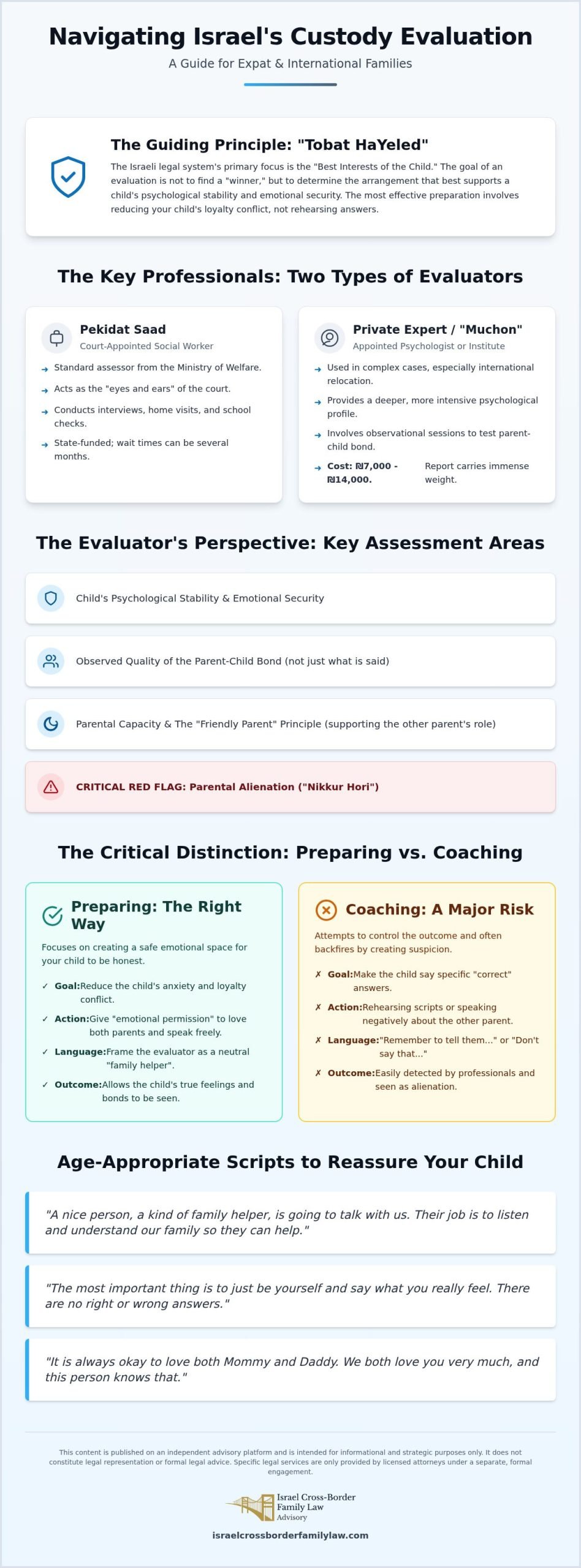
An Israeli custody evaluation is a psychosocial assessment designed to determine what the court calls “Tobat HaYeled,” or the best interests of the child. Unlike many Western systems where private psychologists are the default, the Israeli system relies heavily on the “Pekidat Saad,” a court-appointed social worker within the Ministry of Welfare. This professional acts as the eyes and ears of the court, conducting interviews and home visits to assess the family dynamic and provide a formal recommendation to the judge. The process is intended to be neutral, yet for those unfamiliar with the local bureaucracy, it often feels opaque and intimidating.
To better understand the general principles of these assessments, watch this helpful video:
The Role of the Pekidat Saad (Social Worker)
When a custody dispute enters the Family Court or Rabbinical Court, a judge typically issues an order for a “Teskir” (report). The social worker’s mandate is broad; they investigate the child’s living conditions, school performance, and the quality of the parental relationship. Wait times for these reports in 2026 often stretch several months, adding a layer of procedural stress to already tense situations. It’s vital to recognize that while the social worker provides a recommendation, it’s not a final court order until a judge adopts it. For expats, language accessibility is a major hurdle. If you aren’t fluent in Hebrew, the nuances of your parenting style can sometimes be lost in translation, making early strategic clarity essential before the first interview occurs.
Private Expert Evaluations
In complex cases, especially those involving international custody relocation, the court may appoint a private psychologist or a specialized institute (Muchon) for a more intensive “Muchon” test. These evaluations are significantly more expensive than state-funded reports, with costs in 2026 typically ranging from ₪7,000 to ₪14,000. These experts provide a deeper psychological profile of both the parents and children. When preparing your child for a custody evaluation of this depth, the focus shifts from simple interviews to observational sessions that test the parent-child bond under professional scrutiny. These reports carry immense weight and are often difficult to challenge once submitted.
International families face unique scrutiny regarding their “center of life” and relocation intentions. Evaluators look closely at whether a parent intends to move the children abroad, which can trigger “Relocation Anxiety” within the legal process. This content is published on an independent advisory platform and is intended for informational and strategic purposes only. It does not constitute legal representation or formal legal advice. Specific legal services are only provided by licensed attorneys under a separate, formal engagement.
The Evaluator’s Perspective: What They Are Actually Assessing
Israeli evaluators look beyond the surface of daily routines to identify the core of a child’s psychological stability. In the Israeli legal system, the “Best Interests” standard, or Tobat HaYeled, is heavily weighted toward psychological continuity and the child’s emotional security. When preparing your child for a custody evaluation, it is helpful to understand that the professional is not just listening to what the child says. They are observing the subtle nuances of your interaction and looking for evidence of a resilient, healthy bond that can survive the stresses of a cross-border lifestyle.
Assessments usually involve both individual interviews and observational sessions. During these sessions, the evaluator watches how you play, communicate, and resolve minor conflicts with your child. They are specifically trained to identify “Nikkur Hori,” or parental alienation. In Israel, any indication that one parent is speaking negatively about the other or attempting to undermine the other parent’s role is a significant red flag. The court prioritizes the “Friendly Parent,” which is the parent most likely to facilitate and encourage a meaningful relationship with the other party, despite the geographic distance.
Cultural competence also plays a vital role in these assessments. “Anglo” parenting styles, which may emphasize independence or a more reserved emotional expression, can sometimes be misinterpreted by Israeli social workers who are accustomed to a more collective or expressive cultural norm. It’s essential to present your parenting choices clearly, explaining how they support the child’s development within a multi-jurisdictional family framework. If you are concerned about how your international lifestyle might be perceived, you may want to request a strategy session to clarify your position before the evaluation begins.
Key Factors in the Evaluator’s Report
The final report focuses on the child’s underlying psychological needs rather than their stated wishes, especially if those wishes seem influenced by adult pressure. Evaluators also examine the practicalities of cross-border logistics. They consider how time zone differences, international travel, and shifting school schedules will affect the child’s routine. The goal is to ensure the child maintains a sense of “center of life” stability while preserving the bond with both parents across different countries.
Red Flags for Evaluators
Evaluators are highly sensitive to signs of coaching. When a child uses adult terminology or recites a “scripted” list of grievances against a parent, it suggests they have been improperly prepared. Rigidity is another concern; a parent or child who cannot acknowledge a single positive trait in the other parent often appears less credible. Loyalty conflict is the child’s feeling of being caught between two competing worlds. Evaluators look for this stress, as it indicates the child does not feel “permitted” to love both parents equally, which can negatively impact the final custody recommendation.
Coaching vs. Preparing: The Essential Distinction
Distinguishing between coaching and preparation is the most critical factor in achieving a favorable outcome in an Israeli custody assessment. Coaching involves directing a child toward specific answers or narratives, while preparation focuses on reducing the child’s anxiety and granting them the emotional freedom to participate. In the Israeli system, where evaluators are highly attuned to the dynamics of “Nikkur Hori” (parental alienation), any attempt to script a child’s responses is viewed as a serious breach of parental responsibility. preparing your child for a custody evaluation should never involve telling them what to say, but rather explaining why they are meeting with a professional neutrally.
Expat parents face a unique risk of “accidental coaching.” When you vent about the complexities of the Israeli legal system, the perceived inefficiency of the “Pekidat Saad,” or your frustrations with local culture, your child absorbs these sentiments. A child who repeats these adult grievances during an interview often appears coached, even if you never explicitly told them to share those views. Managing your own anxiety is paramount; if you approach the evaluation with fear or hostility, your child will likely mirror that distress, interpreted by evaluators as a lack of stability in your home environment.
The Dangers of Coaching
Israeli evaluators utilize sophisticated indirect questioning techniques to identify external influence. They may ask what the family did the night before or how the parent explained the meeting. If a child reveals they were “practicing” or “reminded to tell the truth about Dad,” it triggers immediate skepticism. The legal consequences of being found to have influenced a child’s testimony are severe, often resulting in a permanent loss of credibility. This scrutiny is especially intense in cases involving the Hague Convention child abduction, where “grave risk” claims are sometimes found to be the result of parental pressure rather than objective reality.
Effective Preparation Strategies
When preparing your child for a custody evaluation, successful strategies prioritize the “who” and “why” of the meeting over the “what” of the child’s answers. Explain that the evaluator is a “helper” whose job is to learn about the family so the judge can make good decisions. Validate your child’s feelings by acknowledging that it is okay to feel nervous or even to say they don’t know an answer. Providing your child with the explicit permission to speak their mind without fear of disappointing you is the most valuable gift a parent can give during a custody evaluation. This approach protects the child’s psychological well-being and demonstrates to the evaluator that you prioritize your child’s authentic voice over your own litigation goals.
This content is published on an independent advisory platform and is intended for informational and strategic purposes only. It does not constitute legal representation or formal legal advice. Specific legal services are only provided by licensed attorneys under a separate, formal engagement.
Age-Appropriate Scripts for Talking to Your Child
Timing is a critical element when preparing your child for a custody evaluation. If you discuss the meeting too far in advance, you risk creating a prolonged period of unnecessary anxiety. Conversely, mentioning it only moments before the appointment can lead to a sense of shock or betrayal. For most families, a conversation held two or three days before the scheduled interview provides the right balance of awareness and emotional distance. The primary objective is to neutralize the evaluator’s role, framing them as a “talking doctor” or “family helper” rather than a legal investigator.
When children ask why this meeting is happening, it’s essential to keep the focus on the court’s procedural needs. Avoid mentioning the conflict between you and the other parent. Instead, explain that the judge has a very big job and needs an expert’s help to understand the family better. This removes the child from the center of the dispute and places the responsibility on the legal system. Reassure your child that there are no “right” or “wrong” answers; the evaluator simply wants to hear their unique perspective on their daily life.
Preschoolers and Early Elementary (Ages 3-7)
For younger children, use simple metaphors that align with their developmental stage. You might describe the evaluator as someone who helps the judge understand how kids feel. A helpful script for this age group is: “You’re going to play and talk with someone whose job is to help families. You can tell them anything you want, like what you like to eat or what games we play. I’ll be right nearby to make sure you’re safe.” Emphasizing your presence nearby helps maintain their sense of security, which is vital for a successful observational session.
Pre-teens and Teenagers (Ages 12+)
Teenagers require a more transparent approach that acknowledges the inherent awkwardness of the situation. It’s important to relieve them of the “burden of choice” by making it clear that they aren’t the ones making the final decision. Use a script such as: “I know this feels awkward, but the court wants to hear your perspective as they make a plan for our family. They want to know what your days are like and what you think about things. The judge is the one who makes the final decision, not you.” This distinction prevents the teenager from feeling like they are “betraying” one parent by speaking honestly. If you feel uncertain about how to navigate these conversations, you should contact us to discuss a preparation strategy tailored to your child’s specific needs.
This content is published on an independent advisory platform and is intended for informational and strategic purposes only. It does not constitute legal representation or formal legal advice. Specific legal services are only provided by licensed attorneys under a separate, formal engagement.
Strategic Considerations for Cross-Border Families
International families face a distinct set of challenges when the Israeli legal system begins assessing their home life. Cultural differences often lead to misunderstandings between expat parents and the “Pekidat Saad.” For instance, an “Anglo” focus on structured extracurricular activities or specific dietary choices might be viewed differently by a local social worker accustomed to Israeli social norms. When preparing your child for a custody evaluation, you must also consider the language barrier. You have the right to request an English-speaking social worker or a professional translator to ensure your parenting values aren’t lost in translation.
Managing “Relocation Anxiety” is another critical factor for families with ties to multiple countries. If a child expresses a desire to move back to the U.S. during an interview, it can trigger concerns about their stability in Israel. The court looks closely at the “Center of Life” trap, evaluating how well the child has integrated into Israeli schools and social circles. A child who seems disconnected from their local environment may be seen as being held back by a parent’s own desire to relocate. It is highly advisable to seek a confidential case review before your first meeting with a social worker to align your family’s narrative with Israeli legal expectations.
Cultural Nuances in Israeli Evaluations
Israeli evaluators often place high value on local support systems. While you may have a massive network of extended family in the U.S., the social worker is primarily concerned with your support network within Israel. They assess whether the child has “anchors” here, such as friends, Hebrew fluency, and community involvement. If your parenting style leans heavily on American cultural norms, be prepared to explain how these choices benefit the child’s development in their current multi-jurisdictional context. Demonstrating that your child is thriving locally, despite their international background, is essential for a positive report.
Next Steps and Getting Clarity
Success in a cross-border custody dispute depends more on early legal strategy than on last-minute “interview prep.” The decisions you make before the evaluation begins will carry significant weight throughout the entire case. Navigating the Israeli system as an expat requires a nuanced understanding of how local professionals interpret international family dynamics. Using an independent advisory platform allows you to identify risks and manage expectations before they become permanent court records. This content is published on an independent advisory platform and is intended for informational and strategic purposes only. It does not constitute legal representation or formal legal advice. Specific legal services are only provided by licensed attorneys under a separate, formal engagement.
Get clarity before you commit. Request a confidential consultation.
Securing Your Family’s Future Through Strategic Clarity
The Israeli custody system presents unique challenges that require a shift in perspective for many international families. Successful outcomes in these assessments often begin with preparing your child for a custody evaluation by focusing on emotional permission rather than rehearsed answers. By understanding the specific nuances of the Pekidat Saad and the cultural expectations of local courts, you can protect your parental rights and your child’s well-being during this transition.
Our platform provides expert cross-border family law advisory with a specialized focus on US-Israel jurisdictional issues. We offer calm, strategic guidance designed to help expats manage the inherent risks of multi-jurisdictional litigation. This content is published on an independent advisory platform, not a law firm. It focuses on strategy and decision-making rather than formal legal representation; legal services are only provided by licensed attorneys under a separate engagement.
Get clarity before you commit. Request a confidential consultation. You have the power to protect your family’s future with the right strategic approach.
Frequently Asked Questions
Can I be present in the room during my child’s evaluation?
You are generally not permitted to be in the room during your child’s individual interview with the Pekidat Saad or a private evaluator. This separation is designed to create a neutral environment where the child feels free to speak without the influence of either parent’s presence. However, the process often includes separate observational sessions where the evaluator watches you interact and play with your child to assess your bond and communication style.
What happens if my child says they want to live with the other parent?
The evaluator will analyze the underlying reasons for the child’s statement rather than taking it at face value. In the Israeli system, the “Best Interests of the Child” standard outweighs a child’s specific preference, particularly for younger children. The professional looks for signs of coaching or loyalty conflicts to determine if the expressed wish aligns with the child’s actual psychological and developmental needs.
Will the evaluator talk to my child’s teachers or doctors in the U.S.?
Evaluators have the authority to contact international references, but the extent of this outreach varies by case. While they may request school records or conduct brief phone interviews with U.S. based professionals, language barriers and time zone differences often complicate this process. If these contacts are vital to your case, you should discuss how to facilitate this communication during your initial strategic planning sessions.
How long does the custody evaluation process take in Israel?
The process typically spans several months from the court order to the final report. As of 2026, average wait times for Pekidat Saad reports have increased due to high case volumes within the Ministry of Welfare. Private evaluations might move slightly faster but still require significant time for multiple interviews, home visits, and the drafting of a comprehensive psychosocial assessment.
Can the social worker’s recommendation be overturned by the Judge?
A judge has the legal authority to reject a social worker’s recommendation, though they rarely do so in practice. The court typically views the evaluator as an expert witness with specialized knowledge of the family’s dynamic. Overturning a recommendation usually requires demonstrating a significant procedural error or providing new evidence that contradicts the evaluator’s findings regarding the child’s best interests.
Is it okay to tell my child that the evaluator is a ‘friend’?
You should avoid describing the evaluator as a “friend,” as this can be confusing and may be viewed by the court as a form of manipulation. It is more effective to frame them as a “family helper” or a “talking doctor” whose job is to help the judge understand the family. This honest yet neutral description is a key part of preparing your child for a custody evaluation without crossing into the territory of coaching.
What should I do if I suspect the other parent is coaching our child?
If you suspect coaching, you should document specific examples of adult terminology or scripted grievances used by the child without confronting them directly. You can then share these observations with your advisor to determine the best way to alert the evaluator. Evaluators are trained to identify coached behavior through indirect questioning and will likely address these concerns in their final report to the court.
How much does a private custody evaluation cost in Israel?
Court-appointed expert evaluations by private professionals typically range from ₪7,000 to ₪14,000 as of April 2026. These costs depend on the complexity of the family situation and the number of parties involved. In most contested cases, the court orders these fees to be split equally between the parents, though this can vary based on specific financial circumstances or court rulings.
This content is published on an independent advisory platform and is intended for informational and strategic purposes only. It does not constitute legal representation or formal legal advice. Specific legal services are only provided by licensed attorneys under a separate, formal engagement.

Article by
Gabriel Lior
A Personal Journey That Became a Mission
The advisory was founded by an American father Gabriel Lior, LLB, MBA , global entrepreneur, and cross-border advisor who spent more than a decade navigating the Israeli family court system firsthand and now lives in Singapore with his son.
As a divorced parent in a cross-border family, Gabriel faced nearly every legal challenge a foreign parent can encounter in Israel — including child custody disputes, child support proceedings, property matters in Israel and abroad, false accusations, and complex immigration and relocation proceedings.
Over the years, he learned the hard way how difficult it is for non-Israeli parents to understand the system, identify the right legal strategy, and choose the right legal representation — especially when language, culture, and jurisdictional differences are involved. He also witnessed how foreign parents and new immigrants are often disadvantaged or taken advantage of by service providers and institutions simply because they lack local knowledge or fluency.
From Client to Advisor
To truly understand — and survive — the system, Gabriel pursued formal legal education in Israel, completing two Israeli law degrees, alongside a BA and MBA earned in the United States. This was never about becoming a practicing attorney, but about gaining a deep, structural understanding of how the system works — and where it breaks down for foreign parents.
This rare combination of:
Firsthand client experience
Israeli legal and US business education
International business and negotiation training
Decades of commercial execution
created a unique perspective – one that understands both sides of the table.
After years of litigation, persistence, and at times self-representation, he ultimately succeeded in securing custody of his son and relocating abroad through a rare legal victory in the Israeli Supreme Court — becoming one of the first fathers in Israel to do so under these circumstances.
Disclaimer
Important Disclaimer:
The information provided on this website and in its content is for general informational and educational purposes only and does not constitute legal advice, legal opinion, or legal representation.
Gabriel Lior is not licensed to practice law in Israel (nor is he interested in doing so) and does not provide legal services, despite having completed 2 Law Degrees. The services offered are advisory in nature and are intended to provide general guidance, strategic insight, and information regarding cross-border family law considerations.
No attorney-client relationship is formed by accessing this website, reading its content, or communicating with us.
Any decisions made based on this information are at your own discretion and risk. For legal advice specific to your situation, you should consult a licensed attorney in the relevant jurisdiction.
Where appropriate, we may refer clients to independent, licensed attorneys or professionals. Such referrals do not constitute legal representation and no liability is assumed for services provided by third parties.