This article is published on an independent advisory platform and does not constitute an attorney-client relationship or legal representation. Professional legal services are provided only by licensed attorneys under a separate engagement.
Making Aliyah is more than a cultural homecoming; it is a total recalibration of your legal existence that many immigrants don’t fully realize until a crisis hits. When you move your “center of life” to Israel, you’re not just changing your address. You are placing your global assets and family structure under a unique, dual-court jurisdiction. Understanding family law for olim hadashim is essential because the decisions you make during your first months in the country can dictate your legal standing for years to come.
You likely feel a mix of excitement and anxiety about how the Israeli system handles everything from foreign prenuptial agreements to the division of international property. We understand that the transition is complex, especially with recent shifts in the law. This guide will help you understand exactly how your move impacts your marital rights and cross-border obligations. We’ll explore the strategic “race to the court,” the significant expansion of Rabbinical Court jurisdiction passed in March 2026, and how to protect your assets under the new 2026 reporting requirements.
Key Takeaways
- Understand how the “Center of Life” test determines whether Israeli courts gain jurisdiction over your global assets and marital status upon arrival.
- Learn to navigate the dual-court system and why the timing of filing can significantly impact the outcome of property or custody matters.
- Discover why foreign prenuptial agreements are not automatically enforceable and how to properly validate them under family law for olim hadashim.
- Identify the legal protections and risks involving international child relocation, including the strict application of the Hague Convention in Israel.
- Gain a strategic checklist for updating your cross-border estate plans and wills to ensure they remain valid under your new Israeli residency status.
This article is published on an independent advisory platform and does not constitute an attorney-client relationship or legal representation. The content provided here is for informational and advisory purposes only, and no attorney-client relationship is implied by reading this guide. Legal services are only provided by licensed attorneys under a separate engagement.
The Legal Impact of Aliyah on Your Family Status
Making Aliyah represents a fundamental shift in your legal standing that extends far beyond your citizenship status. While your new passport grants you the right to live and work in the country, it also shifts your legal center of gravity. Understanding family law for olim hadashim is the first step in ensuring that your move doesn’t inadvertently jeopardize your rights or your family’s future stability. Many immigrants focus on the logistics of shipping and housing, but the underlying legal reality changes the moment you establish a permanent presence in the country.
To better understand the broader context of a successful move to Israel, watch this helpful video:
Residency and Jurisdiction in Israel
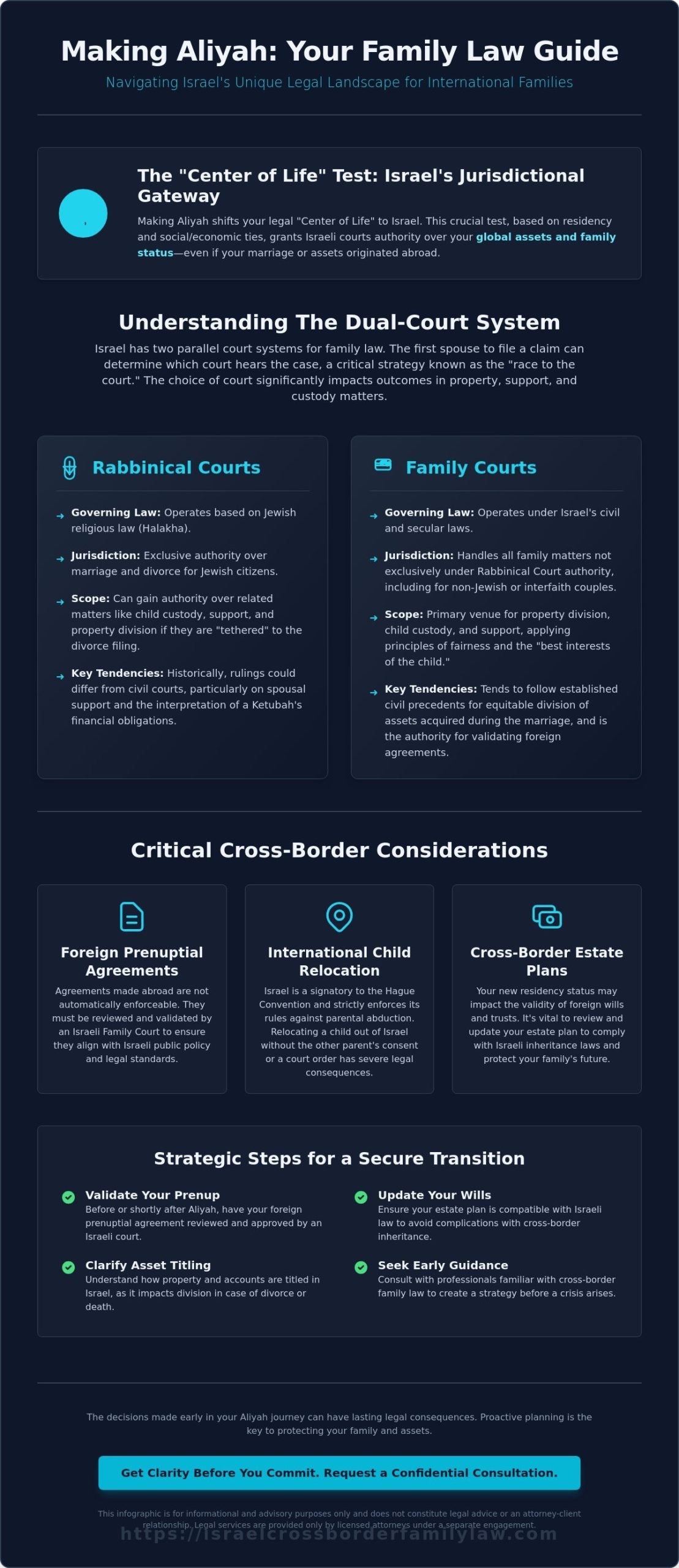
The “Center of Life” test in 2026 is a cumulative assessment of your physical presence, the location of your primary residence, and the depth of your economic and social ties to Israel. This test is critical because it determines whether an Israeli court has the authority to make rulings on your global assets and personal status. Even if you maintain a home or business abroad, spending more than 183 days in Israel or showing a clear intent to settle can trigger the jurisdiction of the local family court system.
When you arrive, your marital status is officially registered through the Ministry of Aliyah and Integration and the Population Authority. It’s essential to realize that while Israel recognizes valid foreign civil marriage certificates for registration purposes, the actual Marriage and divorce laws in Israel are governed by a unique hybrid of religious and civil frameworks. This distinction becomes vital if you ever face a divorce or separation as an international family, as the religious courts may gain jurisdiction over your personal status regardless of where your wedding took place.
Early legal clarity is essential because the transition from being a foreign resident to an Israeli resident happens quickly. Decisions made during your first year, such as how you title property or where you register your children for school, serve as evidence of your new center of life. By understanding these systemic differences early, you can take proactive steps to protect assets brought from abroad and ensure your family’s legal standing remains secure within the Israeli landscape.
This article is published on an independent advisory platform and does not constitute an attorney-client relationship or legal representation. The content provided here is for informational and advisory purposes only, and no attorney-client relationship is implied by reading this guide. Legal services are only provided by licensed attorneys under a separate engagement.
Navigating the Dual-Court System: Rabbinical vs. Family Courts
One of the most striking features of the Israeli legal landscape is the existence of two parallel court systems that share jurisdiction over family matters. For Jewish immigrants, marriage and divorce are governed by Israel’s Rabbinical Courts, which operate according to religious law. Simultaneously, a system of secular Family Courts handles civil matters like property division and child custody. Understanding the dual-court system is a cornerstone of family law for olim hadashim, as both courts may have the authority to hear different aspects of the same case.
This structure creates a unique legal environment where the outcome of a case can depend heavily on which court hears it first. While both courts must follow certain civil laws, such as the principle of equal division of assets, their procedural approaches and interpretations can vary. This dual-jurisdiction model is one of the most distinctive features of family law for olim hadashim, requiring families to think strategically about their legal standing from the moment they arrive.
The Race to the Court Explained
In Israel, the “Race to the Court” (Merotz Samchuyot) refers to the competition between spouses to file for divorce in their preferred venue. If one spouse files a divorce suit in the Rabbinical Court and “binds” (kricha) issues like property or alimony to that suit, that court may gain the exclusive right to decide those matters. Conversely, if the other spouse files for those same issues in the Family Court first, the Family Court takes jurisdiction. This makes timing and early decision-making critical for anyone considering divorce or separation as an international family.
| Feature | Family Court (Civil) | Rabbinical Court (Religious) |
|---|---|---|
| Legal Basis | Secular Civil Law | Religious Law (Halacha) |
| Judges | Civil Judges | Rabbinical Dayanim |
| Jurisdiction | Custody, Property, Support | Divorce and “Bound” Matters |
Religious Law and Secular Expats
Jewish Olim are subject to the jurisdiction of the Rabbinical Courts for the act of marriage and divorce, regardless of how secular their lifestyle may be. Mixed-religion families or non-Jewish expats navigate a slightly different path, often utilizing the Family Court for all matters, though specific religious tribunals still exist for other faiths. It’s also vital to note that as of March 23, 2026, religious courts have expanded authority to act as arbitrators in civil and property disputes if both parties provide written consent. While these religious tribunals have significant power, the Israeli Supreme Court maintains oversight to ensure they don’t exceed their legal authority or violate fundamental civil rights. Gaining a strategic understanding of these venues is vital before any formal action is taken. You may find it helpful to request a confidential consultation to discuss your specific circumstances.
This article is published on an independent advisory platform and does not constitute an attorney-client relationship or legal representation. The content provided here is for informational and advisory purposes only, and no attorney-client relationship is implied by reading this guide. Legal services are only provided by licensed attorneys under a separate engagement.
Asset Protection and Foreign Prenuptial Agreements
Many international families arrive with pre-existing legal documents, assuming their protections cross borders automatically. In the context of family law for olim hadashim, this assumption can lead to significant financial exposure. The default legal regime for couples married after 1973 is the Spouses’ Property Relations Law, which dictates an equal division of assets accumulated during the marriage upon divorce or death. This law applies to all residents, regardless of where they were originally married or where their assets are located.
To override this default, any prenuptial or postnuptial agreement must be formally ratified. According to research on Trends in Marriage and Divorce, the legal landscape is shifting as more families seek to formalize these arrangements. Without ratification by an Israeli Family Court or an authorized notary, a foreign document may be viewed merely as evidence of intent rather than a binding contract. This distinction is critical for protecting wealth brought into the country.
Validating Foreign Agreements
The process of getting an Israeli court to approve a foreign prenup involves demonstrating that the agreement was entered into voluntarily and with full disclosure. Relying on a foreign document that has not been localized creates a risk that it will be ignored during divorce and separation for international families. Israeli courts require that both parties understand the legal consequences of the document under local law. If the agreement is not validated, the court will likely apply the standard community property rules, which could lead to the unintended sharing of pre-Aliyah inheritances or business interests.
The 10-Year Tax Holiday vs. Family Law
There is a common misconception that the 10-year tax exemption for new immigrants protects assets from family law claims. While the tax holiday provides relief from paying Israeli tax on foreign-sourced income, it doesn’t create a shield against property division. In fact, as of January 1, 2026, new Olim must report their worldwide income to the Israeli Tax Authority, increasing the transparency of foreign holdings. To maintain the separate status of pre-Aliyah assets, it’s advisable to avoid commingling foreign funds with Israeli bank accounts used for daily expenses. Strategic use of foreign trusts can offer an additional layer of cross-border protection, provided they’re structured to respect both the foreign jurisdiction and Israeli residency requirements. Keeping these financial boundaries clear is a vital part of navigating family law for olim hadashim effectively.
This article is published on an independent advisory platform and does not constitute an attorney-client relationship or legal representation. The content provided here is for informational and advisory purposes only, and no attorney-client relationship is implied by reading this guide. Legal services are only provided by licensed attorneys under a separate engagement.
Children, Custody, and the Hague Convention for Olim
When families move to Israel, they often assume that their previous custody arrangements or parenting norms will transition seamlessly. However, the Israeli legal system prioritizes the “Best Interests of the Child” as the paramount consideration in any dispute. This standard is flexible and allows judges significant discretion. For those navigating family law for olim hadashim, it’s vital to understand that your children’s legal status changes the moment they establish residency in Israel.
A critical concept for international families is “habitual residence.” Under the Hague Convention, this refers to the place where a child has integrated into a social and family environment. For new Olim, this transition can happen surprisingly quickly. Once a child is considered a habitual resident of Israel, any attempt to return them to their country of origin without the other parent’s written consent or a court order may be legally classified as international child abduction. This creates a significant risk for parents who decide to “go home” with the children during a period of marital strife without securing the necessary legal permissions.
International Custody and Relocation
The line between a temporary visit and a wrongful retention is often thin. If you’re an Anglo expat considering moving back to the US or UK with your children following a marital breakdown, you must obtain formal authorization. Moving back without consent can be deemed abduction under international law. Israeli courts take these matters seriously, with initial hearings for return claims often scheduled within 15 days of filing. A final decision is typically reached within 45 to 90 days. You can find more detailed information in our Hague Convention child abduction guide.
Enforcing Support Orders
Financial obligations also cross borders. US child support orders are generally enforceable in Israel through the Israeli Central Authority, which operates under the Ministry of Justice. This cooperation ensures that support payments continue even after Aliyah. Understanding the mechanics of child support cross-border enforcement is essential for both the paying and receiving parent. The system is designed to prevent parents from evading their responsibilities by moving between jurisdictions.
The intersection of local custody laws and international treaties makes this area of family law for olim hadashim particularly sensitive. If you’re concerned about your rights or your children’s status, it’s prudent to discuss your situation with a qualified advisor before making any major travel or relocation plans.
This article is published on an independent advisory platform and does not constitute an attorney-client relationship or legal representation. The content provided here is for informational and advisory purposes only, and no attorney-client relationship is implied by reading this guide. Legal services are only provided by licensed attorneys under a separate engagement.
Strategic Guidance: Steps for Olim Before and After Aliyah
Aliyah is often viewed through the lens of identity and community, yet it is equally a significant legal transition. Navigating family law for olim hadashim requires a shift from reactive problem-solving to proactive strategic planning. The most common mistake international families make is waiting for a conflict to arise before examining their legal standing in Israel. By the time a dispute reaches the court, many of your most important strategic options may have already expired.
A comprehensive legal audit of your foreign documents is the most effective way to prevent future complications. You should ensure that all marriage certificates, divorce decrees, and custody orders are properly localized. This often involves obtaining Apostille certifications or official translations. Beyond documentation, you must consider how your new residency affects your estate. Israeli law handles inheritance differently than many Western jurisdictions. Updating your wills and estate plans to reflect your Israeli residency ensures that your assets are distributed according to your wishes rather than default statutory rules.
The Pre-Aliyah Legal Checklist
Before you sign your Aliyah papers, it is prudent to gather and review your essential legal portfolio. This preparation allows you to identify potential conflicts between your current arrangements and Israeli law. You can learn more about how we support this process on our about the advisory page. Consider gathering the following:
- Original marriage licenses and any religious marriage documents (such as a Ketubah).
- Final divorce decrees and signed settlement agreements from any previous marriages.
- Existing prenuptial or postnuptial agreements that may require validation in Israel.
- Certified copies of child custody and support orders.
- Current wills, trust documents, and powers of attorney.
Consulting a cross-border specialist before your move can help you understand the impact of Aliyah on existing divorce decrees. In some cases, moving to Israel can trigger a “change in circumstances” that allows for the modification of support or custody orders under local jurisdiction.
Next Steps and Consultations
Education is your best defense against legal uncertainty. We encourage you to explore our deeper resources and watch our educational videos at @IsraelFamilyLaw to gain a clearer picture of the Israeli system. While general information is helpful, every international family has a unique footprint. If you’re managing complex global assets or sensitive custody arrangements, a confidential case review can provide the specific strategic direction you need. Get clarity before you commit. Request a confidential consultation.
Strategic Legal Readiness for Your Aliyah
Establishing a new life in Israel is a profound transition that requires a clear understanding of how your legal status shifts upon arrival. We’ve explored how the “Center of Life” test triggers the jurisdiction of local courts and why the “Race to the Court” makes timing a critical factor in protecting your interests. Successfully managing family law for olim hadashim involves recognizing that your foreign prenuptial agreements and custody arrangements require proactive validation to remain effective within the Israeli system.
Our advisory is dedicated to the unique cross-border complexity that international families face when moving between the US and IL. With practitioners licensed in multiple jurisdictions, we provide the specialized guidance necessary to bridge these two distinct legal landscapes. Ensuring your global assets and parental rights are secure is a vital step in your relocation journey. Get clarity before you commit. Request a confidential consultation to discuss your specific strategic needs.
Taking the time to understand these systemic differences now will provide peace of mind as you integrate into Israeli society. We’re here to help you navigate these complexities with confidence and clarity.
This article is published on an independent advisory platform and does not constitute an attorney-client relationship or legal representation. The content provided here is for informational and advisory purposes only, and no attorney-client relationship is implied by reading this guide. Legal services are only provided by licensed attorneys under a separate engagement.
Frequently Asked Questions
Do I need a new will after I make Aliyah to Israel?
You should update your will to ensure it complies with the Israeli Succession Law of 1965. While Israel may recognize a foreign will under certain conditions, the probate process for a non-Israeli document is often lengthy and expensive. Creating a local will ensures your assets are distributed according to your wishes and helps your heirs avoid the complexities of proving a foreign document’s validity in an Israeli court.
Is my US divorce decree recognized automatically in Israel?
Recognition of a foreign divorce decree is not automatic and requires a formal legal process. You must file a petition for the recognition of a foreign judgment in either the Family Court or the Rabbinical Court. This is necessary to update your personal status with the Population Authority. Without this formal recognition, you’ll still be registered as married in Israel, which can complicate future marriage or financial transactions.
Can my spouse prevent me from taking our children back to the US for a visit?
A spouse can request a “stay of exit” order if they can demonstrate a credible risk that the children won’t be returned to Israel. Because Israel is a signatory to the Hague Convention, courts are very sensitive to the risk of international child abduction. If a dispute exists, it’s common for courts to require a financial guarantee or a formal “Mirror Order” from a US court before allowing children to travel abroad.
What happens to my US-based property if I divorce in Israel?
Israeli courts have the authority to include your global assets in a property division ruling if they have jurisdiction over your case. Under the Spouses’ Property Relations Law, assets accumulated during the marriage are generally divided equally. This includes real estate, retirement accounts, and business interests located in the US. Keeping your foreign assets separate and avoiding commingling with Israeli funds is a key strategy for protecting pre-Aliyah wealth.
Does the Rabbinical court have authority over me if I am not religious?
Religious courts hold exclusive jurisdiction over the marriage and divorce of all Jewish residents in Israel, regardless of their level of observance. While you can choose to have property or custody matters heard in a civil Family Court, the actual termination of the marriage must occur through the Rabbinical Court. Additionally, a March 2026 law allows these religious tribunals to act as arbitrators in civil matters if both parties provide written consent.
How long does it take for Israel to become my “habitual residence” for custody purposes?
Habitual residence is determined by the child’s integration into their new environment rather than a specific number of days. While some cases suggest a period of six months, a child can be considered a habitual resident much sooner if they’re enrolled in school and the family has shown a clear intent to settle. This status is vital because it determines which country’s laws apply to custody and relocation disputes.
Can I enforce a US child support order against a spouse living in Israel?
Foreign child support orders are enforceable in Israel through the Ministry of Justice’s Central Authority. Israel is a party to international conventions that facilitate the cross-border recovery of maintenance funds. Once the US order is recognized by an Israeli court, it can be enforced using local mechanisms, such as salary attachments or travel restrictions. This ensures that relocation doesn’t allow a parent to evade their financial obligations to their children.
What is the “Race to the Court” and how does it affect new immigrants?
The “Race to the Court” is the competition to file first in either the Rabbinical or Family Court to secure a preferred legal venue. This dynamic is a fundamental part of family law for olim hadashim because the first court to gain jurisdiction often decides the framework for your entire divorce. Strategic filing is essential because the two systems can reach different conclusions on matters like alimony or the division of international assets.

Article by
Gabriel Lior
A Personal Journey That Became a Mission
The advisory was founded by an American father Gabriel Lior, LLB, MBA , global entrepreneur, and cross-border advisor who spent more than a decade navigating the Israeli family court system firsthand and now lives in Singapore with his son.
As a divorced parent in a cross-border family, Gabriel faced nearly every legal challenge a foreign parent can encounter in Israel — including child custody disputes, child support proceedings, property matters in Israel and abroad, false accusations, and complex immigration and relocation proceedings.
Over the years, he learned the hard way how difficult it is for non-Israeli parents to understand the system, identify the right legal strategy, and choose the right legal representation — especially when language, culture, and jurisdictional differences are involved. He also witnessed how foreign parents and new immigrants are often disadvantaged or taken advantage of by service providers and institutions simply because they lack local knowledge or fluency.
From Client to Advisor
To truly understand — and survive — the system, Gabriel pursued formal legal education in Israel, completing two Israeli law degrees, alongside a BA and MBA earned in the United States. This was never about becoming a practicing attorney, but about gaining a deep, structural understanding of how the system works — and where it breaks down for foreign parents.
This rare combination of:
Firsthand client experience
Israeli legal and US business education
International business and negotiation training
Decades of commercial execution
created a unique perspective – one that understands both sides of the table.
After years of litigation, persistence, and at times self-representation, he ultimately succeeded in securing custody of his son and relocating abroad through a rare legal victory in the Israeli Supreme Court — becoming one of the first fathers in Israel to do so under these circumstances.
Disclaimer
Important Disclaimer:
The information provided on this website and in its content is for general informational and educational purposes only and does not constitute legal advice, legal opinion, or legal representation.
Gabriel Lior is not licensed to practice law in Israel (nor is he interested in doing so) and does not provide legal services, despite having completed 2 Law Degrees. The services offered are advisory in nature and are intended to provide general guidance, strategic insight, and information regarding cross-border family law considerations.
No attorney-client relationship is formed by accessing this website, reading its content, or communicating with us.
Any decisions made based on this information are at your own discretion and risk. For legal advice specific to your situation, you should consult a licensed attorney in the relevant jurisdiction.
Where appropriate, we may refer clients to independent, licensed attorneys or professionals. Such referrals do not constitute legal representation and no liability is assumed for services provided by third parties.