If you believe that your American court decree automatically follows a parent to Tel Aviv or Jerusalem, you risk losing years of vital financial support. Enforcing US child support order in Israel is not a simple administrative “rubber stamp” process; it’s a rigorous statutory procedure that requires precise legal strategy. It is understandable to feel overwhelmed by a dual legal system where bureaucratic hurdles like Apostilles and the “race to court” can delay payments for months. You shouldn’t have to re-litigate your entire divorce just because of a change in geography.
This guide provides a comprehensive roadmap to the Foreign Judgments Enforcement Law of 1958, ensuring your US court orders are recognized and executed by Israeli courts without the anxiety of starting from scratch. We’ll examine the four statutory conditions for validity, the current 2026 court filing fees starting at ₪893, and the aggressive measures available to secure the payments your children deserve. By understanding the intersection of transnational law and local regulations, you can move toward a successful collection process with confidence.
Key Takeaways
- Foreign judgments possess no inherent authority in Israel; success depends on securing a formal declaration of enforceability under the Foreign Judgments Enforcement Law of 1958.
- Navigate the mandatory statutory requirements for enforcing US child support order in Israel, focusing on proving both the original court’s jurisdiction and the judgment’s finality.
- Determine whether your enforcement motion belongs in the Magistrates or District Court based on the 2026 jurisdictional thresholds and specific procedural requirements.
- Leverage the interplay between Israeli domestic law and international treaties like the Hague Convention to facilitate the efficient collection of child support and maintenance.
- Strengthen your legal position by identifying and pre-empting common defenses, such as allegations of fraud or procedural irregularities, that could jeopardize your claim.
Understanding the Foreign Judgments Enforcement Law (1958)
Israel operates on a foundational principle that prioritizes its own sovereignty; consequently, a judgment issued by a US court possesses no inherent legal authority within Israeli borders until it undergoes a formal conversion process. The Foreign Judgments Enforcement Law (5718-1958) serves as the primary mechanism for this transformation, providing a predictable framework that allows Israeli courts to adopt and execute decisions made abroad. While Israel is known for maintaining a relatively “liberal” stance toward international comity, this openness doesn’t equate to a “rubber stamp” approval. Successfully enforcing US child support order in Israel requires strict adherence to specific statutory conditions designed to protect the integrity of the Israeli legal system and the rights of the parties involved.
The 1958 Law reflects broader international legal principles for enforcing judgments, balancing the desire for global judicial cooperation with the necessity of local oversight. For American citizens or residents moving to Israel, understanding this law is the first step in a strategic approach to securing financial stability. It’s not just about the law itself; it’s about how the Israeli Family Court interprets these rules in light of current 2026 economic conditions, such as the Bank of Israel’s 3.5% interest rate on arrears. To better understand this concept, watch this helpful video:
What Qualifies as a ‘Foreign Judgment’?
Under Section 1 of the Law, a foreign judgment is generally defined as a decision given by a court in a foreign state in a civil matter, including orders for the payment of compensation or damages to an injured party even if they arise from a non-civil case. This is particularly relevant for families who might have multi-jurisdictional orders that touch upon both family law and related financial restitution. To be eligible for enforcement, the judgment must be issued by a court that is recognized by the State of Israel and must be enforceable in the country where it was originally rendered.
Recognition vs. Enforcement: Which Do You Need?
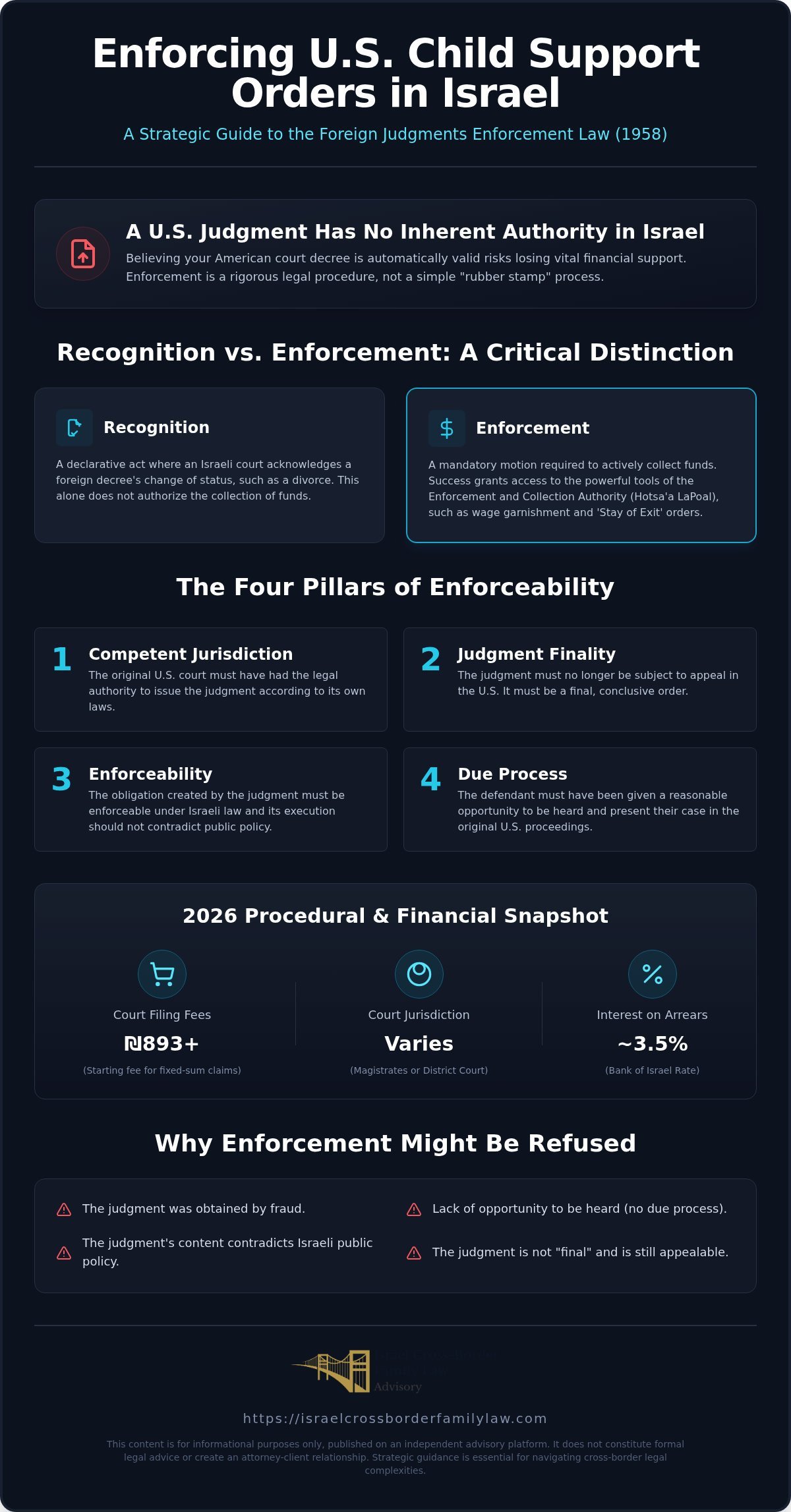
Confusion often arises between the concepts of “recognition” and “enforcement.” Recognition is essentially a declarative act where the Israeli court acknowledges the status established by a foreign decree, such as a change in marital status. However, when the objective involves the actual collection of funds, a formal motion for enforcement is mandatory. This is a critical distinction for those enforcing US child support order in Israel. Recognition alone won’t allow you to access the tools of the Enforcement and Collection Authority (Hotsa’a LaPoal), such as wage garnishment or “Stay of Exit” orders. Choosing the correct path is essential for managing your legal timeline and controlling costs, as a full enforcement proceeding involves more complex filings and higher court fees, which currently start at a minimum of ₪893 for fixed-sum claims. You can learn more about how this applies to your specific family situation by exploring our child support cross-border enforcement resources.
The Four Mandatory Conditions for Enforcement in Israel
To achieve a successful outcome when enforcing US child support order in Israel, the petitioner must demonstrate that the foreign judgment meets four specific statutory criteria. These requirements, listed under Section 3 of the Foreign Judgments Enforcement Law, ensure that the Israeli judicial system maintains its integrity while honoring international obligations. These aren’t suggestions; they’re rigid legal thresholds. Failure to meet even one condition can result in the immediate dismissal of your motion.
The four pillars of enforceability include:
- Competent Jurisdiction: The US court must have possessed the authority to issue the order under its own domestic laws.
- Finality: The judgment cannot be a temporary measure; it must be final and no longer subject to ordinary appeal.
- Reciprocity: Israel requires evidence that the originating US state would, in principle, enforce a similar judgment from an Israeli court.
- Public Policy (Takant HaTzibur): The order must not contradict the fundamental values or moral standards of the State of Israel.
Unlike some generic legal summaries that gloss over the nuances of public policy, it’s vital to recognize that Israeli courts use this as a “safety valve.” If a US judgment was obtained through a process that fundamentally denied a parent’s right to a fair hearing, it may be deemed repugnant to Israeli public order. This defense is frequently raised by debtors seeking to avoid their obligations, making a robust initial filing essential.
Proving Finality and Non-Appealability
Israeli family courts generally refuse to enforce interlocutory or temporary orders because they lack the necessary permanence for cross-border execution. A judgment is considered final only when the period for filing an appeal in the US has expired or the highest court has ruled. To satisfy this condition, you must provide a Certificate of Finality or an equivalent official document from the US court. This administrative detail is often where unguided petitions fail. It leads to costly delays and the need for corrected filings. Don’t assume a standard court stamp is sufficient.
The Reciprocity Hurdle for US Judgments
Reciprocity remains one of the most complex aspects of enforcing US child support order in Israel because it requires de facto evidence that the specific US state honors Israeli decrees. The Israeli Attorney General often reviews these cases to ensure mutual judicial respect exists. However, Section 4 of the Law allows for exceptions if the court is convinced that enforcement is necessary for the sake of justice. Detailed procedures for these interactions are outlined in the U.S. government guide to Israel child support cases, which serves as a vital reference for practitioners. If you are unsure whether your state qualifies, seeking a confidential case review can help clarify your jurisdictional standing before you commit to litigation.
The 2026 Procedural Roadmap: Filing Your Motion in Israeli Court
Moving from the theoretical requirements of the 1958 Law to the actual collection of funds requires a meticulous procedural strategy. Enforcing US child support order in Israel is a multi-step litigation process that begins with a formal motion filed in the appropriate Israeli court. This isn’t a task for general practitioners; it requires a deep understanding of the Israeli court regulations updated in early 2026. One of the most critical procedural hurdles is the statute of limitations. Under the Foreign Judgments Enforcement Law, you must file your motion within five years from the date the US judgment was rendered. Missing this deadline typically results in a permanent loss of enforcement rights within Israel.
Magistrates vs. District Court Thresholds
Identifying the correct venue is your first tactical decision. For 2026, the jurisdictional threshold for civil claims in Israel is set at ₪2,500,000. If the total value of the arrears and the projected future support exceeds this amount, the motion must be filed in the District Court. However, most child support matters are handled within the specialized Family Court system, which operates at the Magistrate level. Filing in the wrong jurisdiction doesn’t just waste time; it can lead to a procedural dismissal and the forfeiture of your initial filing fees, which currently start at a baseline of ₪893 for fixed-sum claims.
The Importance of the Apostille
Israeli courts will not accept a US court order simply because it carries a judge’s signature. Every document must be authenticated via an Apostille to prove its legitimacy to a foreign government. The Apostille is the standard verification method established under the Hague Convention on the International Recovery of Child Support. In the US, you generally obtain this from the Secretary of State in the state where the order was issued. Without this gold-standard seal, your motion will be rejected before it even reaches a judge’s desk.
Once authenticated, the documents must undergo a certified translation into Hebrew. A common mistake for US citizens is providing a translation certified by an American notary. Israeli courts frequently reject these, insisting instead on a translation certified by an Israeli notary who can vouch for the accuracy under local law. This technicality is a primary reason why we emphasize an advisory-first approach for those in our program for expats and foreign nationals. Finally, you must ensure proper service of process on the debtor in Israel. If the debtor isn’t notified according to strict Israeli procedural rules, any subsequent enforcement order can be easily overturned on appeal, sent back to the starting line, and burdened with additional legal costs.
Enforcing Family Law Orders: Child Support and Spousal Maintenance
While the Foreign Judgments Enforcement Law provides the general scaffolding for all civil matters, its application to Enforcing US Child Support Orders in Israel involves additional layers of sensitivity and urgency. Israeli courts recognize that child maintenance is a matter of basic human necessity. Consequently, once a motion for enforcement is granted, the petitioner gains access to a robust execution infrastructure. This process is further strengthened by the interplay between domestic law and the Hague Convention on Child Support, which creates a streamlined administrative path for cooperation between US state agencies and Israeli central authorities.
A unique feature of the Israeli system is the dual jurisdiction of civil Family Courts and religious Rabbinical Courts. This “race to the court” can significantly impact the enforcement strategy. Generally, if a US judgment already exists, the Family Court is the standard venue for enforcement. However, strategic considerations regarding the debtor’s religious status or existing rabbinical proceedings must be evaluated to prevent jurisdictional conflicts that could stall your case. If the debtor attempts to move the matter to a religious court to circumvent the US order, having a pre-established enforcement motion in the Family Court is your strongest defense.
Special Considerations for Child Support
Child support judgments are treated with higher priority than standard commercial debts. Once the Israeli court declares a US order enforceable, it is passed to the Enforcement and Collection Authority (Hotsa’a LaPoal). This body has the power to impose immediate sanctions, including freezing bank accounts and issuing “Stay of Exit” orders. In 2026, petitioners must account for specific Israeli standards, such as the baseline for essential needs, which currently ranges from ₪1,600 to ₪2,250 per month per child. It’s also vital to distinguish between ongoing support and arrears. Arrears are now subject to a 3.5% interest rate following the January 2025 reforms that eliminated compound interest on support debts. Additionally, remember that Israeli law typically reduces support to one-third of the original amount while a child performs mandatory military service, a factor that may require adjustments to your US-based expectations.
Enforceability of US Prenuptial Agreements
A common point of confusion involves US prenuptial agreements. A prenup is not a “judgment” in the eyes of the 1958 Law unless it was previously incorporated into a court order or validated by a judicial body. If you seek to enforce financial provisions from a US agreement that hasn’t been “judicially blessed,” you may face significant hurdles under the Israeli Financial Agreements Law. This local law requires specific formalities that US documents often lack. For a deeper look at navigating these cross-border financial complexities, you can find expert guidance on our YouTube channel. If you are struggling with a non-compliant parent or a complex financial dispute, reaching out for a specialized legal consultation is the most effective way to secure your family’s financial future.
Defenses and Limitations: Why Enforcement Might Be Refused
While the Israeli judicial system maintains a sophisticated framework for international cooperation, the process of enforcing US child support order in Israel is not without its obstacles. Under Section 6 of the Foreign Judgments Enforcement Law, a debtor may present specific defenses to block the declaration of enforceability. It is a common misconception that these defenses allow for a full re-litigation of the original case. Instead, the Israeli court focuses strictly on the procedural and ethical integrity of the US judgment. The burden of proof rests heavily on the party opposing enforcement, and Israeli judges typically require clear, convincing evidence before they will disregard a decree from a competent US jurisdiction.
The primary statutory defenses include:
- Fraud: The debtor must prove the judgment was obtained through active deceit or collusion that misled the US court.
- Lack of Due Process: Enforcement will be refused if the debtor can demonstrate they were not given a reasonable opportunity to present their case or were not properly served with notice.
- Contradictory Judgments: If an Israeli court has already issued a conflicting judgment on the same matter between the same parties, the local ruling generally takes precedence.
- Statute of Limitations: Under current 2026 regulations, a motion must be initiated within five years from the date the US judgment was rendered, unless special circumstances justify a delay.
The ‘Public Policy’ Shield (Takant HaTzibur)
The concept of “Public Policy” or Takant HaTzibur acts as a final safeguard for the Israeli legal system. A US judgment may be rejected if its enforcement would fundamentally contradict the moral standards or basic legal principles of the State of Israel. For example, while US courts frequently award punitive damages, Israeli courts often view these as “penal” rather than “compensatory.” In such cases, the Israeli court may choose to reduce the award to align with local standards of actual loss. This balancing act ensures that while Israel honors its international commitments, it does not import legal outcomes that are entirely foreign to its own jurisprudential values.
Strategy Before Litigation: The Advisory Approach
Success in cross-border family law depends on preparation rather than reaction. Before initiating a motion in the Israeli Family Court, it’s vital to identify potential weaknesses in the US order that a debtor might exploit. We recommend starting with a Confidential Case Review to assess the strength of your judgment against the 1958 Law’s requirements. You should also learn how our advisory works to understand how we bridge the gap between American and Israeli legal expectations. Gaining clarity on the risks, timelines, and potential costs before committing to litigation is the most effective way to ensure the successful collection of the support your children are owed.
Securing Financial Stability Across Jurisdictions
Navigating the intersection of American and Israeli law requires more than just administrative filing; it demands a sophisticated understanding of the Foreign Judgments Enforcement Law and the 2026 procedural landscape. Successfully enforcing US child support order in Israel depends on meeting strict statutory conditions, from proving finality to ensuring reciprocity between specific US states and Israeli courts. By adhering to the mandatory five-year statute of limitations and correctly identifying jurisdictional thresholds, you can avoid the costly delays of re-litigation and move directly toward collection through the Enforcement and Collection Authority.
Strategy is the bridge between a foreign decree and actual payment. As an independent advisory platform with authoritative expertise in cross-border family law, we provide the steady guidance English-speaking expats need to navigate these complex transnational operations. Before you commit to the litigation process, ensure your case is built on a foundation of clarity and strategic foresight. Get the expert perspective necessary to protect your children’s interests. Request a confidential consultation today to begin your roadmap toward successful enforcement. You don’t have to face this bureaucratic challenge alone.
Frequently Asked Questions
How long does it take to enforce a foreign judgment in Israel?
The timeline for enforcing US child support order in Israel typically ranges from 6 to 18 months from the date of filing. This duration depends on the complexity of the case, whether the debtor contests the motion, and the current backlog in the Family Court system. Strategic preparation of documents, including the mandatory Apostille and certified Hebrew translations, can significantly reduce the risk of procedural delays.
Do I need to travel to Israel to enforce my US child support order?
You generally don’t need to travel to Israel to initiate or complete the enforcement process if you have legal representation. Most procedural motions and hearings are handled by your counsel through the Israeli court’s electronic filing system. In rare instances where a specific testimony is required from the petitioner, the court may allow a remote appearance via video conference rather than requiring physical travel.
Can I enforce a US judgment if the debtor has no known assets in Israel?
You can still file for enforcement even if the debtor has no currently known assets in Israel. Once the judgment is declared enforceable, it empowers the Enforcement and Collection Authority (Hotsa’a LaPoal) to use investigative tools to uncover hidden bank accounts, income, or real estate. Additionally, it enables the issuance of a “Stay of Exit” order, which often compels payment when the debtor attempts to leave the country.
What is the statute of limitations for enforcing a foreign judgment in Israel?
The statute of limitations for filing a motion to enforce a foreign judgment is strictly five years from the date the original US order was issued. This deadline is established under the Foreign Judgments Enforcement Law of 1958. If you fail to act within this five-year window, the Israeli court will likely refuse to recognize the order unless you can prove exceptional circumstances that prevented earlier filing.
Will the Israeli court re-examine the facts of my original US case?
Israeli courts do not re-examine the underlying facts or the merits of the original US case during enforcement proceedings. The court’s role is strictly limited to verifying that the judgment meets the statutory conditions of the 1958 Law, such as competent jurisdiction and finality. Unless there is clear evidence of fraud or a fundamental lack of due process, the Israeli judge won’t second-guess the US court’s decision.
How much does it cost to file a motion for enforcement in Israel?
The official court filing fee for a fixed-sum enforcement claim is currently 2.5% of the total amount, with a minimum baseline of ₪893 as of January 2026. This fee covers the court’s administrative costs but does not include expenses for certified Hebrew translations, Israeli notarial certifications, or specialized legal counsel. It is essential to account for these additional administrative costs when budgeting for enforcing US child support order in Israel.
Can I enforce a judgment for punitive damages in Israel?
Israeli courts typically refuse to enforce portions of a US judgment that are purely punitive or exemplary in nature. Under the public policy defense, the court may reduce the enforceable amount to reflect only actual compensatory damages. This is a critical distinction, as the Israeli system views punitive awards as “penal” rather than “civil,” which contradicts local legal standards for debt collection.
What happens if the foreign judgment was given in default?
A US judgment given in default is enforceable in Israel provided that the debtor was properly served and given a reasonable opportunity to appear. If the debtor can prove they were never notified of the US proceedings according to the laws of that state, the Israeli court will likely refuse enforcement based on a lack of due process. Proper documentation of the original service of process is vital for success.

Article by
Gabriel Lior
A Personal Journey That Became a Mission
The advisory was founded by an American father Gabriel Lior, LLB, MBA , global entrepreneur, and cross-border advisor who spent more than a decade navigating the Israeli family court system firsthand and now lives in Singapore with his son.
As a divorced parent in a cross-border family, Gabriel faced nearly every legal challenge a foreign parent can encounter in Israel — including child custody disputes, child support proceedings, property matters in Israel and abroad, false accusations, and complex immigration and relocation proceedings.
Over the years, he learned the hard way how difficult it is for non-Israeli parents to understand the system, identify the right legal strategy, and choose the right legal representation — especially when language, culture, and jurisdictional differences are involved. He also witnessed how foreign parents and new immigrants are often disadvantaged or taken advantage of by service providers and institutions simply because they lack local knowledge or fluency.
From Client to Advisor
To truly understand — and survive — the system, Gabriel pursued formal legal education in Israel, completing two Israeli law degrees, alongside a BA and MBA earned in the United States. This was never about becoming a practicing attorney, but about gaining a deep, structural understanding of how the system works — and where it breaks down for foreign parents.
This rare combination of:
Firsthand client experience
Israeli legal and US business education
International business and negotiation training
Decades of commercial execution
created a unique perspective – one that understands both sides of the table.
After years of litigation, persistence, and at times self-representation, he ultimately succeeded in securing custody of his son and relocating abroad through a rare legal victory in the Israeli Supreme Court — becoming one of the first fathers in Israel to do so under these circumstances.
Disclaimer
Important Disclaimer:
The information provided on this website and in its content is for general informational and educational purposes only and does not constitute legal advice, legal opinion, or legal representation.
Gabriel Lior is not licensed to practice law in Israel (nor is he interested in doing so) and does not provide legal services, despite having completed 2 Law Degrees. The services offered are advisory in nature and are intended to provide general guidance, strategic insight, and information regarding cross-border family law considerations.
No attorney-client relationship is formed by accessing this website, reading its content, or communicating with us.
Any decisions made based on this information are at your own discretion and risk. For legal advice specific to your situation, you should consult a licensed attorney in the relevant jurisdiction.
Where appropriate, we may refer clients to independent, licensed attorneys or professionals. Such referrals do not constitute legal representation and no liability is assumed for services provided by third parties.