The dissolution of a marriage is an inherently complex process. When that process involves dual nationalities, the legal complexities multiply, creating a daunting landscape of uncertainty. Questions immediately arise: Which country’s laws will govern the division of assets? How can you protect your parental rights across borders? What is the risk of a spouse concealing wealth in an international account? These are not merely anxieties; they are the fundamental dual citizen divorce complications that can critically impact the outcome of your case if not managed with sophisticated legal counsel from the outset. Navigating this multi-jurisdictional terrain requires a strategic and informed approach. This guide is designed to provide that essential clarity. We will dissect the five core challenges inherent in a cross-border divorce, from the critical first step of establishing jurisdiction to the intricate processes of international asset division and child custody enforcement. By understanding these issues, you will be equipped with the foundational knowledge to engage with your attorney effectively, protect your interests, and proceed with confidence through one of life’s most challenging transitions.
Jurisdiction: The Critical First Hurdle in a Dual Citizen Divorce
When spouses hold citizenship in two different countries, such as Israel and the United States, a divorce is not a single legal event but a complex, multi-jurisdictional challenge. The first and most consequential decision is determining jurisdiction-the legal authority of a court to hear a case. This choice is monumental, as it dictates which country’s legal framework will govern every subsequent issue, from asset division to child custody. Selecting the proper jurisdiction is the foundational step in successfully navigating the most critical of dual citizen divorce complications. To better understand how different legal systems can interact in these matters, the following discussion provides valuable context:
Determining Which Court Can Hear Your Case
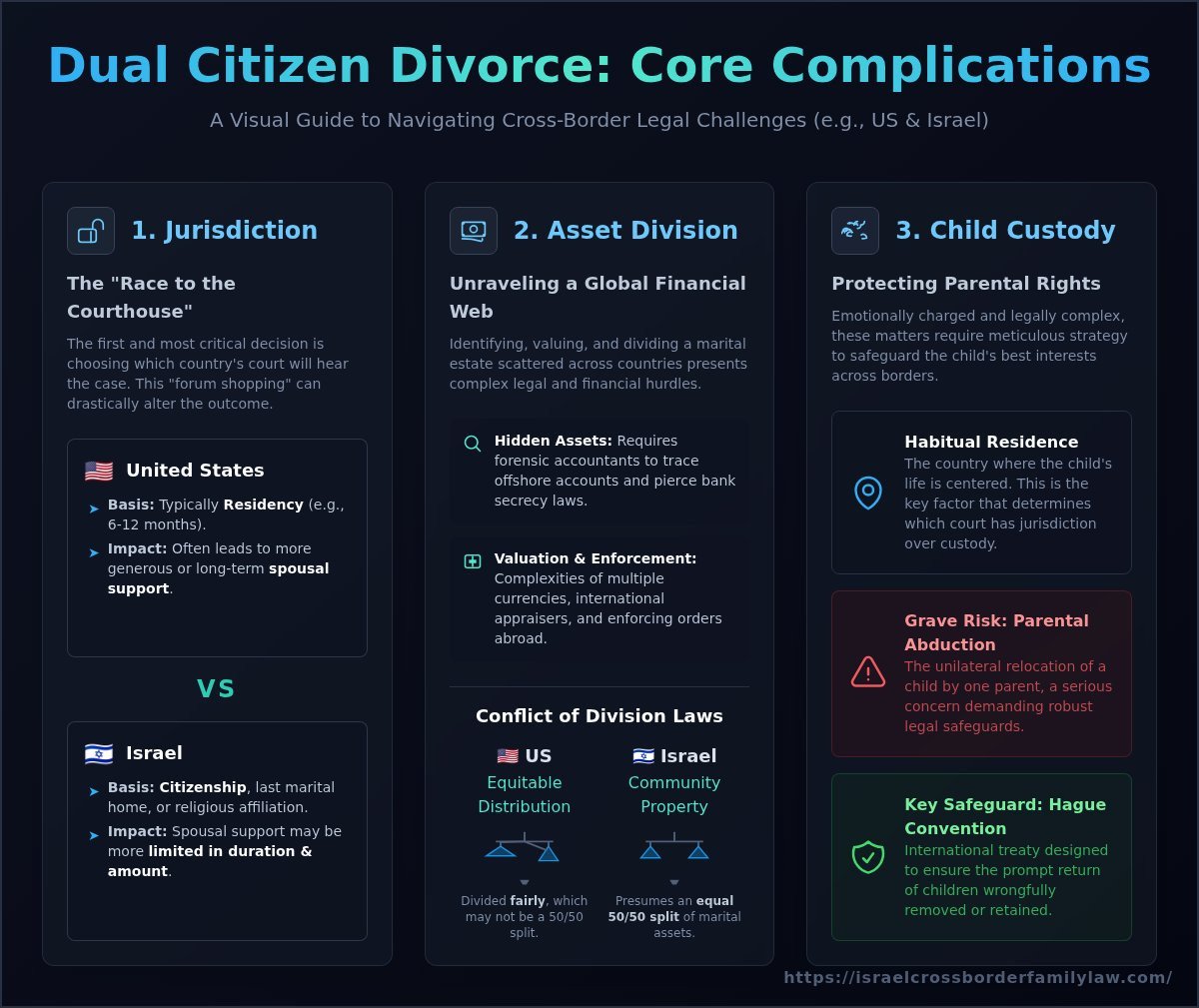
Jurisdiction is typically established through residency. In the United States, for instance, a state court may require that at least one spouse has resided there for a specific period, often six months to a year. Israeli law, however, can establish jurisdiction based on several factors, including the couple’s last common marital home, the citizenship of one or both spouses, or even religious affiliation for Jewish couples. This frequently results in a situation where both an Israeli court and a U.S. court have simultaneous, legitimate jurisdiction, creating a complex conflict of laws in divorce that requires expert strategic guidance.
The Risks of ‘Forum Shopping’
The existence of dual jurisdiction can trigger a “race to the courthouse,” a practice known as forum shopping. One spouse may rush to file in the country with laws more favorable to their position. For example, spousal support (alimony) laws can differ dramatically. A high-earning spouse might prefer to file in Israel, where support awards may be more limited in duration and amount, whereas the financially dependent spouse might seek to file in a U.S. state known for more generous or long-term support orders. This race creates significant risks, including the potential for conflicting orders from two different courts, which complicates and prolongs the resolution. It is imperative to seek immediate legal counsel upon separation to analyze these dual citizen divorce complications and secure the most advantageous legal forum.
Dividing Marital Assets and Debts Across Borders
One of the most significant dual citizen divorce complications involves the equitable division of a marital estate scattered across multiple jurisdictions. When assets such as real estate, investment portfolios, businesses, and bank accounts are located in both the United States and Israel, the process transcends simple accounting. It becomes a complex, multi-jurisdictional challenge requiring a sophisticated understanding of international finance and conflicting legal frameworks. Successfully navigating this landscape is critical to protecting your financial future. The core difficulty lies in identifying, valuing, and ultimately dividing these international assets. A spouse may attempt to conceal property or funds in a jurisdiction with stringent bank secrecy laws, necessitating a global asset search. Furthermore, enforcing a property division order issued by a court in one country is not automatically guaranteed in another. This lack of seamless enforcement can create significant obstacles, demanding strategic legal action in both nations to ensure compliance and secure your rightful share of the marital estate.
Locating and Valuing International Property
Successfully identifying the complete marital estate requires a meticulous approach, often involving forensic accountants adept at tracing offshore accounts and uncovering hidden assets. Valuing these properties presents another layer of complexity; an expert appraiser in Tel Aviv must assess a property’s value in Israeli Shekel (₪), which then needs to be accurately translated for U.S. court proceedings. Differing record-keeping systems, such as the contrast between U.S. county recorders and Israel’s Land Registry Office (Tabu), further complicate discovery.
Conflict of Laws: Equitable Distribution vs. Community Property
The choice of jurisdiction profoundly impacts the financial outcome of a divorce. U.S. states generally follow “equitable distribution,” where assets are divided fairly, which may not mean a 50/50 split. In contrast, Israel’s Law of Spouses’ Property Relations typically presumes an equal division of all assets accumulated during the marriage. This fundamental conflict makes the initial decision of where to file the divorce a critical strategic move. A well-drafted international prenuptial agreement can preemptively address these issues, providing clarity and bypassing potential litigation.
International Child Custody: Protecting Your Parental Rights
Among the most significant dual citizen divorce complications are those involving minor children. These matters are invariably the most contentious and emotionally charged, requiring meticulous legal strategy to protect both parental rights and the child’s best interests across international borders. The risk of one parent unilaterally relocating with a child is a grave concern that demands proactive and robust legal safeguards. A core legal principle in these multi-jurisdictional cases is determining the child’s “habitual residence”-the country where their life is primarily centered-as this typically establishes which nation’s courts have jurisdiction over custody matters, a key challenge in Divorces Involving Dual Citizenship.
The Hague Convention and Preventing Parental Abduction
The Hague Convention on the Civil Aspects of International Child Abduction is a critical international treaty designed to secure the prompt return of children wrongfully removed to or retained in another signatory country. Crucially, both the United States and Israel are signatories. If a child is taken from their country of habitual residence without the other parent’s consent, this treaty provides a legal framework for their return. However, relying on the Convention is a reactive measure; the most effective strategy involves preventative legal actions, such as securing court orders that explicitly prohibit the removal of the child from the jurisdiction without mutual consent or a court decree.
Crafting Enforceable Cross-Border Parenting Plans
Developing a workable cross-border parenting plan is an immensely complex task. It must address sophisticated logistical and financial challenges, including:
- Travel and Holidays: Coordinating different school calendars, allocating major holidays, and stipulating who bears the significant cost of international flights.
- Communication: Establishing clear protocols for regular communication across different time zones.
- Passports and Consent: Clarifying which parent holds the child’s passports and requiring notarized, written consent for any international travel.
To ensure compliance, it is vital to obtain “mirror orders”-having a custody order issued by an Israeli court formally recognized and registered by a court in the other parent’s country of residence, making it enforceable in both jurisdictions. Navigating these specific dual citizen divorce complications requires specialized legal counsel. Protect your parental rights with expert legal guidance.
Enforcing Spousal and Child Support Orders Internationally
A critical challenge arising from a cross-border divorce is the enforcement of spousal and child support orders. A judgment issued by an Israeli Family Court is not automatically enforceable in another country, such as the United States, the UK, or within the EU. This jurisdictional barrier is compounded by disparate legal frameworks; while Israel often calculates support based on the needs of the child and historical precedent, other nations may use strict income-sharing formulas, creating a complex financial and legal landscape for dual citizens. Successfully securing financial support across borders requires a sophisticated understanding of international law and procedure, representing one of the most significant dual citizen divorce complications.
How International Treaties Can Help
To address these enforcement gaps, a network of international agreements provides a structured pathway for legal recognition. Israel is a signatory to key conventions, including the Hague Convention on the International Recovery of Child Support. These treaties establish a system for the reciprocal enforcement of maintenance orders. The process typically involves registering the Israeli court order with the competent authority in the foreign country, which then gives it the same legal weight as a domestic order, enabling local enforcement actions.
Practical Challenges in Collection
Even with treaties in place, formidable practical hurdles remain. Navigating these issues requires deep cross-jurisdictional expertise. Key challenges include:
- Asset and Income Discovery: Locating a former spouse’s employment, income sources, and assets in a foreign country can be an intricate and costly process without an established international legal network.
- Enforcement Mechanisms: Implementing tools like wage garnishment or levying bank accounts becomes a multi-jurisdictional affair, requiring coordinated legal action in both countries.
- Currency Fluctuations: A support order denominated in Israeli Shekels (₪) can result in unpredictable payment amounts when converted to another currency, impacting financial stability for the recipient.
These complex enforcement dynamics underscore why specialized legal counsel is not merely beneficial but essential. Effectively navigating the intricate web of international treaties and local enforcement laws is paramount to protecting your financial rights and ensuring your children’s welfare. For expert assistance in managing these dual citizen divorce complications, our firm provides the strategic guidance necessary to secure and enforce your support orders globally.
Recognition of Foreign Divorce Decrees
Successfully obtaining a divorce decree in one country is a significant milestone, but it is often not the final step in a cross-border separation. The legal principle of ‘comity’-the practice by which courts in one jurisdiction will apply the laws and judicial decisions of another-is a matter of deference, not a mandate. Consequently, a divorce finalized in a U.S. court is not automatically valid in Israel, and vice versa. This lack of automatic recognition can create profound legal ambiguity, directly impacting your ability to remarry, enforce financial settlements, or execute a clear estate plan in the future. Ensuring your divorce is recognized in all relevant jurisdictions is the final, critical step toward achieving true legal finality and mitigating future dual citizen divorce complications.
Why Your Divorce Might Not Be Final Everywhere
The grounds for non-recognition often stem from fundamental differences between legal systems. For example, a swift, no-fault civil divorce granted in a U.S. state may be perfectly valid under American law but could be deemed insufficient by Israel’s Rabbinical Courts, which maintain exclusive jurisdiction over the marriage and divorce of Jewish citizens. A foreign country may refuse to recognize a divorce decree if:
- The original court lacked proper jurisdiction over the parties.
- A party was not given adequate notice of the proceedings, violating due process.
- The judgment contradicts the fundamental public policy of the recognizing nation.
For Jewish couples, the situation is further complicated by the religious requirement of a Get. Without this Jewish divorce document, the State of Israel will not recognize the marriage as dissolved, legally preventing remarriage within its borders, irrespective of a valid foreign civil decree.
The Process of Domesticating a Foreign Judgment
To achieve comprehensive legal closure, your foreign divorce decree must be formally “domesticated” or registered in the other country. This involves a specific legal action, typically filing a petition with the appropriate judicial body, such as the Family Court in Israel. This procedural step is not a mere formality; it is a vital safeguard that provides certainty and prevents future legal challenges to your marital status. This process requires meticulous preparation of documentation, which generally includes an apostilled copy of the original divorce decree, a certified translation into Hebrew, and compelling proof that the foreign court had jurisdiction and that all parties were properly served. Navigating these requirements demands sophisticated legal counsel with deep experience in multi-jurisdictional family law. For specialized guidance on ensuring your divorce is recognized globally, contact our team of cross-border legal experts.
Strategic Guidance for Your Cross-Border Divorce
As we have detailed, a divorce involving dual citizenship introduces a labyrinth of legal challenges, from the pivotal initial decision of establishing jurisdiction to the intricate processes of dividing assets across borders and ensuring the international enforcement of child custody agreements. These dual citizen divorce complications demand more than standard legal counsel; they require sophisticated, multi-jurisdictional expertise to protect your interests effectively. Our firm is uniquely positioned to provide this level of support, offering profound expertise in both US and Israeli family law systems. With decades of experience in complex multi-jurisdictional cases, we deliver authoritative guidance on navigating the international treaties and agreements that will govern your outcome. We invite you to schedule a consultation to navigate your US-Israel cross-border divorce. With strategic legal counsel, you can move forward with clarity and confidence.
Frequently Asked Questions About Dual Citizen Divorce
Can my spouse divorce me in another country without my knowledge?
It is possible for a spouse to initiate and potentially finalize a divorce in a foreign jurisdiction without your direct participation, a process known as an ex parte divorce. The validity of such a proceeding depends on whether the foreign court properly established jurisdiction and met its legal standards for notification. However, Israeli courts may refuse to recognize a foreign divorce decree if it is determined that you were not given adequate notice or opportunity to be heard, violating principles of natural justice.
What happens if we get conflicting custody or support orders from courts in two different countries?
Conflicting orders from courts in two nations create significant enforcement challenges and represent one of the most severe dual citizen divorce complications. Typically, the principle of ‘first in time’ gives precedence to the initial ruling, but this is not absolute. Courts will analyze which jurisdiction has the closest connection to the family, often guided by international agreements like the Hague Convention. Resolving such multi-jurisdictional conflicts requires a sophisticated legal strategy to determine which order is ultimately enforceable in Israel and abroad.
Are prenuptial agreements from one country valid in another?
The enforceability of a prenuptial agreement across international borders is not guaranteed and depends entirely on the laws of the jurisdiction where it is being presented. An agreement valid in the United States, for instance, may not meet the specific formal requirements for validation in Israel, which often requires approval by a Family Court or a notary. A comprehensive cross-border legal review is essential to determine its standing and potential for recognition by an Israeli court during divorce proceedings.
How long does a dual-citizen divorce typically take compared to a domestic one?
A dual-citizen divorce almost invariably involves a more protracted timeline than a purely domestic case. The process is extended by procedural complexities such as international service of documents, the need to gather financial evidence from multiple jurisdictions, and potential disputes over which country’s courts should preside over the matter. Navigating these cross-border legal requirements demands meticulous coordination and can add many months, or even years, to the resolution of the case compared to a standard Israeli divorce.
What is the first thing I should do if I think my dual-citizen spouse is planning to file for divorce?
The most critical first step is to immediately seek strategic legal counsel from a firm with demonstrated expertise in international family law and the unique challenges of a cross-border divorce. Time is of the essence, as your spouse may be planning to file in a jurisdiction that is less favorable to your interests regarding asset division or child custody. Proactive consultation allows your legal team to assess jurisdictional options, protect assets, and prepare a strategy to secure the most advantageous legal forum.
Do I need separate lawyers in each country?
In most multi-jurisdictional divorce cases, engaging legal counsel in each relevant country is a necessity. A lawyer licensed in Israel cannot provide legal advice or represent you in a U.S. court. The optimal approach is to retain an international law firm with dual-qualified attorneys or a coordinated team on the ground in both jurisdictions. This ensures a seamless and unified legal strategy, preventing conflicting advice and effectively managing the complex interplay between different legal systems.

Article by
Gabriel Lior
A Personal Journey That Became a Mission The advisory was founded by an American father Gabriel Lior, LLB, MBA , global entrepreneur, and cross-border advisor who spent more than a decade navigating the Israeli family court system firsthand and now lives in Singapore with his son.
As a divorced parent in a cross-border family, Gabriel faced nearly every legal challenge a foreign parent can encounter in Israel — including child custody disputes, child support proceedings, property matters in Israel and abroad, false accusations, and complex immigration and relocation proceedings. Over the years, he learned the hard way how difficult it is for non-Israeli parents to understand the system, identify the right legal strategy, and choose the right legal representation — especially when language, culture, and jurisdictional differences are involved. He also witnessed how foreign parents and new immigrants are often disadvantaged or taken advantage of by service providers and institutions simply because they lack local knowledge or fluency. From Client to Advisor To truly understand — and survive — the system, Gabriel pursued formal legal education in Israel, completing two Israeli law degrees, alongside a BA and MBA earned in the United States. This was never about becoming a practicing attorney, but about gaining a deep, structural understanding of how the system works — and where it breaks down for foreign parents. This rare combination of: Firsthand client experience Israeli legal and US business education International business and negotiation training Decades of commercial execution created a unique perspective – one that understands both sides of the table. After years of litigation, persistence, and at times self-representation, he ultimately succeeded in securing custody of his son and relocating abroad through a rare legal victory in the Israeli Supreme Court — becoming one of the first fathers in Israel to do so under these circumstances.
Disclaimer
Important Disclaimer: The information provided on this website and in its content is for general informational and educational purposes only and does not constitute legal advice, legal opinion, or legal representation. Gabriel Lior is not licensed to practice law in Israel (nor is he interested in doing so) and does not provide legal services, despite having completed 2 Law Degrees. The services offered are advisory in nature and are intended to provide general guidance, strategic insight, and information regarding cross-border family law considerations. No attorney-client relationship is formed by accessing this website, reading its content, or communicating with us. Any decisions made based on this information are at your own discretion and risk. For legal advice specific to your situation, you should consult a licensed attorney in the relevant jurisdiction. Where appropriate, we may refer clients to independent, licensed attorneys or professionals. Such referrals do not constitute legal representation and no liability is assumed for services provided by third parties.