What if the most effective way to protect your US-based 401(k) and your Israeli property isn’t an aggressive courtroom battle, but a strategically structured conversation? Most international families fear that a cross-border divorce means being caught between the complexities of the Israeli Rabbinical Court and the unfamiliarity of American state laws. You’re likely worried about how your assets will be divided or whether a Hague Convention dispute might impact your children’s future. It’s natural to feel overwhelmed when your life is split between two divergent legal systems.
This 2026 guide explains how cross-border divorce mediation US Israel serves as a vital bridge, allowing you to secure a legally binding agreement that both jurisdictions recognize. By choosing mediation, you can resolve jurisdictional conflicts and protect your family’s wealth without the emotional and financial exhaustion of international litigation. We’ll explore mandatory mediation requirements in Israel, the strategic division of assets, and the steps to ensure your agreement is recognized in both Tel Aviv and New York.
This content is published on an independent advisory platform and is not a law firm. It’s designed to provide strategic guidance and risk assessment for families navigating multi-jurisdictional challenges. Please be aware that legal services are only provided by licensed attorneys under a formal, separate engagement.
Key Takeaways
- Understand why a strategic mediation approach is the most effective way to prevent a jurisdictional “race to the courthouse” while protecting your family’s long-term stability.
- Learn about your specific legal standing during the mandatory 45-60 day cooling-off period required by the Israeli Law for the Settlement of Family Disputes.
- Explore how cross-border divorce mediation US Israel can resolve complex financial conflicts involving US-based retirement accounts and Israeli real estate.
- Identify strategies to define “habitual residence” clearly to protect your children and avoid the high-stakes risks of international Hague Convention litigation.
- Discover how to use “Mirror Orders” to ensure your final divorce agreement is legally recognized and enforceable in both the US and Israel.
Why Mediation is Critical for US-Israel Cross-Border Divorces
Cross-border mediation is a structured negotiation process where parties living under different legal systems work toward a mutually acceptable resolution. In the context of cross-border divorce mediation US Israel, it serves as a strategic shield against the chaotic “race to the courthouse.” This race occurs when one spouse files for divorce in Israel while the other files in a US state court, each attempting to secure a more favorable legal environment for their specific interests. Filing first in one jurisdiction can sometimes lock the other spouse out of certain legal protections, making early strategy sessions vital.
When litigation occurs in two countries simultaneously, it almost always produces conflicting orders. For example, a court in California might order the equal division of a bank account, while an Israeli court might freeze that same account pending a religious ruling. These contradictions create a legal deadlock that can take years and thousands of dollars to resolve. Mediation allows you to maintain direct control over the outcome. Instead of leaving your future to a judge who is unfamiliar with your family’s unique cultural or financial background, you decide the terms yourself.
To better understand how this process works in practice, watch this helpful video:
The Conflict of Laws: US States vs. Israeli Courts
Israel (IL) uses a dual system of civil and religious law that is fundamentally different from the US legal system. For Jewish expats and dual citizens, the Rabbinical Court (Beit Din) often holds exclusive authority over the actual act of divorce, known as the “Get.” This religious component can complicate civil mediation if not handled with care. Citing the Hague Divorce Convention helps clarify how international treaties govern the recognition of these separations between nations. Seeking clarity before making any legal commitments is the only way to avoid being caught between these two very different systems. You can explore our structured approach to these challenges on the how it works page.
Avoiding the Financial Drain of International Litigation
The financial cost of international litigation is a significant risk that many families underestimate. You’re typically required to hire two separate legal teams, pay for certified translations of every document, and potentially fund expert testimony on foreign law. These expenses can rapidly deplete your marital estate, leaving less for your children’s education or your own retirement. A calm and authoritative mediation process protects your assets by focusing on cooperation rather than conflict. It’s a strategic way to ensure that your wealth stays within the family. Beyond the financial savings, mediation reduces the emotional toll on children by modeling a respectful, albeit difficult, transition.
This content is published on an independent advisory platform and is not a law firm. Our focus is on strategy, risk management, and decision-making guidance. Legal services are only provided by licensed attorneys under a separate, formal engagement.
Navigating the Israeli Mandatory Mediation Law (Settlement of Dispute)
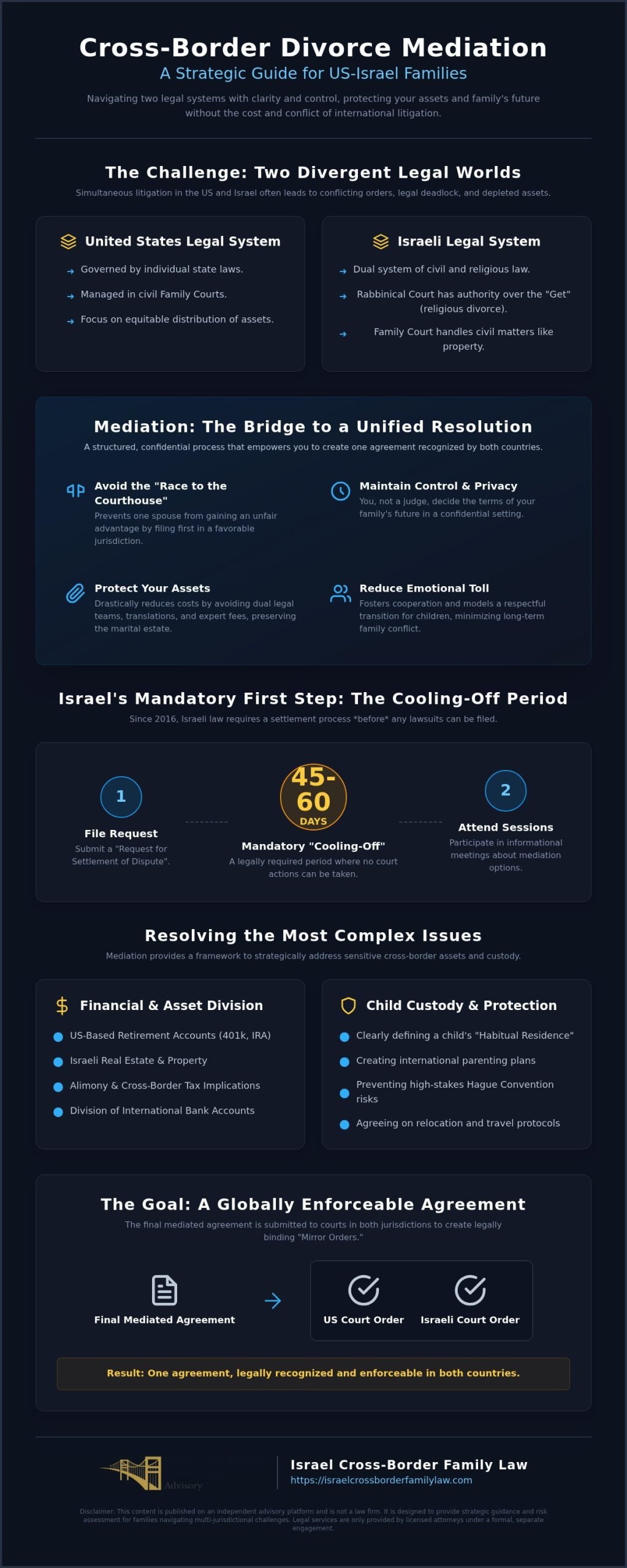
In 2016, Israel enacted the Law for the Settlement of Family Disputes, fundamentally altering the initial stages of the divorce process. This legislation replaced the immediate “race to the courthouse” with a mandatory “Request for Settlement of Dispute.” For US-Israel families, this means that before you can file a lawsuit in either the Family Court or the Rabbinical Court, you must first enter a mandatory cooling-off period. This period typically lasts between 45 and 60 days. During this time, neither spouse can initiate litigation on the main issues of the divorce, such as property division or custody arrangements.
This window is a strategic opportunity. Instead of escalating the conflict through competing filings in two different countries, you can use this time to explore cross-border divorce mediation US Israel. While the law prevents main lawsuits, it does allow for urgent applications, such as those concerning child support or protection orders. Understanding what you can and cannot do during these 60 days is vital for protecting your rights in both jurisdictions.
The MAHUT Meeting: What to Expect
During the cooling-off period, you’ll be invited to a series of meetings known as MAHUT (Information, Coordination, and Evaluation). These sessions are led by social workers and court-appointed mediators from the Unit for the Prevention of Conflict. It’s essential to approach these meetings with a global perspective. Local court staff may not be fully aware of the complexities involving US-based retirement accounts or international relocation risks. You can learn more about preparing for these specific jurisdictional challenges by reviewing how the cross-border advisory works.
Strategic Filing: Israel or the US?
The weight of early decisions cannot be overstated. Deciding where to anchor your divorce affects everything from how your 401(k) is taxed to how child custody is determined. If you have assets in Israel, ignoring the mandatory process can lead to the Rabbinical Court asserting jurisdiction over financial matters, which may not be your preferred outcome. Understanding the legal landscape, including the Law Library of Congress report on Israeli Hague Convention law, helps you make informed choices about where to file. Seeking clarity before you commit to a filing strategy is the best way to manage these risks. If you need help evaluating your options, you might consider reaching out to request a confidential strategy session.
This content is published on an independent advisory platform and is not a law firm. Our focus is on strategy, risk management, and decision-making guidance. Legal services are only provided by licensed attorneys under a separate, formal engagement.
Resolving Financial Conflicts: Alimony, Assets, and US Tax
Financial division in an international context is rarely as simple as splitting assets down the middle. While Israeli law generally favors the equal distribution of marital property, the practical application becomes complex when assets cross national borders. Real estate, often referred to as “immovable assets,” is subject to the specific laws of the country where it’s located. A property in Tel Aviv is governed by Israeli land registry rules, while a home in New York follows state-specific statutes. Cross-border divorce mediation US Israel allows you to address these differences in a single, cohesive strategy rather than fighting separate battles in two different court systems.
One of the most significant hurdles involves US-based retirement accounts. Israeli courts may recognize a 401(k) or IRA as marital property, but they don’t have the jurisdiction to issue a Qualified Domestic Relations Order (QDRO). Without this specific US court order, a plan administrator in the United States cannot legally divide the account without triggering massive tax penalties and early withdrawal fees. Mediation provides the space to negotiate “offsetting” agreements. For instance, one spouse might keep a larger share of Israeli liquid assets in exchange for the other retaining their US retirement funds, maintaining tax-neutrality for both parties.
The concept of ongoing support also varies. In many US states, alimony is calculated based on the length of the marriage and income disparity. In Israel, “Mezonot Isha” (wife support) is rooted in religious law and typically ends the moment the “Get” (religious divorce) is granted. A mediated agreement can bridge this gap by creating a structured settlement that satisfies the financial needs of both spouses while remaining enforceable in both jurisdictions.
Cross-Border Financial Planning in Mediation
Expats face unique reporting requirements that can impact a divorce settlement. As of January 1, 2026, new immigrants (Olim) and returning residents are required to disclose their foreign income and assets to the Israel Tax Authority. While the 10-year tax exemption remains, the reporting exemption has been abolished. Mediating the division of Israeli start-up equity or stock options requires a deep understanding of these transparency rules to avoid future audits. You can find more specific guidance for expats and foreign nationals regarding these complex holdings.
Child Support: Enforcement Across Borders
US child support calculations are often based on rigid, income-driven formulas. In contrast, Israeli courts historically focused on the “essential needs” of the child, though recent trends have shifted toward a more balanced approach based on the income of both parents. Mediation allows families to agree on a figure that reflects the actual cost of living in their specific location. This ensures the agreement is fair and structured to withstand child support cross-border enforcement if one parent moves between countries.
This content is published on an independent advisory platform and is not a law firm. Our focus is on strategy, risk management, and decision-making guidance. Legal services are only provided by licensed attorneys under a separate, formal engagement.
Mediating International Child Custody and Hague Convention Risks
Determining the “habitual residence” of a child is the most critical factor in any international custody dispute. This legal term refers to the place where a child has a settled and primary connection. In cross-border divorce mediation US Israel, parents must proactively define this residence to avoid future jurisdictional battles. If a child has lived in Tel Aviv for several years but one parent wishes to return to the United States, the Israeli courts will likely view Israel as the habitual residence. Mediation allows you to address these geographic realities before they escalate into a legal crisis.
The psychological impact of these transitions on bilingual and bicultural children is often profound. These children frequently feel torn between two national identities and languages. A mediated parenting plan can specifically address how to maintain these cultural ties, ensuring the child remains connected to both their American heritage and their Israeli life. By focusing on the child’s stability rather than parental rights, mediation creates a more resilient long-term arrangement.
Preventing International Child Abduction
Fear of child abduction is a common anxiety for international families. In 2026, Israeli Family Courts prioritize Hague Convention cases, typically scheduling an initial hearing within 15 days of a petition being filed. A final decision is often expected within six weeks. Mediation serves as a preventative measure by including specific travel clauses, clear return dates, and sometimes financial bond requirements in the agreement. These safeguards provide the necessary security for the parent remaining in Israel while allowing the other parent to maintain a relationship with the child in the US. You can learn more about these protections by reviewing our analysis of Hague Convention and child abduction risks.
Relocation and Visitation Strategies
Designing a visitation schedule that spans continents requires immense practical detail. Traditional every-other-weekend models are impossible, so mediation focuses on extended holiday blocks and summer vacations. It’s also essential to integrate technology through “virtual visitation” clauses that guarantee regular video calls and digital interaction. A well-crafted Relocation Agreement acts as a roadmap for the child’s future, covering everything from flight costs to school holiday coordination. For more detailed support, see our international custody and relocation guidance.
If you’re concerned about how relocation might affect your family’s future, you can request a confidential strategy session to explore your options.
This content is published on an independent advisory platform and is not a law firm. Our focus is on strategy, risk management, and decision-making guidance. Legal services are only provided by licensed attorneys under a separate, formal engagement.
Ensuring Your Agreement is Enforceable in Both the US and Israel
The final hurdle in any international separation is ensuring that the terms you’ve agreed upon are actually recognized where you live and where your assets are located. A common mistake is assuming that an Israeli court’s approval of a settlement is the end of the journey. In reality, a standard Israeli agreement often lacks the specific legal phrasing required by US state courts. Without this precision, you might find yourself unable to enforce child support or divide a pension once you return to the United States. Effective cross-border divorce mediation US Israel anticipates these gaps before the document is ever signed.
The Mirror Order Process
To achieve true legal security, families often utilize a “Mirror Order” strategy. This involves taking the agreement reached through mediation and having it formally approved by courts in both jurisdictions. First, the agreement is validated in the Israeli Family Court to cover local assets and custody. Then, it’s “domesticated” in a US state court, such as New York or California. This second step is vital because US judges must ensure the agreement complies with local statutes regarding equitable distribution and the best interests of the child. It’s the only way to ensure a US-based plan administrator can legally process the division of retirement funds discussed earlier.
A bilingual, legally precise document is essential for this process. The language used in Israel must be translated not just linguistically, but legally, so that a US judge understands exactly what is being ordered. This prevents the agreement from being rejected due to vague terms or non-compliance with American procedural rules. Practitioners who are licensed or qualified in multiple jurisdictions are instrumental in drafting these mirrored documents, ensuring that the “legal bridge” between the two countries is structurally sound.
Final Steps: Clarity Before You Commit
One of the most complex aspects of a US-Israel divorce is the “Get,” or religious divorce. While US courts generally avoid interfering in religious matters, a well-mediated agreement can include civil provisions that encourage the timely delivery of the Get. This ensures that your international marital status is resolved in every sense, preventing future legal or personal complications. Understanding the weight of these early decisions is essential for anyone living as an expat or dual citizen. You can explore more about these specific protections for international families on our guidance for expats page.
Reviewing the mediated agreement with an independent cross-border advisor provides an extra layer of security. Mediation isn’t just about ending a marriage; it’s about building the foundation for a functional co-parenting future across borders. Get clarity before you commit. Request a confidential consultation.
This content is published on an independent advisory platform and is not a law firm. Our focus is on strategy, risk management, and decision-making guidance. Legal services are only provided by licensed attorneys under a separate, formal engagement.
Securing Your Family’s Global Future
Navigating a divorce between two nations is an inherently complex task that requires strategic foresight. By prioritizing cross-border divorce mediation US Israel, you move beyond the reactive “race to the courthouse” and toward a controlled, legally sound resolution. You’ve seen how mediation protects your US retirement accounts from unnecessary tax penalties and how it establishes clear “habitual residence” to mitigate Hague Convention risks. These early decisions carry significant weight, shaping your financial security and your children’s stability for years to come.
This advisory is published on an independent platform and focuses on strategy, risk management, and decision-making. We provide calm, authoritative guidance for international families facing jurisdictional conflicts. It’s important to remember that legal services are only provided by licensed attorneys under a separate, formal engagement. Building a functional co-parenting future starts with seeking clarity before you make any binding commitments.
Get clarity before you commit. Request a confidential consultation.
Frequently Asked Questions
Is mediation mandatory for US citizens getting divorced in Israel?
Yes, under the 2016 Law for the Settlement of Family Disputes, all parties filing for divorce in Israel must attend an initial mediation session. This requirement applies to US citizens and expats living in IL. You’re required to participate in a 45 to 60 day cooling-off period before any litigation can proceed. This mandatory window is designed to encourage settlement, though you aren’t forced to reach a final agreement during these specific sessions.
Can an Israeli mediated agreement be enforced in a US court?
Yes, an Israeli agreement can be enforced in the US, but the process isn’t automatic. You usually need to “domesticate” the order in a US state court to ensure it meets local legal standards. Using cross-border divorce mediation US Israel helps you draft the document with the specific terminology required by American judges. Without this precise language, a US court might refuse to recognize certain provisions, particularly those involving retirement accounts or custody.
What happens if we can’t agree on child relocation during mediation?
If you can’t reach an agreement on relocation, the matter will likely proceed to the Israeli Family Court for a judicial decision. The court uses the “best interests of the child” standard and the “habitual residence” test to determine if a move is permissible. Relocation is one of the most complex issues in international law. Failing to agree in mediation often leads to lengthy litigation and significant risks under the Hague Convention.
How does mediation handle assets like a 401k or property in the US?
Mediation allows you to negotiate “offsetting” arrangements for assets like a 401(k) or US real estate. Since Israeli courts cannot issue a Qualified Domestic Relations Order (QDRO) to divide an American retirement account, you might agree that one spouse keeps the 401(k) while the other receives a larger share of Israeli property. This strategic approach avoids the tax penalties and early withdrawal fees associated with direct transfers across national borders.
Do I still need a lawyer if we use a mediator for our cross-border divorce?
Yes, it’s essential to have independent legal counsel review any agreement reached in mediation. While a mediator is a neutral third party who facilitates the conversation, they don’t represent your individual interests or provide legal advice. You’ll need a licensed attorney to ensure the final contract is legally sound and to handle the formal court filings in both IL and the United States to ensure full enforceability.
How long does the cross-border mediation process typically take?
The timeline for cross-border divorce mediation US Israel varies based on the complexity of your assets and the cooperation of both parties. Most families reach a comprehensive agreement within three to six months. This is significantly faster than international litigation, which can easily stretch into several years. The process begins with the mandatory 45 to 60 day cooling-off period required by Israeli law before moving into private, strategic sessions.
What is a “Mirror Order” and why do we need one?
A Mirror Order is an identical court order issued in both Israel and a US state. You need one to ensure your agreement is enforceable in both jurisdictions. For example, an Israeli custody order might not be recognized by US police or schools without a corresponding American order. By “mirroring” the agreement, you provide your family with legal security regardless of which country you are in at the time.
How are child support payments handled if one parent moves back to the US?
Child support agreements should include specific mechanisms for international enforcement. If a parent moves to the US, the agreement must be clear about which currency is used and how payments are transferred. It’s vital to address these details during mediation because Israeli and American support calculations differ significantly. A well-drafted agreement can be enforced through international treaties, ensuring the child’s needs are met regardless of the parents’ locations.
This content is published on an independent advisory platform and is not a law firm. Our focus is on strategy, risks, and decision-making guidance. Legal services are only provided by licensed attorneys under a separate, formal engagement.

Article by
Gabriel Lior
A Personal Journey That Became a Mission
The advisory was founded by an American father Gabriel Lior, LLB, MBA , global entrepreneur, and cross-border advisor who spent more than a decade navigating the Israeli family court system firsthand and now lives in Singapore with his son.
As a divorced parent in a cross-border family, Gabriel faced nearly every legal challenge a foreign parent can encounter in Israel — including child custody disputes, child support proceedings, property matters in Israel and abroad, false accusations, and complex immigration and relocation proceedings.
Over the years, he learned the hard way how difficult it is for non-Israeli parents to understand the system, identify the right legal strategy, and choose the right legal representation — especially when language, culture, and jurisdictional differences are involved. He also witnessed how foreign parents and new immigrants are often disadvantaged or taken advantage of by service providers and institutions simply because they lack local knowledge or fluency.
From Client to Advisor
To truly understand — and survive — the system, Gabriel pursued formal legal education in Israel, completing two Israeli law degrees, alongside a BA and MBA earned in the United States. This was never about becoming a practicing attorney, but about gaining a deep, structural understanding of how the system works — and where it breaks down for foreign parents.
This rare combination of:
Firsthand client experience
Israeli legal and US business education
International business and negotiation training
Decades of commercial execution
created a unique perspective – one that understands both sides of the table.
After years of litigation, persistence, and at times self-representation, he ultimately succeeded in securing custody of his son and relocating abroad through a rare legal victory in the Israeli Supreme Court — becoming one of the first fathers in Israel to do so under these circumstances.
Disclaimer
Important Disclaimer:
The information provided on this website and in its content is for general informational and educational purposes only and does not constitute legal advice, legal opinion, or legal representation.
Gabriel Lior is not licensed to practice law in Israel (nor is he interested in doing so) and does not provide legal services, despite having completed 2 Law Degrees. The services offered are advisory in nature and are intended to provide general guidance, strategic insight, and information regarding cross-border family law considerations.
No attorney-client relationship is formed by accessing this website, reading its content, or communicating with us.
Any decisions made based on this information are at your own discretion and risk. For legal advice specific to your situation, you should consult a licensed attorney in the relevant jurisdiction.
Where appropriate, we may refer clients to independent, licensed attorneys or professionals. Such referrals do not constitute legal representation and no liability is assumed for services provided by third parties.