What if the law promised to return your child within weeks, but the reality of international litigation suggested a much longer journey? For parents caught in the middle of a cross-border dispute, time is the most valuable and stressful resource. You likely feel an urgent need for answers and a deep fear that every day away from your child creates a permanent distance. When you ask how fast do Hague cases move, you’re searching for a way to navigate the high emotional and financial stakes of an international legal system. Please note that while this content is provided by Israel Cross Border Law Firm, it offers general informational strategy rather than formal legal representation for your specific case.
In the following sections, you will gain a clear understanding of the legal timelines, procedural milestones, and the specific factors that influence the speed of Hague Convention cases between the US and Israel. We’ll explore the gap between the aspirational six-week timeline and the practical realities of the Israeli court system. You’ll also learn what typically causes delays and receive a roadmap for the first steps to take. By gaining clarity on these processes, you can manage your expectations and prepare for the road ahead with confidence.
Key Takeaways
- Understand the 42-day “Six-Week Rule” mandated by the Hague Convention and how it compares to the practical reality of litigation in Israel.
- Identify the critical administrative milestones, from filing with the Central Authority to understanding how fast do Hague cases move through the Israeli family court system.
- Learn how specific procedural requirements, such as Hebrew translations and expert evaluations, can influence the speed of your proceedings.
- Navigate the appeals process with confidence by knowing the strict 15-day filing window required to move from the Family Court to the District Court.
- Prepare a proactive strategy by gathering necessary custody documentation immediately and avoiding common mistakes that could jeopardize your legal standing.
Understanding the Hague Convention’s Timeline for Child Abduction Cases
The 1980 Hague Convention serves as a specialized legal instrument designed for one specific purpose: the prompt return of children who have been wrongfully removed from their home country. It functions as a jurisdictional tool rather than a forum for traditional custody disputes. In a Hague Convention case, the court’s role isn’t to determine which parent provides a better home. Instead, the judge focuses on whether the child should be returned to their habitual residence so that the courts in that country can handle long-term custody arrangements.
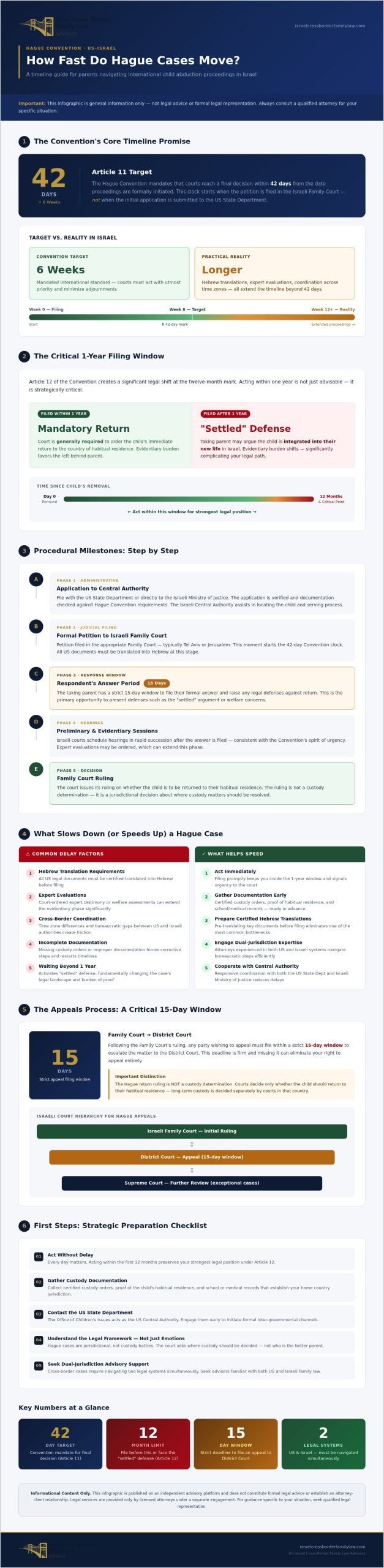
When families ask how fast do Hague cases move, the legal framework provides a specific, albeit aspirational, answer. Article 11 of the Convention mandates that judicial authorities act expeditiously. It sets a target for a final decision to be reached within six weeks, or 42 days, from the date the proceedings are initiated. This clock begins the moment the formal application is filed in the requested country’s court system, such as an Israeli Family Court, rather than when the initial application is submitted to a Central Authority like the US State Department.
The 6-Week Aspiration vs. Reality in Israel
Israeli Family Courts recognize the urgency of these matters and typically prioritize Hague cases on their dockets. While the 42-day goal is the international standard, the practical reality in Israel often sees cases extending beyond this window. Factors such as the mandatory translation of US legal documents into Hebrew and the coordination of expert testimony can slow the process. The Israeli Ministry of Justice defines the expeditious requirement as a mandate for courts to proceed with the utmost priority, minimizing adjournments to the absolute minimum necessary for a fair hearing.
The Significance of the One-Year Filing Window
Speed isn’t just about court efficiency; it’s also about when you choose to act. Article 12 of the Convention creates a significant legal shift at the twelve-month mark. If a claim is filed within one year of the child’s removal, the court is generally required to order the child’s immediate return. However, if more than a year passes before filing, the taking parent can raise the “settled” defense. This allows them to argue that the child has become integrated into their new life in Israel, which significantly complicates the legal path. Waiting too long to initiate a claim can shift the evidentiary burden and potentially change the outcome of the case.
Procedural Milestones: From Application to Initial Hearing in Israel
The journey to recovering a child begins with a series of administrative and judicial steps that dictate the initial momentum of your case. Understanding these milestones is essential for managing expectations regarding how fast do Hague cases move within the Israeli legal landscape. The process typically initiates with a formal application to the Central Authority, which in the United States is the Department of State, or directly to the Israeli Ministry of Justice. This administrative phase involves verifying the claim and ensuring all documentation meets the specific requirements of the 1980 Hague Convention.
Once the application is transmitted to Israel, a formal petition must be filed in the appropriate Family Court, such as those located in Tel Aviv or Jerusalem. Following the filing, the respondent parent is granted a strict 15-day window to submit a formal answer. This period is critical; it is the primary opportunity for the taking parent to present legal defenses against the return order. Once the answer is filed, the court moves into high gear, typically scheduling a preliminary hearing and evidentiary sessions in rapid succession to maintain the Convention’s spirit of urgency.
The Role of the Central Authority in Speeding Up Cases
The Israeli Central Authority acts as a vital liaison during the initial stages. They assist in locating the child if their whereabouts are unknown and facilitate the formal service of process to the respondent parent. However, administrative friction can occur during the transmission of documents between nations, particularly when dealing with different time zones and bureaucratic standards. Learning how our advisory works can help you navigate these early communication challenges between the US and Israeli bodies.
Initial Court Deadlines in the Israeli Family Court
Israeli procedural rules for Hague petitions are designed for speed. One of the most significant powers the court wields immediately upon filing is the issuance of a “Stay of Exit” order, known in Hebrew as a Tsav Ikur Yetzia. This order prevents the child from being moved to another country while the case is pending. Because of the high stakes involved, the first hearing usually occurs within 7 to 10 days of the petition being filed. This aggressive scheduling ensures that the case does not lose momentum and remains on a track toward a prompt resolution. If you are concerned about these initial timelines, seeking a confidential case review can provide clarity on your specific situation.
Factors That Accelerate or Delay a Hague Case in the Israeli System
While the legal framework sets ambitious goals, the practical answer to how fast do Hague cases move depends heavily on local procedural variables. In Israel, one of the most immediate hurdles is the requirement for linguistic precision. Every document originating from the United States, including court orders, birth certificates, and affidavits, must be translated into Hebrew by a certified professional. This step isn’t merely administrative; it’s a foundational requirement for the court to accept evidence. Delays in securing high-quality translations can easily add two weeks to the initial filing phase.
The “Grave Risk of Harm” defense, outlined in Article 13(b) of the Convention, represents the most significant potential for delay. When a taking parent alleges that returning the child would expose them to physical or psychological danger, the court is obligated to investigate these claims thoroughly. This often necessitates extensive evidence gathering, which directly impacts how fast do Hague cases move through the system. Managing the Israeli judicial calendar is another critical factor. Courts often slow down or close during major Jewish holidays, such as Sukkot or Passover, which can stall a case for several weeks if the timing coincides with critical deadlines.
Evidentiary Hurdles and Expert Opinions
Judges often appoint a guardian ad litem or an independent psychological expert to represent the child’s best interests or evaluate the validity of a “grave risk” claim. These professionals require time to conduct comprehensive interviews with both parents and the child, often needing three to four weeks to produce a formal report. While these evaluations are thorough, the court maintains the discretion to limit or skip certain oral testimonies to prioritize speed when the existing documentation is sufficient to reach a decision.
The Impact of Legal Representation on Speed
Securing counsel with specific experience in multi-jurisdictional disputes is vital for maintaining momentum. A generalist lawyer might be unfamiliar with the strict, non-extendable deadlines unique to Hague proceedings, potentially falling into procedural traps that lead to unnecessary adjournments. Our Expat and Foreign National Services focus on bridging the gap between US expectations and Israeli court realities. Expert counsel ensures that all evidentiary submissions are prepared in advance, allowing the court to focus on the legal merits rather than administrative corrections.
The Appeals Process and Finality: Managing Expectations
Many parents assume the Family Court’s decision marks the absolute end of the legal journey, but the losing party holds a right to challenge the outcome. In Israel, the timeline for filing an appeal in Hague Convention cases is significantly shorter than in standard civil matters, typically requiring action within 15 days of the ruling. This compressed window prevents the case from losing momentum. When evaluating how fast do Hague cases move, parents must account for the possibility of this secondary legal phase, which moves to the District Court for review.
A critical procedural element during this stage is the “Stay of Execution.” If the Family Court orders a child’s return, the respondent parent often requests a stay to pause the return until the appeal is heard. Without this pause, the child could be returned to the United States before the District Court has an opportunity to review the case. Judges weigh these requests carefully; they must balance the need for a prompt return with the risk of creating an irreversible situation for the child if the initial ruling is later overturned.
Appealing to the District Court and Supreme Court
Appeals in these matters aren’t “re-trials.” The District Court focuses strictly on legal errors or misinterpretations of the Convention rather than hearing new witnesses or accepting fresh evidence. This narrow scope is a primary reason why the process is faster than a standard civil appeal. While most cases conclude at the District level, a party can request permission to appeal to the Israeli Supreme Court. Such requests are rare and typically granted only when the case involves a significant legal question that hasn’t been previously addressed.
Enforcement of the Return Order
Once a final return order is issued and all stays are lifted, the focus shifts to enforcement. If a parent refuses to comply with the court’s instruction, the judicial system may involve the Israeli police and social services to execute the return. This phase is handled with extreme sensitivity to ensure the child’s safety and emotional well-being during the transition. The efficiency of these administrative bodies often determines how fast do Hague cases move during the final handover. Understanding the nuances of international custody and relocation is essential for managing the logistics of a court-ordered return. If you’re navigating an appeal or need to understand your rights after a ruling, it’s vital to seek professional guidance immediately.
Strategic Steps for Parents Navigating a Cross-Border Hague Case
Success in international child abduction cases depends heavily on the quality of your preparation before the first legal document is even filed. When parents ask how fast do Hague cases move, they must recognize that their own speed in gathering evidence acts as the primary engine for the case. Your first priority is to compile all “Rights of Custody” documentation. This includes certified copies of US court orders, birth certificates, and any written agreements regarding the child’s residence. You must also avoid any “self-help” measures, such as attempting to unilaterally remove the child from their current location in Israel. Such actions can severely damage your standing and credibility in the eyes of an Israeli judge.
Establishing the child’s “habitual residence” is the next critical step. You should prepare a detailed, chronological timeline of the child’s life in the United States prior to the move. This timeline should be supported by concrete evidence, such as school enrollment records, medical appointments, and participation in community activities. This data is essential for countering claims that the child was not settled in their home country or that there was a mutual agreement to relocate to Israel. Engaging an advisor who understands the cultural and legal nuances of both the US and Israeli systems ensures that your narrative is presented effectively within the local court’s framework.
Documentation Readiness as a Speed Multiplier
The administrative requirements for an Israeli petition are strict and leave little room for error. To maintain momentum, you should follow a rigorous checklist of essential documents. Every US-based document requires an apostille to be recognized by Israeli authorities, and as previously noted, everything must undergo certified Hebrew translation. For those seeking visual guides on how to organize these files and prepare for the process, the Israel Family Law YouTube channel offers detailed resources on case preparation. Having these materials ready at the outset prevents the case from stalling during the initial filing phase.
Getting Clarity Before You Commit
In high-stakes abduction cases, a “wait and see” approach is often a recipe for legal failure. The one-year window provided by the Convention is a hard deadline, and every month of delay strengthens the taking parent’s argument that the child has become settled in Israel. A strategic advisory session is the most effective way to identify potential risks and determine how fast do Hague cases move based on your specific circumstances. This proactive step allows you to build a roadmap before making significant financial or legal commitments. Get clarity before you commit. Request a confidential consultation.
Securing Your Family’s Future with Strategic Precision
Success in international child abduction matters requires a blend of procedural discipline and a deep understanding of the jurisdictional bridge between the United States and Israel. By prioritizing administrative readiness and understanding the strict timelines of the Israeli Family Court, you can significantly influence the momentum of your case. While the question of how fast do Hague cases move often depends on the complexity of the legal defenses raised, your proactive preparation remains the most powerful tool at your disposal.
Navigating these high-stakes complexities requires a partner who understands the nuance of both legal systems. We bring decades of experience in US-Israel cross-border law and a specialized focus on the Hague Convention to every advisory session. Our practitioners are uniquely licensed to practice in multiple jurisdictions, providing the authoritative guidance needed to manage these sensitive matters with clarity. Get clarity before you commit. Request a confidential consultation. You don’t have to face this uncertainty alone.
Frequently Asked Questions
How long does a Hague Convention case usually take in Israel?
A typical case in Israel generally takes between three to six months from the initial filing to a final judgment. While the international standard targets 42 days, the practical answer to how fast do Hague cases move involves navigating translation needs and court schedules. Cases in the Tel Aviv Family Court may move at a different pace than those in Jerusalem due to varying docket volumes and judge availability.
Can the 6-week timeline be extended by the court?
Yes, Israeli courts have the discretion to extend the 42-day timeline when complex legal or factual issues arise. If the court exceeds the six-week mark, it’s often required to provide a formal explanation for the delay. Common reasons for extensions include the need for independent psychological evaluations or the gathering of evidence regarding a “grave risk of harm” defense presented by the taking parent.
Does the child have a say in how fast the case moves?
A child’s involvement can slow the process if they are of an appropriate age and maturity to express a valid objection to being returned. When a child objects, the court must appoint a guardian ad litem and potentially an expert to evaluate the child’s perspective. These additional procedural steps inevitably add several weeks to the overall litigation timeline as the court gathers the necessary information.
What happens if the other parent hides the child in Israel?
If a child’s location is unknown, the Israeli Central Authority works with the police and specialized investigators to find them. This search phase pauses the standard judicial clock until the respondent parent is formally served with the petition. Once the child is located, the court may issue immediate “Stay of Exit” orders to ensure the child remains within the jurisdiction until the case concludes.
Will a US custody order speed up the Hague case in Israel?
A US custody order provides critical evidence of your “rights of custody,” but it doesn’t automatically trigger an immediate return. The Israeli court must still conduct a full Hague hearing to determine if any legal defenses apply. Having a clear, certified order helps establish your legal standing quickly, which can prevent early procedural delays regarding your right to request the child’s return under the Convention.
Is there an expedited process for infants or young children?
There isn’t a separate statutory “fast track” for infants, but Israeli judges often treat these cases with heightened urgency. Courts recognize that prolonged separation can be particularly damaging for very young children. While the procedural milestones remain the same, practitioners often advocate for more frequent hearings to minimize the time the child spends in a state of legal and residential uncertainty during the proceedings.
How much does the appeals process add to the total timeline?
An appeal typically adds between four to twelve weeks to the total duration of the case. Because Hague appeals in Israel must be filed within a strict 15-day window, the process is much faster than standard civil litigation. The District Court prioritizes these matters to comply with the Convention’s mandate for an expeditious resolution, though a “Stay of Execution” may pause the return during this period.
What is the fastest way to initiate a Hague case between the US and Israel?
The most efficient method is to file a formal petition directly in the Israeli Family Court with all documentation pre-translated and apostilled. Relying solely on administrative channels between the US State Department and the Israeli Ministry of Justice can result in early delays. Direct filing ensures the judicial clock starts immediately and allows your counsel to request urgent preliminary orders to secure the child’s presence while determining how fast do Hague cases move.

Article by
Gabriel Lior
A Personal Journey That Became a Mission
The advisory was founded by an American father Gabriel Lior, LLB, MBA , global entrepreneur, and cross-border advisor who spent more than a decade navigating the Israeli family court system firsthand and now lives in Singapore with his son.
As a divorced parent in a cross-border family, Gabriel faced nearly every legal challenge a foreign parent can encounter in Israel — including child custody disputes, child support proceedings, property matters in Israel and abroad, false accusations, and complex immigration and relocation proceedings.
Over the years, he learned the hard way how difficult it is for non-Israeli parents to understand the system, identify the right legal strategy, and choose the right legal representation — especially when language, culture, and jurisdictional differences are involved. He also witnessed how foreign parents and new immigrants are often disadvantaged or taken advantage of by service providers and institutions simply because they lack local knowledge or fluency.
From Client to Advisor
To truly understand — and survive — the system, Gabriel pursued formal legal education in Israel, completing two Israeli law degrees, alongside a BA and MBA earned in the United States. This was never about becoming a practicing attorney, but about gaining a deep, structural understanding of how the system works — and where it breaks down for foreign parents.
This rare combination of:
Firsthand client experience
Israeli legal and US business education
International business and negotiation training
Decades of commercial execution
created a unique perspective – one that understands both sides of the table.
After years of litigation, persistence, and at times self-representation, he ultimately succeeded in securing custody of his son and relocating abroad through a rare legal victory in the Israeli Supreme Court — becoming one of the first fathers in Israel to do so under these circumstances.
Disclaimer
Important Disclaimer:
The information provided on this website and in its content is for general informational and educational purposes only and does not constitute legal advice, legal opinion, or legal representation.
Gabriel Lior is not licensed to practice law in Israel (nor is he interested in doing so) and does not provide legal services, despite having completed 2 Law Degrees. The services offered are advisory in nature and are intended to provide general guidance, strategic insight, and information regarding cross-border family law considerations.
No attorney-client relationship is formed by accessing this website, reading its content, or communicating with us.
Any decisions made based on this information are at your own discretion and risk. For legal advice specific to your situation, you should consult a licensed attorney in the relevant jurisdiction.
Where appropriate, we may refer clients to independent, licensed attorneys or professionals. Such referrals do not constitute legal representation and no liability is assumed for services provided by third parties.