Moving your child across the Atlantic isn’t just a change of address; it’s a transfer of legal sovereignty that can trigger international treaties before your plane even touches down. If you’re an expat or an Anglo living in Israel, you already know that the distance between Tel Aviv and New York is measured in more than just miles. You’re likely feeling the weight of this decision, balancing a new life opportunity with the deep anxiety of navigating the Hague Convention and potential kidnapping charges. It’s natural to feel overwhelmed by a dual legal system that often feels like a maze.
This article provides the strategic foresight you need when Relocating with a Child After Divorce. We’ll help you understand the critical differences between Israeli and U.S. jurisdictions so you can move forward with clarity rather than fear. You’ll gain a roadmap for securing legal consent, maintaining compliance in both countries, and protecting your relationship with your child across the ocean. We’ll examine the “Best Interests of the Child” standard and how to build a bridge between these two legal cultures. Please note that this content is published on an independent advisory platform, not a law firm, and is intended for informational strategy and decision-making guidance.
Key Takeaways
- Learn why moving between Israel and the U.S. is a jurisdictional transfer that requires legal alignment to avoid future custody complications.
- Understand the “Center of Life” test and how courts evaluate the educational and social opportunities available in a new country.
- Identify the specific risks of “wrongful removal” under the Hague Convention to ensure Relocating with a Child After Divorce remains legally compliant.
- Gain a practical checklist for building a relocation plan that addresses international travel costs and long-distance visitation schedules.
- Discover why addressing relocation early in your divorce decree provides the most security for your future family life and parental rights.
Defining International Relocation in US-Israel Family Law
In the context of US-Israel family law, international relocation is defined by more than just geography. It represents a fundamental shift in a child’s legal and social environment. When a parent considers Relocating with a Child After Divorce between Israel and the United States, they are moving between two distinct legal systems. This is not a simple domestic move. In Israel, the Legal Capacity and Guardianship Law, 5722-1962 establishes that both parents are natural guardians. This means major decisions, specifically those involving the child’s place of residence, require mutual agreement or a court order. Decisions made in the early stages of a divorce often carry significant weight in how these relocation requests are eventually handled.
Courts treat international relocation with significantly higher scrutiny than domestic moves. While a move from Tel Aviv to Haifa might only slightly alter a visitation schedule, a move to New York or California effectively ends the possibility of mid-week dinners or frequent weekend stays. Because of this, the law focuses on whether the move fundamentally impairs the other parent’s ability to maintain a meaningful relationship. This is why the Hague Convention on the Civil Aspects of International Child Abduction is so critical; it serves as a global framework to prevent the unilateral removal of children across borders. Both Israel and the U.S. are committed to this treaty, which prioritizes the child’s return to their country of habitual residence if they are moved without proper legal authorization.
The Threshold for Cross-Border Relocation
A move becomes a legal relocation when it significantly impacts the existing custody arrangement or the child’s center of life. For families moving between Israel and the US, the 6,000-mile distance means that almost any move across these borders will trigger this threshold. It’s a common misconception that a temporary move, such as a one-year work contract or an extended family visit, doesn’t require formal consent. However, if the move alters the child’s habitual residence, it may be legally classified as a relocation. You should seek clarity on these definitions before making any travel commitments. The Israeli courts prioritize the stability of the child’s current environment and will look closely at how the distance affects frequent access to both parents.
Consent: The Essential Requirement
Obtaining clear, written consent is the only reliable way to manage the risks of moving. Verbal agreements are often forgotten or misinterpreted when the reality of long-distance parenting sets in. In cross-border cases, a lack of documented permission can lead to accusations of wrongful removal, even if you believed your former spouse was in agreement. For expats and foreign nationals, ensuring that consent is formalized in a way that both Israeli and US courts recognize is a vital strategic step. This content is published on an independent advisory platform and does not constitute legal representation; however, understanding these requirements is essential for maintaining legal compliance in both jurisdictions.
The Legal Standard: “Best Interests of the Child” Across Borders
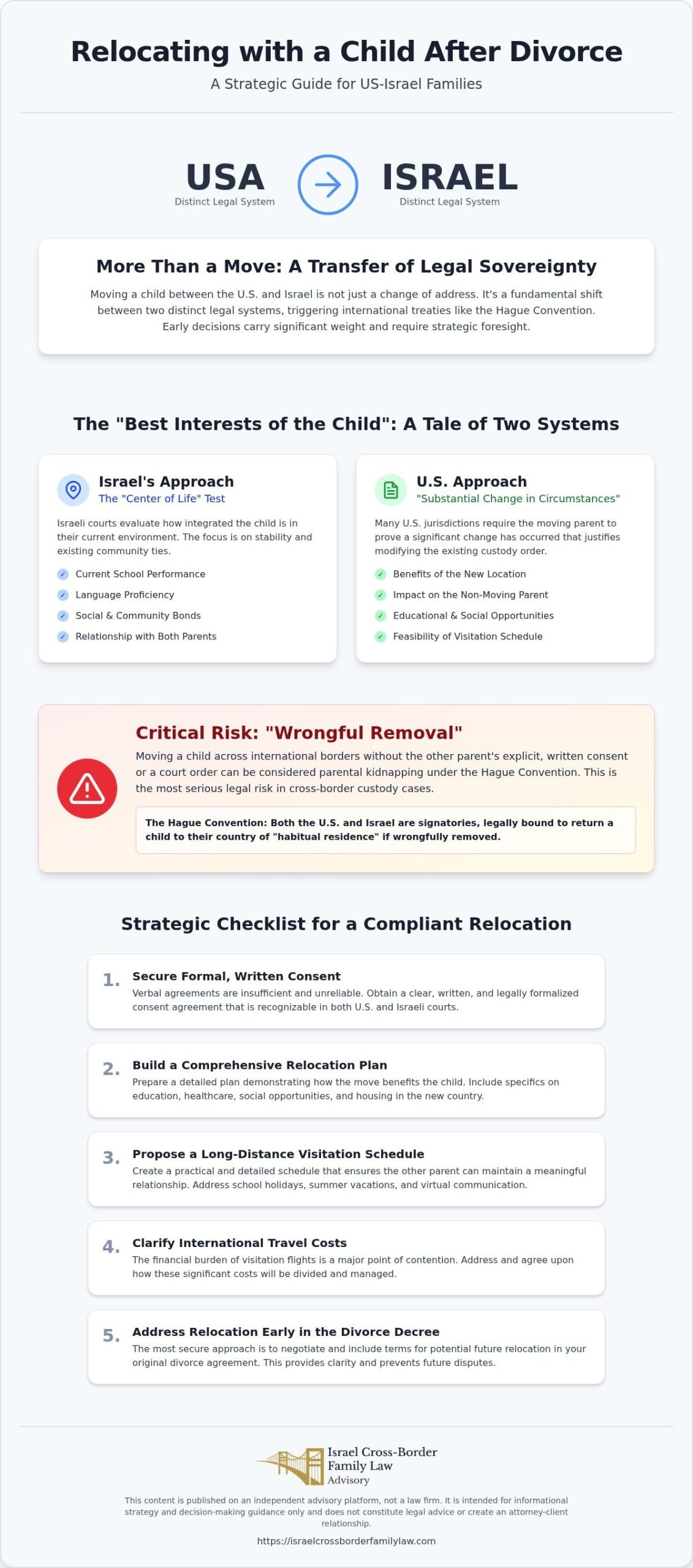
When considering Relocating with a Child After Divorce, the primary metric used by both Israeli and American courts is the “Best Interests of the Child.” However, the interpretation of this standard varies significantly between these two jurisdictions. Israeli courts frequently apply the “Center of Life” test, which evaluates the child’s current integration into Israeli society, including language proficiency, school performance, and community ties. In contrast, many U.S. jurisdictions focus on whether there has been a “Substantial Change in Circumstances” that justifies a modification of the existing order. Scholarly research on Assessing Children’s Best Interests in International Relocation Cases highlights that courts must carefully balance the potential benefits of the new location against the disruption of the child’s existing emotional and social bonds.
Courts evaluate several specific factors when determining if an international move is appropriate:
- Educational and Social Opportunities: The court will compare the specific schools, extracurricular frameworks, and social support systems available in both countries.
- Extended Family Support: Israeli courts place high value on the presence of grandparents and extended family, which is a cultural hallmark of the region. If a move to the U.S. removes this daily support, the relocating parent must demonstrate how the child’s needs will be met elsewhere.
- Maintaining Parental Bonds: The non-relocating parent’s right to maintain a meaningful relationship is heavily protected. The moving party must prove that the 6,000-mile distance won’t effectively sever the bond between the child and the parent left behind.
The Israeli Family Court vs. Rabbinical Court
Israel’s dual legal system creates a unique dynamic known as the “Race to Court” or merutz hasamchuyot. The spouse who files first determines whether the case is heard in the civil Family Court or the religious Rabbinical Court. This choice of venue is critical for international custody and relocation matters. While both courts apply the “Best Interests” standard, their procedural approaches and perspectives on parental roles can differ. This content is published on an independent advisory platform, not a law firm, and focuses on strategy and risk guidance rather than formal legal representation.
US State Law Variations
If the relocation involves a U.S. court, laws differ significantly by state. For instance, New York courts may require a more rigorous showing of “economic necessity” than courts in California. When one parent remains in Israel, U.S. judges often look for “Mirror Orders.” These are identical court orders issued in both countries to ensure that a custody arrangement made in a U.S. state is enforceable in Israel, and vice versa. This cross-border synchronization prevents one parent from using the ocean as a shield against legal obligations. To protect your parental rights, you should seek clarity on your specific jurisdictional risks before you commit to a move.
The Hague Convention and Preventing “Wrongful Removal”
The Hague Convention on the Civil Aspects of International Child Abduction is the primary international legal framework governing the unauthorized removal of children across borders. Many parents mistakenly believe that because they have primary physical custody, they’re free to move as they wish. However, Relocating with a Child After Divorce without the other parent’s written consent or a specific court order can be legally classified as “wrongful removal” or “wrongful retention.” Because both Israel and the United States are signatories to this treaty, they’re committed to a summary process that returns a child to their “country of habitual residence” to resolve custody disputes there.
“Habitual residence” is often the most contested term in these proceedings. It doesn’t necessarily mean where the child was born or what citizenship they hold. Instead, courts look at where the child is integrated into a stable environment. If a child has lived in Israel for several years, attended school there, and built a social circle, Israel is likely their habitual residence. Attempting to move the child to the U.S. without proper authorization triggers the Hague Convention, which can lead to a court-ordered return within weeks, regardless of the moving parent’s intentions. The consequences of an unauthorized move are severe and can include the permanent loss of custody rights in future proceedings.
Defenses Against a Hague Claim
The legal threshold for blocking a return order under the Hague Convention is exceptionally high. One possible defense is the “Grave Risk of Harm” exception, which requires clear evidence that the child would face physical or psychological danger if returned. Another defense is “Acquiescence,” where the parent left behind waited too long to object or initially agreed to the move before changing their mind. Navigating these defenses requires a deep understanding of Hague Convention and Child Abduction protocols to avoid catastrophic legal outcomes. This content is published on an independent advisory platform and is intended for informational strategy rather than formal legal advice.
Preventative Measures for Non-Relocating Parents
Parents who fear an unauthorized move can take proactive steps to secure their rights. Custody agreements should include “Stay Put” orders or “Ne Exeat” clauses, which explicitly forbid the child from leaving the jurisdiction without specific permission. In Israel, a Tsav Ikuv Yetsia can be issued to prevent a child from leaving the country until a court determines the relocation issue. This order is registered with the Israeli Border Police and serves as a powerful safeguard. It’s often easier to prevent a departure than it is to litigate a return from 6,000 miles away. Early strategic decisions in your divorce decree can prevent these high-stakes relocation battles before they start.
Strategic Preparation: A Relocation Checklist for Parents
Moving beyond legal theory, a successful petition for Relocating with a Child After Divorce requires a granular, logistical roadmap. Israeli Family Courts won’t grant a relocation based on vague promises; they require a detailed plan that demonstrates how the child’s daily life will function 6,000 miles away. This plan must serve as a bridge between your current reality in Israel and your proposed future in the United States. It’s vital to address the following practicalities before you step into a courtroom:
- Financial Logistics: International travel between Israel and the U.S. is expensive. Your agreement must explicitly state who pays for the flights, how many times a year the child will travel, and whether an escort is required for younger children.
- Virtual Visitation: In a cross-border context, FaceTime and Zoom are not just “nice to have” tools; they’re legal lifelines. Define the frequency, duration, and time-zone-adjusted schedule for these calls to ensure the parent in Israel remains an active presence.
- Mirror Orders: Once an Israeli court approves a move, you should obtain a “Mirror Order” in the specific U.S. state where you’ll reside. This ensures the Israeli custody arrangement is recognized and enforceable by local U.S. authorities.
Documenting the “Why”
You must prove to the court that the move is intended to benefit the child rather than frustrate the other parent’s rights. This requires tangible evidence. Gather formal job offers with salary details, specific school enrollment information, and comparisons of healthcare providers in the new city. In contested cases, courts often rely on expert testimony from child psychologists or relocation specialists. These professionals evaluate the child’s adaptability and the strength of their bond with both parents. This content is published on an independent advisory platform and is intended for strategic guidance rather than formal legal representation.
The Visitation Schedule for Cross-Atlantic Families
Standard weekend visitation is impossible when families are separated by an ocean. Instead, you’ll need to design a “Block Time” schedule. This typically involves the child spending entire summers, alternating winter breaks, and long holidays in Israel. When drafting these orders, don’t ignore the “Jet Lag” factor. A child arriving on a 12-hour flight from Tel Aviv needs a recovery period before intensive visitation begins. These logistics often intersect with financial obligations, so it’s helpful to understand the nuances of child support cross-border enforcement to ensure the visitation remains sustainable. If you’re ready to build a legally sound plan, request a confidential review of your relocation strategy today.
Navigating the Jurisdictional Bridge: Why Early Decisions Matter
The temptation to engage in “self-help” by moving a child before securing legal permission is a high-risk strategy that rarely succeeds. In cross-border family law, taking the law into your own hands is often viewed by the courts as a fundamental breach of parental responsibility. If you’re Relocating with a Child After Divorce without a clear court order or written consent, you’re exposing yourself to immediate Hague Convention petitions and potential criminal charges. Courts prioritize the status quo; they’re far more likely to order a child’s return to Israel if the move was unilateral, regardless of how beneficial the new life in the U.S. might seem.
The most effective way to manage these risks is to address relocation during the initial divorce negotiations. Early decisions embedded in a divorce decree can prevent years of litigation. By defining under what conditions a parent might move, you create a predictable framework for both parties. Mediation is often the most productive venue for these discussions. It allows parents to build a custom visitation and financial plan that respects the child’s need for both parents while acknowledging the reality of a 6,000-mile separation. The first 90 days in a new jurisdiction are particularly heavy with legal weight, as this period often serves as the threshold for establishing a new habitual residence.
The Advisory Approach
There’s a significant difference between a local attorney and a cross-border advisor. While a local lawyer understands the rules of their specific court, a cross-border advisor understands the bridge between two different legal cultures. Strategy must always precede filing. You need to know how a decision in an Israeli Family Court will be viewed by a judge in New York or California. For visual clarity on these complex topics, you can find educational resources on the Israel Family Law YouTube channel. Understanding the long-term implications of your jurisdictional choices is the best way to protect your parental rights.
Conclusion and Next Steps
Relocation is a permanent decision with profound legal consequences. Achieving clarity before you commit to a move is the only way to ensure legal compliance in both Israel and the United States. This content is for informational purposes and is published on an independent advisory platform, not a law firm. Strategy and risk guidance are provided to help you make informed decisions, but formal legal representation is only established through a separate engagement with a licensed attorney. Get clarity before you commit. Request a confidential consultation.
Securing Your Family’s Future Across Borders
The complexities of Relocating with a Child After Divorce require more than just a desire for a fresh start; they demand a synchronized legal strategy that spans two continents. By prioritizing clarity over convenience, you protect your parental rights and your child’s emotional stability. Remember that the Hague Convention acts as an immediate safeguard against unauthorized moves, making formal consent and court authorization non-negotiable. Building a detailed plan that addresses flight costs, time zones, and mirror orders ensures your family remains connected despite the 6,000-mile distance.
With decades of experience in US-Israel family law and practitioners licensed in multiple jurisdictions, we serve as an authoritative guide for the Anglo-Israeli community. Strategy should always precede action in cross-border matters. This content is published on an independent advisory platform and is intended for informational guidance rather than formal legal advice.
Get clarity before you commit. Request a confidential consultation.
You can successfully navigate this jurisdictional bridge with the right preparation and strategic foresight.
Frequently Asked Questions
Can I move my child to the US if the other parent says no but I have full custody?
Even with full physical custody, you don’t have the right to move your child internationally without the other parent’s written consent or a court order. In Israel, both parents remain natural guardians after a divorce. Relocating with a Child After Divorce without these permissions can be legally classified as international child abduction under the Hague Convention.
What happens if I take my child to Israel for a vacation and decide to stay?
This action is legally defined as “wrongful retention” if the child’s habitual residence is the United States. The parent left behind can file a Hague Convention petition for the child’s immediate return. Because Israel is a signatory, the court will likely order the child back to the US to resolve the custody dispute in the original jurisdiction.
How long does a relocation trial typically take in Israel?
While Hague Convention cases are intended to reach a final decision within six weeks, they practically take between 45 and 90 days. A standard relocation petition in the Israeli Family Court is a much longer process. It can often take 6 to 12 months because the court requires detailed evaluations from social workers or child psychologists.
Will a US court recognize an Israeli custody order regarding relocation?
Yes, US courts generally recognize and enforce Israeli custody orders through the principle of international comity or specific state laws. To ensure seamless enforcement, many families use Mirror Orders. These are identical orders issued by a US court that reflect the terms of the Israeli decree, providing local authorities with a clear mandate to act.
Who pays for the international travel expenses for visitation?
Financial responsibility for cross-border travel is a central part of any relocation plan and is typically negotiated between the parents. The court often places a larger share of the burden on the parent who is Relocating with a Child After Divorce. However, costs can also be split proportionally based on income or addressed through adjustments in child support payments.
What is a “Mirror Order” and why do I need one for a US-Israel move?
A Mirror Order is a separate legal order obtained in the destination country that contains the exact terms of the original custody agreement. You need one because an Israeli court order isn’t automatically registered in every US state’s local police or school system. Having a local order ensures that if a dispute arises in the US, local law enforcement can intervene immediately.
Can my child choose which country they want to live in?
A child’s preference is a factor but is never the sole deciding element in a relocation case. Israeli courts use a specialized “Child’s Voice” unit to interview children in a neutral setting. The weight given to their opinion increases with their age and maturity, typically becoming more significant once the child is 10 to 12 years old.
How does the Hague Convention protect me if my ex moves the child without permission?
The Hague Convention provides a streamlined legal mechanism to return a child to their country of habitual residence. It prevents a parent from gaining a legal advantage by moving a child to a new country and filing for custody there. The focus of a Hague proceeding isn’t to decide who is the better parent, but to determine which country has the jurisdiction to make that decision.

Article by
Gabriel Lior
A Personal Journey That Became a Mission
The advisory was founded by an American father Gabriel Lior, LLB, MBA , global entrepreneur, and cross-border advisor who spent more than a decade navigating the Israeli family court system firsthand and now lives in Singapore with his son.
As a divorced parent in a cross-border family, Gabriel faced nearly every legal challenge a foreign parent can encounter in Israel — including child custody disputes, child support proceedings, property matters in Israel and abroad, false accusations, and complex immigration and relocation proceedings.
Over the years, he learned the hard way how difficult it is for non-Israeli parents to understand the system, identify the right legal strategy, and choose the right legal representation — especially when language, culture, and jurisdictional differences are involved. He also witnessed how foreign parents and new immigrants are often disadvantaged or taken advantage of by service providers and institutions simply because they lack local knowledge or fluency.
From Client to Advisor
To truly understand — and survive — the system, Gabriel pursued formal legal education in Israel, completing two Israeli law degrees, alongside a BA and MBA earned in the United States. This was never about becoming a practicing attorney, but about gaining a deep, structural understanding of how the system works — and where it breaks down for foreign parents.
This rare combination of:
Firsthand client experience
Israeli legal and US business education
International business and negotiation training
Decades of commercial execution
created a unique perspective – one that understands both sides of the table.
After years of litigation, persistence, and at times self-representation, he ultimately succeeded in securing custody of his son and relocating abroad through a rare legal victory in the Israeli Supreme Court — becoming one of the first fathers in Israel to do so under these circumstances.
Disclaimer
Important Disclaimer:
The information provided on this website and in its content is for general informational and educational purposes only and does not constitute legal advice, legal opinion, or legal representation.
Gabriel Lior is not licensed to practice law in Israel (nor is he interested in doing so) and does not provide legal services, despite having completed 2 Law Degrees. The services offered are advisory in nature and are intended to provide general guidance, strategic insight, and information regarding cross-border family law considerations.
No attorney-client relationship is formed by accessing this website, reading its content, or communicating with us.
Any decisions made based on this information are at your own discretion and risk. For legal advice specific to your situation, you should consult a licensed attorney in the relevant jurisdiction.
Where appropriate, we may refer clients to independent, licensed attorneys or professionals. Such referrals do not constitute legal representation and no liability is assumed for services provided by third parties.