The suspicion that a spouse or relative is concealing assets overseas can transform a difficult divorce or inheritance dispute into a seemingly insurmountable international challenge. Navigating the labyrinth of multi-jurisdictional legal frameworks, particularly between Israel and the United States, often feels prohibitively complex. Many individuals fear that foreign privacy laws and the sheer cost, potentially running into tens of thousands of shekels, will make a fair settlement impossible to achieve. However, a just resolution is not only attainable but is frequently secured through a sophisticated and well-executed discovery process for finding foreign assets.
This comprehensive guide is designed to demystify the procedures involved in compelling cross-border financial disclosure. We will illuminate the powerful legal strategies and practical, methodical steps our experienced team utilizes to trace and uncover hidden bank accounts, real estate holdings, and corporate interests. By reading, you will gain a clear understanding of the path forward, empowering you with the confidence that it is possible to locate concealed international assets and secure the equitable outcome you are rightfully owed in your high-stakes legal matter.
Key Takeaways
- Navigating the complexities of international law is critical, as national sovereignty and differing legal systems in the U.S. and Israel present significant hurdles to asset disclosure.
- An effective strategy integrates both formal legal discovery mechanisms and sophisticated informal investigative techniques to build a complete financial picture across borders.
- Understanding common concealment methods, from offshore trusts to complex corporate layering, is essential to effectively structuring the discovery process for finding foreign assets.
- Successfully executing a multi-jurisdictional asset search requires assembling a coordinated team of legal counsel and forensic experts with deep experience in both the U.S. and Israeli markets.
Understanding International Discovery: Why Finding Foreign Assets is Complex
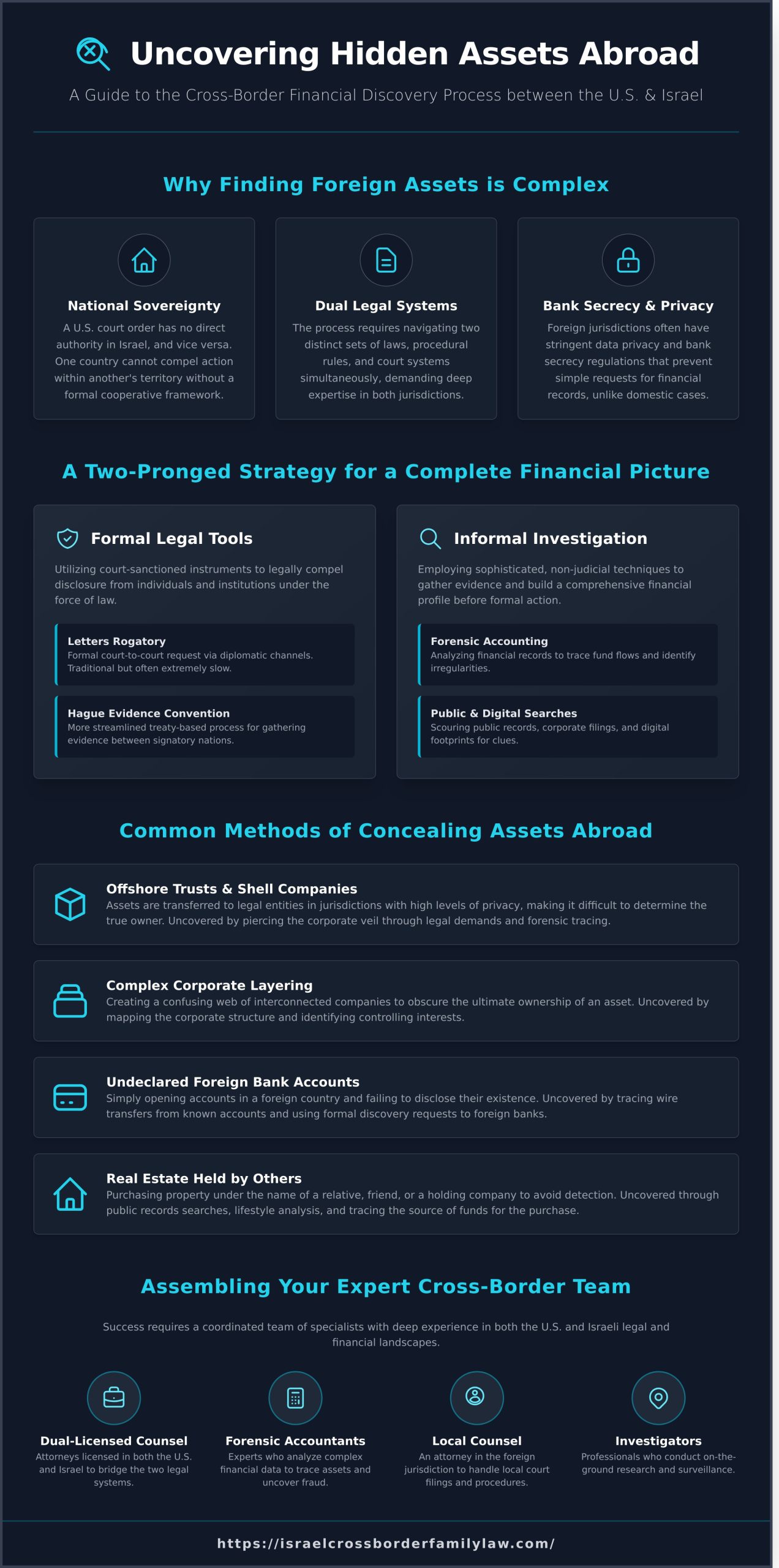
In domestic legal matters, such as a divorce or estate dispute, the pre-trial phase of litigation known as the discovery process is relatively straightforward. It allows parties to obtain evidence from one another through established legal mechanisms. However, when assets are located across international borders, the procedure becomes exponentially more complex. The core challenge lies in the fundamental principle of national sovereignty, which dictates that one country’s courts cannot compel action or enforce orders within another’s territory without a formal cooperative framework.
To better understand the foundational elements of this legal phase, the following overview is instructive:
Unlike a domestic case where a simple subpoena can compel a bank to produce records, the international arena is governed by a labyrinth of foreign laws, including stringent data privacy and bank secrecy regulations in jurisdictions like Switzerland or even Israel. This inherent friction between legal systems makes the discovery process for finding foreign assets a sophisticated endeavor demanding specialized expertise. This complexity is particularly acute in high-net-worth international divorce cases, where a fair and equitable division of the marital estate is contingent upon a complete and accurate financial picture.
Key Jurisdictional Challenges
The primary obstacle in cross-border discovery is jurisdiction. A subpoena issued by a court in the United States, for example, holds no legal authority over a financial institution in Israel, and the reverse is also true. Litigants must therefore navigate two distinct sets of legal rules and procedural requirements simultaneously. This underscores the critical need for representation by legal counsel licensed and deeply experienced in both jurisdictions, who can act as a seamless bridge between the disparate legal systems.
The Role of International Treaties and Agreements
To overcome jurisdictional barriers, legal professionals rely on international treaties. The Hague Convention on the Taking of Evidence Abroad in Civil or Commercial Matters is a principal framework that establishes formal channels for requesting evidence between signatory countries. In addition, specific bilateral agreements may exist that can streamline cooperation. However, it is crucial to understand that these treaties are not a magic wand. They are procedural mechanisms that require meticulous adherence to protocol and can be a lengthy, strategically complex process.
Formal Legal Tools for Compelling Disclosure of Foreign Assets
When informal inquiries and preliminary investigations prove insufficient, the next phase involves leveraging formal, court-sanctioned legal instruments. These tools represent the coercive power of the judicial system, compelling individuals and institutions to disclose information they would otherwise conceal. Executing this phase of the discovery process for finding foreign assets requires deep multi-jurisdictional expertise, as a misstep can result in significant delays or outright failure. Navigating this complex landscape demands the guidance of experienced cross-border attorneys who understand the procedural nuances of both domestic and foreign courts, ensuring that each action is precise, enforceable, and strategically sound.
Letters Rogatory: A Formal Request for Judicial Assistance
The most traditional method for obtaining evidence across sovereign borders is through Letters Rogatory. This is a formal, written request from a court in one country (e.g., the United States) to a court in another (e.g., Israel), asking for judicial assistance. The process is often cumbersome, requiring the request to be drafted, translated, and transmitted through slow-moving diplomatic channels. Due to the multiple layers of government and judicial review involved, this method can take many months, or even years, to yield results, making it a tool of last resort in time-sensitive matters.
Hague Evidence Convention Procedures
For signatory countries, including both the United States and Israel, the Hague Convention on the Taking of Evidence Abroad in Civil or Commercial Matters provides a more streamlined alternative. The Convention simplifies the discovery process for finding foreign assets by establishing a standardized “Model Letter of Request” that is sent directly to a designated Central Authority in the foreign state. This mechanism can be used effectively to obtain bank records from an Israeli financial institution or to compel deposition testimony from a witness located in Israel for use in a U.S. legal proceeding, significantly reducing the bureaucratic delays associated with traditional Letters Rogatory.
Domestic Court Orders and Contempt Powers
Often the most powerful and efficient route is to leverage the jurisdiction of a domestic court over a party to the litigation. For instance, a U.S. court can order a defendant who is present in its jurisdiction to disclose details of their assets held in Israel. The court’s authority is not limited by geography; its power is over the person. Non-compliance with such an order can lead to severe sanctions, including contempt-of-court rulings that may result in substantial daily fines or even imprisonment. This direct approach, which is among the methods outlined in the U.S. Department of State’s guide on U.S. Asset Recovery Tools & Procedures, bypasses the need for international judicial cooperation and can produce results far more quickly.
Informal Discovery & Investigative Techniques
While the formal legal tools for compelling disclosure are powerful, they are not the only path to uncovering hidden international assets. A successful discovery process for finding foreign assets often begins with sophisticated, parallel investigative work conducted outside the courtroom. These legally permissible techniques are not a substitute for formal discovery but serve as a crucial precursor, developing the strategic ‘road map’ necessary to guide and focus subsequent legal actions. The intelligence gathered through these methods provides the evidentiary basis for targeted and effective formal requests, such as those made under complex statutes analyzed by sources like the University of Chicago Law Review on Exporting American Discovery.
The Role of Forensic Accountants
In cases involving complex cross-border financial structures, forensic accountants are indispensable. These specialists possess the expertise to analyze intricate financial statements, corporate filings, and tax returns for subtle clues of concealed wealth. They are adept at tracing money transfers between U.S. and Israeli financial institutions, identifying unusual transactions, and flagging sources of unexplained wealth that may point directly to undeclared assets. Their analysis can unravel shell corporations and complex ownership schemes designed to obscure the true location of funds.
Leveraging Open-Source Intelligence (OSINT)
A significant amount of information is often available through publicly accessible sources, provided one knows where to look. Our teams leverage advanced OSINT techniques to build a comprehensive asset profile. This includes:
- Scrutinizing public records such as the Israel Land Registry (Tabu) and the Israeli Corporations Authority for property deeds and corporate ownership details.
- Analyzing social media profiles and online activity for evidence of a lifestyle inconsistent with declared income, which may reveal assets like vehicles, art, or vacation properties.
- Utilizing specialized international databases to track complex corporate structures and identify beneficial owners across jurisdictions.
Working with Private Investigators
In certain circumstances, engaging a licensed private investigator becomes a strategic necessity. It is critical to retain reputable firms with proven experience in both the U.S. and Israeli operating environments. These professionals can conduct surveillance, within strict legal and ethical bounds, to verify the existence and use of physical assets. Their ‘on-the-ground’ work can confirm a subject’s place of residence, business operations, or possession of high-value items, providing tangible evidence that strengthens the overall discovery process for finding foreign assets.
Common Methods of Concealing Assets Abroad (and How to Uncover Them)
Individuals seeking to conceal substantial wealth often employ sophisticated, multi-jurisdictional strategies designed to obscure ownership and control. However, these tactics follow recognizable patterns that a robust legal strategy can systematically dismantle. Understanding these common concealment methods is the first step in structuring an effective discovery process for finding foreign assets and ensuring a complete and accurate financial picture emerges during legal proceedings.
Shell Corporations and Offshore Companies
A prevalent method involves the use of shell corporations in jurisdictions renowned for corporate secrecy, such as the British Virgin Islands, Panama, or the Cayman Islands. Assets, from real estate to investment portfolios, are titled in the name of the offshore company, creating a layer of separation from the individual owner. Our approach involves leveraging international corporate registry searches and engaging forensic accountants to trace funding sources and pierce the corporate veil, thereby establishing the true beneficial ownership of the assets held by the entity.
Undeclared Foreign Bank and Brokerage Accounts
The most direct method for hiding liquid assets involves establishing undeclared bank and brokerage accounts abroad. The key to uncovering these accounts often lies within domestic financial records. A meticulous review of known bank and credit card statements can reveal wire transfers or payments to unfamiliar international financial institutions. Once a foreign bank is identified, we can utilize Letters Rogatory-a formal request for judicial assistance submitted to the foreign jurisdiction-to compel the production of complete bank records and transaction histories.
Complex Trusts and Foundations
Sophisticated asset protection often utilizes complex, irrevocable international trusts or private foundations. By transferring legal title of assets to a trustee, an individual attempts to sever their connection to the wealth. However, the discovery process can expose this arrangement. A detailed analysis of the trust instrument and related documents can prove that the spouse remains a de facto controller or beneficiary. Furthermore, deposing the offshore trustee can provide critical testimony regarding the control, management, and flow of trust assets.
While these concealment strategies appear formidable, they are not impenetrable. A disciplined and strategic approach, guided by legal counsel with deep cross-border experience, can effectively unravel these structures. For guidance on navigating the complexities of international asset discovery, our firm provides the specialized expertise required to bring hidden assets to light.
Assembling Your Expert Team for a Cross-Border Asset Search
Successfully navigating the complex, multi-jurisdictional terrain of an international asset search is not a task for a single practitioner. It demands a coordinated, multi-disciplinary approach, led by experienced legal counsel who can direct a team of specialists. The complete discovery process for finding foreign assets is an intricate operation where each expert plays a critical, interconnected role. The lead law firm acts as the central quarterback, developing the overarching strategy and ensuring every action is legally sound and serves the ultimate objectives of the case.
The Lead Cross-Border Attorney
At the center of the operation is the lead cross-border attorney, who serves as the strategic director. This legal expert must possess sophisticated, dual-qualified expertise in both U.S. and Israeli family or estate law to effectively manage the case. They are responsible for deploying formal legal tools like letters rogatory and subpoenas, orchestrating the actions of the entire team, and interpreting all findings through the critical lens of the legal proceedings. Learn more about how our advisory works to coordinate these multifaceted efforts.
The Forensic Accountant
When financial records are intentionally obscured, involve complex corporate structures, or cross multiple borders, the forensic accountant becomes an indispensable member of the team. These specialists are engaged to meticulously analyze financial data, trace fund flows, and identify patterns of concealment that may not be immediately apparent. Their detailed reports are not only pivotal for strategy but also provide credible, expert testimony in court, quantifying the precise value of hidden assets to ensure an equitable settlement or judgment.
Local Counsel and Investigators
Effective cross-border discovery requires more than remote analysis; it necessitates a “team on the ground” in the foreign jurisdiction. We deploy a network of trusted local counsel in Israel to manage in-country court filings, execute local discovery procedures, and navigate the specific nuances of the Israeli legal system. In parallel, private investigators provide crucial on-the-ground intelligence, cultural context, and surveillance capabilities that are essential for a comprehensive discovery process for finding foreign assets. Ready to begin? Request a confidential case review with our team.
Navigating Your Cross-Border Asset Search with Strategic Expertise
The pursuit of hidden international assets is an inherently complex, multi-jurisdictional challenge. As we have explored, success demands more than a single approach; it requires a sophisticated integration of formal legal tools with diligent investigative work to counteract concealment tactics. Ultimately, a successful discovery process for finding foreign assets is not merely a legal procedure but a strategic campaign, one that hinges on meticulous planning and deep cross-border legal knowledge.
Our firm provides the specialized expertise in US-Israel cross-border law necessary to navigate these intricate matters. With decades of experience in complex international family law cases, we excel at the strategic coordination of a global team of experts to protect your financial interests. If you are facing the challenge of locating assets abroad, we invite you to take the next step toward a resolution.
Schedule a Confidential Case Review to Discuss Your Situation. By securing the right guidance, you can move forward with confidence, ensuring your rights are vigorously defended across international lines.
Frequently Asked Questions
How long does the international discovery process typically take?
The duration of a cross-border asset search is contingent upon several complex factors, including the specific jurisdictions involved, the level of cooperation from foreign institutions, and the sophistication of the concealment structures. A straightforward search in a cooperative jurisdiction may conclude within several months. However, more intricate cases involving multiple countries or uncooperative entities can extend the timeline to a year or significantly longer, requiring a strategic, multi-faceted legal approach to navigate international protocols and treaties.
What is the estimated cost of a comprehensive search for foreign assets?
The cost of a comprehensive international asset search is highly variable and directly correlates with the case’s complexity. Initial retainers for such sophisticated engagements often begin in the range of ₪50,000 to ₪100,000 and can escalate substantially. These figures account for legal fees, the engagement of specialized forensic accountants, local counsel in foreign jurisdictions, and administrative costs. We provide a detailed, strategic budget proposal after an initial assessment of the matter’s scope and objectives.
Is it possible to find assets hidden in a country known as a ‘tax haven’?
While jurisdictions with stringent banking secrecy laws present significant challenges, it is indeed possible to identify and trace assets. Success in these matters requires a sophisticated legal strategy, leveraging international treaties, letters rogatory, and the expertise of our established network of local counsel. Our firm possesses deep experience in navigating these complex legal frameworks, compelling disclosure through meticulously executed legal procedures and demonstrating our capacity to operate effectively within these challenging multi-jurisdictional environments.
What happens if we find hidden assets? How does it affect my case?
The discovery of concealed foreign assets provides critical leverage and can fundamentally alter the trajectory of your legal matter. Once identified, we can initiate legal proceedings to freeze these assets through court-ordered injunctions, preventing their dissipation. This evidence can be used to enforce judgments, secure a more favorable settlement in commercial disputes, or ensure an equitable division of the marital estate in divorce proceedings. The successful discovery strengthens your position and moves you closer to achieving your legal objectives.
Can I use information I found myself, like private emails or messages?
While any information you possess can be valuable, its admissibility in court is governed by strict legal rules regarding privacy and how it was obtained. Evidence procured through illicit means, such as unauthorized access to private communications, is often inadmissible under Israeli law and can create significant legal complications for your case. It is imperative that you present any such information to your legal counsel for a thorough assessment before any action is taken, ensuring our strategy remains legally sound and effective.
Are my suspicions enough to start a formal discovery process?
While mere suspicion alone may not be sufficient to compel a court-ordered disclosure, it serves as the critical starting point for a preliminary investigation. Our role is to take your credible suspicions and develop them into a legally sound basis for action, gathering preliminary evidence to justify a formal request. This initial phase is crucial for building the foundation of the discovery process for finding foreign assets, ensuring that when we petition the court, we do so from a position of strength and credibility.

Article by
Gabriel Lior
A Personal Journey That Became a Mission
The advisory was founded by an American father Gabriel Lior, LLB, MBA , global entrepreneur, and cross-border advisor who spent more than a decade navigating the Israeli family court system firsthand and now lives in Singapore with his son.
As a divorced parent in a cross-border family, Gabriel faced nearly every legal challenge a foreign parent can encounter in Israel — including child custody disputes, child support proceedings, property matters in Israel and abroad, false accusations, and complex immigration and relocation proceedings.
Over the years, he learned the hard way how difficult it is for non-Israeli parents to understand the system, identify the right legal strategy, and choose the right legal representation — especially when language, culture, and jurisdictional differences are involved. He also witnessed how foreign parents and new immigrants are often disadvantaged or taken advantage of by service providers and institutions simply because they lack local knowledge or fluency.
From Client to Advisor
To truly understand — and survive — the system, Gabriel pursued formal legal education in Israel, completing two Israeli law degrees, alongside a BA and MBA earned in the United States. This was never about becoming a practicing attorney, but about gaining a deep, structural understanding of how the system works — and where it breaks down for foreign parents.
This rare combination of:
Firsthand client experience
Israeli legal and US business education
International business and negotiation training
Decades of commercial execution
created a unique perspective – one that understands both sides of the table.
After years of litigation, persistence, and at times self-representation, he ultimately succeeded in securing custody of his son and relocating abroad through a rare legal victory in the Israeli Supreme Court — becoming one of the first fathers in Israel to do so under these circumstances.
Disclaimer
Important Disclaimer:
The information provided on this website and in its content is for general informational and educational purposes only and does not constitute legal advice, legal opinion, or legal representation.
Gabriel Lior is not licensed to practice law in Israel (nor is he interested in doing so) and does not provide legal services, despite having completed 2 Law Degrees. The services offered are advisory in nature and are intended to provide general guidance, strategic insight, and information regarding cross-border family law considerations.
No attorney-client relationship is formed by accessing this website, reading its content, or communicating with us.
Any decisions made based on this information are at your own discretion and risk. For legal advice specific to your situation, you should consult a licensed attorney in the relevant jurisdiction.
Where appropriate, we may refer clients to independent, licensed attorneys or professionals. Such referrals do not constitute legal representation and no liability is assumed for services provided by third parties.