What if the court that decides your child’s future is determined not by the law of your home country, but by who reaches the courthouse first in Israel? For many expats and international families, the realization that Israeli custody laws operate under a dual-court system can be overwhelming. You’re likely concerned about how the “Tender Years” presumption might affect your rights or whether you can ever legally relocate back home. We understand that Custody Issues for Foreign Residents in Israel carry a unique weight, especially when cross-border jurisdictional conflicts and the Hague Convention are involved.
This guide provides a clear roadmap to help you navigate these complexities with confidence and strategic foresight. You’ll gain a thorough understanding of how the “Best Interests of the Child” standard is applied in both civil and religious courts. We’ll also explore the legal requirements for international relocation and how to protect your parental status within the Israeli system. Please note that this content is published on an independent advisory platform and is intended for informational purposes only; it doesn’t constitute legal representation or formal legal advice. Our focus is on providing the strategy and risk management guidance necessary to bridge the gap between legal systems and cultures.
Key Takeaways
- Understand the “race to jurisdiction” and how choosing between Family and Rabbinical courts significantly shapes your long-term legal strategy.
- Learn how the “Best Interests of the Child” standard and the “Tender Years Presumption” are interpreted regarding Custody Issues for Foreign Residents in Israel.
- Gain clarity on the legal requirements for international relocation to avoid the severe risks and penalties associated with the Hague Convention.
- Follow the mandatory procedural roadmap, starting from the initial settlement of dispute application through the required mediation process.
- Discover why early decisions regarding a child’s “habitual residence” are vital for maintaining your parental status and future mobility.
Understanding the Dual-Court System for Foreign Residents
This advisory content is published on an independent platform and does not constitute legal representation or formal legal advice; strategy and risk management should be discussed with a licensed professional.
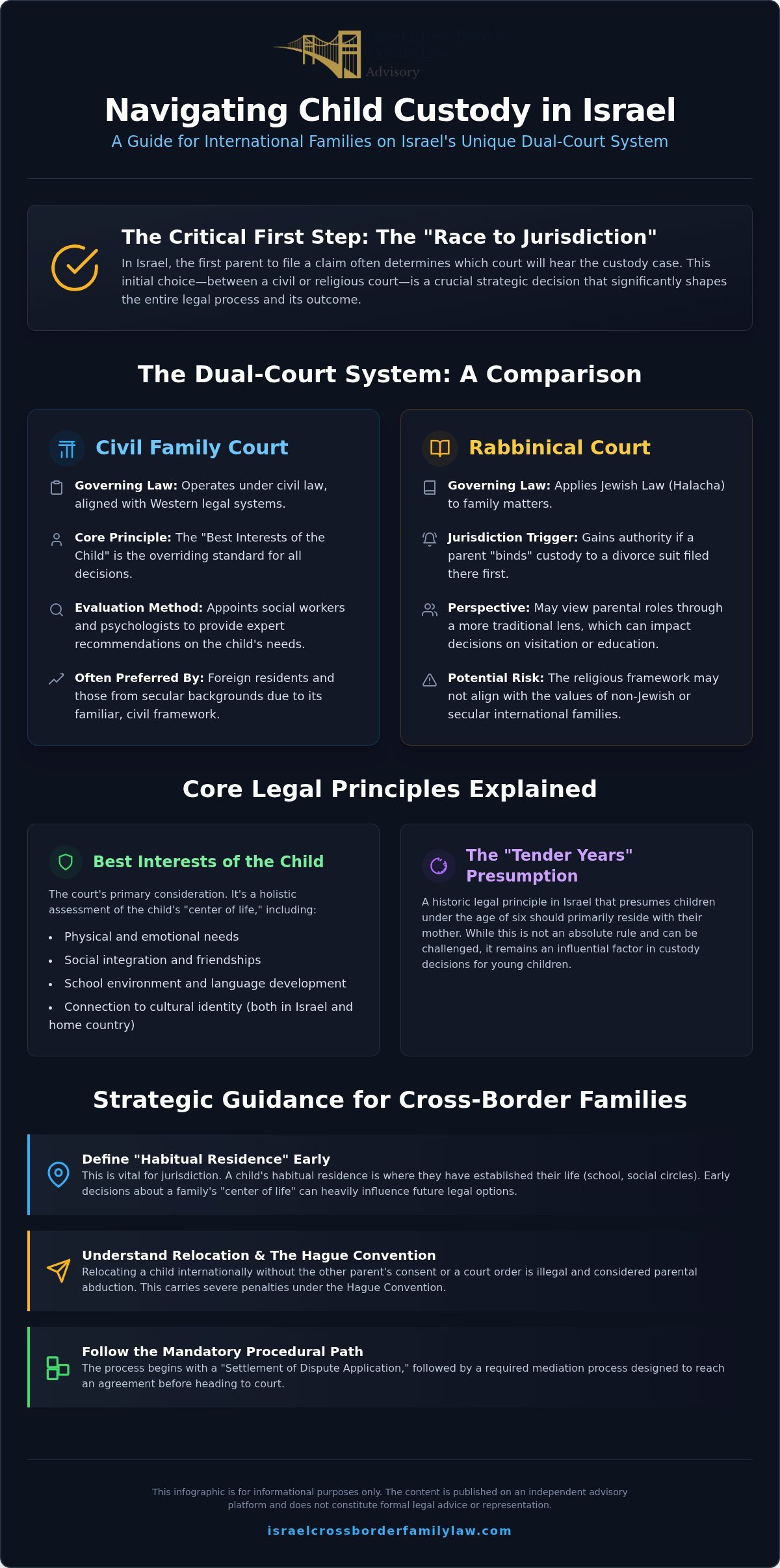
Israel maintains a unique legal landscape where family matters are divided between civil and religious authorities. For international families, Understanding the Dual-Court System is the first step in protecting your parental rights. This structure creates a “race to jurisdiction,” where the first parent to file a claim often determines which court will oversee the case. If a parent files for divorce in the Rabbinical Court and “binds” custody to that suit, the religious court may gain exclusive authority over the children’s future.
Jurisdictional authority isn’t automatic for foreign residents. An Israeli court typically claims jurisdiction if the child’s “habitual residence” is in Israel, meaning they’ve established their life, school, and social circles here. This is a critical point for families who’ve recently moved or are planning a temporary stay. Dealing with Custody Issues for Foreign Residents in Israel requires a clear strategy before any legal papers are served, as the choice of venue dictates the entire legal process.
To better understand the legal challenges foreign spouses face in the Israeli system, watch this helpful video:
The Civil Family Court Approach
The Family Court operates under civil law, prioritizing the “Best Interests of the Child” as the overriding standard. This venue is often preferred by foreign residents because its procedures and standards are more aligned with Western legal systems. To determine the child’s needs, the court frequently appoints social workers, known as Sita’im, and independent psychologists to conduct evaluations. These experts provide recommendations on living arrangements and visitation schedules. Additionally, the Family Court is the primary authority for handling international travel concerns, including the issuance of “stay of exit” orders to prevent a child from being removed from the country without consent.
The Rabbinical Court Nuance
While the Family Court is civil, the Rabbinical Court applies Jewish law, or Halacha. This system can gain authority over custody if it’s legally “bound” to a divorce file before a separate claim is made in Family Court. For international families, this adds a layer of multi-jurisdictional complexity. Religious judges may view parental roles through a traditional lens, which can impact visitation rights or educational decisions. It’s especially risky for non-Jewish foreign residents or those with secular lifestyles, as the religious framework may not reflect their personal values or the norms of their home country. Navigating these systems requires a proactive approach. For those managing Custody Issues for Foreign Residents in Israel, understanding these jurisdictional boundaries is the foundation of a sound legal strategy.
Key Legal Presumptions: Tender Years and Best Interests
In the Israeli legal system, every decision regarding a child’s future is anchored in the “Best Interests of the Child” (Tobat HaYeled). For international families, this standard takes on a multi-layered meaning. The court doesn’t just look at physical needs; it evaluates the child’s “center of life,” which includes their social integration, school environment, and linguistic development. When addressing Custody Issues for Foreign Residents in Israel, judges must weigh the benefits of a child’s current Israeli lifestyle against the potential advantages of returning to their home country or maintaining a specific cultural identity.
A historic pillar of Israeli law is the “Tender Years Presumption” (Hazzakat Hagil Harach). This principle traditionally suggested that children under the age of six should remain in the primary custody of their mother. However, by 2026, the application of this doctrine has significantly declined. Courts now adopt a more nuanced, gender-neutral approach that prioritizes the stability of the child’s routine over rigid presumptions. While the age of six remains a legal benchmark, it no longer serves as an automatic guarantee of custody, especially in cases where both parents have been active caregivers.
The Shifting Landscape of Shared Parenting
There’s a clear trend in Israel toward “Shared Parental Responsibility” (Achrayut Horit Meshutefet). This model moves away from designating one parent as the “custodian” and instead views both parents as equal guardians. This shift has practical financial implications; for example, shared custody often leads to a reduction in child support (alimony) payments, provided the parents’ incomes are relatively similar. For foreign residents, this can be challenging. Without a local support network of grandparents or extended family, maintaining a strict 50/50 shared schedule requires meticulous planning and professional strategy. If you’re unsure how these shifts affect your specific situation, it’s helpful to discuss your circumstances with an advisor.
Cultural and Educational Considerations
Israeli courts recognize that children of expats have unique needs, particularly regarding their connection to their home country. Decisions about schooling, religious upbringing, and language are often contested when one parent wishes to emphasize an international path while the other focuses on local integration. The court generally seeks to maintain the “status quo” to provide stability. However, if a child is old enough, usually around 10 to 12 years old, the court may appoint an expert to hear the child’s own preferences. Because these decisions often involve the risk of one parent wanting to move the child abroad, the Israeli Ministry of Justice provides strict oversight to ensure that any change in residence or education aligns with international treaties and the child’s long-term welfare. Understanding how your “habitual residence” is defined today will dictate your ability to make these international moves in the future.
International Relocation and the Hague Convention
International relocation, referred to in Israel as Hagira, represents one of the most complex and high-stakes Custody Issues for Foreign Residents in Israel. Under Israeli law, a parent cannot unilaterally decide to move a child abroad permanently. Doing so without the other parent’s explicit, written consent or a formal court order is legally classified as child abduction. This classification triggers the Hague Convention on the Civil Aspects of International Child Abduction, a treaty designed to ensure the prompt return of children wrongfully removed from their country of habitual residence.
For foreign residents, the Hague Convention acts as both a shield and a restriction. It provides a legal mechanism to recover a child taken from Israel, but it also prevents an expat parent from simply “going home” with their children after a relationship dissolves. To mitigate the risk of unauthorized removal, Israeli courts frequently issue “Stay of Exit” orders (Tsav Ikur Yetzia Min HaAretz). These orders are a standard protective measure that prevents a child from leaving the country’s borders without specific judicial approval or the verified consent of both parents.
Seeking Permission to Relocate
When a parent seeks to relocate legally, the court applies a rigorous “Best Interests of the Child” analysis that outweighs all other factors. The burden is on the relocating parent to present a comprehensive “Relocation Plan” that demonstrates long-term stability in the destination country. This plan must include concrete details on housing, school enrollment, and healthcare. The court also examines the parent’s motives and the potential impact on the child’s relationship with the parent staying in Israel. Success often depends on crafting a long-distance visitation schedule that includes extended holiday periods and robust digital communication to maintain the parental bond across borders.
The Risk of Unilateral Action
Taking unilateral action by removing a child from Israel without authorization leads to immediate and severe legal consequences. Under the Hague Convention, Israeli law requires an initial hearing within 15 days of a petition being filed, with the goal of completing the first instance proceeding within six weeks. The court’s primary focus is determining the child’s “habitual residence” rather than deciding which parent is superior. This test looks at the child’s integration into Israeli life, including school attendance and social connections. If the court finds Israel is the habitual residence, it will likely order the child’s immediate return. To understand the gravity of these proceedings, you can Learn more about the Hague Convention and child abduction. Strategy must be established before any international travel is planned to avoid these multi-jurisdictional conflicts.
The Procedural Path: From Mediation to Judgment
This advisory content is published on an independent platform and does not constitute legal representation or formal legal advice; strategy and risk management should be discussed with a licensed professional.
In Israel, the path to a custody judgment begins with a mandatory procedural hurdle that often surprises foreign residents. You can’t file a traditional lawsuit for custody until you’ve first submitted a “Request for Settlement of Dispute.” This application, which carries a modest fee of 119 NIS, initiates a mandatory cooling-off period. During this time, a 45 to 60-day stay of proceedings is imposed. This effectively freezes the ability of either parent to litigate unless an urgent situation arises.
For those managing Custody Issues for Foreign Residents in Israel, this period is a strategic window. It’s during these weeks that parents meet with the Yechidat HaSiyu’a, a court-linked support unit comprising social workers and mediators. These professionals assess whether the family can reach an agreement without the intervention of a judge. While the process is designed to reduce conflict, it requires careful preparation. Your statements during these sessions can influence the court’s perception of your willingness to cooperate and your long-term intentions.
Mandatory Mediation (Settlement of Dispute Law)
The Settlement of Dispute Law mandates that mediation be the first avenue of resolution. You generally can’t bypass this stage to file a custody lawsuit immediately. This law aims to protect children from the vitriol of prolonged litigation. For international families, it can feel like a delay in securing their status. There are, however, critical exceptions. If there’s a documented risk of domestic violence or a credible threat of international child relocation, the court may grant a waiver. It may also issue temporary custody orders (S’eadim Zmaniyim) to maintain the status quo while the mediation process unfolds. These temporary orders are essential for stabilizing Custody Issues for Foreign Residents in Israel when one parent fears the child might be removed from the country.
Court-Appointed Experts and Social Workers
If mediation doesn’t result in a signed agreement, the case moves into the formal litigation phase. At this point, the most influential document in your file becomes the Teskir, or social worker report. A court-appointed social worker will interview both parents, visit their homes, and speak with the children’s teachers. For a foreigner, these interviews are high-stakes. Cultural misunderstandings or language barriers can lead to a report that doesn’t accurately reflect your parenting capabilities or the child’s needs.
In contested international cases, the court may also appoint a Guardian ad Litem to represent the child’s interests independently of the parents. Judges often order a Mivchan Masugalut Horit, a comprehensive psychological evaluation to determine parental fitness. Preparing for these evaluations involves more than just showing up. It requires a clear understanding of how Israeli social services view the “Best Interests of the Child” standard. If you’re facing these procedural steps, it’s vital to request a confidential case review to align your strategy with local expectations and protect your parental status.
Strategic Guidance for Cross-Border Families
This content is published on an independent advisory platform and does not constitute legal representation or formal legal advice. Legal services are only provided by licensed attorneys under a separate engagement. Our focus is on providing strategic risk management and decision-making guidance for international families.
Managing Custody Issues for Foreign Residents in Israel requires a level of foresight that extends far beyond the immediate dispute. Because the Israeli legal system places immense weight on the established “status quo,” every early decision you make carries long-term consequences for your parental status. Seeking clarity before taking any formal legal action is the most effective way to protect your rights. For international families, the goal is not just to win a local case, but to ensure that your parental role remains secure across multiple jurisdictions.
A central pillar of this strategy involves understanding how “Habitual Residence” is defined. As discussed in previous sections, this is not merely a matter of where a child lives, but where their life is most deeply rooted. If you allow a child to remain in Israel for an extended period without a clear, written agreement regarding their residence, you may inadvertently waive your right to relocate with them in the future. Courts are hesitant to uproot a child once they’ve integrated into a local community, making early strategic planning essential for anyone who envisions an eventual move back to their home country.
Drafting an Enforceable International Agreement
When resolving Custody Issues for Foreign Residents in Israel through mediation or settlement, the final document must be robust enough to withstand international scrutiny. A standard Israeli custody agreement may not be automatically recognized or enforceable in the United States or other home jurisdictions. To bridge this gap, we often recommend “mirror orders.” These are identical legal orders filed in both the Israeli Family Court and the court of the home country. This ensures that travel schedules, holiday rotations, and digital communication rights are protected regardless of which country the child is currently in. For families requiring specialized support for expats and foreign nationals, these clauses are the difference between a functional co-parenting relationship and a jurisdictional nightmare.
The Weight of Early Decisions
Expats often agree to “temporary” arrangements during a separation, assuming these can be easily modified later. In the Israeli court system, these temporary setups frequently become the permanent foundation for a final judgment. If you agree to a visitation schedule that limits your time or allows for a “Stay of Exit” order without a clear expiration date, you may find it difficult to reverse these conditions later. You must evaluate the risk of every concession before it is recorded in a court protocol. Balancing the requirements of two different legal systems is inherently complex, and the cultural differences in how “parental fitness” is viewed can lead to unexpected outcomes.
Get clarity before you commit. Request a confidential consultation.
Securing Your Family’s Future Across Borders
Protecting your parental status in Israel requires more than just local compliance; it demands a comprehensive strategy that accounts for both domestic laws and international treaties. We’ve explored how the dual-court system creates a race to jurisdiction and why the Hague Convention makes unilateral relocation a high-risk endeavor. By prioritizing early decisions regarding your child’s habitual residence, you can maintain the stability of their environment while preserving your future mobility.
Addressing Custody Issues for Foreign Residents in Israel involves navigating complex cultural and legal differences between systems. Our advisory approach provides the specialized US-Israel cross-border expertise necessary to manage these multi-jurisdictional conflicts with confidence. Whether you’re dealing with the mandatory mediation process or drafting mirror orders for international enforcement, seeking clarity is the first step toward a functional co-parenting relationship.
Get clarity before you commit. Request a confidential consultation to discuss your specific circumstances and risk management goals. You don’t have to navigate this intricate landscape alone; professional guidance can bridge the gap between legal systems and protect what matters most.
Frequently Asked Questions
Can a foreign resident get sole custody in Israel?
Sole custody is possible in Israel, though the judicial trend has moved strongly toward shared parental responsibility. Courts evaluate whether one parent’s primary care is essential for the child’s welfare based on the specific facts of the case. For those managing Custody Issues for Foreign Residents in Israel, this often involves demonstrating how a specific living arrangement supports the child’s stability within an international lifestyle.
What is the Tender Years Presumption in 2026?
The Tender Years Presumption is a legal principle suggesting that children under the age of six should remain with their mother. By 2026, its influence has waned as courts prioritize the “Best Interests of the Child” over rigid gender-based rules. Judges now look at the actual caregiving history and the child’s emotional bonds with both parents before making a determination.
Can I leave Israel with my child if there is no custody order?
You cannot legally remove a child from Israel permanently without the other parent’s written consent or a court order, even if a formal custody arrangement isn’t yet in place. Doing so is often classified as international child abduction under the Hague Convention. If your child’s habitual residence is Israel, any unilateral move back to your home country carries severe legal risks and potential return orders.
How does the ‘Best Interests of the Child’ standard apply to expats?
For expat families, the “Best Interests of the Child” standard focuses heavily on the child’s “center of life” and their integration into their current environment. The court examines school enrollment, social connections, and the parents’ original intent when moving to Israel. Judges try to balance the child’s need for stability in Israel with the importance of maintaining cultural and linguistic ties to their home country.
Do Israeli courts recognize US custody orders?
Israeli courts don’t automatically enforce US custody orders without a formal recognition process. If a child has established habitual residence in Israel, a local court has the authority to modify a foreign judgment to reflect the child’s current needs. This is why many international families use mirror orders to ensure their agreements are legally binding in both jurisdictions simultaneously.
What happens if a parent refuses to return a child to Israel?
If a parent refuses to return a child to Israel, the other parent can file a petition under the Hague Convention. Israeli law requires an initial hearing within 15 days of such a filing, with the goal of concluding the first instance of the proceeding within six weeks. The court’s primary objective is to return the child to their country of habitual residence so the local courts there can decide on long-term custody.
Is mediation mandatory for foreign residents in custody disputes?
Mediation is a mandatory first step for all families in Israel, including foreign residents and expats. You must file a “Settlement of Dispute” application and attend meetings with the court’s support unit before you’re allowed to litigate in court. This process includes a 45 to 60-day stay of proceedings designed to help parents reach an amicable agreement before a judge intervenes.
How long does a custody case typically take in the Israeli Family Court?
The timeline for a custody case in the Israeli Family Court depends on whether the matter involves an international abduction or a standard dispute. Hague Convention cases are expedited, with a target completion of six weeks in the court of first instance. Standard custody cases take longer, beginning with the mandatory 45 to 60-day mediation period followed by several months of evaluations by social workers and court-appointed experts.

Article by
Gabriel Lior
A Personal Journey That Became a Mission
The advisory was founded by an American father Gabriel Lior, LLB, MBA , global entrepreneur, and cross-border advisor who spent more than a decade navigating the Israeli family court system firsthand and now lives in Singapore with his son.
As a divorced parent in a cross-border family, Gabriel faced nearly every legal challenge a foreign parent can encounter in Israel — including child custody disputes, child support proceedings, property matters in Israel and abroad, false accusations, and complex immigration and relocation proceedings.
Over the years, he learned the hard way how difficult it is for non-Israeli parents to understand the system, identify the right legal strategy, and choose the right legal representation — especially when language, culture, and jurisdictional differences are involved. He also witnessed how foreign parents and new immigrants are often disadvantaged or taken advantage of by service providers and institutions simply because they lack local knowledge or fluency.
From Client to Advisor
To truly understand — and survive — the system, Gabriel pursued formal legal education in Israel, completing two Israeli law degrees, alongside a BA and MBA earned in the United States. This was never about becoming a practicing attorney, but about gaining a deep, structural understanding of how the system works — and where it breaks down for foreign parents.
This rare combination of:
Firsthand client experience
Israeli legal and US business education
International business and negotiation training
Decades of commercial execution
created a unique perspective – one that understands both sides of the table.
After years of litigation, persistence, and at times self-representation, he ultimately succeeded in securing custody of his son and relocating abroad through a rare legal victory in the Israeli Supreme Court — becoming one of the first fathers in Israel to do so under these circumstances.
Disclaimer
Important Disclaimer:
The information provided on this website and in its content is for general informational and educational purposes only and does not constitute legal advice, legal opinion, or legal representation.
Gabriel Lior is not licensed to practice law in Israel (nor is he interested in doing so) and does not provide legal services, despite having completed 2 Law Degrees. The services offered are advisory in nature and are intended to provide general guidance, strategic insight, and information regarding cross-border family law considerations.
No attorney-client relationship is formed by accessing this website, reading its content, or communicating with us.
Any decisions made based on this information are at your own discretion and risk. For legal advice specific to your situation, you should consult a licensed attorney in the relevant jurisdiction.
Where appropriate, we may refer clients to independent, licensed attorneys or professionals. Such referrals do not constitute legal representation and no liability is assumed for services provided by third parties.