This article is published on an independent advisory platform and is not a law firm; the information provided does not imply an attorney-client relationship.
What if the most significant obstacle to your future isn’t the Israeli legal system, but the isolation that prevents you from making clear, strategic decisions? For many international families, the “race to jurisdiction” between Rabbinical and Civil courts creates a unique pressure that local friends might not grasp. Finding dedicated support groups for expats going through divorce is often the first step toward regaining your footing. You likely feel a profound sense of uncertainty regarding how the dual legal system handles property division or child custody. It’s natural to worry about language barriers or the risk of losing residency across borders.
This guide explores how specialized support groups help you navigate the emotional and strategic complexities of a cross-border divorce. You’ll learn how to find a community that offers a safe space to process emotions while learning from others who have navigated the IL legal system. We’ll preview resources to help you reduce the feeling of being trapped in a foreign jurisdiction. For more insights, view the Israel Family Law YouTube channel. Get clarity before you commit. Request a confidential consultation.
Key Takeaways
- Understand why traditional support networks in your home country often fail to address the specific pressures of navigating a foreign legal system while managing personal loss.
- Identify specialized support groups for expats going through divorce in Israel, including gender-specific resources and English-speaking recovery programs tailored for international families.
- Learn how emotional stability gained through peer support can help you avoid reactive legal decisions and manage the complexities of the Israeli court system more effectively.
- Discover how finding a linguistic and cultural niche within the community provides clarity on the critical differences between Rabbinical and Civil jurisdictions.
- Recognize the necessary transition from emotional healing to strategic action, ensuring your early legal decisions are based on logic rather than isolation or fear.
This article is published on an independent advisory platform and is not a law firm; the information provided does not imply an attorney-client relationship.
The Unique Need for Expat-Specific Divorce Support
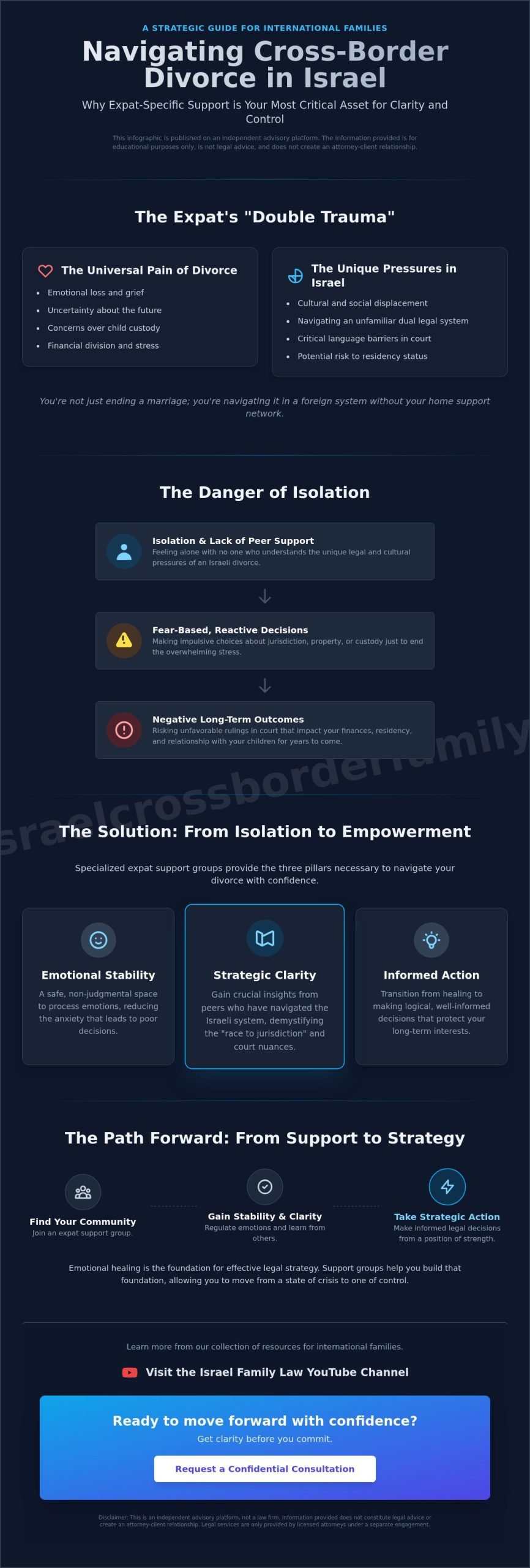
Expats in Israel often face what professionals describe as “double trauma.” You aren’t just processing the end of a marriage; you’re doing so while feeling culturally displaced in a country where the legal system operates on unfamiliar logic. While friends back home offer sympathy, they rarely understand the specific anxiety of a “race to jurisdiction” or the nuances of the Rabbinical courts. This gap in understanding is exactly why The Unique Need for Expat-Specific Divorce Support is so critical for international families. Without a community that mirrors your specific reality, it’s easy to feel like an outsider looking in on your own life.
Isolation can lead to reactive, fear-based choices that have long-term consequences for your residency or custody arrangements. Engaging with support groups for expats going through divorce provides a necessary reality check. Peers who’ve already navigated the IL system can offer insights that those outside of Israel simply cannot provide. This shared experience helps ground you when the complexity of cross-border litigation feels overwhelming.
To better understand the value of community during this transition, watch this helpful video:
Isolation and the Expat Experience
The absence of “boots on the ground” family support is perhaps the most significant challenge for Anglos in Israel. When you don’t have a local network to help with childcare or provide a temporary home, your leverage in divorce and separation for international families often feels diminished. Being an outsider in the local court system adds another layer of stress, especially when proceedings are conducted in a language you haven’t fully mastered. Speaking your native English in a group setting isn’t just about comfort; it’s vital for emotional healing and ensuring you fully grasp the strategic implications of your situation.
The Connection Between Emotion and Strategy
High-conflict emotions are the primary reason cross-border negotiations derail. When you feel unsupported, you’re more likely to make impulsive legal concessions just to end the stress, or conversely, dig in your heels on minor issues that don’t serve your long-term goals. support groups for expats going through divorce act as a steadying hand, helping you regulate these emotions so you can focus on strategy. Common pitfalls, such as failing to account for international travel restrictions or miscalculating the impact of IL child support laws, often stem from a lack of community guidance. Finding a safe space to process these fears allows you to move from a state of panic to one of informed decision-making. Get clarity before you commit. Request a confidential consultation.
This article is published on an independent advisory platform and is not a law firm; the information provided does not imply an attorney-client relationship.
Types of Support Groups for Expats in Israel
Finding the right community depends on your specific needs, whether you’re seeking emotional healing or strategic insights from peers who’ve stood where you are. While many organizations focus on the local Hebrew-speaking population, there are several support groups for expats going through divorce that cater specifically to the English-speaking community. These range from structured recovery programs to informal networks that help bridge the gap between your home culture and your current life in IL. Understanding these support networks for expats is essential for anyone dealing with the friction of a cross-border separation.
Local Israeli Support Organizations
The Rackman Center at Bar-Ilan University is a primary resource for women. Their “A Woman by Your Side” program provides emotional assistance and accompaniment through the complex legal process. Other established organizations like WIZO and Na’amat also offer counseling and legal aid, though their services may vary by branch. However, there’s a recognized lack of support groups for expats going through divorce specifically tailored for men in IL. While some Jewish communities offer groups for divorced men, expat men often find they must rely more heavily on private therapeutic groups or informal Anglo meetups to find peers who understand their unique jurisdictional concerns. University-affiliated programs are excellent but can sometimes be geographically limited to central Israel, making remote or private options necessary for those in the north or south.
Digital and Online Global Communities
Digital communities have become a vital lifeline for those who can’t find local in-person meetings. Facebook groups for “Anglos in Israel” or “Expats in Israel” often have private spin-off groups for those in the midst of a transition. These spaces provide immediate feedback and 24/7 access, which is invaluable during high-stress phases. You must approach these forums with caution, however. Peer advice isn’t a substitute for professional strategy, especially when dealing with the high stakes of for expats and foreign nationals legal issues. Use these forums for emotional validation and to learn about others’ experiences with the mandatory “Mahut” mediation meetings. Distinguishing between a group meant for venting and one that provides valuable insight into the Israeli legal landscape is key to protecting your mental health.
Before joining any group, consider your current goals. Are you looking for a place to process grief, or do you need practical tips on managing the “Get” in the Rabbinical court? Identifying your needs early helps you find the right fit. Get clarity before you commit. Request a confidential consultation.
This article is published on an independent advisory platform and is not a law firm; the information provided does not imply an attorney-client relationship.
How Support Groups Improve Your Legal Outcome
Stability is a strategic asset in any legal proceeding. When you’re in “reactive mode,” you’re more likely to agree to unfavorable terms or pursue litigation that doesn’t serve your long-term interests. Engaging with support groups for expats going through divorce allows you to regulate these high-conflict emotions outside of the courtroom. By processing your grief or anger with peers, you arrive at legal meetings with a clearer head and a focus on your objectives. This emotional regulation directly impacts your ability to follow a complex strategy, especially when multi-jurisdictional assets or custody arrangements are at stake.
Peers also provide a unique window into the “unspoken rules” of the Israeli legal system. While your legal team manages the filings, other expats can share what it actually feels like to stand before a judge in the Family Court or a panel in the Rabbinical Court. They can explain the cultural tempo of the “race to jurisdiction” and help you understand why the local style of litigation might seem more aggressive than what you’re used to in your home country. However, you must remain cautious; while shared experiences regarding relocation or the Hague Convention are comforting, a peer’s legal outcome doesn’t guarantee yours. Always distinguish between emotional validation and actual legal strategy.
Avoiding Emotional Overspending
One of the most practical benefits of these groups is financial. It’s common for expats to use their attorney as an unofficial therapist, but this leads to significant “emotional overspending.” Lawyers typically charge for every communication; if you’re calling them to vent about a recent argument with your spouse, you’re paying legal rates for emotional support. By using support groups for expats going through divorce to handle your emotional grievances, you can keep your legal budget focused on technical filings and court appearances. Understanding the costs of cross-border divorce is essential for maintaining your financial health throughout the process.
Gaining Cultural Clarity
The Israeli legal environment can feel jarringly different from the civil systems in the US, UK, or Canada. Support groups help you decode this environment by explaining the differences between Civil and Rabbinical courts in plain English. You’ll learn that “aggressive” litigation is often just the local standard, rather than a personal attack. This clarity helps you develop a long-term mindset for multi-jurisdictional parenting. Instead of focusing on short-term wins, you’ll see the value in making early, informed decisions that protect your family’s future across borders. Get clarity before you commit. Request a confidential consultation.
This article is published on an independent advisory platform and is not a law firm; the information provided does not imply an attorney-client relationship.
Navigating Language and Cultural Barriers in Israel
Expats often find that language is more than just a tool for communication; it’s a bridge to shared values and mutual understanding. In Israel, the “Anglo” community forms a specific niche where cultural expectations regarding privacy, parenting, and legal decorum differ significantly from the local standard. This is why finding language-specific support groups for expats going through divorce is indispensable. When you’re explaining a complex cross-border issue, you shouldn’t have to translate your emotions or your cultural background while simultaneously trying to understand a foreign legal framework.
The challenge of finding the right fit is compounded by the secular versus religious divide in IL. Many local resources are tailored toward the Hebrew-speaking religious community or the secular Israeli public. For an expat, neither may feel like a perfect fit. You might find yourself in a group where the “conflict style” feels jarringly aggressive or where the focus on traditional family structures doesn’t account for your international lifestyle. Dedicated expat groups bridge this gap by providing a space where your specific cultural lens is the default, not the exception.
Finding English-Speaking Resources
Searching for “Anglo” or “Olim” specific divorce networks is the most effective way to find peers who share your perspective. Organizations like the AACI (Association of Americans and Canadians in Israel) serve as a vital hub, often providing referrals to English-speaking therapists and peer-led support networks. When vetting these resources, look for a bilingual group facilitator. A facilitator who understands both English and Hebrew doesn’t just translate words; they translate the system. They can help you decode the nuances of a Hebrew-language court order or explain the cultural expectations behind a social worker’s recommendation in a way that makes sense to a foreign national.
Understanding the Israeli Context
The Israeli context is deeply family-oriented, which impacts everything from support group discussions to how judges view custody arrangements. For many expats, navigating the intersection of secular life and Jewish law is the most challenging part of the process. Even if you consider yourself entirely secular, the Rabbinical court holds exclusive jurisdiction over the “Get” (the religious divorce bill). Understanding how these religious requirements overlap with civil law is a core part of divorce and separation for international families. Support groups help you manage these cultural differences by reframing local litigation norms. Instead of viewing an aggressive legal move as a personal attack, peers can help you see it as a systemic standard, allowing you to remain calm and focused on your long-term strategy.
If you’re feeling overwhelmed by the linguistic or cultural demands of the IL legal system, don’t wait to seek clarity. Request a strategic case review to understand your options and protect your family’s future across borders.
This article is published on an independent advisory platform and is not a law firm; the information provided does not imply an attorney-client relationship.
Strategy First: Transitioning from Support to Action
While support groups for expats going through divorce offer a vital space for emotional recovery, there comes a point where you must pivot toward long-term planning. Healing is a necessary process, but the Israeli legal system does not wait for emotional closure. Early decisions regarding where to file and how to approach property division can set the trajectory for your entire case. Transitioning from “healing” to “planning” means using the clarity you’ve gained to make risk-based choices rather than emotional ones. It’s about recognizing when the comfort of shared experience needs to be supplemented with a concrete legal roadmap.
The insights shared by peers are most valuable when they help you become a more effective client for your legal team. Instead of arriving at meetings overwhelmed by the “race to jurisdiction,” you can use your group’s collective experience to ask more pointed, strategic questions. This allows you to provide your counsel with concise instructions based on a nuanced understanding of how IL courts handle international families. Seeking professional cross-border advisory ensures that the emotional support you’ve received translates into a technical strategy that protects your assets and your residency.
Building Your Professional Team
Your support group is just one pillar of a successful transition. Integrating peer support with licensed legal and financial advisory is the only way to navigate multi-jurisdictional complexity safely. Many expats make the mistake of waiting too long to formalize their team, assuming they can “wait and see” how things develop. In reality, early intervention is critical for child custody and relocation issues, where a single misstep or a delay in filing can lead to years of avoidable litigation. You can learn more about how the advisory process works to understand the steps involved in securing your future. A well-rounded team provides the balance of emotional validation and technical precision required for a cross-border case.
A Reassuring Path Forward
Maintaining a calm, advisory-led approach is the best way to protect your interests and your mental health. Moving forward doesn’t mean leaving your support network behind; it means adding professional expertise to your toolkit so you aren’t carrying the burden alone. A confidential case review can help you determine the specific risks and opportunities in your situation, providing a clear path out of the feeling of being “trapped.” For additional guidance, visit the Israel Family Law YouTube channel to watch videos like “Navigating Divorce in Israel for Expats.” Taking the next step toward professional advisory isn’t about escalating conflict; it’s about gaining the clarity you need to resolve it. Get clarity before you commit. Request a confidential consultation.
This article is published on an independent advisory platform and is not a law firm; the information provided does not imply an attorney-client relationship.
Securing Your Future with Strategic Community Support
Navigating a cross-border divorce requires more than just technical filings; it demands emotional resilience and a nuanced understanding of the Israeli legal landscape. By engaging with support groups for expats going through divorce, you gain the stability needed to move from a state of reactive isolation to one of informed, strategic action. You’ve seen how community resources like the Anglo niche in IL help bridge linguistic gaps and provide clarity on the critical differences between Civil and Rabbinical jurisdictions.
Success in multi-jurisdictional family law depends on early, risk-based decision-making. Our advisory focuses on providing tailored guidance for the international community, leveraging deep expertise in US-Israel cross-border family law to help you protect your assets and custody rights. Integrating peer support with professional strategy ensures that your path forward is built on logic rather than fear. Get clarity before you commit. Request a confidential consultation to begin planning your next steps. You have the power to navigate this transition with confidence and secure a stable future for your family.
This article is published on an independent advisory platform and is not a law firm; the information provided does not imply an attorney-client relationship.
Frequently Asked Questions
Are there English-speaking divorce support groups in Tel Aviv or Jerusalem?
Yes, major metropolitan hubs like Tel Aviv and Jerusalem have the highest concentration of English-speaking resources for the Anglo community. Organizations such as the AACI often provide referrals to “Olim” specific networks and community centers that host regular meetings. You can also find private therapeutic groups led by English-speaking professionals who specialize in the unique needs of international families living in these cities.
Can a support group help me if my spouse has already started proceedings in the Rabbinical Court?
A support group provides essential emotional grounding when you’re facing the pressure of the “race to jurisdiction” in the Rabbinical Court. While peers cannot change the legal filing, they can share their personal experiences with the “Get” process and Rabbinical panels. This shared knowledge helps reduce the initial shock and allows you to focus on your strategic response with your professional advisors.
Is it safe to discuss my cross-border case in a public Facebook group?
It’s generally not advisable to share specific details of a cross-border case in public or semi-public social media forums. Information shared online can sometimes be used in litigation or may inadvertently impact your privacy during sensitive negotiations. It’s better to seek out private, moderated support groups for expats going through divorce where confidentiality is a core rule of engagement for all members.
What is the difference between a support group and group therapy for expats?
Support groups are typically peer-led or facilitated by community members who focus on shared experience and mutual encouragement. Group therapy is led by a licensed mental health professional and focuses on clinical healing and psychological processing of trauma. Both are valuable, but therapy offers a higher level of professional oversight for those dealing with complex emotional distress during a foreign divorce.
How do I find a support group that understands the Hague Convention and relocation fears?
Look for groups specifically labeled for “international families” or “expats” rather than general local divorce groups. These specialized communities are more likely to include members who have dealt with the Hague Convention or relocation applications in IL. You can also ask for referrals from cross-border legal advisors who work specifically with the English-speaking community and understand these high-stakes jurisdictional issues.
Are there support groups specifically for expat fathers in Israel?
There is currently a recognized shortage of gender-specific support groups for expats going through divorce for men in IL compared to the resources available for women. Some Anglo-centric religious communities or private therapists host men’s groups intermittently. Many expat fathers find significant value in broader expat networks or digital forums dedicated to the specific challenges of fatherhood in a foreign legal system.
What should I do if my local support group gives me conflicting legal advice?
You should always prioritize the strategy provided by your licensed legal counsel over peer anecdotes or group suggestions. While support groups are excellent for emotional validation, every cross-border case has unique facts that peers may not fully understand. Use the group for “reality checks” on the emotional process, but leave the technical legal strategy to your professional team to avoid dangerous errors.
Do I need to be an Israeli citizen to join local emotional assistance programs?
Most non-governmental organizations and private support groups do not require Israeli citizenship for participation. Programs offered by organizations like the Rackman Center or WIZO are generally open to residents and foreign nationals living in IL who are navigating the local court system. It’s always best to check with the specific organization regarding their current eligibility criteria for their counseling or accompaniment services.

Article by
Gabriel Lior
A Personal Journey That Became a Mission
The advisory was founded by an American father Gabriel Lior, LLB, MBA , global entrepreneur, and cross-border advisor who spent more than a decade navigating the Israeli family court system firsthand and now lives in Singapore with his son.
As a divorced parent in a cross-border family, Gabriel faced nearly every legal challenge a foreign parent can encounter in Israel — including child custody disputes, child support proceedings, property matters in Israel and abroad, false accusations, and complex immigration and relocation proceedings.
Over the years, he learned the hard way how difficult it is for non-Israeli parents to understand the system, identify the right legal strategy, and choose the right legal representation — especially when language, culture, and jurisdictional differences are involved. He also witnessed how foreign parents and new immigrants are often disadvantaged or taken advantage of by service providers and institutions simply because they lack local knowledge or fluency.
From Client to Advisor
To truly understand — and survive — the system, Gabriel pursued formal legal education in Israel, completing two Israeli law degrees, alongside a BA and MBA earned in the United States. This was never about becoming a practicing attorney, but about gaining a deep, structural understanding of how the system works — and where it breaks down for foreign parents.
This rare combination of:
Firsthand client experience
Israeli legal and US business education
International business and negotiation training
Decades of commercial execution
created a unique perspective – one that understands both sides of the table.
After years of litigation, persistence, and at times self-representation, he ultimately succeeded in securing custody of his son and relocating abroad through a rare legal victory in the Israeli Supreme Court — becoming one of the first fathers in Israel to do so under these circumstances.
Disclaimer
Important Disclaimer:
The information provided on this website and in its content is for general informational and educational purposes only and does not constitute legal advice, legal opinion, or legal representation.
Gabriel Lior is not licensed to practice law in Israel (nor is he interested in doing so) and does not provide legal services, despite having completed 2 Law Degrees. The services offered are advisory in nature and are intended to provide general guidance, strategic insight, and information regarding cross-border family law considerations.
No attorney-client relationship is formed by accessing this website, reading its content, or communicating with us.
Any decisions made based on this information are at your own discretion and risk. For legal advice specific to your situation, you should consult a licensed attorney in the relevant jurisdiction.
Where appropriate, we may refer clients to independent, licensed attorneys or professionals. Such referrals do not constitute legal representation and no liability is assumed for services provided by third parties.