What if the court that decides your family’s future is determined not by where you live, but by who files a piece of paper first? For many expats and international families, the israeli family court system feels like a maze of competing jurisdictions and unfamiliar religious laws. It’s natural to feel anxious about how a dual-court system might impact your US-based orders or global assets. You aren’t alone in this confusion; the interaction between civil and religious authorities in Israel is unique and often demands a strategic approach from the very start.
This guide provides a clear, authoritative overview of how the civil and Rabbinical systems interact. You’ll gain a roadmap for navigating jurisdictional rules, understanding the high-stakes “race for jurisdiction,” and protecting your international interests. This content is published on an independent advisory platform, not a law firm, to help you find clarity before you commit to any legal path. Our focus is on strategy, risks, and decision-making guidance rather than an attorney-client relationship, ensuring you have the knowledge needed to navigate this multi-jurisdictional complexity.
Key Takeaways
- Identify how parallel civil and religious jurisdictions influence your case and which legal framework applies to your specific family matters.
- Learn why the timing of your initial filing is the most critical factor in determining whether the israeli family court or a Rabbinical court takes charge.
- Gain clarity on international protections like the Hague Convention to ensure your children’s stability isn’t compromised by cross-border moves.
- Prepare for mandatory mediation sessions that can significantly impact the outcome and duration of your legal journey in Israel.
- Discover why a multi-jurisdictional strategy’s vital for ensuring that foreign court orders are recognized and enforced within the Israeli system.
The Dual Court System in Israel: Civil vs. Religious Jurisdiction
Israel operates a dual-track legal system for family matters, which means two distinct court systems have the authority to hear your case. This structure is rooted in the “Status Quo” agreement established at the state’s founding to balance secular and religious needs. The 1953 Rabbinical Courts Jurisdiction Law remains the cornerstone of this arrangement. It grants religious authorities power over matters of “Personal Status,” a category that includes marriage, divorce, and certain aspects of inheritance and alimony.
This jurisdictional framework isn’t limited to the Jewish population. While the Rabbinical Court handles matters for Jewish citizens and residents, Sharia courts serve the Muslim community. Christian and Druze families also have their own respective religious tribunals. This system respects the religious identity of citizens, but it creates significant complexity for those used to a single, unified civil court system. Understanding which court will hear your case is the first step in protecting your interests.
The Civil Family Court (Beit Mishpat L’Inyanay Mishpacha)
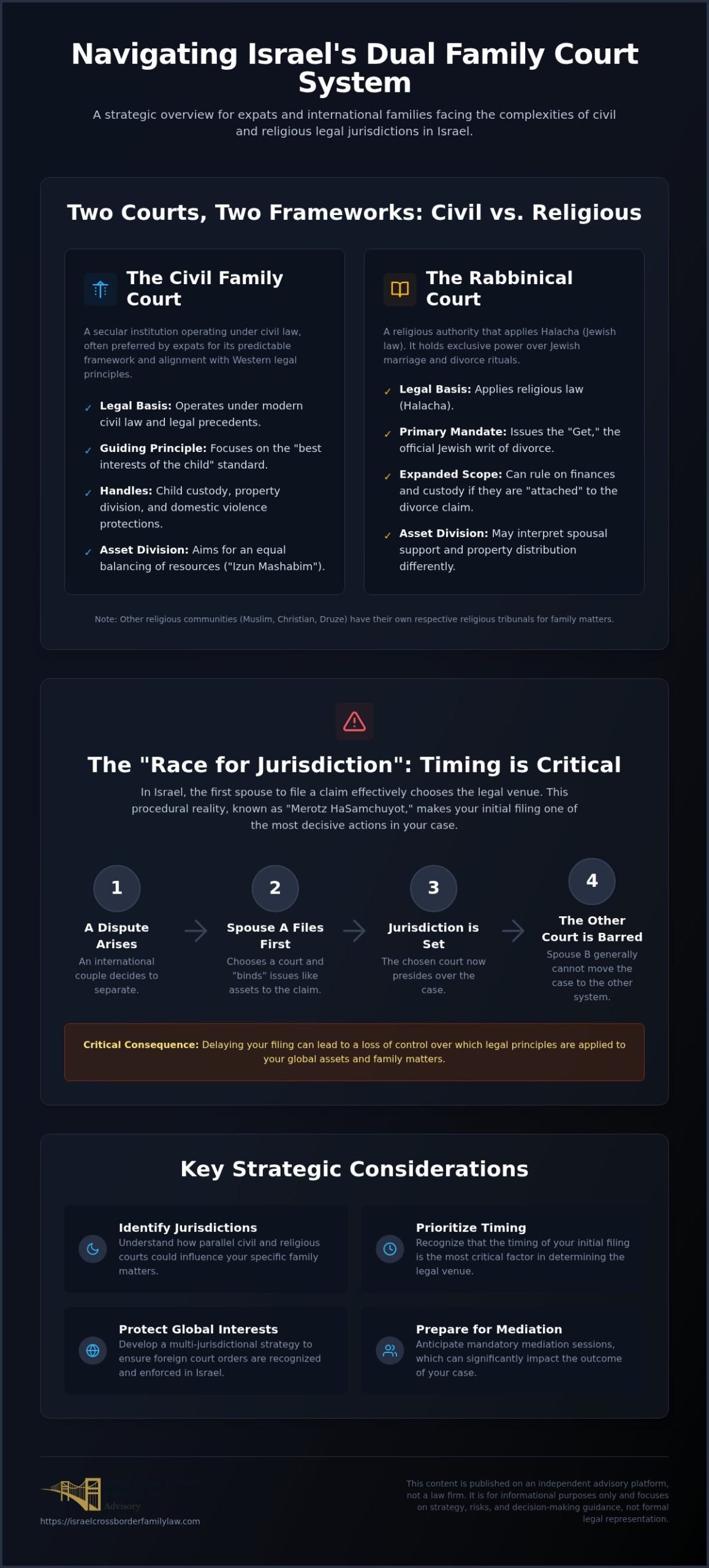
The israeli family court is a secular institution that operates under civil law rather than religious doctrine. Judges in this forum focus on civil rights, modern legal precedents, and the “best interests of the child” standard. For expats and foreign nationals, this forum is often preferred because it provides a more predictable framework for distributing international assets. It handles matters like child custody, property division, and domestic violence protections. The civil court’s focus on egalitarian principles often aligns more closely with the legal expectations of families moving to Israel from Western jurisdictions.
The Religious Rabbinical Court (Beit Din Rabbany)
The religious track holds exclusive power over the “Get,” the Jewish writ of divorce. Without this document, a Jewish couple isn’t considered legally divorced in Israel, regardless of any civil filings. While their primary mandate is the ritual of divorce, these courts can also rule on financial matters and child support if those issues are “attached” to the divorce claim. In November 2025, a law was passed that temporarily expanded this authority, allowing Rabbinical courts to rule on all matters of child support, including housing and healthcare, for a two-year period. They apply Halacha (Jewish law), which may interpret spousal support and asset distribution differently than secular courts. This content is published on an independent advisory platform, not a law firm, and is for informational purposes only.
The ‘Race for Jurisdiction’: Why Timing is Everything in Israel
The race is particularly intense because of the ability to “bind” secondary issues to a divorce claim. When a spouse files for divorce in the Rabbinical court, they can attach matters such as the division of assets or child arrangements to that religious filing. If the other spouse hasn’t already initiated these specific claims in the civil system, the religious tribunal gains the power to rule on them. Delaying a filing when your assets are located in multiple countries can lead to a loss of control over which legal principles will be applied to your global portfolio. This content is published on an independent advisory platform, not a law firm, and focuses on strategic risk management rather than providing formal legal representation.
Choosing the right forum requires a careful comparison of potential outcomes. While The Family Courts typically follow the “Izun Mashabim” principle, which aims for an equal balancing of resources, Rabbinical courts may apply different interpretations of financial responsibility based on religious law. For international families, the civil track often provides a more familiar environment for handling complex financial disclosures. Coordinating your Israeli filings with any pending US legal actions is essential to ensure your strategy remains consistent across both jurisdictions.
The Impact of Early Decisions on International Assets
Early jurisdictional choices have a profound impact on US-based real estate, retirement accounts, and brokerage funds. Navigating the tension between Israeli “binding” claims and the US principle of “comity” is complex, especially regarding SEC compliance and the specific tax regulations governing 401(k) or IRA plans. If an Israeli order is issued without considering these US-specific regulatory hurdles, it may prove impossible to enforce abroad. It’s vital to seek clarity on these risks before the race begins. Understanding how each court views international assets helps you avoid long-term financial loss and ensures your multi-jurisdictional interests are protected from the start.
Navigating Cross-Border Issues: Hague Convention and Enforcement
Cross-border families often encounter conflicting legal mandates when moving between jurisdictions. The israeli family court serves as the primary venue for resolving complex disputes involving international child custody and relocation. When a parent considers Aliyah or a return to the US, the court prioritizes the “best interests of the child,” often focusing on the stability of the child’s daily routine. It’s vital to recognize that US court orders don’t carry automatic weight in Israel. They require a formal domestication process to be recognized and enforced by local authorities.
Child Support Enforcement Across Borders
Enforcing US child support orders within the Israeli system presents specific procedural hurdles that many expats overlook. While Israel is a signatory to international treaties, the transition of a foreign support order into a locally enforceable mandate isn’t always seamless. The Israeli Central Authority plays a pivotal role as a liaison, yet the practical difficulty of aligning US financial standards with Israeli cost-of-living benchmarks remains a significant factor in litigation. Gaining clarity on Cross-border child support enforcement helps families manage expectations regarding timelines and potential recovery.
The Hague Convention in the Israeli Court System
The Hague Convention on International Child Abduction provides the legal framework for addressing the “wrongful removal” or retention of a child. In the israeli family court, these petitions are fast-tracked to minimize disruption to the child’s life. By law, an initial hearing must take place within 15 days of the petition being filed. While the international standard for resolution is six weeks, practical cases in 2026 often conclude within 45 to 90 days. A critical factor in these rulings is the child’s “habitual residence.”
Following the departure of non-emergency US personnel in February 2026, courts have adjusted their interpretation of “habitual residence” for families displaced by regional instability. Additionally, the wishes of children aged 12 or 13 are given significant weight by presiding judges during these proceedings. This content is published on an independent advisory platform, not a law firm, focusing on strategy and risks rather than an attorney-client relationship. Reviewing the nuances of the Hague Convention and child abduction is essential for any family navigating a cross-border dispute.
Procedural Reality: What to Expect Inside the Israeli Courtroom
Entering the israeli family court for the first time often surprises those accustomed to the strictly adversarial nature of US litigation. In Israel, the judicial approach is more “inquisitorial.” This means the judge takes an active role in questioning parties and directing the flow of the case. They aren’t just neutral referees; they’re tasked with uncovering the truth to protect the family unit. This content is published on an independent advisory platform, not a law firm, and focuses on strategic guidance rather than providing formal legal representation.
Language is a primary hurdle for many expats. While English is widely spoken in professional circles, the official language of the court is Hebrew. All documents, filings, and testimonies must be in Hebrew or accompanied by a certified translation. While you can request a translator for hearings, the cultural nuances and pace of the proceedings can still feel overwhelming. It’s helpful to contact us for a strategic review of how these procedural realities might impact your specific case.
The Mahut Process: Mandatory Dispute Resolution
You can’t jump straight into litigation in Israel. The law mandates a “cooling off” period through a process called Mahut. This involves four mandatory meetings with the Unit for Assistance, a social-work branch of the court system. These meetings aim to explore settlement options before a judge hears the case. For cross-border families, these sessions are a critical opportunity to resolve complex issues like international travel or asset distribution without the high cost of a trial. If these meetings don’t result in an agreement, the “stay of proceedings” is lifted, and formal litigation begins.
Evidence and Experts in International Cases
Israeli judges rely heavily on court-appointed experts rather than “hired guns” from either side. In custody disputes, the report from a Pkidat Saad (a court-appointed social worker) carries immense weight. Their recommendations regarding the child’s “best interests” are rarely overturned. When dealing with international assets or witnesses, the court may allow for specific accommodations:
- Video Testimony: Witnesses located in the United States can often testify via video link to avoid the expense of travel.
- Foreign Appraisals: While the court prefers its own experts, it will consider foreign appraisals of US-based real estate if they meet specific evidentiary standards.
- Expert Testimony: In cases involving complex US tax or pension laws, the court may appoint a specialized accountant to bridge the gap between the two legal systems.
Understanding these procedural steps helps you prepare for the unique rhythm of the Israeli system. It ensures that your evidence is presented in a way that aligns with local judicial expectations while protecting your global interests.
Strategic Planning: Protecting Your Interests Before You Commit
Strategic planning is the cornerstone of a successful cross-border legal outcome. For families with interests in both nations, adopting a narrow, single-jurisdiction perspective often leads to significant enforcement failures. Whether you are dealing with the israeli family court or a US tribunal, a “US-only” or “Israel-only” strategy ignores the reality of how these systems intersect. This content is published on an independent advisory platform, not a law firm, focusing on strategy and decision-making rather than an attorney-client relationship.
High-net-worth dual citizens must also consider how family law proceedings impact corporate asset protection and SEC compliance. For instance, an Israeli court order that attempts to divide US-based brokerage accounts or restricted stock units without considering US regulatory hurdles can become a paper judgment that’s impossible to execute. Integrating these financial realities into your legal strategy ensures that the division of assets remains compliant with both Israeli family law and US federal regulations.
Coordinating Counsel in Two Jurisdictions
Effective management requires a “bridge” approach where counsel in both jurisdictions works in tandem. Without this coordination, you risk making contradictory filings that can damage your credibility. For example, claiming a child’s “habitual residence” is in New York while simultaneously arguing for Israeli jurisdiction in a separate filing creates a procedural nightmare. You must also ensure that asset division doesn’t trigger unexpected IRS penalties. Proper reporting of foreign trusts, FBAR requirements, and the treatment of Passive Foreign Investment Companies (PFICs) must be managed alongside the israeli family court proceedings to avoid long-term tax liabilities.
Clarity Before Commitment: The Advisory Approach
Seeking advisory clarity before you commit to a specific path is essential for identifying “red flags” in your cross-border situation. As we discussed earlier, the “Race for Jurisdiction” is won by the first person to file, but a rushed filing without a multi-jurisdictional plan can be a costly mistake. The long-term financial and emotional cost of choosing the wrong forum can far outweigh the benefits of speed. You can learn more about how the advisory process works to help you navigate these risks objectively.
For more insights on these topics, visit our YouTube channel: @IsraelFamilyLaw. Get clarity before you commit. Request a confidential consultation.
Moving Forward with Jurisdictional Clarity
Navigating the israeli family court system requires more than just local legal knowledge; it demands a comprehensive, multi-jurisdictional strategy that respects both Israeli and US legal frameworks. The “race for jurisdiction” and the mandatory Mahut process create a unique procedural environment where early decisions carry immense weight. For expats and international families, success often depends on aligning Israeli filings with US tax compliance and existing foreign court orders.
This platform operates as an independent advisory service focusing on strategy and risk management. We provide authoritative guidance tailored specifically for Anglos and cross-border families who need a bridge between established global markets and the Israeli legal landscape. By seeking objective risk assessment before filing formal documents, you protect your international assets and ensure your family’s stability isn’t compromised by procedural oversights. This content is for informational purposes only and does not constitute legal advice.
Get clarity before you commit. Request a confidential consultation today to begin building a roadmap that protects your interests in both jurisdictions. You don’t have to navigate these complexities alone.
Frequently Asked Questions
Can an Israeli Family Court override a US divorce decree?
An israeli family court generally respects final foreign judgments under the principle of comity, provided they’ve been formally domesticated. However, matters involving children, such as custody or support, are never truly “final” in the eyes of the law. If a child’s habitual residence shifts to Israel, the court may modify existing US orders to reflect the current “best interests of the child.” This content is published on an independent advisory platform, not a law firm.
What happens if I file for divorce in the US and my spouse files in Israel?
This scenario triggers a complex jurisdictional conflict known as lis alibi pendens. The israeli family court will evaluate which filing occurred first and which forum has a more substantial connection to the family’s daily life. If the Israeli filing includes “bound” matters like property, the court may claim authority over those assets. Coordinating with counsel in both nations is vital to prevent conflicting orders and protect your global interests.
Do I need to be in Israel physically to attend family court hearings?
Physical presence isn’t always mandatory for every hearing. Israeli judges frequently permit foreign residents to testify via video link, especially during preliminary stages or when travel presents a significant hardship. However, certain critical sessions, such as mandatory mediation (Mahut) or final cross-examinations, may require your attendance. It’s essential to seek procedural clarity from your advisory team before assuming remote participation will be granted for your specific case dates.
How long does a typical cross-border divorce case take in the Israeli court system?
Timelines vary significantly based on the complexity of international assets and the level of conflict. A contested cross-border divorce often takes between 12 to 24 months to reach a final judgment. Hague Convention cases are the exception; they’re fast-tracked with a goal of resolution within 45 to 90 days. The mandatory Mahut mediation process also adds a baseline delay of several months before litigation can truly begin in earnest.
Are US prenuptial agreements recognized by Israeli family courts?
Israeli courts generally recognize foreign prenuptial agreements if they were signed voluntarily and with full financial disclosure. However, the agreement must not contradict Israeli public policy. For example, provisions that waive child support are typically unenforceable. To ensure a US agreement carries weight in Israel, it must often be “validated” by an Israeli judge, a process that confirms both parties understood the legal implications at the time of signing.
Can the Rabbinical Court take away my passport if I am in a divorce dispute?
Yes, the Rabbinical Court has the authority to issue a “stay of exit” order, effectively preventing you from leaving the country. This is often used as a tool to ensure a spouse doesn’t flee to avoid child support obligations or the granting of a religious divorce. While these orders are powerful, they can be challenged or canceled if you provide sufficient financial guarantees or collateral to ensure your return to Israel.
Is the Israeli Family Court biased against foreigners or non-residents?
The legal framework is designed to be neutral, focusing on the “best interests of the child” and equitable asset division regardless of nationality. However, non-residents often feel a “cultural” bias due to language barriers and unfamiliar procedural rhythms. Navigating the system as an English speaker requires a strategy that bridges these gaps, ensuring your US-based evidence and testimony are presented in a way that resonates with an Israeli judge.
What is the role of the ‘Unit for Assistance’ in Israeli family law?
The Unit for Assistance acts as the social-work arm of the court system. Their primary role is to manage the mandatory Mahut mediation meetings, where they attempt to help families reach a settlement without litigation. They don’t provide legal advice; instead, they focus on reducing conflict and protecting children. Their reports and recommendations often serve as the foundation for a judge’s eventual rulings on custody, visitation, and other sensitive family matters.

Article by
Gabriel Lior
A Personal Journey That Became a Mission
The advisory was founded by an American father Gabriel Lior, LLB, MBA , global entrepreneur, and cross-border advisor who spent more than a decade navigating the Israeli family court system firsthand and now lives in Singapore with his son.
As a divorced parent in a cross-border family, Gabriel faced nearly every legal challenge a foreign parent can encounter in Israel — including child custody disputes, child support proceedings, property matters in Israel and abroad, false accusations, and complex immigration and relocation proceedings.
Over the years, he learned the hard way how difficult it is for non-Israeli parents to understand the system, identify the right legal strategy, and choose the right legal representation — especially when language, culture, and jurisdictional differences are involved. He also witnessed how foreign parents and new immigrants are often disadvantaged or taken advantage of by service providers and institutions simply because they lack local knowledge or fluency.
From Client to Advisor
To truly understand — and survive — the system, Gabriel pursued formal legal education in Israel, completing two Israeli law degrees, alongside a BA and MBA earned in the United States. This was never about becoming a practicing attorney, but about gaining a deep, structural understanding of how the system works — and where it breaks down for foreign parents.
This rare combination of:
Firsthand client experience
Israeli legal and US business education
International business and negotiation training
Decades of commercial execution
created a unique perspective – one that understands both sides of the table.
After years of litigation, persistence, and at times self-representation, he ultimately succeeded in securing custody of his son and relocating abroad through a rare legal victory in the Israeli Supreme Court — becoming one of the first fathers in Israel to do so under these circumstances.
Disclaimer
Important Disclaimer:
The information provided on this website and in its content is for general informational and educational purposes only and does not constitute legal advice, legal opinion, or legal representation.
Gabriel Lior is not licensed to practice law in Israel (nor is he interested in doing so) and does not provide legal services, despite having completed 2 Law Degrees. The services offered are advisory in nature and are intended to provide general guidance, strategic insight, and information regarding cross-border family law considerations.
No attorney-client relationship is formed by accessing this website, reading its content, or communicating with us.
Any decisions made based on this information are at your own discretion and risk. For legal advice specific to your situation, you should consult a licensed attorney in the relevant jurisdiction.
Where appropriate, we may refer clients to independent, licensed attorneys or professionals. Such referrals do not constitute legal representation and no liability is assumed for services provided by third parties.