This article is published on an independent advisory platform and is not a law firm. The content does not imply an attorney-client relationship.
This information is for advisory purposes only and does not constitute legal representation or legal advice. Legal services are only provided by licensed attorneys under a separate engagement.
Most parents believe that winning an international child abduction case requires the loudest, most aggressive representation possible. In reality, the Israeli court system rewards precision and a deep understanding of “habitual residence” rather than raw legal force. It’s natural to feel overwhelmed by the fear of a local court favoring the resident parent or to worry that language barriers will obscure your side of the story. The emotional and financial stakes of these cross-border disputes are incredibly high. This guide will help you identify the right lawyer for hague convention case in israel by explaining the critical criteria for legal counsel and the strategic nuances of the Israeli Family Court. We’ll explore why early decisions matter, how the six-week decision timeline actually functions in practice, and how to bridge the gap between different legal cultures to secure a swift return for your child.
Key Takeaways
- Learn why Israeli Family Courts hold exclusive jurisdiction over Hague cases and how their specialized focus differs from other judicial bodies.
- Understand the “six-week rule” for court decisions and how to manage your expectations regarding the actual timeline of international litigation in Israel.
- Identify the essential qualifications for a lawyer for hague convention case in israel, specifically the ability to bridge the gap between divergent legal cultures and languages.
- Explore the narrow legal defenses used to contest a return, such as the “grave risk” exception, and how Israeli judges typically interpret these high standards.
- Discover why early strategic planning is more effective than “self-help” measures, which can often complicate or undermine your legal standing in court.
This article is published on an independent advisory platform and is not a law firm. The content does not imply an attorney-client relationship.
This information is for advisory purposes only and does not constitute legal representation or legal advice. Legal services are only provided by licensed attorneys under a separate engagement.
Understanding the Hague Convention Framework in Israel
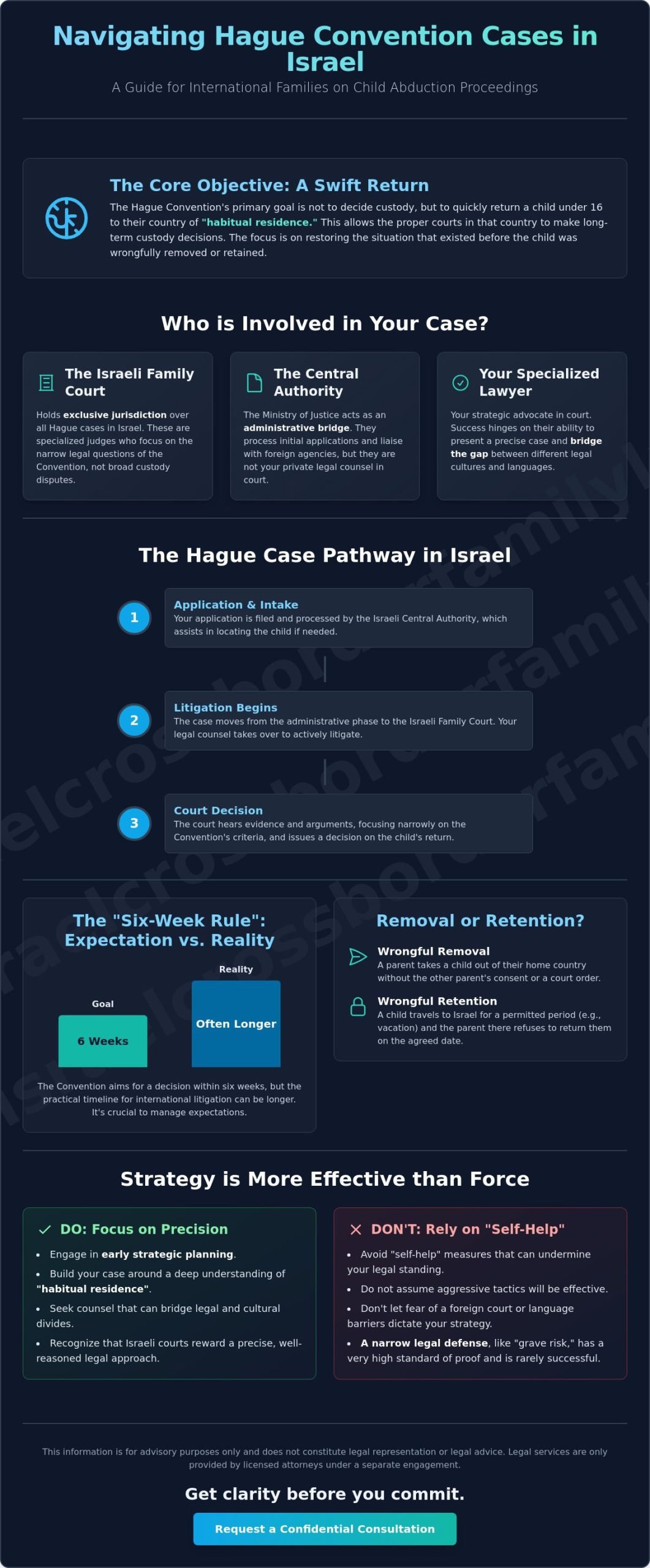
The 1980 Hague Convention on the Civil Aspects of International Child Abduction serves as the primary legal mechanism for returning a child who has been taken across international borders. Israel joined this treaty in 1991, committing its courts to a specialized process designed to restore the status quo. The core objective is simple; a child should be returned to their country of “habitual residence” so that the proper courts in that country can decide on custody matters. Under this framework, a left-behind parent has a fundamental right to request the immediate return of their child if their custody rights were being exercised at the time of the abduction. This treaty applies strictly to children under the age of 16. If a child reaches their 16th birthday during the proceedings, the Convention no longer governs the case. Finding a specialized lawyer for hague convention case in israel is vital because these cases move much faster than standard family law matters.
To better understand how these international protocols function within the Israeli legal system, watch this overview:
The Role of the Israeli Central Authority
Within Israel, the Department for International Affairs in the Ministry of Justice acts as the Central Authority. They serve as the official bridge between Israel and foreign agencies like the US State Department or the UK’s International Child Abduction and Contact Unit. Their primary responsibilities include:
- Administrative Processing: Handling the initial intake of Hague applications from abroad.
- Location Services: Assisting in locating the child if their whereabouts in Israel are unknown.
- International Liaison: Communicating with the foreign central authority to verify legal documents.
While the Central Authority handles the initial administrative paperwork, they don’t act as your private legal counsel in court. There’s a significant difference between filing an application with the government and actively litigating a case before a judge. You’ll need a strategy that moves you from the administrative phase into the courtroom effectively. For more details on these procedures, you can review our guide on the Hague Convention and child abduction.
Wrongful Removal vs. Wrongful Retention
Most cases fall into one of two categories. Wrongful removal occurs when a parent takes a child out of their home country without the other parent’s consent. Wrongful retention is often more subtle; it happens when a child travels to Israel for a permitted vacation or family visit, but the parent in Israel refuses to send the child back on the agreed date. Both scenarios trigger the Convention, but the evidence required for each can vary. Your initial filing must clearly define which occurred to ensure the court applies the correct legal tests from the start. Identifying the right lawyer for hague convention case in israel will help you categorize your claim accurately, avoiding delays that could impact the outcome.
This article is published on an independent advisory platform and is not a law firm. The content does not imply an attorney-client relationship.
This information is for advisory purposes only and does not constitute legal representation or legal advice. Legal services are only provided by licensed attorneys under a separate engagement.
The Israeli Family Court Process for Hague Cases
In Israel, Hague Convention cases follow a strictly civil path. They are heard exclusively in specialized Family Courts. Unlike many other personal status issues in the country, these matters do not fall under the jurisdiction of Rabbinical Courts. This distinction is critical for a lawyer for hague convention case in israel to manage from the outset. The court’s role is narrow and procedural. It’s vital to understand that the Israeli Family Court does not decide which parent should have permanent custody; its only task is to determine if the child must be returned to their home country.
Because of this jurisdictional focus, the evidence presented centers on residency patterns and existing custody rights rather than parental fitness. The treaty and Israeli regulations mandate a “swift” return process. By law, the first hearing should occur no later than 15 days after the claim is filed. The court is then required to issue a detailed decision within six weeks. While these deadlines are ambitious, they reflect the system’s commitment to preventing a child from becoming “settled” in a new environment through legal delay.
Procedural Timeline and Deadlines
Timing is a decisive factor in international child abduction cases. If a petition is filed more than one year after the abduction, the court may consider the “settled” exception. This allows a judge to refuse a return if it’s proven the child is now well-integrated into their new Israeli life. After the initial filing, the court holds a preliminary hearing to define the legal issues. This is followed by an evidentiary stage where the court may hear testimony, sometimes via video conference for parents abroad. If a party wishes to appeal, the timeline remains compressed; an appeal to the District Court must be filed within seven days of the judgment. To verify the administrative requirements for your specific country, you can consult the contact details for Israel’s Central Authority for the Hague Convention.
Language and Cultural Considerations
The Israeli legal system operates entirely in Hebrew. Every foreign document, from birth certificates to foreign court orders, must be professionally translated into Hebrew to be admissible. For those unfamiliar with the local landscape, the courtroom can feel alien and isolating. For expats and foreign nationals, the challenge is often the cultural disconnect between their home legal system and Israeli civil procedure. A successful strategy requires a bridge between these different legal worlds. If you are feeling uncertain about how these timelines or requirements apply to your family, it’s helpful to reach out for a brief advisory discussion to gain clarity before moving forward.
This article is published on an independent advisory platform and is not a law firm. The content does not imply an attorney-client relationship.
This information is for advisory purposes only and does not constitute legal representation or legal advice. Legal services are only provided by licensed attorneys under a separate engagement.
Qualities of an Effective Lawyer for Hague Convention Cases in Israel
Selecting a lawyer for hague convention case in israel requires looking beyond standard litigation skills. These cases are unique because they sit at the intersection of two different legal systems. You need a practitioner who understands the nuances of both Israeli law and the legal framework of your home country. A primary focus for any effective counsel is the “Habitual Residence” test. Israeli judges use this test to determine where a child’s life was truly centered before the move. This involves a deep analysis of schooling, social ties, and parental intentions. A calm, advisory approach is often more effective in these high-stakes matters than aggressive posturing. In the sensitive environment of an Israeli Family Court, a steady hand and a clear strategy build more credibility with a judge than loud arguments.
The Cross-Border Strategy Advantage
A successful outcome often depends on how well your Israeli counsel coordinates with your lawyer back home. This unified strategy is essential to prevent conflicting court orders in two different jurisdictions. Your representative must be well-versed in Hague Convention Child Abduction protocols globally, not just locally. This is particularly important in US-Israel cases, where the legal cultures and procedural expectations can vary widely. The official guidelines provided by Israel’s Central Authority for Hague Convention Cases highlight the importance of these international standards. A lawyer with a cross-border perspective can anticipate how a move in an Israeli court will affect your standing in your home jurisdiction, protecting your long-term parental rights.
Communication and Transparency
For international families, clear and jargon-free communication is a necessity, not a luxury. You shouldn’t have to struggle with complex Hebrew legal terms or poorly translated documents. Your counsel should provide explanations in plain English so you can make informed choices at every stage. Transparency regarding pricing and fee structures is also vital. International litigation involves significant costs, and you need a clear understanding of the financial commitment before you begin. In the first 48 hours of a case, strategy should always be prioritized over “winning at all costs.” A rushed decision can have permanent consequences. An effective expert will help you pause, assess the risks, and build a foundation based on facts and treaty law rather than impulse.
This article is published on an independent advisory platform and is not a law firm. The content does not imply an attorney-client relationship.
This information is for advisory purposes only and does not constitute legal representation or legal advice. Legal services are only provided by licensed attorneys under a separate engagement.
Common Challenges and Exceptions in Israeli Proceedings
The legal starting point in any abduction case is the presumption of return. Israeli courts are mandated to return a child to their country of habitual residence unless the taking parent can prove a specific exception exists under the treaty. These exceptions are high hurdles. Israeli judges interpret these defenses very narrowly to prevent the Convention from being undermined by tactical litigation. The most common defense is the “Grave Risk” exception. This requires proof that returning the child would expose them to physical or psychological harm or otherwise place them in an intolerable situation. Another exception involves the “Child’s Objection.” If a child has reached an appropriate age and degree of maturity, the court may take their views into account. However, there’s no fixed age for this; the judge must be convinced the child’s objection is independent and not the result of parental influence. Successfully navigating these defenses requires a lawyer for hague convention case in israel who can distinguish between genuine risks and mere preferences.
Proving Habitual Residence
The most complex part of many cases is determining where a child “actually” lived before they were moved. This isn’t always as simple as looking at a passport. Israeli courts look for the center of the child’s life. They examine school records, medical registrations, and social ties. They also consider the shared intent of the parents. This becomes difficult for families who have recently relocated or those who split their time between two countries. For example, if a family moved to Israel for a “trial year,” the court must decide if that move was intended to be permanent. A skilled lawyer for hague convention case in israel will gather objective evidence to prove that the child’s habitual residence remains in the home country. For more on how these residency issues impact your case, you can review our guidance on international custody and relocation.
The “Settled” Defense
Time is a critical factor in Hague litigation. If a parent waits more than 12 months from the date of the abduction to file their petition, the “Settled” defense may apply. In these instances, the court can refuse to return the child if it’s demonstrated that they are now well-integrated into their new environment in Israel. “Settled” status involves looking at the child’s stability, their language skills, and their local community connections. Early decisions are vital because every month of delay strengthens the argument that the child should stay. If you suspect your child has been wrongfully retained in Israel, you should request a confidential strategy session immediately to understand your options before the 12-month clock expires.
This article is published on an independent advisory platform and is not a law firm. The content does not imply an attorney-client relationship.
This information is for advisory purposes only and does not constitute legal representation or legal advice. Legal services are only provided by licensed attorneys under a separate engagement.
Taking Action: Strategy Before Commitment
When you discover your child has been taken to Israel without your consent, the impulse to act immediately can lead to tactical errors. Successful recovery depends on disciplined strategy rather than emotional reaction. It’s vital to avoid “self-help” measures, such as attempting to physically remove the child from Israel yourself. These actions can undermine your standing in court and may even be viewed as a separate legal violation under Israeli law. Instead, the first priority is securing a Confidential Case Review to assess the specific facts of your situation. A specialized lawyer for hague convention case in israel will help you build a timeline that clearly demonstrates wrongful removal or retention from the outset.
Preparation is the foundation of a successful Hague petition. As the left-behind parent, you should immediately begin gathering a comprehensive documentation package. This includes:
- Proof of Habitual Residence: School enrollment records, medical appointments, and records of extracurricular activities in the home country.
- Evidence of Custody Rights: Existing court orders or a summary of the local laws that grant you parental rights in your home jurisdiction.
- Travel Records: Copies of flight itineraries, text messages, or emails discussing the intended length of the child’s stay in Israel.
- Recent Photographs: Current images of the child to assist authorities if location services are required.
Initial Consultation and Assessment
During your first meeting with a lawyer for hague convention case in israel, focus on their specific experience with the Israeli Ministry of Justice. Ask how they coordinate with foreign counsel and what their typical timeline looks like for filing an initial claim. It’s also important to understand the distinction between an advisory role and formal legal representation. An advisor helps you map out the cross-border risks and strategy, while a litigator handles the specific filings in the Israeli Family Court. Beginning the process with a clear assessment allows you to move forward without escalating the conflict unnecessarily, which is often in the best interest of the child.
Next Steps for International Families
Once you have a strategy in place, you’ll need to coordinate with the Central Authority in your home country and the relevant departments in Israel. Maintaining a meticulous record of all communication with the taking parent is essential. Don’t stop communicating, but keep your exchanges professional, brief, and focused on the child’s well-being. These records can serve as vital evidence if the taking parent later claims you consented to the move. To gain clarity on your specific situation and the risks involved in your case, you’re invited to reach out for a confidential advisory discussion or send a message via WhatsApp.
Get clarity before you commit. Request a confidential consultation.
This article is published on an independent advisory platform and is not a law firm. The content does not imply an attorney-client relationship.
This information is for advisory purposes only and does not constitute legal representation or legal advice. Legal services are only provided by licensed attorneys under a separate engagement.
Securing Your Family’s Future Through Strategic Action
Navigating international child abduction requires more than just local legal knowledge. It demands a sophisticated understanding of how the Israeli Family Court interacts with global treaty standards. Success often hinges on the early determination of habitual residence and the ability to navigate narrow legal exceptions like grave risk. A steady, knowledgeable guide can help you manage these complexities while keeping the focus on your child’s swift return to their home country. Decisions made in the first 48 hours often dictate the trajectory of the entire case.
Finding the right lawyer for hague convention case in israel is the most significant choice you’ll make in this process. Our specialized focus on US-Israel family law and licensed expertise in cross-border jurisdictions provide the authoritative advisory international families need during these high-stakes disputes. You don’t have to face the Israeli legal system alone or without a clear plan. Take the time to gather your documentation and assess your risks before committing to a specific legal path.
Get clarity before you commit. Request a confidential consultation.
This article is published on an independent advisory platform and is not a law firm. The content does not imply an attorney-client relationship.
This information is for advisory purposes only and does not constitute legal representation or legal advice. Legal services are only provided by licensed attorneys under a separate engagement.
Frequently Asked Questions
Is the Hague Convention always enforced in Israel?
Israel is a dedicated signatory to the treaty, and its courts strictly enforce the obligation to return abducted children. While the judicial starting point is always the child’s immediate return to their home country, the law does allow for narrow exceptions. These include situations where a return would cause grave harm or if the child has become settled in Israel after a significant filing delay.
How long does a Hague Convention case take in the Israeli courts?
The Israeli legal system prioritizes these cases, aiming for a resolution within six weeks for the first instance decision. While the law mandates this rapid timeline, complex litigation involving international witnesses or extensive evidence can sometimes extend the process. Even with potential delays, these cases move significantly faster than standard family law disputes in Israel.
Can I file a Hague petition if we didn’t have a formal custody agreement?
Yes, you can file a petition even without a signed custody order. The Convention protects “rights of custody” that exist by operation of law in your child’s country of habitual residence. If you were exercising parental responsibilities and living with the child before the removal, you likely have the legal standing necessary to request a return.
What is the cost of hiring a Hague Convention lawyer in Israel?
Legal costs for international child abduction cases depend on the complexity of the cross-border strategy and the amount of evidence required. Engaging a specialized lawyer for hague convention case in israel involves expenses for litigation, professional Hebrew translations, and potential expert testimony. It’s best to request a clear breakdown of fee structures during your initial strategy session to understand the investment required.
Will the Israeli court listen to my child’s wishes?
Israeli judges have the discretion to consider a child’s objection if they’ve reached an appropriate age and maturity. There is no fixed age in the law for this determination; instead, the judge evaluates the child’s ability to form an independent opinion. The court often uses specialized professionals to ensure the child’s views are their own and not the result of parental influence.
What happens if the other parent claims I was abusive?
Claims of abuse are evaluated under the “Grave Risk” exception of the treaty. The parent who moved the child must prove that a return would expose the child to physical or psychological harm. Israeli courts interpret this exception narrowly and often consider whether the courts in the child’s home country are equipped to provide the necessary protection orders upon return.
Can I use the Hague Convention for a child over 16?
No, the Hague Convention ceases to apply the moment a child turns 16. If a child reaches this age during the legal proceedings, the court must dismiss the Hague petition. For children 16 and older, parents must seek alternative legal remedies under standard international custody laws or local Israeli civil statutes.
Do I need to travel to Israel for the court hearings?
You may not be required to travel to Israel for every stage of the litigation. Israeli Family Courts are increasingly flexible and often allow left-behind parents to provide testimony via video conference. However, your lawyer for hague convention case in israel may advise that your physical presence during the evidentiary stage could be beneficial for the overall strategy of your case.
Get clarity before you commit. Request a confidential consultation.

Article by
Gabriel Lior
A Personal Journey That Became a Mission
The advisory was founded by an American father Gabriel Lior, LLB, MBA , global entrepreneur, and cross-border advisor who spent more than a decade navigating the Israeli family court system firsthand and now lives in Singapore with his son.
As a divorced parent in a cross-border family, Gabriel faced nearly every legal challenge a foreign parent can encounter in Israel — including child custody disputes, child support proceedings, property matters in Israel and abroad, false accusations, and complex immigration and relocation proceedings.
Over the years, he learned the hard way how difficult it is for non-Israeli parents to understand the system, identify the right legal strategy, and choose the right legal representation — especially when language, culture, and jurisdictional differences are involved. He also witnessed how foreign parents and new immigrants are often disadvantaged or taken advantage of by service providers and institutions simply because they lack local knowledge or fluency.
From Client to Advisor
To truly understand — and survive — the system, Gabriel pursued formal legal education in Israel, completing two Israeli law degrees, alongside a BA and MBA earned in the United States. This was never about becoming a practicing attorney, but about gaining a deep, structural understanding of how the system works — and where it breaks down for foreign parents.
This rare combination of:
Firsthand client experience
Israeli legal and US business education
International business and negotiation training
Decades of commercial execution
created a unique perspective – one that understands both sides of the table.
After years of litigation, persistence, and at times self-representation, he ultimately succeeded in securing custody of his son and relocating abroad through a rare legal victory in the Israeli Supreme Court — becoming one of the first fathers in Israel to do so under these circumstances.
Disclaimer
Important Disclaimer:
The information provided on this website and in its content is for general informational and educational purposes only and does not constitute legal advice, legal opinion, or legal representation.
Gabriel Lior is not licensed to practice law in Israel (nor is he interested in doing so) and does not provide legal services, despite having completed 2 Law Degrees. The services offered are advisory in nature and are intended to provide general guidance, strategic insight, and information regarding cross-border family law considerations.
No attorney-client relationship is formed by accessing this website, reading its content, or communicating with us.
Any decisions made based on this information are at your own discretion and risk. For legal advice specific to your situation, you should consult a licensed attorney in the relevant jurisdiction.
Where appropriate, we may refer clients to independent, licensed attorneys or professionals. Such referrals do not constitute legal representation and no liability is assumed for services provided by third parties.