What if the specific court door you walk through first determines the legal trajectory of your family’s life for the next decade? For many international families, the discovery of a “race for jurisdiction” between civil Family Courts and religious Rabbinical courts is a source of significant anxiety. You likely feel that your children’s stability is your highest priority, yet the path to protecting that stability feels obscured by unfamiliar terminology and conflicting legal hierarchies. This article provides Israeli Child Custody Law Explained in a way that prioritizes strategic clarity over emotional stress.
By reading this guide, you’ll gain a clear understanding of the core principles governing parental rights in Israel, from the “Best Interests” standard to the nuances of the Tender Age Doctrine. We’ll examine how the system handles shared parenting and the significant risks involved in international relocation or potential abduction scenarios. Please note that this information is published on an independent advisory platform for educational purposes and isn’t a substitute for formal legal advice from a licensed attorney. Our goal is to provide the framework you need to make informed decisions for your family’s future in IL.
Key Takeaways
- Learn why the “race for jurisdiction” between Family and Rabbinical courts makes the timing of your initial filing a critical strategic decision.
- Understand the vital distinction between natural guardianship for major life choices and the day to day responsibilities of physical custody.
- Explore the core principles of Israeli Child Custody Law Explained, including how courts prioritize the child’s best interests in 2026.
- Identify the legal requirements for international relocation and the significant risks associated with moving children without formal court approval.
- Discover how mediation and the “Settlement of Dispute” process can provide a more stable, less confrontational path for families than traditional litigation.
Understanding the Israeli Custody Framework: Civil vs. Religious Courts
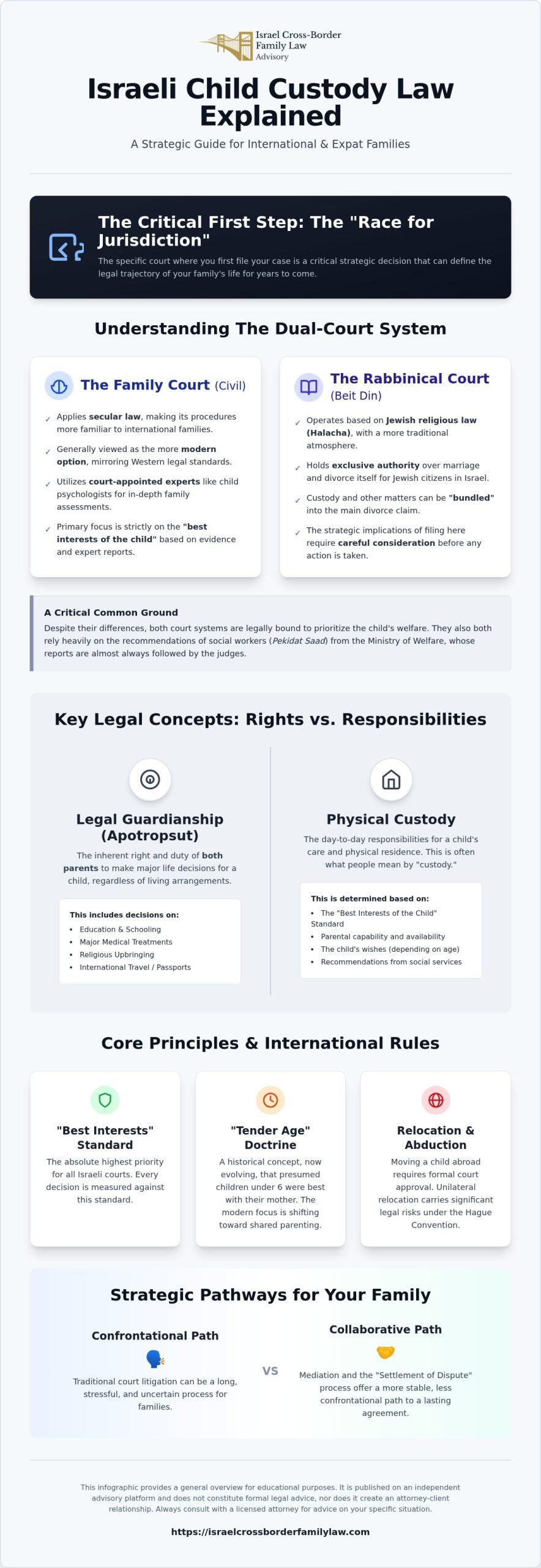
Israel’s legal landscape for families is unique because it operates under a dual-court system. You can have your case heard in either the civil Family Court or the religious Rabbinical Court (Beit Din). While both courts are legally bound to prioritize the child’s welfare, their procedural approaches and cultural perspectives vary significantly. This creates a situation often called the “race for jurisdiction.” If one parent files for divorce and includes custody in the Rabbinical Court before the other parent files in the Family Court, the Rabbinical Court usually gains authority over the matter.
Understanding how these systems interact is the first step toward achieving a stable outcome. When seeking to have Israeli Child Custody Law Explained, it’s vital to recognize that your choice of court can influence the long-term trajectory of your family’s life. Both systems rely heavily on reports from the Ministry of Welfare. Social workers, known as Pekidat Saad, conduct home visits and interviews to provide recommendations that the judges almost always follow. This content is published on an independent advisory platform, not a law firm, and focuses on helping you understand the risks and strategic frameworks involved in cross-border cases.
To better understand the rights of children within this complex system, watch this helpful video:
The Family Court System
The Family Court applies secular law and is generally viewed as the more modern option. It’s often preferred by international families because its procedures mirror Western legal standards more closely than the religious alternative. Proceedings here involve court-appointed experts, such as child psychologists, who conduct deep assessments of the family unit. The court’s primary lens is the “best interests of the child,” a standard that evolved from historical concepts like The “Tender Age Doctrine” to a more modern focus on shared parenting. You can learn more about how we support families on our expats and foreign nationals page.
The Rabbinical Court (Beit Din)
The Rabbinical Court operates based on Jewish religious law, or Halacha. For Jewish citizens in IL, the Rabbinical Court has exclusive authority over the marriage and divorce itself, but custody can be “bundled” into the divorce claim. Non-religious or foreign parents may find the atmosphere more traditional or culturally specific. It’s a common misconception that the Beit Din always favors one parent over another based on gender. However, the strategic implications of religious jurisdiction require careful thought before any papers are filed. This is why having Israeli Child Custody Law Explained through a strategic lens is so important; early decisions regarding which court hears your case will dictate the rules of the game for years to come.
Key Legal Concepts: Guardianship vs. Physical Custody
While our previous discussion focused on the procedural choice between civil and religious courts, understanding the specific legal rights at stake is equally vital. In many Western jurisdictions, “custody” is used as a broad term for all parental rights. However, under Israeli Child Custody Law Explained, the system distinguishes between your legal status as a decision-maker and the child’s physical residence. This content is provided by an independent advisory platform for informational purposes and isn’t formal legal representation.
Legal Guardianship (Apotropsut)
Guardianship is an inherent right and duty held by both parents, regardless of whether they are married or living together. It doesn’t depend on where the child sleeps at night. Instead, it covers the fundamental decisions that shape a child’s future. This includes choosing a school, authorizing medical treatments, and determining religious upbringing. In the IL legal system, both parents are considered natural guardians, meaning neither parent can unilaterally change these core aspects of the child’s life.
For international families, guardianship has immediate practical implications for travel. Because you’re a natural guardian, you generally cannot take a child out of the country for a vacation or a permanent move without the other parent’s explicit written consent or a court order. If parents reach a deadlock on a major decision, the court intervenes to break the tie, often relying on the social worker recommendations mentioned in Section 1. If you find yourself facing a disagreement over these fundamental rights, it may be helpful to speak with a professional advisor to explore your strategic options.
Physical Care and Visitation
Physical custody, often called “Care and Control,” determines the child’s primary residence and daily routine. While guardianship is almost always shared, physical care is structured based on the family’s specific geography and needs. The IL system is currently shifting away from the term “custody” in favor of “Parental Responsibility,” emphasizing a parent’s duties over their “ownership” of the child’s time.
- Primary Care: The child resides primarily with one parent, while the other has defined visitation periods, including stay-over arrangements.
- Joint Physical Care (Mishmoret Meshutefet): In 2026, this is becoming the standard starting point. It involves a balanced split of time, often close to 50/50, provided the parents live in close proximity.
- The Impact of Distance: For expats living in different cities, such as Tel Aviv and Haifa, a 50/50 split is often physically impossible due to school commutes.
The courts prioritize a stable routine that minimizes disruption. Early decisions regarding where you choose to live post-separation can have long-term legal consequences for your visitation schedule. It’s essential to understand these definitions before committing to a new residence or signing a temporary agreement, as the status quo often becomes the permanent legal standard.
The “Best Interests” Standard and the Tender Age Doctrine
The ultimate benchmark for every custody decision in Israel is the “Best Interests of the Child.” While earlier sections discussed the procedural choice between courts, the actual outcome of your case depends on how a judge interprets this standard. This content is published on an independent advisory platform for strategic guidance and doesn’t constitute formal legal representation or an attorney-client relationship. Our focus is helping you understand the complex criteria used to evaluate parental fitness in a cross-border context.
In the IL legal system, the “Best Interests” standard is not a rigid formula. It’s a holistic assessment of the child’s physical, emotional, and developmental needs. Judges rely heavily on the professional opinions of social workers and court-appointed psychologists to determine which arrangement provides the most stability. Having Israeli Child Custody Law Explained through this lens helps parents prepare for the high level of scrutiny involved in these evaluations.
Evaluating the Child’s Best Interests
The court examines several specific factors when determining what serves a child’s welfare. Psychological stability and continuity of care are paramount. If a child has spent their entire life in one environment, the court is often reluctant to authorize a sudden or drastic change. Other key factors include:
- Parental Cooperation: The court assesses the ability of each parent to foster a healthy, ongoing relationship with the other parent.
- The Child’s Voice: Depending on their age and maturity, the court may hear the child’s own wishes, though these are never the sole deciding factor.
- Primary Caregiver History: The system looks at who has historically managed the child’s daily needs, school life, and medical care.
Navigating the Tender Age Presumption
A central, and often misunderstood, part of Israeli Child Custody Law Explained is the Tender Age Doctrine. This legal presumption, found in the 1962 Legal Capacity and Guardianship Law, suggests that custody of children under the age of six should remain with the mother. However, the application of this doctrine has shifted significantly by 2026. While the law hasn’t been formally abolished, courts no longer apply it as an automatic rule.
The modern trend in IL is a strong move toward joint parental responsibility and shared physical care, even for very young children. To rebut the tender age presumption, the other parent must demonstrate that a different arrangement, such as equal parenting time, is more aligned with the child’s specific needs. This shift reflects a broader judicial recognition that active involvement from both parents is usually the most beneficial path. Because early decisions regarding residence and care can set a long-term legal precedent, it’s vital to develop a clear strategy before entering the “Settlement of Dispute” phase.
International Relocation and the Hague Convention
For international families, the most complex aspect of Israeli Child Custody Law Explained is the legal framework surrounding relocation. In a US-Israel context, relocation isn’t just a change of address; it’s a fundamental shift in the child’s life that often severs regular contact with one parent. Under IL law, you cannot move a child’s residence out of the country without the explicit written consent of the other guardian or a formal court order. This content is published on an independent advisory platform and focuses on strategic guidance rather than formal legal representation.
The system treats unauthorized moves with extreme seriousness. If a parent attempts to leave the country with a child without permission, they may face immediate legal consequences under international treaties. To prevent such scenarios, parents often seek a “Stay of Exit” order, known in Hebrew as a Tzav Ikur Yetzia. This order prevents the child from clearing border control until the court resolves the underlying custody or relocation dispute.
Applying for Relocation
A parent wishing to move abroad with their children carries a heavy burden of proof. The court doesn’t just look at the parent’s career opportunities or personal desires; it focuses entirely on the child’s welfare. You’ll need to present a comprehensive “Life Plan” for the destination country. This plan should detail schooling, healthcare, and a concrete strategy for maintaining the child’s relationship with the parent staying in Israel. Courts evaluate how the move will impact the child’s psychological stability and whether the relocating parent will truly facilitate long-distance visitation. Because these cases are often “all or nothing,” early strategic planning is essential. You can learn more about the risks involved on our international custody and relocation page.
The Hague Convention in Israel
Israel is a signatory to the Hague Convention on the Civil Aspects of International Child Abduction, a critical component of how Israeli Child Custody Law Explained functions in a global context. This treaty governs “wrongful removal” (taking a child across a border without consent) and “wrongful retention” (failing to return a child after a permitted trip). Hague cases are handled on an expedited basis, often reaching a conclusion within weeks. The court’s primary goal is to return the child to their “habitual residence” so the local courts there can decide on custody.
Defenses against a return order, such as a “grave risk of harm,” have an incredibly high threshold in IL courts. The system is designed to discourage parents from taking the law into their own hands. If you’re concerned about a potential abduction or need to understand your rights regarding a move, it’s vital to request a confidential case review before the situation escalates. For more information on these specific legal protections, see our guide on the Hague Convention and child abduction.
Strategic Planning: Protecting Your Parental Rights
Strategic planning is the bridge between the uncertainty of a family crisis and a stable future for your children. When seeking to have Israeli Child Custody Law Explained, it’s clear that the system rewards those who prioritize clarity over conflict. This content is published on an independent advisory platform, not a law firm, and focuses on helping you understand the strategic risks inherent in cross-border cases. Our goal is to provide a framework for informed decision-making before you enter a formal legal battle.
One of the most significant differences between the US and IL systems is the weight given to early, seemingly small decisions. Where you choose to live immediately after a separation or how you manage international travel in the short term can set a legal precedent that’s difficult to reverse. For more visual guidance on these dynamics, you can explore the resources on the Israel Family Law YouTube channel.
The Mandatory Dispute Resolution Process
Since 2016, the IL legal system has required a “Settlement of Dispute” phase before parents can proceed to litigation. This process begins with a simple application and a mandatory fee of 119 NIS. Instead of heading straight to a judge, you’ll attend “Mahut” meetings with social workers from the court’s assistance unit. These professionals aren’t there to decide your case; they’re there to evaluate whether you can reach an agreement without a protracted court battle.
It’s vital to use this period for strategic reflection rather than escalation. While the litigation “stay” is in effect, you have the opportunity to build a support network of cross-border experts who understand both the US and Israeli legal landscapes. Understanding how the advisory process works during this phase can help you avoid the common pitfalls of the dual-court hierarchy discussed earlier in this guide.
Next Steps for International Parents
Protecting your rights as an expat or foreign national requires meticulous preparation. You should begin gathering documentation from both jurisdictions, including school records, medical history, and evidence of your historical role as a primary caregiver. Continuity of care is a primary factor in the “Best Interests” standard, and having this data ready is essential.
You must also be cautious about actions that the court might interpret as a “flight risk.” Quitting a job, selling significant assets, or making unilateral changes to a child’s routine can signal to a judge that you intend to relocate without consent. Such signals can trigger “Stay of Exit” orders that restrict your ability to travel. Before taking any steps that could impact your standing, it’s prudent to request a confidential case review to understand your specific risks. Get clarity before you commit.
Securing Your Family’s Future in Israel
The transition through a custody dispute is undeniably complex, particularly when your family’s life spans two different legal cultures. By now, you’ve seen how the dual-court hierarchy and the specific nuances of natural guardianship create a unique landscape for parental rights in Israel. With Israeli Child Custody Law Explained through this strategic lens, you can move away from the anxiety of the unknown and toward a framework that prioritizes your children’s stability.
Success in these matters often depends on your ability to coordinate multi-jurisdictional issues before they escalate into litigation. Whether you’re navigating the “best interests” standard or addressing the risks of international relocation, early-stage planning remains your most powerful tool. Our advisory-first approach is built on decades of experience with US-Israel legal matters, serving as a bridge between divergent systems. Please remember that this content is published on an independent advisory platform and isn’t a substitute for formal legal representation.
Get clarity before you commit. Request a confidential consultation to discuss your strategic options. You don’t have to face these cross-border challenges alone.
Frequently Asked Questions
This content is published on an independent advisory platform, not a law firm. It’s provided for informational and educational purposes and doesn’t constitute formal legal representation or an attorney-client relationship. For specific legal guidance, you should consult with a licensed attorney.
Does the mother always get custody of young children in Israel?
No, the Tender Age Doctrine is no longer an automatic rule in 2026. While historical presumptions favored mothers for children under six, modern Israeli Child Custody Law Explained through recent court rulings shows a strong shift toward shared parenting. Judges now prioritize a case-by-case analysis of the child’s best interests. They’re increasingly open to joint custody arrangements if both parents demonstrate they can provide a stable, supportive environment for the child.
Can I take my child to the US for a vacation during a custody dispute?
You generally cannot take a child out of Israel without the other parent’s written consent or a court order while a dispute is active. Doing so without permission can be viewed as “wrongful removal” under the Hague Convention. Parents often request “Stay of Exit” orders, known as Tzav Ikur Yetzia, as a preventative measure. These orders ensure children remain in the country until the court reaches a final decision on the matter.
What is the difference between joint custody and shared guardianship?
Joint custody refers to the physical care and residence of the child, whereas shared guardianship, or Apotropsut, involves the right to make major life decisions. In Israel, both parents are natural guardians by law. This means they must agree on education, medical care, and religious upbringing. Joint custody specifically addresses the day to day schedule and ensures the child spends significant, often equal, time living in both households throughout the week.
How does child support work if we have joint custody in Israel?
Child support calculations in IL consider the income of both parents and the time spent with each child. In cases of joint custody with equal parenting time, the financial obligation may be reduced for the higher earning parent, but it isn’t automatically canceled. The court aims to ensure the child’s standard of living remains consistent in both homes. This calculation accounts for the direct expenses each parent covers during their respective time with the child.
Can an Israeli custody order be enforced in the United States?
Yes, Israeli custody orders are generally enforceable in the US through international treaties and the principle of comity. However, you’ll likely need to domesticate the order in a US state court to ensure local authorities can act on it. Having the Israeli Child Custody Law Explained clearly within the original judgment is vital for US judges to understand the jurisdictional basis. This process requires careful strategic coordination between legal experts in both countries.
What happens if one parent wants to move back to their home country?
A parent wishing to relocate must either obtain the other parent’s consent or win a relocation claim in court. These cases are difficult to win because the moving parent must prove the move is in the child’s absolute best interests. The court will evaluate a detailed Life Plan and consider how the child will maintain a meaningful relationship with the parent staying behind in Israel. Early strategic planning is essential before filing such a claim.
How long does a typical custody case take in the Israeli Family Court?
A standard custody case can take anywhere from several months to over a year, depending on the complexity of the family’s situation. The process begins with a mandatory Settlement of Dispute period which lasts about 45 to 60 days. If mediation fails, the litigation phase involves home visits by social workers and psychological evaluations. These steps naturally extend the timeline as the court gathers the necessary expert recommendations to make an informed decision.
Do children have a say in which parent they live with in Israel?
Children do have a voice in the process, but they don’t make the final decision. Judges and social workers may interview children to understand their wishes, usually starting around age 10 to 12. Younger children may also be heard if they show sufficient maturity. The court weighs these wishes against other factors, such as the child’s psychological stability and long term welfare, to determine the arrangement that best serves their interests.

Article by
Gabriel Lior
A Personal Journey That Became a Mission
The advisory was founded by an American father Gabriel Lior, LLB, MBA , global entrepreneur, and cross-border advisor who spent more than a decade navigating the Israeli family court system firsthand and now lives in Singapore with his son.
As a divorced parent in a cross-border family, Gabriel faced nearly every legal challenge a foreign parent can encounter in Israel — including child custody disputes, child support proceedings, property matters in Israel and abroad, false accusations, and complex immigration and relocation proceedings.
Over the years, he learned the hard way how difficult it is for non-Israeli parents to understand the system, identify the right legal strategy, and choose the right legal representation — especially when language, culture, and jurisdictional differences are involved. He also witnessed how foreign parents and new immigrants are often disadvantaged or taken advantage of by service providers and institutions simply because they lack local knowledge or fluency.
From Client to Advisor
To truly understand — and survive — the system, Gabriel pursued formal legal education in Israel, completing two Israeli law degrees, alongside a BA and MBA earned in the United States. This was never about becoming a practicing attorney, but about gaining a deep, structural understanding of how the system works — and where it breaks down for foreign parents.
This rare combination of:
Firsthand client experience
Israeli legal and US business education
International business and negotiation training
Decades of commercial execution
created a unique perspective – one that understands both sides of the table.
After years of litigation, persistence, and at times self-representation, he ultimately succeeded in securing custody of his son and relocating abroad through a rare legal victory in the Israeli Supreme Court — becoming one of the first fathers in Israel to do so under these circumstances.
Disclaimer
Important Disclaimer:
The information provided on this website and in its content is for general informational and educational purposes only and does not constitute legal advice, legal opinion, or legal representation.
Gabriel Lior is not licensed to practice law in Israel (nor is he interested in doing so) and does not provide legal services, despite having completed 2 Law Degrees. The services offered are advisory in nature and are intended to provide general guidance, strategic insight, and information regarding cross-border family law considerations.
No attorney-client relationship is formed by accessing this website, reading its content, or communicating with us.
Any decisions made based on this information are at your own discretion and risk. For legal advice specific to your situation, you should consult a licensed attorney in the relevant jurisdiction.
Where appropriate, we may refer clients to independent, licensed attorneys or professionals. Such referrals do not constitute legal representation and no liability is assumed for services provided by third parties.