
This article is published on an independent advisory platform, not a law firm, and does not imply an attorney-client relationship. Legal services are only provided by licensed attorneys under a separate engagement.
What if the most critical factor in your financial future isn’t the percentage of assets you agree upon, but the specific country where that agreement is signed? When you’re negotiating a divorce settlement from different countries, the legal landscape changes based on who files first and where. You likely feel the weight of conflicting laws between Israel and the US, or the stress of managing high-stakes conversations across eight time zones. It’s common to worry that a lack of local knowledge could lead to a settlement that is unenforceable or strategically weak.
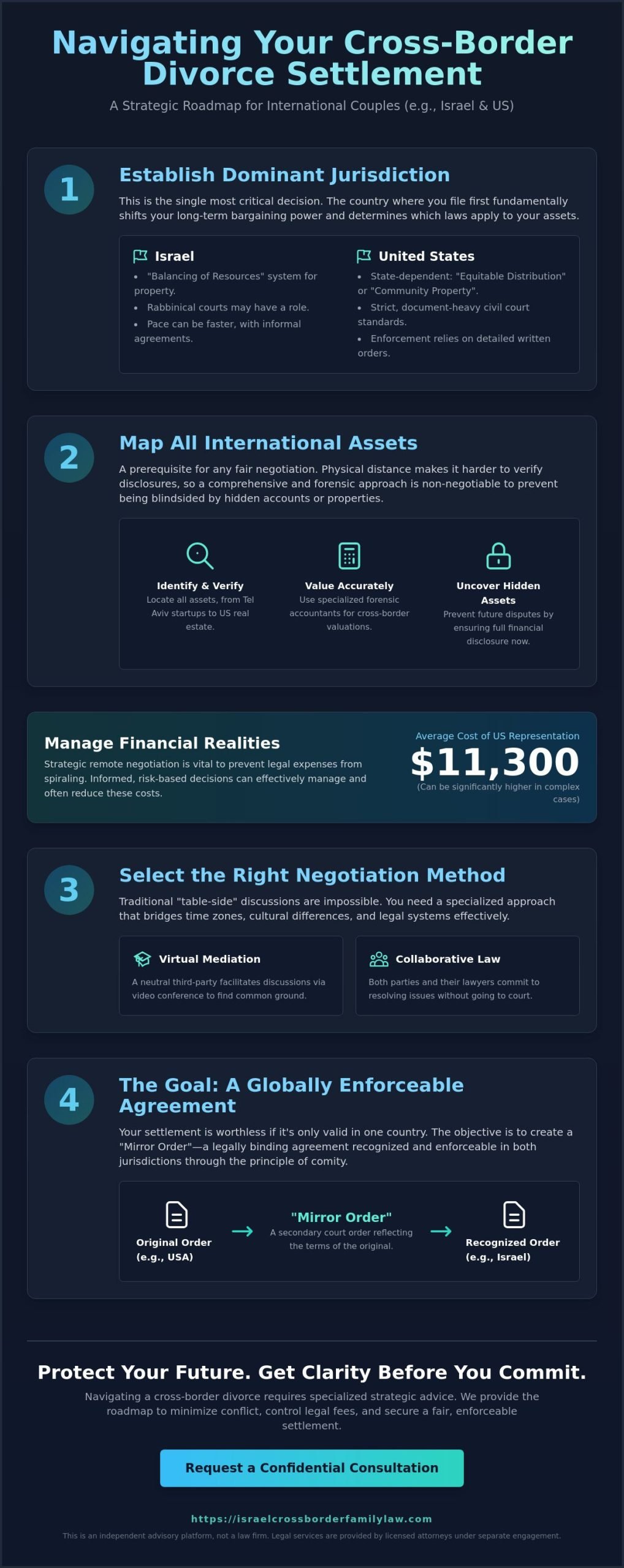
We’ll show you how to navigate these tactical complexities to reach an agreement that protects your interests in both jurisdictions. You’ll gain clarity on how to leverage the principle of comity and manage the average $11,300 cost of US representation effectively. This guide provides a roadmap for minimizing conflict and legal fees through informed, risk-based decision-making. Get clarity before you commit. Request a confidential consultation.
This article is published on an independent advisory platform, not a law firm, and does not imply an attorney-client relationship. Legal services are only provided by licensed attorneys under a separate engagement.
Key Takeaways
- Understand why establishing the dominant jurisdiction is a prerequisite for any successful negotiation strategy.
- Learn how negotiating a divorce settlement from different countries requires a specialized approach to virtual mediation and cross-border collaborative law.
- Explore the critical steps for mapping assets across international borders to ensure your agreement remains legally binding in both jurisdictions.
- Recognize how tactical decisions, such as filing first in Israel or the US, can fundamentally shift your long-term bargaining power.
This article is published on an independent advisory platform, not a law firm, and does not imply an attorney-client relationship. Legal services are only provided by licensed attorneys under a separate engagement.
Understanding Remote Divorce Negotiation Across Borders
Remote divorce negotiation is the process of reaching a financial and custodial agreement when spouses reside in separate legal jurisdictions, such as Israel and the United States. This isn’t a traditional “table-side” discussion held in a single conference room. It’s a complex interaction between two distinct legal systems. Success in these cases depends on a firm grasp of international matrimonial law to ensure every clause holds weight in both locations. Without this foundation, you risk signing an agreement that is valid in one country but completely unenforceable in the other.
When you’re negotiating a divorce settlement from different countries, you face unique hurdles in communication and trust. Physical distance often slows the pace of financial discovery. It makes it harder to verify asset disclosures or value property accurately. Considering the median cost of a US divorce with representation reached $7,000 as of 2026, strategic remote negotiation is vital to prevent expenses from spiraling. The primary goal is often the creation of a “Mirror Order,” which is a secondary court order issued in one country that reflects the terms of the original agreement from the other. This ensures your settlement is recognized and enforceable globally through the principle of comity.
To better understand how to structure these proposals effectively, watch this helpful video:
The Complexity of Multi-Jurisdictional Assets
Israel and various US states treat marital property through different lenses. You might encounter “equitable distribution” in New York or “community property” in California, which contrasts with the Israeli “balancing of resources” system. Valuing a high-tech startup in Tel Aviv from a home office in London requires specialized forensic accounting. Identifying “hidden” assets becomes more difficult across borders. Comprehensive asset mapping is a prerequisite for any offer. This step prevents you from being blindsided by undisclosed accounts or real estate holdings during the final stages of negotiation.
Cultural and Legal Clashes in Settlement Expectations
The “Start-up Nation” pace often prioritizes speed and informal agreements. This can clash with the rigid, document-heavy requirements of US corporate legal standards. Different legal “defaults” also influence a spouse’s bottom line. For instance, the role of the Rabbinical courts in Israel regarding alimony can differ significantly from civil court standards in the US. Bilingual and bicultural support is essential to bridge these communication gaps. It ensures that both parties understand the nuances of the legal language being used, which reduces the risk of conflict. For further guidance on these dynamics, explore our resources on divorce and separation for international families.
Get clarity before you commit. Request a confidential consultation.
This article is published on an independent advisory platform, not a law firm, and does not imply an attorney-client relationship. Legal services are only provided by licensed attorneys under a separate engagement.
Jurisdictional Strategy: The Foundation of Your Settlement
Before you exchange a single financial spreadsheet, you must establish which court holds the primary authority over your case. Determining the “Home State” or dominant jurisdiction is the most consequential step in negotiating a divorce settlement from different countries. Without this clarity, any offer you make exists in a legal vacuum. If you negotiate based on US standards while your spouse intends to file in Israel, you may inadvertently waive rights or concede assets that the Israeli system would have protected. You must know which legal “default” applies before you can effectively compromise.
The “Race to the Courthouse,” known in Israel as Meroz Samchuyot, is a unique tactical reality that many international families overlook. In Israel, jurisdiction is often granted to the court where the first valid claim is filed. This could be the civil Family Court or the religious Rabbinical Court. Filing first allows you to choose the forum that best aligns with your strategic goals. For example, the Rabbinical Court may handle matters of “binding” alimony differently than a US civil court. A tactical filing secures your leverage if negotiations stall, preventing your spouse from choosing a jurisdiction that puts you at a disadvantage. Get clarity before you commit. You may wish to speak with a professional advisor to evaluate your jurisdictional leverage.
Sometimes, a strategic pause in negotiations is necessary to secure jurisdiction, while in other cases, a “Stay of Proceedings” may be requested. This occurs when one court pauses its activities because a case is already active in another country. This legal maneuver prevents conflicting orders but can significantly delay remote talks. Navigating these timelines requires a sophisticated understanding of how Israeli courts interact with foreign systems. Decisions made in the first 30 days of a separation often dictate the financial outcome for the next decade.
Israel’s Dual Court System: Civil vs. Rabbinical
The Rabbinical Court (Beth Din) holds exclusive jurisdiction over the act of divorce for Jewish couples in Israel. Even for secular US citizens, the Beth Din’s influence over the final settlement can be substantial if financial matters are “attached” to the divorce claim. Understanding these religious legal frameworks is essential for any Anglo expat. The U.S. State Department on divorce abroad notes that while the US generally recognizes foreign divorces, the specific procedures followed in religious courts can impact how a US state court views the final decree. This bicultural reality is a core component of cross-border strategy.
International Treaties and the Hague Convention
When children are involved, jurisdictional strategy must account for the 1980 Hague Convention. This treaty governs where custody disputes are heard, typically focusing on the child’s “habitual residence.” Negotiating relocation or visitation from abroad requires a deep understanding of these protocols to avoid accidental violations. You can learn more about these complexities in our guide to international custody and relocation. Ensuring your settlement respects both Israeli law and international reciprocity is the only way to achieve a truly enforceable agreement that stands up in both countries.
This article is published on an independent advisory platform, not a law firm, and does not imply an attorney-client relationship. Legal services are only provided by licensed attorneys under a separate engagement.
Methods for Negotiating from Different Countries
Moving from jurisdictional strategy to active negotiation requires choosing a method that accounts for both physical distance and the specific legal requirements of both countries. When you’re negotiating a divorce settlement from different countries, you aren’t just discussing terms; you’re building a framework that must survive scrutiny in two distinct courtrooms. The process is often more structured than local negotiations, as it relies on bicultural advisors to bridge the gap between Israeli and US legal expectations.
Virtual mediation has become a standard tool for international families, utilizing secure video platforms to host three-way or four-way meetings. In a collaborative law model, spouses build a team of cross-border experts, including lawyers, forensic accountants, and therapists, who work toward a settlement without litigation. However, in high-conflict cases or where a significant power imbalance exists, attorney-led negotiation is often the safer path. This “lawyer-to-lawyer” communication ensures that every proposal is vetted for jurisdictional risks before it reaches the other spouse. This layer of protection is vital when dealing with complex assets like Israeli pension funds or US-based 401(k) accounts.
The “Four-Way” virtual meeting serves as the cornerstone of this process. These sessions require strict ground rules to remain productive. Participants must agree on the platform used, ensure the absence of unauthorized recording, and confirm the presence of bilingual professionals who can explain how a specific term might be interpreted in Israel versus the US. This structure prevents the confusion that often arises when legal concepts don’t have a direct equivalent in the other language.
The Role of Technology in Remote Settlements
Sharing sensitive financial data across borders requires more than simple email attachments. Secure document portals are essential for managing discovery while protecting privacy. While digital signatures have gained wider acceptance, their legal validity in cross-border agreements depends on specific procedural steps in both Israel and the US. For instance, the Israeli Electronic Signature Law of 2001 provides a framework, but the document must still meet the requirements for a “Mirror Order” to be enforceable abroad. You can learn more about how we facilitate this process through our advisory model.
Managing Time Zones and Communication Fatigue
The seven to ten-hour time difference between Israel and the US creates a unique logistical challenge. A 10:00 AM meeting in New York is 5:00 PM in Jerusalem, which can lead to fatigue and poor decision-making during late-night or early-morning sessions. Establishing a formal “Negotiation Calendar” helps manage expectations and prevents the stress of constant, unscheduled communication. It’s critical to avoid “WhatsApp negotiations.” While convenient, these informal exchanges lack legal nuance and can create unintended, binding commitments. For a broader perspective on these logistical factors, consult a guide to international divorce. We also recommend watching the instructional videos on the IsraelFamilyLaw YouTube channel for practical tips on managing remote communication.
Get clarity before you commit. Request a confidential consultation.
This article is published on an independent advisory platform, not a law firm, and does not imply an attorney-client relationship. Legal services are only provided by licensed attorneys under a separate engagement.
5 Steps to a Successful Cross-Border Settlement
Achieving a durable agreement while negotiating a divorce settlement from different countries requires a move from abstract strategy to a disciplined, multi-step process. Each phase must be completed with an eye toward how the final document will be viewed by a judge in both Israel and the US. Failure to follow a structured path often leads to “settlement fatigue,” where parties agree to terms that later prove impossible to enforce across borders.
- Step 1: Conduct a Comprehensive Asset Mapping. You must identify all global wealth, including real estate, business interests, and retirement accounts in both jurisdictions.
- Step 2: Secure Jurisdictional Advice. Establish your “Plan B” by understanding exactly what a court would likely order if negotiations fail. This provides a baseline for a fair compromise.
- Step 3: Choose your Negotiation Forum. Decide whether virtual mediation or attorney-led negotiation is most appropriate for your specific conflict level and asset complexity.
- Step 4: Draft the “Mirror Agreement.” This involves creating a document that meets the technical legal requirements of both countries to ensure multi-country validity.
- Step 5: Execute and Validate. The final settlement must be formally approved by the Israeli Family Court and domesticated in the relevant US court to become legally binding.
Mapping Global Wealth and Liabilities
Disclosing assets across different systems is rarely straightforward. In Israel, you may have a Keren Hishtalmut (study fund) or specific pension arrangements that don’t have a direct equivalent in the US. Conversely, a US-based 401(k) or IRA requires specific valuation methods to be recognized by an Israeli court. You must also account for the tax liabilities associated with transferring large sums of money between countries. An agreement that looks fair on paper can become lopsided once capital gains taxes or international transfer fees are applied. For more details on these dynamics, see our guide on divorce and separation for international families.
Drafting for Enforceability
Enforceability is the most common point of failure in remote settlements. A standard US settlement agreement might be rejected by an Israeli court if it lacks specific language required by the 1973 Financial Relations Between Spouses Law. Similarly, Israeli orders regarding “stay of exit” or child support must be carefully translated into terms a US judge can domesticate. Your agreement should include a “Choice of Law” clause to decide which country’s law governs future disputes. This prevents “forum shopping” if one party moves to a third country later. If you are ready to begin this process, you should request a strategic consultation to review your specific asset structure.
Get clarity before you commit. Request a confidential consultation.
This article is published on an independent advisory platform, not a law firm, and does not imply an attorney-client relationship. Legal services are only provided by licensed attorneys under a separate engagement.
Managing Risks and Next Steps in Your Negotiation
Negotiating a divorce settlement from different countries involves a high degree of procedural risk that extends beyond the initial agreement. One of the most significant threats is “forum shopping.” This occurs when a spouse attempts to move the legal proceedings to a country with more favorable laws after negotiations have already begun. To protect yourself, you must ensure your initial agreement includes a clear choice of forum clause. This prevents one party from suddenly filing in a US state with high filing fees, such as California’s $435 fee, or in a jurisdiction that doesn’t respect the principle of comity. Recent 2025 and 2026 court cases demonstrate that judges will scrutinize foreign judgments for due process before granting recognition. If your spouse resides in the UK, they may face a £612 filing fee as of April 2025, which adds another layer of financial consideration to the choice of jurisdiction.
Early decisions regarding child relocation can also derail financial settlements. If you agree to a specific child support amount without considering a future move from Israel to the US, the costs of travel and the change in the cost of living can make the original agreement unsustainable. Financial and custodial negotiations must remain linked to avoid future litigation. Once a deal is reached, it isn’t enough to sign a contract. In Israel, the settlement must be “Judiciously Confirmed” by the Family Court or Rabbinical Court. This process involves a judge reviewing the document to ensure both parties understand the terms and that the agreement serves the best interests of any children involved.
Common Pitfalls in Remote Negotiations
Many international families overlook the impact of currency exchange rate fluctuations on long-term support. A monthly payment set in Israeli Shekels (ILS) may lose significant value against the US Dollar (USD) over a five-year period, affecting the recipient’s purchasing power. It’s also vital to account for dual tax filing requirements. The US and Israel have different reporting standards for asset transfers and alimony, which can lead to unexpected liabilities if not addressed in the settlement. For Jewish couples, overlooking the need for a “Get” (religious divorce) can lead to significant legal and personal complications later. The settlement should clearly outline the timeline and conditions for the delivery of the Get to ensure total closure.
How an Advisory Strategy Provides Clarity
The transition from emotional reaction to a risk-based strategy is the most effective way to protect your future. An independent advisory platform helps international families move past the logistical stress of time zones and conflicting laws. By conducting a Confidential Case Review, you can identify hidden jurisdictional advantages before you make your first offer. This approach ensures that your settlement is not just a compromise, but a strategic document that is enforceable in both Israel and the US. Get clarity before you commit. Request a confidential consultation.
This article is published on an independent advisory platform, not a law firm, and does not imply an attorney-client relationship. Legal services are only provided by licensed attorneys under a separate engagement.
Securing Your Global Financial Future
Successful resolution of an international marriage depends on moving from emotional reaction to a risk-based strategy. You’ve learned that negotiating a divorce settlement from different countries requires more than just a division of assets; it demands a sophisticated understanding of how Israeli and US legal systems interact. By establishing jurisdictional leverage early and drafting for dual-country enforceability through “Mirror Orders,” you protect your interests against future “forum shopping” or compliance issues. Our specialized expertise in Israel-US cross-border law provides the “team on the ground” perspective needed to bridge these complex legal cultures.
A strategy-first approach ensures that your final agreement is not just a compromise, but a durable, legally binding framework. This clarity allows international families to move forward with confidence, knowing their settlement respects the nuances of both jurisdictions. Get clarity before you commit. Request a confidential consultation to begin your strategic review. You have the tools to navigate this transition with certainty and strength.
This article is published on an independent advisory platform, not a law firm, and does not imply an attorney-client relationship. Legal services are only provided by licensed attorneys under a separate engagement.
Frequently Asked Questions
Can I negotiate a divorce settlement if I am in the US and my spouse is in Israel?
Yes, you can effectively reach an agreement through virtual platforms and bicultural advisors. Negotiating a divorce settlement from different countries requires a coordinated strategy that accounts for the 7 to 10 hour time difference and the specific filing requirements in both Israel and the US. Successful outcomes often rely on early asset mapping to ensure all global holdings are disclosed before the first offer is made.
Is a remote divorce settlement legally binding in both countries?
A remote settlement is legally binding only after it is judiciously confirmed by an Israeli court and domesticated in the relevant US state. This process ensures the agreement meets the 1973 Financial Relations Between Spouses Law in Israel and the principle of comity in the US. Without these formal steps, your agreement remains a private contract that may not be enforceable if one party fails to comply with the terms.
What happens if we can’t agree on which country’s law should apply?
If you cannot agree, the court that first receives a valid filing will typically determine which law applies to the case. This is why the “Race to the Court” is a critical factor in cross-border strategy. You can resolve this conflict during negotiations by including a specific “Choice of Law” clause. This clause defines which country’s legal standards will govern the division of assets and any future disputes.
How do we handle child custody negotiations from different countries?
Child custody negotiations are primarily governed by the 1980 Hague Convention, which focuses on the child’s “habitual residence.” Agreements must include detailed visitation schedules and travel protocols that respect the laws of both jurisdictions. Clear provisions regarding “stay of exit” orders are essential to prevent legal complications when children travel between Israel and the US. Get clarity before you commit. Request a confidential consultation.
Do I need a lawyer in both Israel and the US for a cross-border settlement?
You generally require legal expertise in both jurisdictions to ensure the settlement is enforceable globally. While one primary advisor can lead the strategy, local attorneys must review the document to confirm it meets specific state or religious court requirements. This collaborative approach prevents a situation where a US judge rejects an Israeli order due to a lack of due process or improper service of documents.
How are assets like pensions and real estate divided in an international divorce?
Assets are divided based on the dominant jurisdiction’s laws, such as “equitable distribution” or the Israeli “balancing of resources” system. Israeli study funds (Keren Hishtalmut) and US 401(k) plans require specialized forensic valuation to ensure a fair trade. You must also account for the tax implications of transferring funds across borders, as capital gains rules differ significantly between the two countries as of 2026.
What is the ‘Race to the Court’ and how does it affect our negotiation?
The “Race to the Court” refers to the tactical advantage gained by the spouse who files a valid claim first in their chosen jurisdiction. In Israel, this often determines whether the case is heard in the civil Family Court or the Rabbinical Court. This early decision can fundamentally change your bargaining power and the legal “defaults” that apply to your financial settlement before negotiations even begin.
Can we use mediation if we are living in different time zones?
Virtual mediation is a highly effective tool for spouses in different time zones when managed with a formal “Negotiation Calendar.” Secure video platforms allow for multi-way meetings that bridge the gap between Israel and the US. By setting sessions that respect both parties’ working hours, you can maintain a calm environment that minimizes fatigue and leads to better decision-making during the process.

Article by
Gabriel Lior
A Personal Journey That Became a Mission
The advisory was founded by an American father Gabriel Lior, LLB, MBA , global entrepreneur, and cross-border advisor who spent more than a decade navigating the Israeli family court system firsthand and now lives in Singapore with his son.
As a divorced parent in a cross-border family, Gabriel faced nearly every legal challenge a foreign parent can encounter in Israel — including child custody disputes, child support proceedings, property matters in Israel and abroad, false accusations, and complex immigration and relocation proceedings.
Over the years, he learned the hard way how difficult it is for non-Israeli parents to understand the system, identify the right legal strategy, and choose the right legal representation — especially when language, culture, and jurisdictional differences are involved. He also witnessed how foreign parents and new immigrants are often disadvantaged or taken advantage of by service providers and institutions simply because they lack local knowledge or fluency.
From Client to Advisor
To truly understand — and survive — the system, Gabriel pursued formal legal education in Israel, completing two Israeli law degrees, alongside a BA and MBA earned in the United States. This was never about becoming a practicing attorney, but about gaining a deep, structural understanding of how the system works — and where it breaks down for foreign parents.
This rare combination of:
Firsthand client experience
Israeli legal and US business education
International business and negotiation training
Decades of commercial execution
created a unique perspective – one that understands both sides of the table.
After years of litigation, persistence, and at times self-representation, he ultimately succeeded in securing custody of his son and relocating abroad through a rare legal victory in the Israeli Supreme Court — becoming one of the first fathers in Israel to do so under these circumstances.
Disclaimer
Important Disclaimer:
The information provided on this website and in its content is for general informational and educational purposes only and does not constitute legal advice, legal opinion, or legal representation.
Gabriel Lior is not licensed to practice law in Israel (nor is he interested in doing so) and does not provide legal services, despite having completed 2 Law Degrees. The services offered are advisory in nature and are intended to provide general guidance, strategic insight, and information regarding cross-border family law considerations.
No attorney-client relationship is formed by accessing this website, reading its content, or communicating with us.
Any decisions made based on this information are at your own discretion and risk. For legal advice specific to your situation, you should consult a licensed attorney in the relevant jurisdiction.
Where appropriate, we may refer clients to independent, licensed attorneys or professionals. Such referrals do not constitute legal representation and no liability is assumed for services provided by third parties.
Related Insights & Resources

How to Serve Divorce Papers Internationally from Israel: A Strategic Guide
A single procedural error in notifying your spouse can invalidate months of legal work and...Read More →
Crafting a Bulletproof International Co-Parenting Plan After Divorce: A Definitive Guide
For parents in Israel navigating the complexities of a multi-jurisdictional family life, a divorce that...Read More →
5 Critical Hague Convention Mistakes to Avoid
What if the instinct to act immediately is exactly what jeopardizes your child’s return? In...Read More →