What if your original US custody order is no longer the protective shield you thought it was after your move to Israel? Many expats arrive in Jerusalem assuming their American decree is set in stone, only to find that life’s changes require a legal update. It’s common to feel a sense of unease when considering modifying a US custody agreement in Jerusalem. You might worry that Israeli courts will overlook your original agreement or that the Hebrew-speaking legal system will feel like an impenetrable maze. These concerns are valid because the intersection of two different legal cultures is inherently complex.
This guide offers the clarity you need to handle this transition with strategic foresight. You’ll gain a clear understanding of the material change threshold required by Israeli judges and a roadmap for registering a foreign order. We’ll explore how to bridge the gap between US jurisdictional rules and the Israeli Best Interests of the Child standard. By understanding the weight of early decisions, you can protect your child’s stability and find peace of mind. This content is published on an independent advisory platform, not a law firm, and provides strategic guidance rather than formal legal representation.
Key Takeaways
- Understand how the concept of “habitual residence” under international law determines whether a Jerusalem court has the legal authority to hear your case.
- Learn the specific “material change in circumstances” threshold required for modifying a US custody agreement in Jerusalem to ensure the child’s best interests are met.
- Identify the essential procedural steps for registering a foreign order, including the mandatory requirements for an apostille and certified Hebrew translations.
- Gain clarity on the strategic differences between the Family and Rabbinical court systems and why the timing of your initial filing is a decisive factor.
- Evaluate the potential risks of triggering a Hague Convention case and the role of mandatory mediation in the Israeli legal process.
The Jurisdictional Bridge: Can a Jerusalem Court Modify a US Order?
Moving from a US state to Jerusalem often feels like a clean break, but legal obligations regarding children don’t simply vanish at the border. The central question for many families is whether the Jerusalem Family Court has the legal authority to change a decree issued by a court in New York, Florida, or California. This isn’t just about Israeli law; it’s about a complex interplay between the two systems. Determining authority is the first, and perhaps most critical, step when modifying a US custody agreement in Jerusalem.
US courts generally operate under the Uniform Child Custody Jurisdiction and Enforcement Act (UCCJEA). This framework often dictates that the original US court retains exclusive, continuing jurisdiction as long as at least one parent or the child still lives in that state. If you attempt to change terms in Israel while the US court still believes it has authority, you may end up with conflicting orders. These conflicts create significant risks, especially during international travel, as one country might view an action as a legal modification while the other sees it as a violation of a court order.
Understanding Habitual Residence in 2026
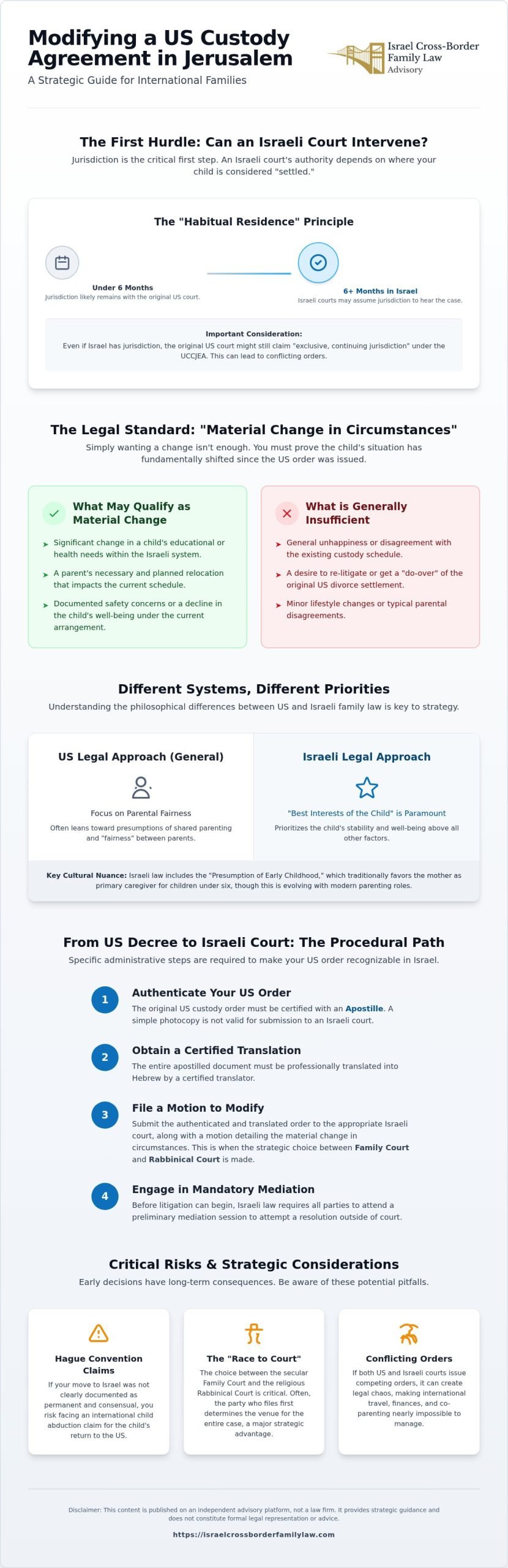
Israeli courts determine their authority based on where the child is “settled.” This is known as habitual residence. Habitual residence is the place where a child’s life is primarily centered, including school and social ties. In practice, Israeli judges typically look for a period of at least six months of residency before they’ll consider assuming jurisdiction over a foreign custody matter. If the child has only been in Jerusalem for a few weeks, the court will likely defer to the original US jurisdiction to avoid the appearance of forum shopping.
The Role of International Treaties
The Hague Convention on the Civil Aspects of International Child Abduction plays a silent but powerful role in these cases. It ensures that children aren’t wrongfully kept in a country against a valid court order. Before modifying a US custody agreement in Jerusalem, it’s essential to analyze whether your move was documented as permanent. Many US agreements include a choice of law clause, which might state that US law should apply even if the family moves. Understanding how these clauses interact with the international-custody-relocation framework is vital. This content is published on an independent advisory platform and does not constitute legal representation; strategic decisions should always be made with professional guidance.
Legal Grounds: Material Change in Circumstances in Israel
Once jurisdiction is established, the focus shifts to the legal justification for change. Israeli courts generally respect existing agreements as final and binding. They are notably reluctant to disturb a settled arrangement unless a “material change in circumstances” has occurred since the original US order was signed. This means that simply being unhappy with the current schedule or wanting more time isn’t enough. When modifying a US custody agreement in Jerusalem, the burden of proof rests on the parent seeking the change to demonstrate that the status quo no longer serves the child.
Fundamental shifts include significant changes in the child’s educational requirements within the Israeli school system, a parent’s planned relocation, or documented safety concerns. Minor adjustments to visitation hours might be handled with less scrutiny, but any change that alters the primary residence or legal custody status requires a high evidentiary threshold. The court wants to see that the change is a necessity born from new realities, not a “do-over” of the original divorce settlement.
The ‘Best Interests’ Standard vs. US Standards
The Israeli “Best Interests of the Child” test is the paramount consideration, yet it differs from many US state standards. While US courts often lean toward a presumption of shared parenting or “fairness” between parents, Jerusalem courts prioritize the child’s immediate and long-term stability. A significant factor in 2026 remains the “Presumption of Early Childhood” (Godo Ha-Gage), which traditionally favors the mother as the primary caregiver for children under six, though this is increasingly balanced against modern parenting roles. Understanding these cultural nuances is vital before you discuss your strategy with a professional.
Evidence Required for a Modification
To succeed, you must present objective evidence rather than personal grievances. Israeli judges value professional input from social workers (Pekidat Sa’ad), school reports from Jerusalem institutions, and evaluations from licensed therapists. As children grow older and show more maturity, the court may also take their preferences into account, though their voice is rarely the sole deciding factor. It’s also important to avoid the “litigation trap.” Filing a weak request for modification can lead the court to view the moving parent as a source of instability, potentially resulting in a more restrictive order than the one currently in place. Stability is the court’s goal, and they will protect it above all else.
The Procedural Path: Registering and Updating Foreign Orders
To an Israeli judge, a US custody decree is initially just a piece of foreign paper. Before you can begin modifying a US custody agreement in Jerusalem, the court must first formally recognize the existing order. This process, known as registration, is the legal bridge that makes your American judgment “visible” and enforceable within the Israeli system. Without this step, the Jerusalem Family Court has no foundation upon which to build a new or updated arrangement.
The technical requirements for registration are strict. You’ll need an original or certified copy of the US judgment bearing an Apostille. This international certification confirms the document’s authenticity for use abroad. In 2026, specific requirements for the Apostille on US judgments remain a critical first hurdle. Additionally, every page must be accompanied by a certified Hebrew translation performed by an Israeli-licensed notary. Once these documents are submitted, the Israeli Central Authority may play a role in cross-border enforcement, ensuring that the transition between jurisdictions remains orderly and compliant with international treaties.
Registration of Foreign Judgments
The formal recognition process is governed by the Enforcement of Foreign Judgments Law. This law ensures that the US order does not contradict Israeli public policy and was issued by a court with proper authority. Registration is a mandatory prerequisite. You cannot ask a judge to change a schedule they haven’t yet accepted into their own record. To understand the broader context of how these stages fit together, you can review how the process works across different types of cross-border cases. This content is published on an independent advisory platform and is not a substitute for legal representation.
The Modification Timeline
Once the order is registered, you file a “Petition for Modification.” The other parent then has a set window, typically 30 to 60 days, to file a response. In Jerusalem, the court will involve “Siyu,” the court’s dedicated social service unit. These professionals meet with the family to assess the child’s situation and provide the judge with a neutral recommendation. It’s important to account for the current Jerusalem Family Court backlog. As of 2026, families should prepare for significant lead times, as the court’s calendar is often booked months in advance. Early strategic planning is essential to manage these delays and maintain stability for your child during the transition. Seeking clarity on these timelines before you file can prevent unexpected disruptions to your family’s routine.
Navigating the Jerusalem Court Environment: Family vs. Rabbinical
Jerusalem presents a unique legal landscape because of its dual-court system. Unlike the US, where family matters are handled in a single civil court system, Israel maintains concurrent jurisdiction between the Family Court and the Rabbinical Court. This creates a high-stakes environment often referred to as the “Race for Jurisdiction.” When modifying a US custody agreement in Jerusalem, the court where the petition is filed first typically secures the authority to hear the case. This early decision can significantly influence the procedural tone and the legal framework applied to your family’s transition.
While the Jerusalem Family Court (Beit Mishpat Le’Inyanei Mishpacha) is a civil institution, the Rabbinical Court (Beit Din Rabbany) operates under religious law. It’s a common misconception that Rabbinical courts only serve the ultra-religious. In reality, any Jewish expat may find their case in a Rabbinical court if their spouse files there first or if the original divorce was finalized within that system. Each venue has its own cultural nuances and procedural expectations. Understanding which environment best suits your family’s needs is a critical strategic step that must be taken before any documents are submitted to the authorities.
The Jerusalem Family Court Experience
Hearings at the Jerusalem Family Court are generally private and conducted in Hebrew. The atmosphere is professional but can feel intense for those unfamiliar with the Israeli “interventionist” judicial style. Judges here rely heavily on the court-appointed social worker, known as a Pashat. These professionals conduct home visits and interviews to assess the child’s well-being. Social worker recommendations are often the single most influential factor in a judge’s decision. Because these reports carry such weight, presenting your situation clearly and calmly during the assessment phase is vital for a successful outcome.
The ‘Anglo’ Advantage and Pitfalls
Anglos often face a steep learning curve when moving from a US legal mindset to the Israeli system. A major pitfall is the assumption that US legal terms, such as “joint legal custody,” have an identical Hebrew equivalent. Precise English-to-Hebrew translation is not just a formality; it’s a necessity to ensure the original intent of your American agreement is preserved. Misunderstandings during the pre-trial phase can lead to orders that don’t align with your family’s lifestyle or the child’s educational needs in Jerusalem. To avoid these complications, many families seek specialized guidance for expats to bridge the cultural gap. This content is published on an independent advisory platform and does not constitute formal legal representation. To protect your interests, you should consult with a professional regarding your specific case before initiating any court filings.
Strategic Preparation: Getting Clarity Before You File
Success in modifying a US custody agreement in Jerusalem depends heavily on the work done before the first document is ever filed. A primary risk in cross-border cases is the potential for a “return order” under the Hague Convention. If the move to Israel was not clearly established as permanent or if the other parent claims the child is being wrongfully detained, a petition to modify custody could inadvertently trigger an abduction claim. It is vital to assess these risks honestly. You must ensure that the Jerusalem court’s assumption of jurisdiction is legally sound and will not be contested by a US court still claiming authority over the family.
Strategic preparation also requires a unified approach between your legal representatives in both countries. A modification in Israel that contradicts a standing order in New York or California can lead to a “limping” judgment; an order that is enforceable in one country but ignored in the other. This creates long-term instability for the child and legal peril for the parents, particularly during international travel. Aligning these two systems requires a deep understanding of how US state laws interact with Israeli procedures. This content is published on an independent advisory platform and does not constitute formal legal representation or an attorney-client relationship.
The Mandatory Mediation Phase
Israel mandates a specific “Dispute Resolution” process known as Yishuv Sichsach. Under this regulation, you cannot file a full lawsuit for modification until you have attended a series of meetings with the court’s Assistance Center. This 45-day period acts as a legal freeze, designed to encourage families to reach a consent agreement. Reaching a settlement during this phase is almost always preferable. It saves significant time and reduces the emotional stress on the children while ensuring the final order reflects the unique needs of an expat family living in Jerusalem.
Next Steps for Jerusalem Residents
Before moving forward, you should carefully review your original US decree for “trap” clauses. These are provisions that might mandate a specific US state for all future disputes or include “choice of law” requirements that complicate an Israeli filing. Once these risks are cleared, focus on building a parenting plan that reflects the reality of life in Israel. This includes accounting for Israeli school calendars, religious holidays, and the logistics of international visitation. For more detailed guidance on these complexities, view our guide on International Custody. Seeking clarity before you commit to a court case is the most effective way to protect your child’s stability and your own peace of mind.
Securing Stability for Your Family in Israel
Successfully modifying a US custody agreement in Jerusalem requires more than just a desire for change; it demands a precise alignment of two distinct legal cultures. You must first bridge the jurisdictional gap by establishing habitual residence and formally registering your American order with an Apostille and certified translations. Once the court recognizes your decree, the focus shifts to demonstrating a material change in circumstances that prioritizes the child’s stability over parental preference. These early strategic decisions carry significant weight in cross-border matters and can prevent the risk of conflicting international orders.
By understanding the nuances of the Jerusalem Family Court and navigating the mandatory mediation phase with clarity, you can manage these complexities with confidence. This platform provides specialized US-Israel cross-border expertise and authoritative guidance tailored for the Anglo community. This content is published on an independent advisory platform and is not a substitute for formal legal representation. Get clarity before you commit. Request a confidential consultation. Protecting your child’s future in a new country is a significant undertaking, but with the right preparation, you can achieve a sustainable and secure outcome.
Frequently Asked Questions
Can the Israeli court completely cancel my US custody agreement?
Israeli courts do not technically “cancel” foreign orders; instead, they register them as the baseline for the family’s legal status in Israel. Once registered, a judge in Jerusalem can modify specific terms if a material change in circumstances is proven. While the original US order remains the legal foundation, the updated Israeli decree becomes the governing rule for daily life and enforcement within the Israeli system.
How long does it take to modify a US custody order in Jerusalem?
The duration varies based on whether the parents reach a consent agreement. In 2026, the Jerusalem Family Court backlog often results in contested cases lasting from several months to over a year. Every case must begin with a mandatory 45-day mediation period (Yishuv Sichsach). If mediation fails, the process slows significantly as the court must wait for evaluations from social workers and expert witnesses.
Do I need a US lawyer and an Israeli lawyer to change my agreement?
While not strictly a requirement, coordinating with professionals in both jurisdictions is highly recommended. An Israeli lawyer manages the local filing, but a US attorney ensures that modifying a US custody agreement in Jerusalem does not violate state laws like the UCCJEA. Without this dual approach, you risk creating a “limping” order that is valid in Israel but viewed as a violation by your home state court.
What happens if the other parent doesn’t agree to the modification?
If the other parent contests the request, the case moves into formal litigation. The Jerusalem court will typically appoint a social worker (Pashat) to conduct an investigation and submit a recommendation. The judge then holds evidentiary hearings to determine if the proposed change truly serves the child’s needs. Because the court prioritizes stability, the parent seeking the modification must provide compelling evidence that the current arrangement is no longer viable.
Is my US child support order also modified when custody changes in Israel?
A change in custody does not automatically trigger a change in child support. In the Israeli legal system, custody and support are often treated as separate petitions. If a fundamental shift in the parenting schedule occurs, you must specifically ask the court to review the financial obligations. It’s important to note that Israeli support calculations differ from US state guidelines and factor in local costs of living and religious law nuances.
Can I modify a US order if the other parent still lives in America?
Yes, but this scenario involves significant jurisdictional hurdles. If one parent remains in the US, that state court may claim exclusive, continuing jurisdiction over the matter. The Jerusalem court must determine if it has the authority to hear the case based on the child’s habitual residence and international treaty rules. You must carefully navigate these competing claims to ensure any new order is enforceable and does not trigger an abduction claim.
What is the ‘Best Interests of the Child’ test in Jerusalem courts?
The ‘Best Interests’ test is the primary standard used by Israeli judges to evaluate any custody modification. Unlike some US courts that emphasize parental rights or equal time, Jerusalem courts focus on the child’s emotional, educational, and physical stability. Judges rely heavily on professional assessments from social workers and psychologists to determine which parenting arrangement offers the most secure and supportive environment for the child’s long-term development in Israel.
Do I have to attend court hearings in person if I am visiting the US?
Israeli family courts generally expect both parents to be physically present for mediation sessions and significant hearings. However, for those modifying a US custody agreement in Jerusalem while traveling, it is possible to request permission for video testimony. In 2026, judges are more open to remote appearances for expats, but you must obtain formal approval in advance. Failing to appear without an approved excuse can negatively impact the court’s view of your commitment.
Disclaimer: This content is published on an independent advisory platform and provides strategic guidance; it does not constitute legal representation or formal legal advice. Legal services are only provided by licensed attorneys under a separate engagement.

Article by
Gabriel Lior
A Personal Journey That Became a Mission
The advisory was founded by an American father Gabriel Lior, LLB, MBA , global entrepreneur, and cross-border advisor who spent more than a decade navigating the Israeli family court system firsthand and now lives in Singapore with his son.
As a divorced parent in a cross-border family, Gabriel faced nearly every legal challenge a foreign parent can encounter in Israel — including child custody disputes, child support proceedings, property matters in Israel and abroad, false accusations, and complex immigration and relocation proceedings.
Over the years, he learned the hard way how difficult it is for non-Israeli parents to understand the system, identify the right legal strategy, and choose the right legal representation — especially when language, culture, and jurisdictional differences are involved. He also witnessed how foreign parents and new immigrants are often disadvantaged or taken advantage of by service providers and institutions simply because they lack local knowledge or fluency.
From Client to Advisor
To truly understand — and survive — the system, Gabriel pursued formal legal education in Israel, completing two Israeli law degrees, alongside a BA and MBA earned in the United States. This was never about becoming a practicing attorney, but about gaining a deep, structural understanding of how the system works — and where it breaks down for foreign parents.
This rare combination of:
Firsthand client experience
Israeli legal and US business education
International business and negotiation training
Decades of commercial execution
created a unique perspective – one that understands both sides of the table.
After years of litigation, persistence, and at times self-representation, he ultimately succeeded in securing custody of his son and relocating abroad through a rare legal victory in the Israeli Supreme Court — becoming one of the first fathers in Israel to do so under these circumstances.
Disclaimer
Important Disclaimer:
The information provided on this website and in its content is for general informational and educational purposes only and does not constitute legal advice, legal opinion, or legal representation.
Gabriel Lior is not licensed to practice law in Israel (nor is he interested in doing so) and does not provide legal services, despite having completed 2 Law Degrees. The services offered are advisory in nature and are intended to provide general guidance, strategic insight, and information regarding cross-border family law considerations.
No attorney-client relationship is formed by accessing this website, reading its content, or communicating with us.
Any decisions made based on this information are at your own discretion and risk. For legal advice specific to your situation, you should consult a licensed attorney in the relevant jurisdiction.
Where appropriate, we may refer clients to independent, licensed attorneys or professionals. Such referrals do not constitute legal representation and no liability is assumed for services provided by third parties.