What if the most effective way to protect your international assets in an Israeli divorce isn’t through a courtroom battle, but through a mandatory meeting you might currently be dreading? For many expats and international families, the prospect of entering the Israeli legal system feels like walking into a maze of language barriers and unfamiliar religious jurisdictions. It’s completely natural to feel overwhelmed by the “Mahut” process or the potential influence of the Rabbinical courts on your future. Choosing Israel family mediation allows you to step out of the high-conflict litigation cycle and maintain control over your family’s transition.
This guide provides the clarity you need to move forward with confidence. You’ll learn how the 2016 Law for the Settlement of Disputes mandates a stay of proceedings to encourage amicable solutions before litigation begins. We’ll explain how to draft an agreement that protects your US-based assets while remaining fully enforceable in both jurisdictions. By understanding the strategic bridge that mediation provides, you can reach a peaceful resolution that respects both Israeli law and your international lifestyle. This content is published on an independent advisory platform for informational purposes; it’s designed to help you weigh risks and strategy before seeking formal legal counsel.
Key Takeaways
- Understand the mandatory 2016 legal framework that requires a stay of proceedings to prioritize settlement before any litigation can begin.
- Learn how to address the unique risks of cross-border assets, ensuring your agreement is recognized by both Israeli and foreign courts.
- Navigate the specific steps of Israel family mediation, from the initial filing to the informational ‘Mahut’ sessions.
- Discover creative solutions for property division and child support that reflect the cost-of-living realities of international families.
- Recognize the vital distinction between a neutral mediator and a strategic cross-border advisor who protects your long-term interests.
Understanding Israel Family Mediation: The Mandatory First Step
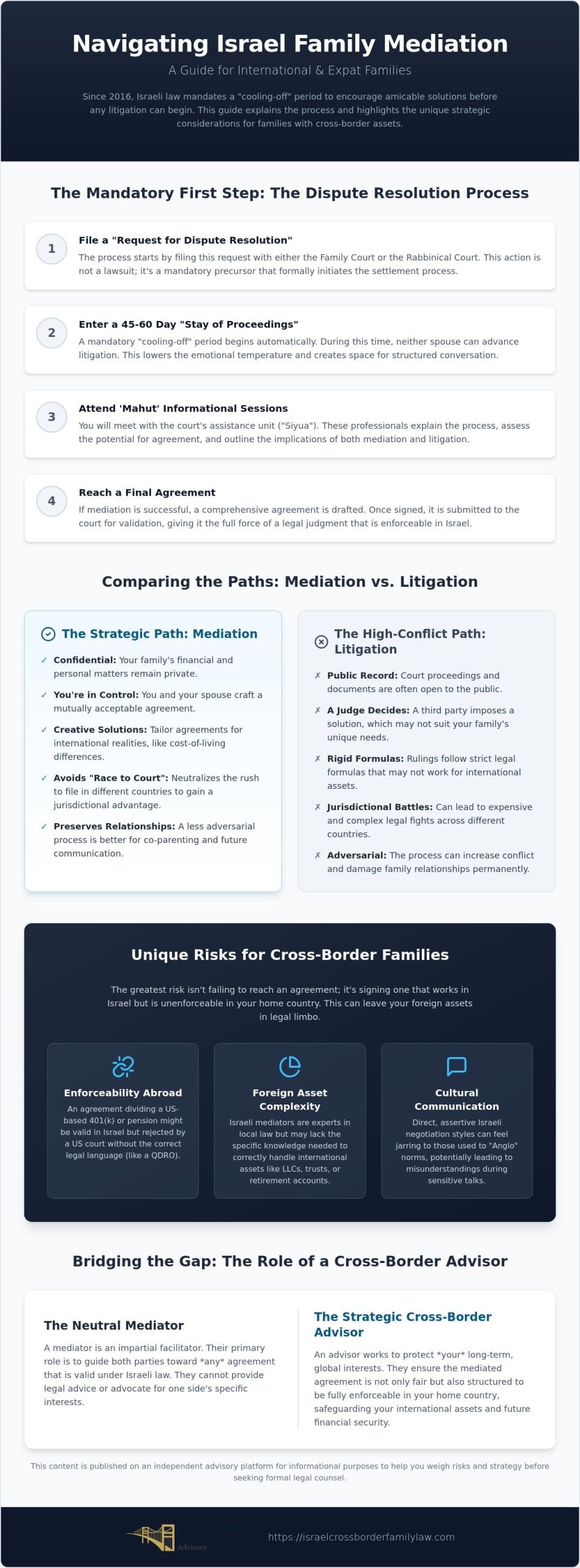
Since July 2016, the Law for the Settlement of Disputes in Family Matters has fundamentally changed how families end their relationships in Israel. You can’t simply walk into a court and file a divorce claim. Instead, the law requires a “Request for Dispute Resolution.” This step initiates a mandatory stay of proceedings. During this time, which typically lasts between 45 and 60 days, neither spouse can advance litigation. This period is designed to lower the emotional temperature and encourage a structured conversation. Family mediation is a process built on voluntariness and transparency, allowing you to reach a resolution without a judge’s decree.
To better understand how this process differs from a standard trial, watch this helpful video:
This content is published on an independent advisory platform and is not a law firm. It focuses on strategy and risk guidance rather than establishing an attorney-client relationship. You can learn more about how it works on our advisory page.
The ‘Request for Settlement of Dispute’ Explained
You file this request in either the Family Court or the Rabbinical Court. Once filed, the 45-to-60-day “cooling off” period begins. During this window, you meet with the court’s assistance unit, known as “Siyua.” These professionals help determine if an agreement is possible. There are rare exceptions to this rule. If there’s an urgent need for a protective order or if a child is at risk of being moved across borders illegally, the court can bypass the stay. For most, this process is the essential gateway to Israel family mediation.
Why Mediation is Preferred for International Families
For expats and those with assets in multiple countries, Israel family mediation offers a strategic advantage. It prevents the “race to court” where spouses rush to file in different countries to secure a favorable jurisdiction. Mediation also keeps your financial life private. Unlike public court records, mediation sessions are confidential. This is vital for families with complex cross-border holdings like US-based LLCs or pensions. You also avoid the rigid rulings of a judge. A judge might follow a strict formula, but a mediated agreement can account for the cost-of-living differences between Tel Aviv and New York. You can move beyond the standard 50/50 property division to find solutions that protect your global interests.
The Cross-Border Challenge: Why International Families Need a Specialized Approach
For international families, the primary risk of Israel family mediation isn’t failing to reach an agreement. It’s reaching an agreement that works in Israel but is unenforceable in your home country. Israeli mediators are highly skilled in local law, but they may lack expertise in US financial vehicles like 401(k)s or the specific language required for a Qualified Domestic Relations Order (QDRO). Without this specialized knowledge, you might sign a document that a US court later rejects, leaving your foreign assets in legal limbo. This content is published on an independent advisory platform and is not a law firm. We focus on strategy and risk guidance rather than establishing an attorney-client relationship.
The cultural aspects of mediation in Israel often involve a more direct, assertive communication style that can be jarring for those used to “Anglo” norms. This cultural gap can lead to misunderstandings during sensitive negotiations. If you’re an expat, you need a process that respects these differences while ensuring your US-based assets, like real estate or LLCs, are handled with precision. It’s vital to seek clarity on your specific risks before you sign any binding documents.
Dual-Jurisdiction Assets and Tax Nuances
Your mediator must understand the difference between Israeli and US tax implications. Dividing a property in Tel Aviv is different from liquidating a US brokerage account. If you don’t account for capital gains taxes or foreign reporting requirements, your “equal” split could become very lopsided. You need to address the division of assets that don’t physically exist in Israel. For more detail, see our Guidance for Expats and Foreign Nationals.
International Custody and Relocation
Parenting plans for international families must be much more detailed than local ones. You have to account for international travel, school holidays in different countries, and the logistics of long-distance communication. More importantly, the language in your agreement must be clear to prevent future “child abduction” claims under the Hague Convention. A well-mediated plan protects both parents’ rights and provides the children with stability. Learn more about International Custody and Relocation to understand how these plans are structured to withstand cross-border scrutiny.
The Mediation Process in Israel: From ‘Mahut’ Meetings to Final Agreement
The journey through Israel family mediation follows a structured legal path designed to minimize conflict. It begins when one party files a “Request for Settlement of Dispute” at the local Family Court or Rabbinical Court. This action immediately triggers a freeze on all other legal proceedings. You can’t file for custody or property division while this stay is in effect. This period creates a protected space where you can explore settlement without the pressure of an impending trial. This content is published on an independent advisory platform and is not a law firm. It focuses on strategy and risk guidance rather than establishing an attorney-client relationship.
What Happens During the ‘Mahut’ Meetings?
The court’s assistance unit, known as Siyua, conducts four mandatory “Mahut” meetings. “Mahut” is a Hebrew acronym for Information, Coordination, and Direction. You’ll meet with a social worker and a legal advisor who explain your options for dispute resolution. While attending these meetings is a legal requirement, you aren’t forced to settle. You’re only required to listen and consider the alternatives to litigation. If your Hebrew is limited, you’re entitled to bring a translator or request a professional who speaks English. These meetings are meant to be an intake process, not the final negotiation of your assets.
Private vs. Public Mediation: Making the Choice
Once the Mahut meetings conclude, you must decide whether to continue mediation through the court’s unit or hire a private mediator. For international families, private mediation is often the more effective route. Public sessions are limited in time and may not have the resources to handle complex foreign assets. A private mediator who is fluent in English can ensure that nothing is lost in translation. This choice allows for multi-day, intensive sessions that can address the intricacies of cross-border estates. You can review Understanding our Pricing and Advisory Model to see how private strategic support fits into your planning.
After reaching an agreement, the final document, called a “Heskem Girushin,” is drafted. This comprehensive contract covers everything from child support to the division of global property. The process ends with a “Validation of Agreement” hearing. A judge reviews the contract to ensure it’s fair and that both parties understand the terms. Once the judge signs it, the agreement has the same legal force as a court judgment. This final step is crucial for ensuring your resolution is enforceable in both Israel and abroad. Getting clarity on these steps before you commit helps you maintain control over the outcome.
Key Pillars of a Mediated Agreement: Assets, Custody, and Support
Building a comprehensive agreement requires more than just compromise; it requires a strategic alignment of your family’s international reality with Israeli legal requirements. Israel family mediation allows you to move beyond the rigid 50/50 property split often imposed by the court. For international families, a simple division of local assets is rarely sufficient. You might choose to offset the value of an Israeli residence against a US-based pension or brokerage account. This creative approach prevents the need to liquidate foreign holdings, which often carries significant tax penalties. This content is published on an independent advisory platform and is not a law firm; we focus on strategy and risk guidance rather than establishing an attorney-client relationship.
Child support and spousal maintenance also require a nuanced approach. In Israel, child support is calculated based on specific formulas, yet these often fail to account for the expenses unique to the expat community, such as international school tuition or annual flights to visit family abroad. Similarly, spousal support, or “mezonot isha,” is often tied to the religious status of the marriage. Your mediated agreement must bridge the gap between civil property rights and the requirements of the Rabbinical court to ensure a smooth path to the “get” (religious divorce).
Child Support and Cross-Border Enforcement
When one parent plans to reside outside of Israel, the agreement must be drafted with international enforcement in mind. It’s essential to ensure that support orders are compatible with US state agencies, specifically the IV-D programs, to facilitate collection across borders. It’s also necessary to address currency fluctuations and how they impact the real-world value of support payments over time. You can find more detail on Child Support Cross-Border Enforcement to understand these technical complexities.
The Final Validation: Making it Legal
An agreement reached through Israel family mediation is not legally binding until it undergoes “Ishur Heskem,” a formal validation by a judge in the Family Court. This hearing ensures the terms are fair and the parties are entering the contract willingly. Once validated, the agreement has the force of a court judgment, making it enforceable both locally and internationally. This step also provides a level of protection against future claims of “changed circumstances” that could otherwise destabilize your financial future. To ensure your agreement is built on a solid foundation, you should request a confidential case review before finalizing your terms.
Navigating the Strategic Gap: The Role of a Cross-Border Advisor
Entering the mediation room without a clear strategy is one of the most common mistakes international families make. While the mediator is a vital professional, you must understand their specific role. A mediator is a neutral third party. Their primary objective is to facilitate an agreement between you and your spouse. They don’t represent your individual interests, and they won’t tell you if a proposal is financially disadvantageous for your long-term future. This is where the strategic gap exists. Relying solely on the neutral process of Israel family mediation without independent counsel can leave you vulnerable to lopsided settlements that are difficult to correct later.
A cross-border advisor serves as your advocate, working behind the scenes to prepare you for what we call “Shadow Negotiations.” This involves analyzing the other party’s likely positions and drafting counter-proposals that protect your global interests. Your advisor helps you understand the weight of every concession. For instance, agreeing to a specific valuation of an Israeli apartment might seem fair, but if you haven’t accounted for the tax burden of liquidating a US brokerage account to pay for it, the deal is flawed. Having a strategist in your corner ensures that you remain proactive rather than reactive during the sessions.
Seeking Clarity Before You Commit
The early stages of the mediation process carry significant weight. Decisions made during the initial meetings often set the trajectory for the entire resolution. You must be able to identify “red flags” before signing any interim documents. Common warning signs include vague language regarding international travel or a lack of clarity on how foreign pensions will be divided. It’s essential to understand how the advisory works to provide you with the necessary checks and balances. This content is published on an independent advisory platform and is not a law firm; our focus is on strategy, risk assessment, and decision-making guidance.
Educational Resources
To help you prepare for the complexities of Israel family mediation, we recommend exploring deeper educational content. You can find detailed breakdowns of specific cross-border topics on the Israel Family Law YouTube channel. These resources offer a more granular look at how the Israeli system interacts with international standards.
Reaching a peaceful resolution is possible, but it requires a foundation of clarity and strategic planning. By bridging the gap between local requirements and your global reality, you can secure a future that protects both your assets and your family’s well-being. Get clarity before you commit. Request a confidential consultation.
Securing Your Global Future through Strategic Resolution
Transitioning through a family dispute requires a balance of local compliance and global foresight. You’ve seen how the mandatory “Mahut” process acts as a gateway, but the true value of Israel family mediation lies in its ability to accommodate complex, cross-border realities. By addressing US-based assets and international parenting plans early, you prevent future legal friction. This independent advisory platform provides the strategic framework necessary to mitigate risks before you enter the mediation room. We offer specialized expertise in US-Israel jurisdictions, focusing on strategy and risk mitigation for expats outside traditional law firm constraints.
The weight of early decisions can’t be overstated. A well-structured agreement, validated by the court, offers a steady path forward for your family and your finances. Get clarity before you commit. Request a confidential consultation to discuss your specific cross-border needs. You can reach a resolution that respects your past while protecting your future.
Frequently Asked Questions
Is mediation mandatory for all divorces in Israel?
Yes, since the 2016 “Law for the Settlement of Disputes in Family Matters,” all couples must file a “Request for Dispute Resolution” before they can litigate. This initiates a mandatory stay of proceedings for 45 to 60 days. During this time, you must attend informational meetings at the court’s assistance unit, though the decision to settle remains entirely voluntary.
Can I use a US-based mediator for my assets in Israel?
You can’t use a US-based mediator to create an agreement that is legally binding within the Israeli court system. However, many international families use a cross-border advisor to work in tandem with an Israeli mediator. This ensures that your US-based assets, such as 401(k)s or real estate, are handled with the technical precision required for dual-jurisdiction enforcement.
What happens if we cannot reach an agreement during the mandatory mediation period?
If you don’t reach a settlement during the mandatory stay of proceedings, either party is free to file a formal lawsuit. Once the “cooling off” period expires, the court allows litigation to proceed in either the Family Court or the Rabbinical Court. It’s important to remember that any progress made during mediation can still serve as a foundation for future negotiations even after litigation starts.
Will an Israeli mediated agreement be recognized by a US court?
An Israeli mediated agreement will generally be recognized by US courts if it has been validated by an Israeli judge and drafted with international standards in mind. For the agreement to be enforceable abroad, it must meet specific criteria, such as clear language regarding asset division and child custody. Israel family mediation is specifically designed to create these globally enforceable outcomes when managed by experienced advisors.
Do I need a lawyer if I am already working with a mediator?
It’s highly recommended to have independent strategic counsel while working with a mediator. A mediator is a neutral party and cannot provide you with individual legal advice or advocate for your specific interests. Having your own advisor ensures that you understand the long-term impact of the decisions you’re making and that the final agreement doesn’t contain lopsided terms.
How long does the mediation process typically take in Israel?
The initial mandatory phase of Israel family mediation lasts approximately 45 to 60 days. If the parties choose to enter private mediation to resolve complex issues, the process can take anywhere from a few weeks to several months. Most international families find that reaching a mediated agreement is significantly faster than the one to two years often required for a fully litigated divorce.
Can we mediate child custody if one parent intends to relocate to the US?
You can mediate relocation and custody, and doing so is often the best way to prevent future conflict. A mediated plan can include specific details about travel costs, holiday schedules, and communication methods that a judge might overlook. Clear language in a mediated agreement is also a vital tool for preventing future claims under the Hague Convention during an international move.
Is the information shared in mediation confidential if we eventually go to court?
Information shared during mediation is strictly confidential and cannot be used as evidence in a court of law if you fail to reach an agreement. This legal privilege allows you to speak freely and explore creative solutions without the risk of your words being used against you in future litigation. This content is published on an independent advisory platform for informational purposes and does not constitute legal representation.

Article by
Gabriel Lior
A Personal Journey That Became a Mission
The advisory was founded by an American father Gabriel Lior, LLB, MBA , global entrepreneur, and cross-border advisor who spent more than a decade navigating the Israeli family court system firsthand and now lives in Singapore with his son.
As a divorced parent in a cross-border family, Gabriel faced nearly every legal challenge a foreign parent can encounter in Israel — including child custody disputes, child support proceedings, property matters in Israel and abroad, false accusations, and complex immigration and relocation proceedings.
Over the years, he learned the hard way how difficult it is for non-Israeli parents to understand the system, identify the right legal strategy, and choose the right legal representation — especially when language, culture, and jurisdictional differences are involved. He also witnessed how foreign parents and new immigrants are often disadvantaged or taken advantage of by service providers and institutions simply because they lack local knowledge or fluency.
From Client to Advisor
To truly understand — and survive — the system, Gabriel pursued formal legal education in Israel, completing two Israeli law degrees, alongside a BA and MBA earned in the United States. This was never about becoming a practicing attorney, but about gaining a deep, structural understanding of how the system works — and where it breaks down for foreign parents.
This rare combination of:
Firsthand client experience
Israeli legal and US business education
International business and negotiation training
Decades of commercial execution
created a unique perspective – one that understands both sides of the table.
After years of litigation, persistence, and at times self-representation, he ultimately succeeded in securing custody of his son and relocating abroad through a rare legal victory in the Israeli Supreme Court — becoming one of the first fathers in Israel to do so under these circumstances.
Disclaimer
Important Disclaimer:
The information provided on this website and in its content is for general informational and educational purposes only and does not constitute legal advice, legal opinion, or legal representation.
Gabriel Lior is not licensed to practice law in Israel (nor is he interested in doing so) and does not provide legal services, despite having completed 2 Law Degrees. The services offered are advisory in nature and are intended to provide general guidance, strategic insight, and information regarding cross-border family law considerations.
No attorney-client relationship is formed by accessing this website, reading its content, or communicating with us.
Any decisions made based on this information are at your own discretion and risk. For legal advice specific to your situation, you should consult a licensed attorney in the relevant jurisdiction.
Where appropriate, we may refer clients to independent, licensed attorneys or professionals. Such referrals do not constitute legal representation and no liability is assumed for services provided by third parties.