In the high-stakes environment of cross-border divorce, the most critical decisions are often made weeks before a single document is filed in court. For many expats and international families, the realization that their future depends on which country’s laws apply can be paralyzing. Seeking an international family law consultation in Israel is not just about legal representation; it’s about gaining a strategic advantage in a system where the “race to court” determines everything from asset division to parental rights.
We understand the anxiety that comes with navigating the Israeli Rabbinical court system and the fear of how international child custody might be handled under 2026 standards. You want to protect your family and your assets without being blindsided by jurisdictional traps. This guide promises to provide you with a clear roadmap of legal risks and strategic clarity before you make any formal commitments. We’ll examine the shift toward joint parental responsibility, the authentication of foreign prenuptial agreements, and the vital importance of early-stage advisory support.
Please note that this content is published on an independent advisory platform and does not constitute legal representation or formal legal advice. Strategy and decision-making guidance are the focus here, while specific legal services are provided only by licensed attorneys under a separate engagement.
Key Takeaways
- Understand why the “race to court” between the US and Israel determines which legal framework governs your divorce and asset division.
- Learn how an international family law consultation israel serves as a strategic mapping session to identify jurisdictional risks before formal filings occur.
- Gain clarity on how the Hague Convention and international child support orders are enforced within the unique dual-court system of Israel.
- Discover the advisory-led approach that prioritizes risk mitigation and long-term strategy for business owners with transnational assets.
- Identify the essential global documentation required to protect your interests across both jurisdictions during a cross-border legal matter.
The Complexity of US-Israel Family Law Matters
Dealing with family law across borders isn’t just about personal change; it’s a complex legal puzzle involving two distinct sovereign systems. When you hold dual citizenship or own assets in both the US and Israel, you face unique vulnerabilities that local laws don’t always address clearly. This is where the principles of private international law become central. These rules determine which country’s courts have the authority to decide your future, making an international family law consultation israel a vital first step in your strategic planning. This content is published on an independent advisory platform to help you understand these risks before you commit to a specific legal path.
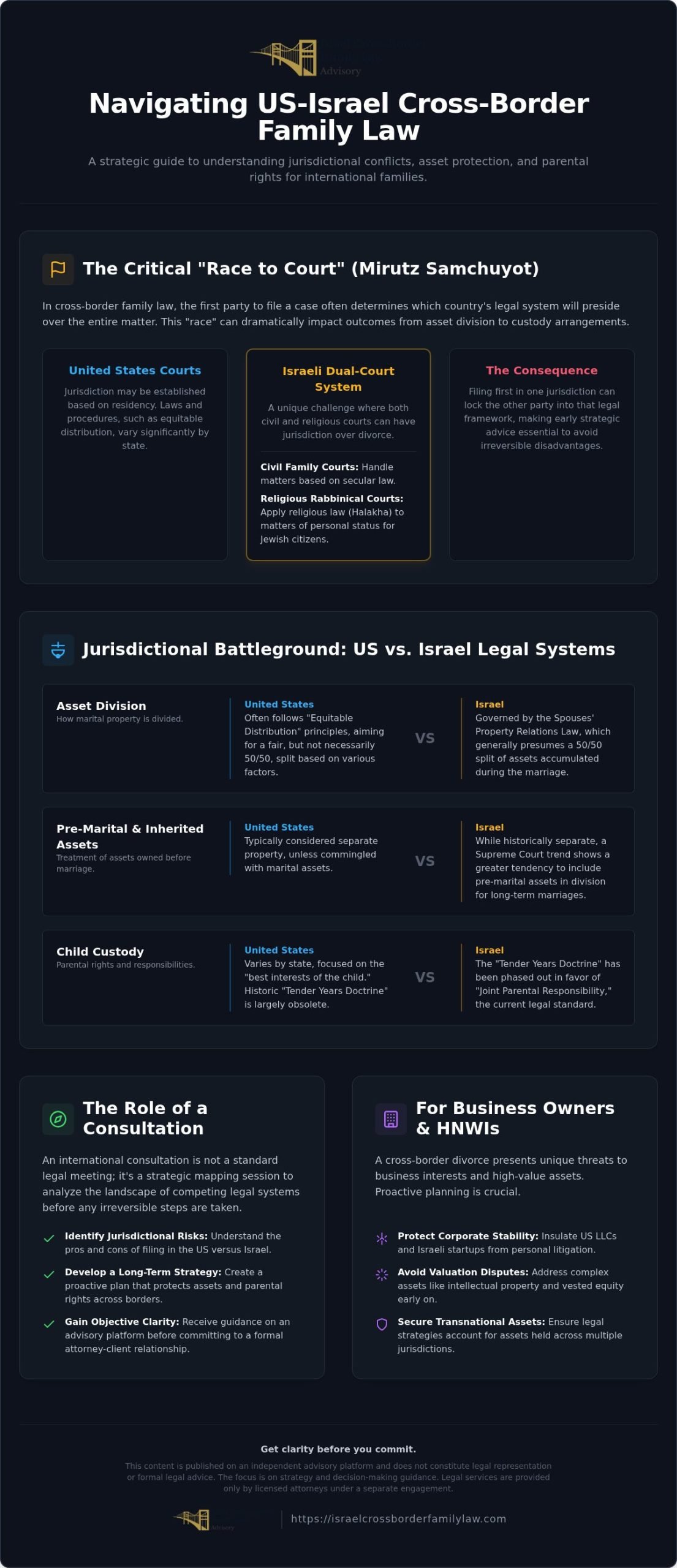
A defining feature of the Israeli system is the “Race to Court,” known in Hebrew as Mirutz Samchuyot. Because both the civil Family Courts and the religious Rabbinical Courts can have jurisdiction over divorce matters, the location where a case is first filed often dictates which laws and procedures will apply. In an international context, this race expands to include US courts. Filing first in one jurisdiction can lock out the other, significantly impacting the outcome of property division or custody. Even the mandatory 119 NIS “Settlement of Dispute” application in Israel can set a jurisdictional clock in motion that is hard to stop once it starts.
To better understand how these systems intersect, watch this helpful overview:
High-Net-Worth and Business Considerations
For business owners, a cross-border divorce can disrupt corporate stability. If you have interests in Israeli startups or US-based LLCs, the intersection of family law and corporate governance is critical. Divorce proceedings can impact M&A activity or trigger unwanted valuation disputes over intellectual property. It’s essential to understand how these proceedings might affect US-Israel corporate structures before any legal action is taken. This proactive approach helps protect startup equity and ensures that business operations remain insulated from personal litigation, especially when dealing with multi-jurisdictional assets and complex equity vesting schedules.
The Cultural Gap in Legal Systems
There is often a significant cultural gap in how courts view “fairness.” While many US states favor equitable distribution, Israeli courts follow the Spouses’ Property Relations Law, which has its own nuances regarding pre-marital assets and future earning capacity. As of 2026, the Israeli Supreme Court has shown a greater tendency to include pre-marital assets in the division for long-term marriages, a shift that catches many expats by surprise. Additionally, the phase-out of the “Tender Years Doctrine” in favor of “Joint Parental Responsibility” means that custody expectations from the US may not align with the current Israeli legal climate.
Using plain English to explain these statutes is vital for those navigating the challenges for expats and foreign nationals in Israel. Early decisions carry immense weight; once a jurisdictional commitment is made, it’s very difficult to reverse. Working with multi-qualified practitioners who understand both cultures helps bridge this gap, ensuring you have strategic clarity before making any formal commitments to the court system.
What is an International Family Law Consultation?
An international family law consultation israel is a specialized strategy session designed to map out the jurisdictional risks inherent in US-Israel legal matters. It differs significantly from a standard local consultation. While a local lawyer might focus on immediate filing procedures, a cross-border advisory session examines the broader landscape of two competing legal systems. This content is published on an independent advisory platform to provide objective guidance before you enter into a formal attorney-client relationship. Strategic clarity is the priority here, ensuring you understand the weight of early decisions.
A critical component of this session is identifying your “Center of Life” or Merkaz Chaim. Israeli courts use this concept to determine if they have the authority to hear your case. They look at where you work, where your children go to school, and where your primary social ties are located. If your center of life is found to be in the US, an Israeli court might decline jurisdiction, even if you’re currently residing in Israel. Understanding where you stand on this spectrum is essential before making any formal commitments to a court system.
Key Objectives of the Strategy Session
Assessing the risks associated with the Hague Convention is a priority during these sessions. If relocation is a factor, you must understand how Israeli courts interpret “habitual residence” and the restrictive nature of exceptions in abduction cases. You’ll gain clarity on international custody and relocation protocols as they stand in 2026. The goal is to determine which legal framework, Israel or a specific US state, offers the most favorable environment for your specific goals. This includes evaluating how each jurisdiction handles asset protection, business interests, and parental rights.
Addressing the ‘Race to Court’
The “Race to Court” is a tactical reality in international matters. Filing first in Israel might bring the case into the Rabbinical court system, which has concurrent jurisdiction with civil Family Courts for Jewish spouses. A jurisdictional race is a critical first-mover advantage that establishes which court will ultimately decide the outcome of your case. Choosing whether to file in Israel or the US requires a deep understanding of how each system views alimony, child support, and property division. If you’re feeling overwhelmed by these choices, you can request a strategic review to understand your options more clearly.
Early strategic planning helps mitigate the fear of the unknown. By mapping out these jurisdictional conflicts before any documents are filed, you reduce the risk of being trapped in an unfavorable legal system. This advisory model prioritizes your long-term stability over immediate litigation, giving you the tools to make informed decisions for your family’s future.
Navigating Jurisdictional Conflicts: US vs. Israel
Jurisdictional conflicts between the US and Israel create a dense thicket of legal challenges for international families. When a family moves between these two nations, their legal rights don’t always transition seamlessly. This content is published on an independent advisory platform to help you understand these friction points before you engage in formal litigation. An international family law consultation israel provides the necessary framework to evaluate which system will govern your assets and your children’s future.
Enforcing US child support or alimony orders within the Israeli system is a common area of concern. While Israel generally respects foreign judgments, they aren’t automatically active. They must be “declared enforceable” by an Israeli court through a specific legal process. Your Aliyah status can further complicate this, as it changes your legal standing regarding marital property and tax obligations. For those managing these transitions, understanding child support cross-border enforcement is a critical step in maintaining financial stability.
Child Custody and the Hague Convention
The Hague Convention is the primary mechanism for resolving international custody disputes between the US and Israel. In this context, “wrongful removal” occurs when one parent takes a child across a border without the other’s consent or a valid court order. The Israeli Central Authority oversees these cases, focusing on returning the child to their “habitual residence” for a final custody determination. By 2026, Israeli courts have continued to interpret exceptions to this return very restrictively. You can find more specific guidance on the Hague Convention and child abduction protocols to understand how these rules protect parental rights.
Financial Agreements and Asset Division
Asset division remains a major source of anxiety for expats. In many US states, “equitable distribution” allows judges significant discretion. Israel, however, follows the “Balancing of Resources” principle, which generally mandates an equal split of assets acquired during the marriage. A 2026 Supreme Court decision established that pre-marital assets are now more likely to be included in this division for long-term marriages. This makes the status of US prenuptial agreements particularly sensitive. These agreements are not automatically enforceable in Israel; they must be reviewed and authenticated by an Israeli Family Court or a certified notary to ensure they align with the Spouses’ Property Relations Law. This is vital for protecting assets held in US trusts or 401(k) accounts, which may be treated differently under Israeli statutes.
The complexity of these overlapping rules means that early strategy is your best defense. Mapping out these risks during an international family law consultation israel ensures you don’t make commitments that could jeopardize your financial or parental standing in either country.
How to Prepare for Your Cross-Border Consultation
Preparation is the bridge between legal confusion and a clear strategic roadmap. When you schedule an international family law consultation israel, you aren’t just meeting with a professional; you’re initiating a high-stakes strategy session that requires organized data. Because the Israeli legal system places immense weight on early filings and jurisdictional status, arriving with a complete picture of your global footprint is essential. This content is published on an independent advisory platform to help you organize your facts before you engage in formal legal representation.
Your goal for this session is to move beyond emotional distress and toward tactical clarity. You’ll need to identify your primary objectives, whether they involve securing custody, protecting business equity, or ensuring a specific jurisdictional preference. Formulating specific questions about how US statutes intersect with Israeli laws, such as the 2026 standards for joint parental responsibility, will help you maximize the value of the advisory session. If you’re ready to begin this process, you can request a confidential strategy review to map out your next steps.
The Documentation Checklist
Gathering documents from two different countries can be a logistical challenge, but it’s the only way to assess your risks accurately. You’ll need copies of marriage and birth certificates from both the US and Israel to establish legal standing. It’s also vital to track your “Center of Life” indicators. These include municipal tax (Arnona) records, utility bills, Israeli school enrollment letters, and US tax filings. These documents serve as evidence if the court needs to determine whether Israel or a US state is the appropriate jurisdiction for your case.
Financial transparency is equally critical. You should compile a comprehensive list of global assets, including:
- Statements for all US and Israeli bank accounts.
- Valuations for real estate holdings in both jurisdictions.
- Documentation of business interests, startup equity, or intellectual property.
- Records of US-based retirement accounts like 401(k)s and Israeli pension funds.
Identifying Strategic Priorities
Before the consultation, you must distinguish between your immediate needs and your long-term legal goals. Are you looking for a rapid resolution through mediation, or is high-conflict litigation inevitable? In Israel, the mandatory “Settlement of Dispute” application encourages consensual resolution, but you must be prepared for either path. Understanding the pricing and how it works for cross-border matters will help you budget for the complexities of multi-jurisdictional litigation. A clear timeline of your family’s transition to Israel will also help the advisor identify potential vulnerabilities in your current status.
Seeking Clarity: The Israel Cross Border Advisory Approach
The Israel Cross Border advisory model is built on the premise that clarity is the most valuable asset in an international dispute. Unlike traditional litigation-first approaches, this model prioritizes strategy and risk mitigation for international families. When you schedule an international family law consultation israel, you aren’t just looking for an attorney; you’re seeking a structured plan of action to navigate the friction between two legal cultures. This content is published on an independent advisory platform to provide objective guidance. It helps you move from the initial anxiety of jurisdictional uncertainty to a position of informed decision-making.
By focusing on the “Advisory” model, we emphasize the importance of understanding the weight of early decisions. In cross-border matters, a single filing in the wrong court can have permanent consequences for your assets and parental rights. Our approach provides a steady, knowledgeable guide to lead you through these challenging legal landscapes. This proactive strategy ensures that you aren’t just reacting to the system, but actively directing your legal journey.
A Bridge Between Legal Systems
For Anglos and expats, the Israeli legal system can feel opaque and unpredictable. Trust is often built on a shared language and a mutual understanding of the cultural background that shapes your expectations of fairness. Our approach acts as a bridge, utilizing multi-qualified practitioners who are licensed to practice in multiple jurisdictions and understand the nuances of both US and Israeli statutes. You can learn more about the advisory and how we integrate professional environments to protect your interests. Seeking an objective strategy before engaging in formal litigation is the most effective way to avoid the jurisdictional traps that often catch international families off guard.
Your Next Steps for Resolution
The transition from confusion to resolution begins with a systematic assessment of your situation. One of the most effective tools in our advisory model is the “early neutral evaluation.” This process provides a frank assessment of the strengths and weaknesses of your case across both jurisdictions before you commit to a specific path. It allows you to visualize the potential outcomes of asset division or custody disputes without the pressure of an active court case. This evaluation is designed to provide strategic clarity, helping you understand which legal framework offers the most security for your specific needs.
To begin your strategic journey, you can request a confidential case review. This initial step allows us to map out the specific jurisdictional risks associated with your transnational operations or family structure. It’s important to note that the content provided here is for informational and educational purposes only. It doesn’t constitute legal representation or formal legal advice. Legal services are only provided by licensed attorneys under a separate, formal engagement.
Get clarity before you commit. Request a confidential consultation.
Securing Your Family’s Future Across Borders
Navigating the intersection of US and Israeli legal systems requires more than just local representation; it demands a comprehensive strategy that accounts for transnational assets and the evolving 2026 standards for joint parental responsibility. The “Race to Court” makes the timing of your initial filings a critical factor in determining which jurisdiction will govern your divorce or custody matter. It’s essential to recognize that early decisions carry immense weight and are often difficult to reverse once the legal process begins.
An international family law consultation israel provides the necessary clarity to identify these jurisdictional risks before you make any formal commitments. This platform serves as an independent advisory bridge, offering authoritative guidance specifically tailored to the unique needs of the Anglo and expat community. By prioritizing strategy and risk mitigation over immediate litigation, you can move forward with a structured plan that protects your long-term interests and your family’s stability. Legal services are only provided by licensed attorneys under a separate engagement, but your strategic journey starts here.
Get clarity before you commit. Request a confidential consultation to discuss your specific situation. Taking this step ensures you have a clear roadmap for the path ahead.
Frequently Asked Questions
What is the difference between a family law consultation and a strategy session?
A strategy session focuses on jurisdictional mapping and risk mitigation across two legal systems, whereas a standard consultation often addresses local procedures. This independent advisory platform prioritizes long-term planning before any formal court commitments are made. It helps you understand the weight of early decisions, such as the “race to court,” rather than just explaining how to file a form. Strategic clarity is the priority here.
Can an Israeli court decide on my property located in the United States?
Yes, an Israeli court can decide on the division of property located in the United States if it has jurisdiction over the divorce. Under the Spouses’ Property Relations Law, the court looks at the “balancing of resources” for all global assets. However, enforcing that Israeli ruling in a US state requires additional legal steps. Strategic clarity is needed to determine if the US or Israel is the more favorable forum.
How does the Hague Convention protect my children in a US-Israel custody dispute?
The Hague Convention ensures that children who are “wrongfully removed” are promptly returned to their country of “habitual residence” so custody can be decided there. Israeli courts interpret the exceptions to this return rule very restrictively. This protects your parental rights by preventing one parent from unilaterally changing the child’s home. Understanding these protocols is a core part of an international family law consultation israel before you begin litigation.
Do I need a lawyer in both the US and Israel for my divorce?
You often need legal guidance in both jurisdictions to ensure your rights are protected globally. While an advisory session maps out the overarching strategy, you may eventually require licensed attorneys in both Israel and the US for specific filings. This content is published on an independent advisory platform; legal services are only provided under a separate engagement. Working with multi-qualified practitioners helps bridge the gap between these different legal systems.
How long does a typical cross-border family law consultation take?
A typical cross-border strategy session usually lasts between 60 and 90 minutes. This time is dedicated to reviewing your documentation, listing global assets, and identifying your primary goals. It’s a high-level mapping session rather than a simple Q&A. Because an international family law consultation israel involves complex jurisdictional questions, the focus is on providing a clear roadmap of legal risks before you make any formal commitments to a specific legal system.
Is my US prenuptial agreement valid if we now live in Israel?
A US prenuptial agreement isn’t automatically valid in Israel and must be reviewed by an Israeli authority. For it to be enforceable, it usually needs to be authenticated by an Israeli Family Court or a certified notary to ensure it aligns with the Spouses’ Property Relations Law. Without this “importation” process, you risk your assets being divided according to Israeli statutes, which may differ significantly from your original agreement.
What happens if my spouse files for divorce in Israel before I file in the US?
If your spouse files in Israel first, they may trigger the “race to court,” which determines whether the Rabbinical or civil Family Court hears the case. This initial filing can lock in the jurisdiction and significantly impact the outcome of asset division and alimony. It highlights the importance of seeking strategic clarity early. Once a case is active in Israel, it becomes much harder to move the proceedings to a US state.
How can I enforce a US child support order if the payer lives in Israel?
You can enforce a US child support order in Israel by having it declared enforceable by an Israeli court. This process involves proving the order is final and doesn’t contradict Israeli public policy. Once recognized, the order can be enforced through the Israeli Enforcement and Collection Authority. Understanding these cross-border enforcement protocols is vital for maintaining financial security when the payer or assets are located in different countries across both jurisdictions.

Article by
Gabriel Lior
A Personal Journey That Became a Mission
The advisory was founded by an American father Gabriel Lior, LLB, MBA , global entrepreneur, and cross-border advisor who spent more than a decade navigating the Israeli family court system firsthand and now lives in Singapore with his son.
As a divorced parent in a cross-border family, Gabriel faced nearly every legal challenge a foreign parent can encounter in Israel — including child custody disputes, child support proceedings, property matters in Israel and abroad, false accusations, and complex immigration and relocation proceedings.
Over the years, he learned the hard way how difficult it is for non-Israeli parents to understand the system, identify the right legal strategy, and choose the right legal representation — especially when language, culture, and jurisdictional differences are involved. He also witnessed how foreign parents and new immigrants are often disadvantaged or taken advantage of by service providers and institutions simply because they lack local knowledge or fluency.
From Client to Advisor
To truly understand — and survive — the system, Gabriel pursued formal legal education in Israel, completing two Israeli law degrees, alongside a BA and MBA earned in the United States. This was never about becoming a practicing attorney, but about gaining a deep, structural understanding of how the system works — and where it breaks down for foreign parents.
This rare combination of:
Firsthand client experience
Israeli legal and US business education
International business and negotiation training
Decades of commercial execution
created a unique perspective – one that understands both sides of the table.
After years of litigation, persistence, and at times self-representation, he ultimately succeeded in securing custody of his son and relocating abroad through a rare legal victory in the Israeli Supreme Court — becoming one of the first fathers in Israel to do so under these circumstances.
Disclaimer
Important Disclaimer:
The information provided on this website and in its content is for general informational and educational purposes only and does not constitute legal advice, legal opinion, or legal representation.
Gabriel Lior is not licensed to practice law in Israel (nor is he interested in doing so) and does not provide legal services, despite having completed 2 Law Degrees. The services offered are advisory in nature and are intended to provide general guidance, strategic insight, and information regarding cross-border family law considerations.
No attorney-client relationship is formed by accessing this website, reading its content, or communicating with us.
Any decisions made based on this information are at your own discretion and risk. For legal advice specific to your situation, you should consult a licensed attorney in the relevant jurisdiction.
Where appropriate, we may refer clients to independent, licensed attorneys or professionals. Such referrals do not constitute legal representation and no liability is assumed for services provided by third parties.