Navigating the complexities of an international inheritance dispute presents a formidable challenge, particularly when you are based in the United States and the estate is governed by Israeli law. The uncertainty of foreign legal procedures, the anxiety over crucial deadlines, and the suspicion that a loved one’s final wishes were not honored can create significant distress. For many, the task of contesting a will in Israel from the US seems like an insurmountable, multi-jurisdictional obstacle. This is precisely where clear, authoritative guidance becomes indispensable for protecting your rightful inheritance. This comprehensive guide is designed to serve as your strategic roadmap through this sophisticated legal landscape. We provide a clear, step-by-step framework for US residents, demystifying the nuances of Israeli succession law. You will gain a deep understanding of the legitimate grounds for challenging a will-from undue influence to lack of testamentary capacity-and learn the critical procedural steps required by Israeli family courts. Our objective is to empower you with the knowledge needed to confidently assess your position and secure the expert legal representation required to successfully navigate this complex cross-border process on your behalf.
Can You Contest an Israeli Will While Living in the US?
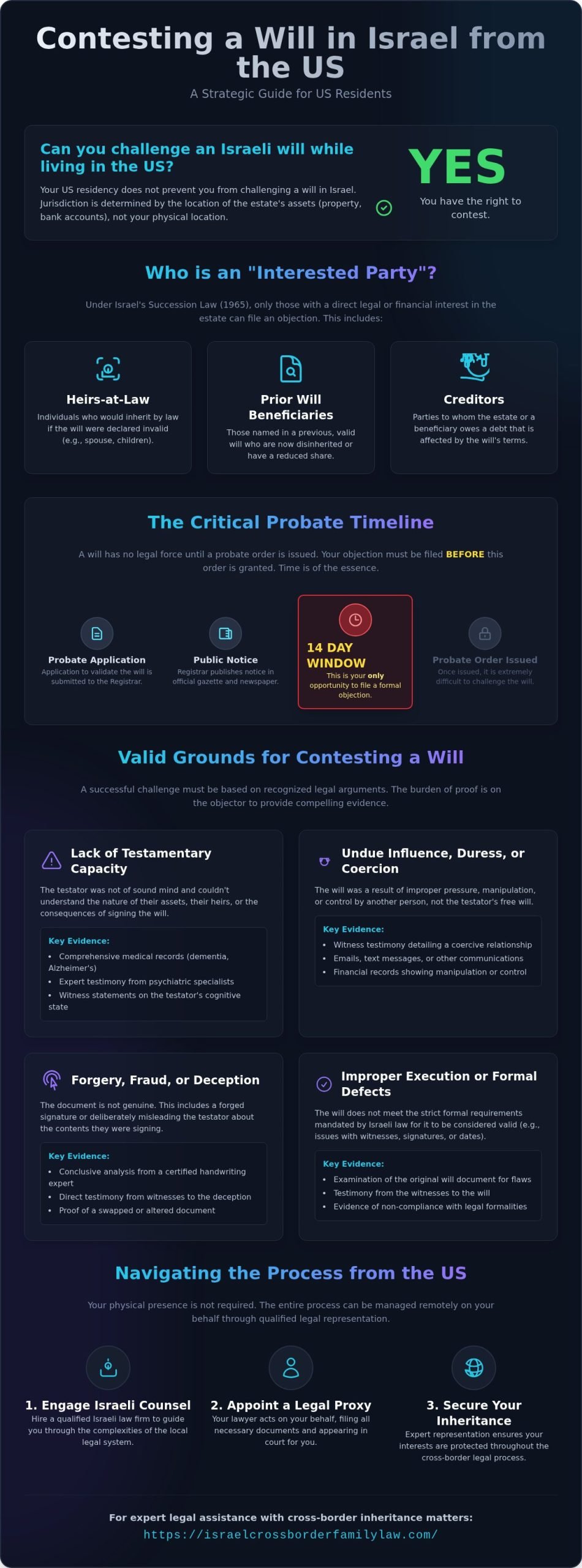
The definitive answer is yes. Your residency in the United States does not preclude you from challenging the validity of a will in Israel. The jurisdiction of Israeli courts is determined by the location of the estate’s assets, not the physical location of the potential beneficiaries or challengers. If the deceased person owned property, bank accounts, or other assets within Israel, the Israeli legal system, specifically the Family Court or the Registrar of Inheritance, has the authority to adjudicate any disputes concerning the will governing those assets. This is a fundamental aspect of managing multi-jurisdictional estate matters. Navigating the procedural requirements of different legal systems is a critical first step. The following video provides valuable insight into how foreign legal opinions are handled within the Israeli judicial framework:
However, the right to challenge a will is not granted to everyone. Under Israeli law, you must have legal standing as an “interested party.” Furthermore, your physical presence in Israel is not a prerequisite for initiating a challenge. By engaging qualified Israeli legal counsel, you can appoint a legal proxy to act on your behalf, file all necessary documents, and represent your interests in court proceedings, making the process of contesting a will in Israel from the US a manageable legal endeavor.
Who is Considered an ‘Interested Party’?
According to Israel’s Succession Law, 1965, only an ‘interested party’ (Ba’al Inyan) has the standing to file an objection to a will. This status is not defined by emotional connection but by a direct and tangible legal or financial interest in the outcome of the probate process. Your standing is determined by your relationship to the deceased and how the will’s execution would affect you, a core principle in global inheritance laws. Generally, this includes:
- Heirs-at-law: Individuals who would inherit from the estate under the rules of intestacy if the will were declared invalid.
- Beneficiaries of a Prior Will: Persons named as beneficiaries in a previous, validly executed will who have been disinherited or had their share reduced in the current will.
- Creditors: Creditors of the estate or of a specific beneficiary who can demonstrate that their ability to collect a debt is impacted by the will’s terms.
The Importance of the Probate Order
A will has no legal force in Israel until a probate order (Tzav Kiyum Tzavaha) is granted by the Registrar of Inheritance. This order validates the will and authorizes the executor to distribute the estate’s assets. The most critical factor when contesting a will in Israel from the US is timing: your objection must be filed before this probate order is issued. Once the probate application is submitted, the Registrar publishes a notice in the official gazette (Reshumot) and a daily newspaper, initiating a brief window for objections. Typically, an interested party has 14 days from the date of publication to formally submit their opposition. Missing this strict deadline can severely compromise your ability to challenge the will.
Valid Grounds for Contesting a Will Under Israeli Law
Navigating the complexities of Israeli succession law requires a clear understanding of the specific legal grounds upon which a will can be challenged. Unlike general dissatisfaction with an inheritance, a successful challenge must be founded on one of several recognized legal arguments. The burden of proof rests entirely on the party objecting to the will. For those initiating the process of contesting a will in Israel from the US, this necessitates a diligent and strategic approach to gathering compelling evidence from afar to substantiate any claims before the Israeli Family Court or Registrar of Inheritance.
Lack of Testamentary Capacity
A primary ground for invalidation is proving the testator lacked the requisite mental capacity when the will was executed. This means they were not of sound mind and could not comprehend the nature of their assets, identify their heirs, or understand the consequences of signing the document. This state can result from conditions like dementia, Alzheimer’s disease, severe illness, or other psychiatric disorders. Essential evidence includes comprehensive medical records, expert testimony from geriatric or psychiatric specialists, and statements from witnesses who can attest to the testator’s cognitive state.
Undue Influence, Duress, or Coercion
A will can be nullified if it was created not from the testator’s free will but as a result of improper pressure exerted by another individual. Courts look for evidence of a testator who was dependent, isolated, or controlled by a dominant influencer who benefited from the will. Proving undue influence often requires witness testimony detailing the coercive relationship, alongside communication records such as emails, text messages, or financial documents that illustrate a pattern of manipulation or control over the testator.
Forgery, Fraud, or Deception
This claim asserts that the will itself is not a genuine document. This can manifest in several ways, including a forged signature of the testator or witnesses, or a situation where the testator was deliberately misled about the contents or nature of the document they were signing. Successfully arguing forgery or fraud typically requires powerful evidence, such as a conclusive analysis from a certified handwriting expert or direct testimony from witnesses who were present during the deceptive signing.
Improper Execution or Formal Defects
Israeli law mandates strict formal requirements for a will to be valid. A challenge on these grounds is not about the testator’s intent but about procedural failures. Common defects include an incorrect number of witnesses, witnesses not being present simultaneously during the signing, or other failures to comply with the specific legal formalities. Understanding these technicalities is crucial, as they are foundational to the entire probate process, which is formally initiated with documents like the Israeli Application for Succession Order. A procedural error can be sufficient to invalidate the entire will.
The Legal Process: A Step-by-Step Guide for US Residents
Navigating the Israeli legal system to challenge a will requires a structured, time-sensitive approach. For beneficiaries residing in the United States, understanding the chronological progression of a will contest is critical to protecting your inheritance rights. The entire process underscores the necessity of engaging experienced Israeli legal counsel immediately upon learning of a probate application, as strict deadlines apply. Successfully contesting a will in Israel from the US depends on decisive action and expert guidance on the ground. The journey from initial objection to a final court judgment follows a distinct, multi-stage path within Israel’s judicial framework.
Step 1: Filing the Formal Objection
The legal challenge commences with the submission of a formal “Objection to the Grant of a Probate Order” to the Israeli Registrar of Inheritance. This is not a simple letter but a comprehensive legal document. It must be supported by a detailed affidavit, sworn by the objector, that meticulously outlines the specific legal grounds for the challenge. All initial supporting documents and evidence must be attached to this filing. Upon acceptance, the Registrar transfers the entire case to the jurisdiction of the Family Court, which will adjudicate the dispute.
Step 2: Evidence Gathering and Discovery
Once the case is before the Family Court, the discovery phase begins. This is a critical period where both sides exchange information and evidence. For a US-based objector, this stage involves complex, multi-jurisdictional challenges, such as obtaining notarized witness statements or authenticated medical records from the United States to support claims of undue influence or lack of testamentary capacity. This phase presents unique logistical hurdles. Learn about the specific challenges faced by expats and foreign nationals during this process. Your legal team may also need to depose key witnesses located in either Israel or the US.
Step 3: The Court Proceedings
The litigation phase includes pre-trial hearings where the court and legal counsel for both parties work to define the core issues of the dispute and schedule the main hearing. During the trial, your Israeli lawyer will present all evidence, cross-examine witnesses, and argue your case before the judge. A significant advantage of having a dedicated legal team in Israel is that your physical presence can often be minimized, saving you the considerable time and expense of international travel. The court will ultimately issue a final, binding judgment, which may be subject to appeal to a higher court.
Navigating the Practical Challenges from the United States
The prospect of contesting a will in Israel from the US introduces significant logistical complexities, including vast distances, inconvenient time zones, and unfamiliar bureaucratic procedures. However, these obstacles are not insurmountable. With a proactive strategy and a dedicated cross-border legal team, these challenges can be effectively managed, ensuring your case proceeds without disruption. Our advisory is built on bridging this geographical divide through specialized expertise and modern technology.
Executing Legal Documents from Abroad
Authorizing legal action in Israel requires correctly authenticated documents. This is streamlined through a few key instruments:
- Power of Attorney: Granting a limited Power of Attorney (PoA) to your Israeli lawyer empowers them to file documents, appear in court, and act on your behalf, minimizing your need for international travel.
- Apostille Certification: As both the US and Israel are signatories to the Hague Convention, documents like a PoA or a sworn affidavit can be authenticated with an Apostille. This certification, issued by the Secretary of State in the state where the document was notarized, is recognized as valid by Israeli courts, simplifying the entire process.
Managing Communication and Strategy
Maintaining clear and consistent communication is paramount. Our firm leverages video conferencing for strategic planning sessions, ensuring you are fully engaged in every decision, regardless of your location. This is reinforced by a deep, nuanced understanding of both US and Israeli business cultures, which prevents misinterpretations. We have engineered a refined methodology to ensure seamless cross-border collaboration; you can explore how our process works to see this structure in action.
The Importance of a Unified Legal Team
Engaging separate legal counsel in the US and Israel creates a fragmented approach fraught with risk. A unified, cross-border firm acts as your single point of contact, developing a cohesive legal strategy that considers all multi-jurisdictional implications. This integrated structure is essential when contesting a will in Israel from the US, as it eliminates the potential for miscommunication and strategic errors that can arise between uncoordinated teams, ensuring your objectives are pursued efficiently and effectively. Contact us to learn how our team can assist you.
Why a Specialized US-Israel Cross-Border Lawyer is Essential
Navigating the complexities of an Israeli inheritance dispute requires sophisticated legal counsel. When you are managing this challenge from the United States, the need for specialized expertise becomes paramount. While a general Israeli lawyer can address local probate law, the process of contesting a will in Israel from the US introduces a multi-jurisdictional dimension that demands a firm with dedicated cross-border experience. Protecting your inheritance requires a legal partner who can operate seamlessly across both legal and cultural landscapes.
Expertise in Both Legal Systems
A successful will contest often involves navigating the intricate intersection of US and Israeli law. A lawyer dually qualified or with deep experience in both jurisdictions provides a critical advantage. This includes:
- Advising on the application of Israeli inheritance law while considering how evidence gathered in the US will be treated in an Israeli court.
- Understanding the potential US tax implications of an Israeli inheritance, an area frequently overlooked by counsel focused solely on the Israeli legal framework.
- Strategizing on the enforceability of related US court orders or judgments within the Israeli legal system, ensuring a comprehensive and cohesive legal approach.
Bridging the Cultural and Language Gap
Effective representation extends beyond legal statutes. It requires a nuanced understanding of culture, communication, and local customs. A US-Israel cross-border attorney acts as your essential bridge, translating not just the language, but the legal culture. They can communicate complex Israeli legal procedures and concepts in clear, unambiguous English and appreciate the distinct nuances of Israeli court etiquette and negotiation styles. This ensures your intentions are accurately represented and that you remain fully informed and empowered throughout the process.
Your Advocate on the Ground
Attempting to manage a legal dispute from thousands of miles away is a significant source of stress and uncertainty. Having a dedicated advocate on the ground in Israel provides invaluable peace of mind. Our firm is structured to serve as your direct representative, handling all necessary court appearances, administrative filings, and local negotiations on your behalf. We provide regular, comprehensive updates, ensuring you are never in the dark about the status of your case. This allows you to focus on your life in the US, confident that your interests are being vigorously protected by a team that understands the unique challenges of contesting a will in Israel from the US. The complexities of your situation demand a tailored, expert solution. Ready to discuss your case? Request a confidential case review with our experts.
Secure Your Inheritance with Expert Cross-Border Representation
The process of contesting a will in Israel from the US is undeniably complex, governed by a unique set of laws and procedural requirements. As this guide has demonstrated, success hinges not only on establishing valid legal grounds under Israeli Inheritance Law but also on skillfully navigating the logistical challenges of an international dispute. The distance, language barriers, and differing legal systems create a sophisticated legal challenge that demands specialized, multi-jurisdictional expertise to protect your interests effectively. Navigating this intricate landscape requires a legal partner with a proven track record of representing US clients in Israeli Family Courts. Our firm offers precisely that: decades of focused experience in US-Israel cross-border family and inheritance law. Our dedicated team is fluent in both English and Hebrew and features attorneys licensed to practice in both jurisdictions, providing a seamless and powerful advantage in these critical matters. Do not let geography or complexity deter you from pursuing your rightful claim. We invite you to Schedule a Confidential Consultation to Protect Your Inheritance Rights and take the decisive first step toward securing your family’s legacy with a team that expertly bridges the legal gap between the United States and Israel.
Frequently Asked Questions
How long do I have to contest a will in Israel after a person dies?
The timeframe is extremely strict. An objection to a probate application must be filed with the Inheritance Registrar within 14 days of its publication. Given this narrow window, immediate action is paramount for any party wishing to contest the will. Our firm is positioned to act swiftly on behalf of international clients, ensuring these critical deadlines are met and your rights are preserved from the outset of the complex probate process.
What kind of evidence is most effective in proving undue influence from the US?
For clients contesting a will in israel from the us, effective evidence includes documented communications like emails revealing coercion and financial records showing unusual transfers. Sworn affidavits from US-based witnesses, such as caregivers who observed the testator’s isolation, are critical. Furthermore, medical expert opinions regarding the testator’s vulnerability can substantially strengthen the claim within the Israeli family court system, providing a comprehensive evidentiary foundation for the challenge.
Do I have to travel to Israel for the court hearings if I contest a will?
It is not always necessary for you to travel to Israel for court proceedings. Through a legally executed Power of Attorney, our Israeli-admitted attorneys can represent you in all hearings. For evidentiary matters, Israeli courts often permit testimony via video conference, a common practice in multi-jurisdictional litigation. This allows you to participate effectively from the United States while we navigate the legal framework on your behalf, minimizing disruption and travel expenses.
What are the estimated legal costs for contesting a will in Israel from abroad?
Legal costs for these complex cross-border matters are variable and depend on the case’s intricacy and duration. While initial court filing fees are modest, comprehensive legal representation for a contested probate can range from ₪50,000 to over ₪200,000. This estimate encompasses attorney fees, securing expert witness testimony, and administrative costs. We provide a transparent fee structure, advising clients on the financial commitment required for a robust legal challenge.
What happens to the estate’s assets while the will is being contested?
Once a will contest is formally initiated, the estate’s assets are typically frozen by the court to preserve their value. A temporary estate administrator may be appointed to manage the assets, pay necessary debts, and prevent any distributions until the court renders a final judgment on the will’s validity. This legal safeguard ensures that all property, funds, and other assets are protected throughout the duration of the sophisticated legal dispute.
If a will is declared invalid, who inherits the property?
If the court declares a will invalid, asset distribution is determined by one of two scenarios. If a prior, valid will exists, its terms will be executed. In the absence of any other valid will, the estate is distributed according to Israel’s Inheritance Law of 1965. This statute of intestate succession dictates a specific hierarchy of heirs, typically beginning with the deceased’s spouse and children, ensuring an orderly and legally-defined transfer of assets.

Article by
Gabriel Lior
A Personal Journey That Became a Mission The advisory was founded by an American father Gabriel Lior, LLB, MBA , global entrepreneur, and cross-border advisor who spent more than a decade navigating the Israeli family court system firsthand and now lives in Singapore with his son.
As a divorced parent in a cross-border family, Gabriel faced nearly every legal challenge a foreign parent can encounter in Israel — including child custody disputes, child support proceedings, property matters in Israel and abroad, false accusations, and complex immigration and relocation proceedings. Over the years, he learned the hard way how difficult it is for non-Israeli parents to understand the system, identify the right legal strategy, and choose the right legal representation — especially when language, culture, and jurisdictional differences are involved. He also witnessed how foreign parents and new immigrants are often disadvantaged or taken advantage of by service providers and institutions simply because they lack local knowledge or fluency. From Client to Advisor To truly understand — and survive — the system, Gabriel pursued formal legal education in Israel, completing two Israeli law degrees, alongside a BA and MBA earned in the United States. This was never about becoming a practicing attorney, but about gaining a deep, structural understanding of how the system works — and where it breaks down for foreign parents. This rare combination of: Firsthand client experience Israeli legal and US business education International business and negotiation training Decades of commercial execution created a unique perspective – one that understands both sides of the table. After years of litigation, persistence, and at times self-representation, he ultimately succeeded in securing custody of his son and relocating abroad through a rare legal victory in the Israeli Supreme Court — becoming one of the first fathers in Israel to do so under these circumstances.
Disclaimer
Important Disclaimer: The information provided on this website and in its content is for general informational and educational purposes only and does not constitute legal advice, legal opinion, or legal representation. Gabriel Lior is not licensed to practice law in Israel (nor is he interested in doing so) and does not provide legal services, despite having completed 2 Law Degrees. The services offered are advisory in nature and are intended to provide general guidance, strategic insight, and information regarding cross-border family law considerations. No attorney-client relationship is formed by accessing this website, reading its content, or communicating with us. Any decisions made based on this information are at your own discretion and risk. For legal advice specific to your situation, you should consult a licensed attorney in the relevant jurisdiction. Where appropriate, we may refer clients to independent, licensed attorneys or professionals. Such referrals do not constitute legal representation and no liability is assumed for services provided by third parties.