What if the path to parenthood in a foreign legal system is actually more accessible than the complex Hebrew bureaucracy suggests? For many international families and expats, understanding the israel embryo carrying agreements law surrogate unmarried requirement was once a major hurdle, but landmark legal shifts have recently transformed the landscape. Since the 2021 High Court ruling was fully implemented in 2022, Israel has become a leading jurisdiction for inclusive surrogacy, yet the process remains strictly regulated by the Ministry of Health.
You probably feel a mix of hope and anxiety as you face the rigorous approval process required for gestational agreements. It’s common to feel overwhelmed by the genetic link mandates or the residency tests required by Israeli authorities to prove your life is centered in the country. This article provides a clear roadmap through the Embryo Carrying Agreements Law, ensuring you understand the eligibility criteria for single parents and the specific steps needed for committee approval. We’ll explore the strategic decisions you must make early on to avoid delays and navigate the cross-border complexities of building your family in Israel. Please note that this content is published on an independent advisory platform and does not constitute formal legal representation or advice.
Key Takeaways
- Identify the core requirements of gestational surrogacy in Israel, where a genetic link to at least one parent is a mandatory legal threshold.
- Navigate the updated israel embryo carrying agreements law surrogate unmarried requirement to understand how recent legal shifts have opened the process to single parents and same-sex couples.
- Learn how to prepare for the Ministry of Health’s Approval Committee by meeting specific residency, age, and medical necessity criteria.
- Bridge the gap between Israeli regulations and international requirements, particularly regarding US citizenship for children born to expat parents.
- Gain clarity on the strategic importance of early decision-making to manage the bureaucratic and emotional complexities inherent in the Israeli surrogacy system.
Understanding the Embryo Carrying Agreements Law in Israel
The legal framework for surrogacy in Israel is established by the Embryo Carrying Agreements (Agreement Approval and Status of the Newborn) Law, 5756-1996. This legislation provides a structured, ethical path for intended parents while ensuring the protection of all parties involved. Unlike many jurisdictions with less oversight, the Israeli system requires every contract to be reviewed by a specialized statutory committee under the Ministry of Health. This central oversight ensures that the israel embryo carrying agreements law surrogate unmarried requirement is met according to the latest legal standards and ethical guidelines.
The primary objective of this law is to balance the deep desire for parenthood with the rights of the surrogate and the welfare of the future child. By centralizing control within the Ministry of Health, the state prevents exploitation and maintains high medical and ethical standards. This rigorous process provides a sense of security for international families and expats who may be unfamiliar with the local legal culture. It’s important to understand that this content is published on an independent advisory platform and does not constitute formal legal representation or advice.
To better understand the recent shifts in this legal landscape, watch this helpful video:
Gestational vs. Traditional Surrogacy
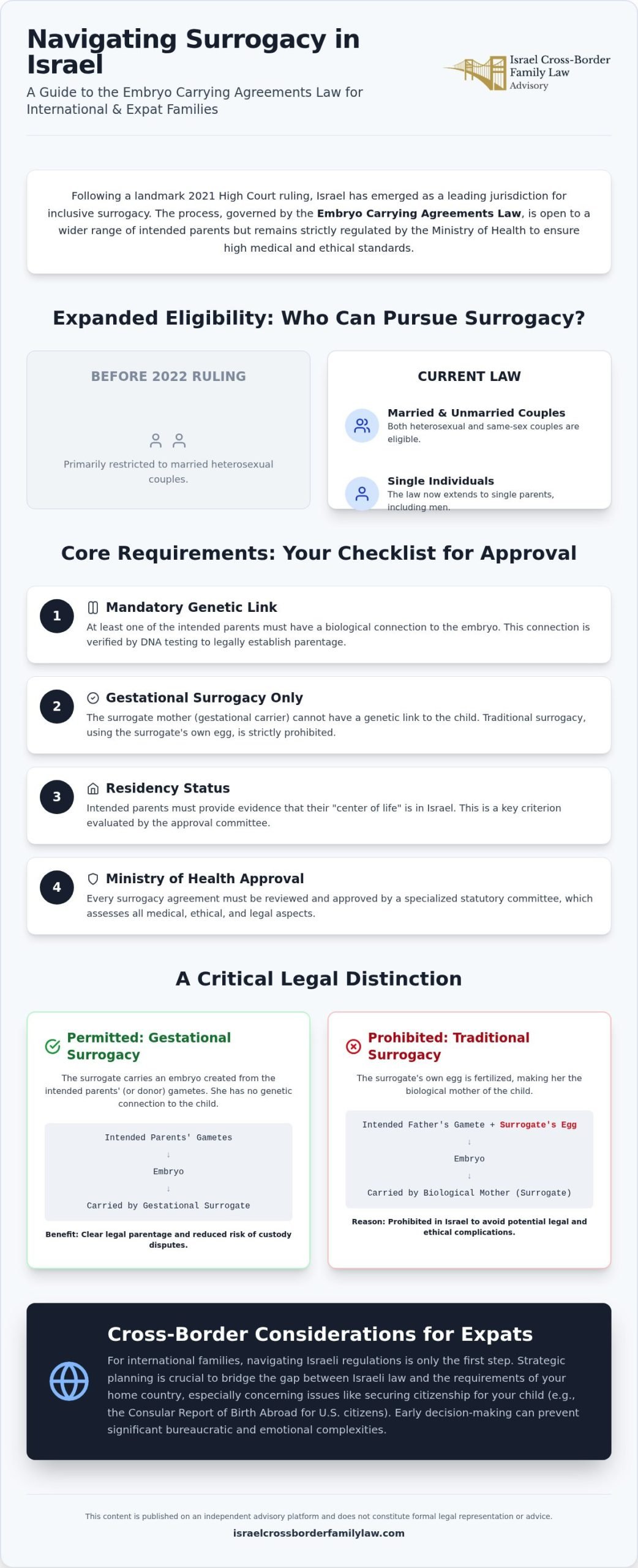
In Israel, the law permits only gestational surrogacy. This means the surrogate mother cannot have a biological link to the embryo she carries. Traditional surrogacy, where the surrogate’s own eggs are used, is strictly prohibited. The courts view the surrogate as a gestational carrier rather than a biological parent. This distinction is critical because it clarifies the legal status of the newborn from the moment of birth. It reduces the risk of complex custody disputes that often plague traditional surrogacy arrangements in other countries. For those navigating these rules as expats or foreign nationals, understanding this “human incubator” model is the first step toward a successful application.
The Genetic Link Requirement
A cornerstone of the Israeli system is the mandatory genetic link. At least one of the intended parents must have a biological connection to the embryo. This requirement was a central theme in the landmark High Court ruling that expanded access to the process for single men and same-sex couples. The state verifies this link through DNA testing to confirm parentage before the child’s status is finalized. If neither parent can provide viable gametes, the process cannot proceed under current Israeli regulations. This mandate ensures that the legal relationship between the child and the intended parents is grounded in a biological reality recognized by the state. Decisions made at this stage carry significant weight, as they dictate the long-term legal security of the family unit.
Surrogacy for Unmarried Individuals and Same-Sex Couples
The landscape of reproductive rights in Israel underwent a seismic shift in July 2021. For decades, the legal framework favored married heterosexual couples, leaving single individuals and same-sex partners to seek options abroad. This changed when the High Court of Justice struck down discriminatory provisions, which officially opened surrogacy to same-sex couples and single men in January 2022. Today, the israel embryo carrying agreements law surrogate unmarried requirement ensures that marital status is no longer a barrier to entry. This content is published on an independent advisory platform and does not constitute formal legal representation or advice.
The Shift from “Spouses” to “Individuals”
Legislative amendments have replaced restrictive terminology with more inclusive language. The law now recognizes “intended parents” as individuals, regardless of their relationship status. This means a single man or woman faces the same medical and psychological screening as a married couple. The israel embryo carrying agreements law surrogate unmarried requirement now focuses on the individual’s capacity to parent rather than their marital status. While the legal path is now open, the increased pool of applicants has impacted matching timelines. Strategic planning is essential for expats and foreign nationals who must coordinate their “center of life” requirements with these evolving wait times.
Legal Protections for Unmarried Intended Parents
Establishing legal parentage for unmarried individuals requires a specific judicial step known as a Parental Order. This court-issued document serves as the definitive proof of parentage, bypassing the need for a marriage certificate. For same-sex male couples, where only one partner typically shares a biological link with the child, this order is vital for securing the non-biological parent’s rights. The process involves mandatory oversight from the Ministry of Welfare and Social Security. Social workers conduct evaluations to ensure the child’s best interests are protected. While this adds a layer of bureaucracy, it creates a robust legal foundation that is recognized across international borders. It’s often helpful to seek clarity on these procedural nuances before initiating the formal committee application.
The Approval Committee: Navigating the Ministry of Health Process
The Committee for Approval of Embryo Carrying Agreements is the central regulatory body that oversees every surrogacy arrangement in the country. This multi-disciplinary board includes medical specialists, social workers, a public representative, a cleric, and a legal professional. Their mandate is to ensure that every case strictly adheres to Israel’s Embryo Carrying Agreements Law. For international families, this committee acts as the final gatekeeper, and understanding their criteria is the most important part of your preparation. This content is published on an independent advisory platform and does not constitute formal legal representation or advice.
The approval process generally unfolds in three distinct stages. First, the committee reviews threshold conditions to confirm that the intended parents meet age, residency, and medical necessity standards. Second, all parties must undergo comprehensive psychological and medical evaluations to ensure they’re prepared for the emotional and physical demands of the journey. Finally, the committee reviews the legal contract itself, focusing on financial transparency and the protection of the surrogate’s rights. Only after this final signature can medical procedures legally begin. You can learn more about how this sequence fits into a broader strategy on our how it works page.
Threshold Requirements for Prospective Parents
To qualify for the process in 2026, intended parents must be at least 18 years old. At least one parent must not exceed the age of 54 at the time of application. The committee requires a robust document checklist, including expert medical opinions confirming the necessity of surrogacy, criminal record checks, and evidence of financial stability. A critical factor for expats is the residency requirement. The state typically requires at least one party to the agreement to be an Israeli resident, often applying a “center of life” test to verify that the family truly lives in the country. Decisions made during this initial filing are heavy, as missing documents can lead to significant delays in an already lengthy process.
The Surrogate Matching Process
The israel embryo carrying agreements law surrogate unmarried requirement creates a specific profile for potential surrogates. By law, a surrogate must be between 22 and 39 years old and must have previously given birth to at least one child of her own. The law generally mandates that the surrogate be unmarried. While the committee can make exceptions if intended parents demonstrate they couldn’t find an unmarried surrogate after reasonable effort, these cases are rare. Additionally, the committee prioritizes matching the surrogate’s religion with that of the intended mother to avoid complex religious-legal issues regarding the child’s status. A candidate will be rejected if she has already served as a surrogate more than twice or if there are concerns regarding her physical or mental readiness for another pregnancy.
Cross-Border Considerations for Expats and US Citizens
Navigating the Israeli surrogacy system as a foreign national requires a dual-track strategy. While you must satisfy the israel embryo carrying agreements law surrogate unmarried requirement to proceed locally, you must also satisfy the requirements of your home country’s consulate. This is especially true for American citizens, where the transmission of citizenship is not automatic in surrogacy arrangements. Families must bridge the gap between Israeli domestic law and international regulatory standards. This content is published on an independent advisory platform and does not constitute formal legal representation or advice.
Securing US Citizenship for the Newborn
The Consular Report of Birth Abroad (CRBA) is the critical document for your child’s US citizenship. The US Embassy in Jerusalem or the Branch Office in Tel Aviv requires clear evidence of a genetic link between the child and the American parent. Even with an Israeli Parental Order in hand, the Embassy usually mandates DNA testing through an accredited laboratory. This verification process can take several weeks; you should account for this delay before planning any international travel. For those managing these requirements, specialized guidance for expats and foreign nationals can help align local procedures with consular expectations.
Timing and logistics are often the most stressful components for expat families. You cannot simply apply for a US passport the day after birth. The process requires a physical appointment, the submission of the genetic link verification, and the presence of both parents or specific notarized consent. Most families should expect to remain in the country for at least four to six weeks following the birth to finalize these federal requirements. Planning for this window early in the process prevents significant logistical hurdles later on.
Enforcing Support and Custody Across Borders
An Israeli Parental Order is a powerful legal instrument within the country, but its recognition in US state courts is not always guaranteed. Because family law in the United States is handled at the state level, the level of recognition given to foreign orders varies. Many families choose to pursue a mirror agreement or a secondary parentage order in their home state to ensure absolute legal security. This prevents future disputes regarding custody or cross-border child support enforcement. If you are managing the complexities of a cross-border family, it’s vital to request a strategic review of your situation.
You must also consider how your child’s status affects your estate planning and inheritance rights. Inheritance laws differ significantly between Israel and the US, particularly regarding how different jurisdictions view children born via gestational carriers. Ensuring your assets are protected requires a multi-jurisdictional approach that accounts for the child’s unique legal origin. Early decisions in the contract phase will dictate your long-term security in both legal systems.
Strategic Planning and Risk Management
Success in the Israeli surrogacy process depends on more than just meeting the israel embryo carrying agreements law surrogate unmarried requirement. It requires a proactive approach to risk management and a clear understanding of the long-term impact of your early decisions. This content is published on an independent advisory platform and does not constitute formal legal representation or advice. Every choice you make, from the initial contract drafting to the selection of your medical team, dictates your legal and emotional security for years to come.
Financial planning is a critical component of this strategy. Intended parents often focus primarily on the surrogate’s base compensation, but the total commitment includes medical insurance, psychological support, legal drafting, and potential neonatal care costs. You’ll find that having a comprehensive budget prevents surprises during the committee’s financial review. For a detailed breakdown of how these costs are structured, you can review our page on Understanding Our Pricing and Advisory Model.
The Ministry of Health process is frequently described as emotionally and physically demanding. The Approval Committee’s scrutiny is intense, as they’re tasked with protecting the welfare of all parties. Preparing for this level of oversight is essential for maintaining your well-being throughout the journey. By understanding the israel embryo carrying agreements law surrogate unmarried requirement early, you can align your expectations with the rigid bureaucratic reality of the Israeli system.
Clarity Before Commitment
Seeking independent advisory before signing with a surrogacy agency is a vital step in managing risk. Agencies provide valuable services, but they aren’t independent advisors; their primary goal is to facilitate a match. You should look for “red flags” in potential surrogate matches, such as a lack of transparency in medical history or vague terms regarding escrow management. While international surrogacy in countries like Georgia or Albania might seem faster, the domestic Israeli path offers superior legal stability and protections that aren’t available in less regulated jurisdictions. Strategic clarity at the start prevents expensive and emotionally draining corrections later.
Next Steps for Intended Parents
Building a robust support team is your next priority. This team should include medical experts, psychological counselors, and legal advisors who understand the nuances of cross-border family law. When preparing for the Committee interview, expect direct questions about your motivations and your plan for supporting the surrogate. Remaining calm and transparent during this interview is the best way to demonstrate your readiness for parenthood. Most families find that having a roadmap for these interviews significantly reduces the anxiety of the process.
Get clarity before you commit. Request a confidential case review to discuss your specific situation and strategic needs.
Securing Your Path to Parenthood in Israel
Building a family through the Israeli surrogacy system requires a sophisticated understanding of the israel embryo carrying agreements law surrogate unmarried requirement alongside a proactive cross-border strategy. While the 2021 legal shifts offer significant opportunities for single parents and same-sex couples, the rigid oversight of the Ministry of Health remains a complex hurdle. You must balance local residency tests with international citizenship mandates to ensure your child’s future is legally secure in both jurisdictions. This content is published on an independent advisory platform focusing on US-Israel strategy; it’s designed to provide clarity for expat legal navigation rather than formal legal advice, which is only provided by licensed attorneys under a separate engagement.
Strategic planning is your most effective tool for managing the inherent complexities of this journey. You can access more educational resources on our YouTube channel to deepen your knowledge of these regulatory landscapes. Get clarity before you commit. Request a confidential consultation to discuss your unique situation and decision-making roadmap. Your goal of parenthood is achievable with the right preparation and a steady guide through the bureaucracy.
Frequently Asked Questions
Can an unmarried person legally enter into a surrogacy agreement in Israel?
Yes, an unmarried individual can legally pursue surrogacy in Israel. Since the implementation of the 2021 High Court ruling in early 2022, the israel embryo carrying agreements law surrogate unmarried requirement ensures that single men, single women, and same-sex couples have equal access to the process. This shift removed previous discriminatory barriers. Prospective parents in Tel Aviv or Jerusalem must still meet residency and medical criteria, proving that their center of life remains within the country.
What are the medical requirements for intended parents under the Embryo Carrying Law?
Intended parents must demonstrate a medical necessity that prevents them from carrying a pregnancy to term. The law requires applicants to be at least 18 years old, and at least one parent must be under 54 at the time of the agreement. Additionally, a clear genetic link to the embryo is mandatory. These standards are reviewed by the Ministry of Health committee to ensure the physical and psychological readiness of parents living in cities like Ra’anana or Netanya.
Does the surrogate mother have any legal rights to the child after birth in Israel?
Under Israeli law, the surrogate mother does not retain legal rights to the child after birth. The process is strictly gestational, meaning she has no biological connection to the infant. A Parental Order is issued by the court to establish the intended parents as the sole legal guardians. This legal mechanism provides security for families in Haifa or Modi’in, ensuring the newborn’s status is clear and protected from the moment of birth.
Is a genetic link to the child mandatory for surrogacy in Israel?
Yes, a genetic link between at least one intended parent and the child is a mandatory requirement. The state uses DNA testing to verify this biological connection before finalizing legal parentage. This mandate applies to all applicants, including those in Beit Shemesh or Ashdod. If neither parent can provide viable gametes, the arrangement cannot proceed under current regulations. This requirement is a foundational element of the israel embryo carrying agreements law surrogate unmarried requirement.
How long does the Ministry of Health approval process typically take?
The approval process with the Ministry of Health is thorough and typically takes several months to complete. While exact timelines vary based on the complexity of the case and current committee workloads, the demand for these agreements has risen significantly since 2012. Families in Herzliya or Petah Tikva should prepare for a sensitive, multi-stage review involving medical, psychological, and legal evaluations. Early strategic planning is essential to manage these bureaucratic timelines effectively.
Can US citizens living in Israel use a surrogate from another country?
US citizens residing in Israel may pursue international surrogacy, but they must navigate complex cross-border regulations and government advisories. The Israeli government has issued specific notices for countries like Albania, Kenya, and Ukraine. Parents must also coordinate with the US Embassy in Jerusalem or Tel Aviv to secure a Consular Report of Birth Abroad. This process requires proving a genetic link and meeting federal transmission of citizenship requirements, making it significantly more complex than domestic arrangements.
What happens if the surrogate and intended parents have different religions?
The Ministry of Health committee generally requires the surrogate and the intended mother to share the same religion. This policy aims to prevent future legal or religious complications regarding the child’s status under Israeli law. While the committee can grant exceptions in rare circumstances, they are the exception rather than the rule. Families in Givatayim or Hod Hasharon should consider this religious matching factor early when searching for a potential surrogate candidate to avoid delays.
Is traditional surrogacy (using the surrogate’s egg) ever allowed in Israel?
No, traditional surrogacy is strictly prohibited in Israel. The law only permits gestational surrogacy, where the surrogate carries an embryo created from the eggs of the intended mother or a donor. This prohibition ensures that the surrogate has no genetic link to the child, which simplifies the legal transfer of parentage. This model is a core principle for all arrangements in Israel, providing a clear legal framework for families in Caesarea or Eilat. This content is published on an independent advisory platform.

Article by
Gabriel Lior
A Personal Journey That Became a Mission
The advisory was founded by an American father Gabriel Lior, LLB, MBA , global entrepreneur, and cross-border advisor who spent more than a decade navigating the Israeli family court system firsthand and now lives in Singapore with his son.
As a divorced parent in a cross-border family, Gabriel faced nearly every legal challenge a foreign parent can encounter in Israel — including child custody disputes, child support proceedings, property matters in Israel and abroad, false accusations, and complex immigration and relocation proceedings.
Over the years, he learned the hard way how difficult it is for non-Israeli parents to understand the system, identify the right legal strategy, and choose the right legal representation — especially when language, culture, and jurisdictional differences are involved. He also witnessed how foreign parents and new immigrants are often disadvantaged or taken advantage of by service providers and institutions simply because they lack local knowledge or fluency.
From Client to Advisor
To truly understand — and survive — the system, Gabriel pursued formal legal education in Israel, completing two Israeli law degrees, alongside a BA and MBA earned in the United States. This was never about becoming a practicing attorney, but about gaining a deep, structural understanding of how the system works — and where it breaks down for foreign parents.
This rare combination of:
Firsthand client experience
Israeli legal and US business education
International business and negotiation training
Decades of commercial execution
created a unique perspective – one that understands both sides of the table.
After years of litigation, persistence, and at times self-representation, he ultimately succeeded in securing custody of his son and relocating abroad through a rare legal victory in the Israeli Supreme Court — becoming one of the first fathers in Israel to do so under these circumstances.
Disclaimer
Important Disclaimer:
The information provided on this website and in its content is for general informational and educational purposes only and does not constitute legal advice, legal opinion, or legal representation.
Gabriel Lior is not licensed to practice law in Israel (nor is he interested in doing so) and does not provide legal services, despite having completed 2 Law Degrees. The services offered are advisory in nature and are intended to provide general guidance, strategic insight, and information regarding cross-border family law considerations.
No attorney-client relationship is formed by accessing this website, reading its content, or communicating with us.
Any decisions made based on this information are at your own discretion and risk. For legal advice specific to your situation, you should consult a licensed attorney in the relevant jurisdiction.
Where appropriate, we may refer clients to independent, licensed attorneys or professionals. Such referrals do not constitute legal representation and no liability is assumed for services provided by third parties.