Could the most expensive mistake in your Israeli legal matter be the fee agreement you didn’t fully understand? Many expats and international families arrive in the Israeli legal system fearing they’ll be charged a “tourist price” simply because they don’t speak Hebrew or understand local norms. It’s a valid concern; the transition from a foreign system to the Israeli framework often feels opaque, especially when costs aren’t clearly defined from the start.
This guide provides a comprehensive breakdown of the typical israeli lawyer price structures, ensuring you have the clarity needed to evaluate quotes and manage your legal budget with confidence. We’ll examine the differences between hourly and global fees, the mandatory nature of written agreements, and the often-overlooked administrative costs like the standard 18% VAT and court filing fees. By understanding how these costs are structured, you can approach your family law or estate matter with a strategic mindset rather than uncertainty. This information is published on an independent advisory platform to help you gain clarity before you commit to a formal legal engagement.
Key Takeaways
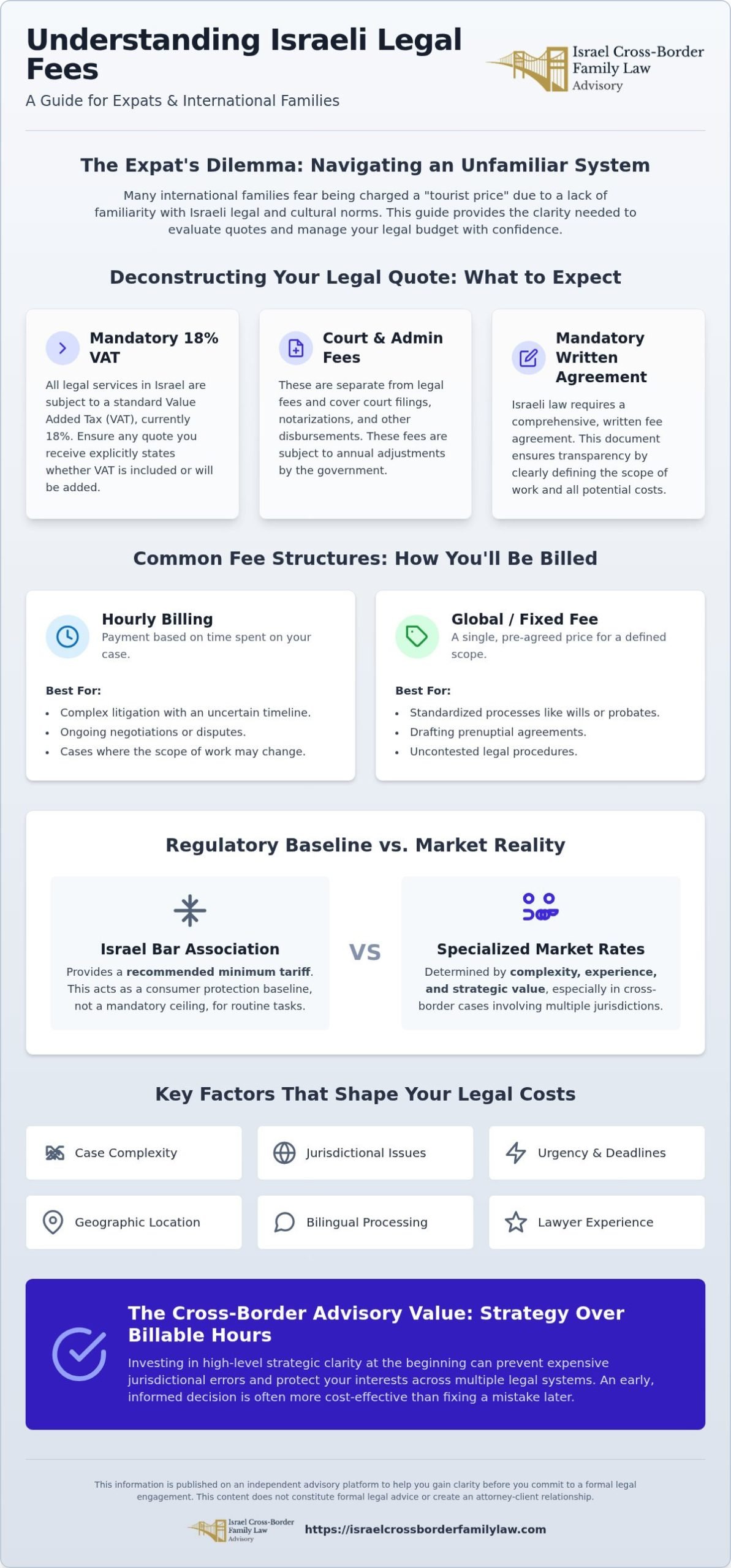
- Distinguish between the Israel Bar Association’s recommended minimum tariffs and the market rates typical of specialized cross-border firms.
- Learn how to evaluate a quoted israeli lawyer price by accounting for the mandatory 18% VAT and annual adjustments to court filing fees.
- Determine the most appropriate fee structure for your needs, from hourly billing in litigation to fixed fees for wills and prenuptial agreements.
- Understand how early strategic clarity can prevent expensive jurisdictional errors and ensure your interests are protected across multiple legal systems.
- Recognize the necessity of a comprehensive, written fee agreement to ensure transparency regarding the scope of work and potential administrative disbursements.
The Israeli Legal Fee Landscape: Regulated vs. Market Rates
Expats often find the Israeli legal market confusing because it operates under a unique mixture of regulatory recommendations and free-market dynamics. Understanding the standard israeli lawyer price requires a look at how the Israel Bar Association (Lishkat Ha’orech HaDin) influences the industry. While the Bar provides a framework, it doesn’t strictly control what a private firm can charge for specialized representation. Most practitioners in high-demand fields like family law or estates set their rates based on the complexity of the matter and the strategic value they provide.
The Minimum Tariff acts as a consumer protection baseline in Israel, establishing suggested lower limits for legal fees to prevent predatory pricing or service degradation.
To better understand the context of legal costs in the region, watch this helpful video:
The Role of the Israeli Bar Association
The Bar Association sets the ethical standards for how fees are collected and communicated to clients. Its recommended minimum tariff provides a reference point for routine tasks like simple contracts, basic filings, or uncontested probate applications. However, it’s vital to recognize that these figures are recommendations rather than mandatory ceilings. Expats should use the tariff as a baseline for comparison rather than an expected fixed price. For complex matters, such as international family law or multi-jurisdictional estate planning, the intensive labor and specialized knowledge required usually exceed what the minimum tariff anticipates.
Market Forces in Major Israeli Hubs
Market rates fluctuate significantly based on geography and the specific nature of the case. In commercial and high-tech hubs like Tel Aviv and Herzliya, fees are generally higher than in smaller municipalities. This “Experience Premium” reflects the higher overhead and the concentration of veteran practitioners who handle complex, multi-jurisdictional matters. When a case involves US-Israel jurisdiction, the complexity of managing divergent legal systems naturally impacts the base market rate.
Finding a fair israeli lawyer price involves balancing these local market forces with the specific strategic needs of your cross-border situation. A lawyer’s reputation, seniority, and track record in handling international clients often justify rates that sit well above the Bar’s minimum recommendations. This content is provided by an independent advisory platform to help families gain strategic clarity before entering into formal legal representation. It’s often more cost-effective to pay for high-level strategy early on than to fix a jurisdictional mistake later.
Factors That Determine Your Legal Costs in Israel
Determining a fair israeli lawyer price depends on several variables that go beyond simple hourly rates. While the overarching regulatory environment is influenced by factors like Knesset legislation on membership dues, the specific cost of your matter is usually dictated by its unique requirements. For expats and international families, the need for bilingual processing and the volume of documentation often drive the initial budget. Processing legal documents in both Hebrew and English requires precision and time, especially when dealing with foreign affidavits or financial records that must be recognized by Israeli courts.
Urgency also plays a significant role in pricing. If your case requires expedited filings or emergency injunctions, such as preventing a child from being removed from the country, the cost will reflect the priority and speed required. These “fire drill” scenarios often involve around-the-clock work that standard fee structures don’t cover. Seeking clarity on your specific situation early can help you avoid the premium costs associated with last-minute legal emergencies.
Case Complexity and Jurisdictional Issues
Cases involving assets in both the US and IL require deeper research and a more sophisticated approach than purely local matters. A “conflict of laws” analysis is often necessary to determine which country’s laws apply to specific assets or custody arrangements. This adds significant billable hours to the process. You should also budget for expert witness fees. In complex family law cases, it’s common to require input from financial experts for asset valuation or psychologists for custody evaluations. These professionals charge their own fees, which are separate from your lawyer’s base rate.
Expertise and Specialisation Fees
There is a distinct difference in pricing for a generalist versus a cross-border specialist. Multi-qualified practitioners licensed in both IL and the US are priced differently because they offer a nuanced understanding of divergent business and legal cultures. While their base rate might be higher, their ability to prevent jurisdictional mistakes can save you significant sums in the long run. Strategic advisory focuses on decision-making and risk mitigation before you commit to high-cost litigation. This approach often reduces the total number of billable hours by resolving issues through strategy rather than prolonged court battles. This information is published on an independent advisory platform to help you evaluate the value of specialized expertise before making a commitment.
Common Fee Structures: Hourly, Global, and Success Fees
Selecting the right fee structure is a critical step in managing your legal budget. The Israel Bar Association’s core functions include regulating these fee arrangements to ensure ethical conduct across the profession. When evaluating an israeli lawyer price, you’ll generally encounter four primary models: hourly billing, global fees, success fees, and retainers.
Hourly billing remains the standard for corporate matters and complex family law litigation. Because court schedules and the opposing party’s actions are unpredictable, lawyers often charge for the actual time spent on your case. Global or fixed fees are more common for predictable, transactional tasks. Drafting a Will, creating a Prenuptial Agreement, or setting up a trust usually involves a one-time payment that covers the entire scope of the project.
Success fees, or contingency fees, are permitted in specific areas like labor disputes or debt collection. However, they are strictly forbidden in divorce and personal status cases in IL. This prohibition ensures that legal fees don’t become a barrier to resolving sensitive family matters or create incentives that conflict with the best interests of the family. Retainers serve as a down payment against future work; the lawyer holds these funds in a client account and draws from them as work is performed.
When to Choose Hourly vs. Fixed Fees
Open-ended hourly billing in the Israeli Rabbinical or Family Courts can lead to budget exhaustion if a case becomes high-conflict. Fixed fees provide peace of mind for estate planning and asset protection because the total cost is known upfront. If your situation requires hourly billing, you can often request a “cap” for specific stages of a case. This limits your financial exposure while allowing the lawyer to handle the inherent unpredictability of litigation.
The Hybrid Model: Capped Fees and Stage-Based Billing
A more modern approach involves breaking a case into distinct phases, such as Discovery, Mediation, and Trial. You might agree to separate budgets for each phase, allowing you to evaluate your strategy at every turn without being locked into a massive, upfront commitment. This stage-based billing provides a level of predictability often missing in traditional litigation.
The advisory model offers a distinct advantage for those seeking initial strategy without a long-term retainer. By focusing on decision-making and risk assessment first, you gain a clear view of the road ahead. You can see how it works to understand how this phased approach prioritizes strategic clarity over endless billable hours. This independent advisory platform focuses on helping you navigate these choices before you commit to formal representation.
Evaluating a Quote: Avoiding Hidden Costs and ‘Expat Pricing’
When you receive a quote for legal services, the number on the page often doesn’t tell the whole story. For many expats, the primary concern is whether they’re being quoted a standard israeli lawyer price or an inflated rate based on their status as a foreigner. To avoid surprises, you must look beyond the professional fee and identify the ‘hidden’ costs that are standard in Israeli practice. These include Value Added Tax (VAT), court filing fees, and the costs associated with processing international documentation.
The most significant addition to any quote is ‘Ma’am’ (VAT). As of January 1, 2025, the standard VAT rate in Israel is 18%. Many firms provide quotes exclusive of VAT, which can lead to a substantial budget shortfall if you haven’t factored it in. It’s essential to clarify whether a price is ‘inclusive’ or ‘exclusive’ before signing any commitment. This transparency is a cornerstone of the advisory model, which prioritizes clarity before you enter a formal engagement.
Disbursements, or out-of-pocket expenses, are another area where costs can accumulate. Court filing fees, known as ‘Agrot’, are updated every January 1st and are adjusted based on the Consumer Price Index. Court fees (Agrot) are separate from the lawyer’s professional fee. You should also account for messenger services, international communication charges, and travel time if your lawyer must attend hearings in a different city. For cross-border matters, translation and notarisation are frequently overlooked. Making US documents valid in Israel requires certified translations and, often, an Apostille. These services carry their own costs and can add thousands of shekels to a complex case.
Understanding the Retainer Agreement (Schar Tircha)
Israeli Bar Association regulations mandate a written fee agreement, known as a Schar Tircha, before work begins. For English speakers, it’s vital to have this agreement in a language you fully understand. Look for clauses that clearly define the scope of work and how out-of-pocket expenses are handled. A robust agreement should also include a termination clause and a clear policy on fee refunds if the engagement ends early. This transparency ensures that your expectations align with the firm’s delivery and prevents disputes over the israeli lawyer price later in the process.
The Impact of VAT for Foreign Residents
There are specific scenarios where foreign residents may be eligible for a ‘zero-rate’ VAT on certain legal services. This usually applies when the service is provided to a person residing outside of Israel and the matter doesn’t involve assets or interests physically located within IL. However, family law and estate matters almost always involve local interests, making the 18% VAT mandatory. Always ask for the final price including all taxes to ensure your budget is realistic. If you’re unsure how these taxes apply to your cross-border case, you can request a confidential review of your situation.
The Cross-Border Advisory Value: Strategy Over Billable Hours
Focusing solely on the hourly israeli lawyer price can be a strategic error when managing complex US-Israel legal matters. A higher initial investment in specialized strategy often results in significant long-term savings by preventing jurisdictional mistakes that are difficult and costly to reverse. For example, filing for divorce in the wrong court or failing to account for US tax implications on Israeli assets can lead to financial consequences far outweighing any legal fee. Strategy isn’t just about representation; it’s about making high-stakes decisions with full awareness of the risks involved across both legal systems.
Clarity Before Commitment
One of the most effective ways to manage your budget is to seek a confidential case review before you hire a full litigation team. This initial assessment allows you to identify hidden risks that generalist lawyers might miss, such as the impact of currency fluctuations on child support payments or the specific requirements of the Hague Convention. Accessing specialized for expats resources helps bridge the cultural gap in legal billing, providing a clearer picture of what to expect from the Israeli system. This approach prioritizes decision-making guidance, ensuring you don’t commit to a high-cost path without a clear roadmap.
Final Recommendation for International Families
Transparency is the most important metric when you choose an Israeli lawyer. You need an advisor who understands both the US and Israeli mindsets, bridging the gap between two very different legal and business cultures. While the israeli lawyer price is a factor, the real value lies in the clarity of the fee agreement and the attorney’s willingness to explain every cost in plain English. This content is published on an independent advisory platform to help you navigate these complexities with confidence. Legal services are only provided by licensed attorneys under a separate engagement, but strategic clarity is the first step toward a successful outcome.
Get clarity before you commit. Request a confidential consultation.
Securing Strategic Clarity for Your Cross-Border Matter
Understanding the distinction between the Bar Association’s minimum recommendations and the market rates of specialized firms is the first step in evaluating any legal quote. You should prioritize absolute transparency regarding the 18% VAT and court filing fees to avoid unexpected budget overruns during your case. Most importantly, remember that the lowest israeli lawyer price isn’t always the most cost-effective option if it overlooks the jurisdictional risks inherent in cross-border family law and estates.
By focusing on high-level strategy and decision-making before committing to long-term litigation, you ensure that your financial resources are used effectively to achieve your commercial and personal goals. This independent advisory platform is dedicated to providing international families with the authoritative guidance needed to bridge the gap between US and IL legal cultures. Navigating two distinct systems is undeniably complex, but with the right strategic roadmap, you can move forward with clarity and confidence.
Get clarity before you commit. Request a confidential consultation.
Frequently Asked Questions
This content is published on an independent advisory platform (not a law firm) and focuses on strategy, risks, and decision-making guidance rather than an attorney-client relationship. Legal services are only provided by licensed attorneys under a separate engagement.
Is there a standard hourly rate for lawyers in Israel?
Standard market rates for legal services in Israel generally range from $100 to $250 per hour. However, specialized cross-border practitioners often charge higher rates that reflect their multi-jurisdictional expertise. While the Israel Bar Association provides recommended minimums, these are non-binding baseline figures. Every israeli lawyer price is ultimately determined by the seniority of the lead attorney and the strategic complexity of your specific family or estate matter.
Do I have to pay VAT (Value Added Tax) on legal fees if I live in the US?
Most legal services involving Israeli assets or personal status are subject to the standard 18% VAT, even for residents of the US. While certain services for non-residents can qualify for a zero-rate under specific conditions, family law and estate cases almost always involve interests physically located within IL. This local connection typically makes the tax mandatory. You should always clarify if a quote includes this tax before making a commitment.
Can an Israeli lawyer work on a ‘no win, no fee’ basis for family law?
Contingency or “no win, no fee” arrangements are strictly prohibited in Israeli family and divorce law to prevent conflicts of interest. While these structures are common in labor disputes or debt collection, family law practitioners must bill using hourly rates or fixed global fees. This regulation ensures that legal strategy remains focused on the best interests of the family rather than the financial outcome of a specific settlement.
How much are court filing fees (Agrot) in the Israeli Family Court?
Family court filing fees, known as Agrot, are updated annually on January 1st to account for inflation. As a benchmark, 2024 fees included ₪515 for child custody claims and ₪402 for divorce applications. You should anticipate a 2-3% annual increase for budgeting purposes in 2026. These official fees are paid directly to the court system and are entirely separate from your lawyer’s professional service fees.
Should I expect to pay for the initial consultation with an Israeli lawyer?
You should expect to pay for a formal strategy session, with fees typically ranging from ₪600 to ₪1,500 plus VAT. This fee covers the professional time required to review your case history, analyze cross-border risks, and provide preliminary guidance. Paying for a consultation ensures you receive an objective strategic assessment rather than a promotional meeting. Some firms may credit this initial fee toward a future retainer if you proceed.
Are legal fees in Israel negotiable?
While professional fees are not regulated, established firms typically maintain consistent pricing to ensure ethical standards. You can often negotiate the structure of the fee, such as requesting a cap on hourly billing for specific phases of litigation. However, the base israeli lawyer price usually reflects the attorney’s experience and the firm’s overhead. Seeking clarity on these costs early helps you evaluate if a quote is fair and sustainable.
What happens if I want to fire my lawyer—do I get my retainer back?
Your right to terminate a legal engagement is protected, and any unearned portion of a retainer should be returned according to your agreement. The written fee agreement must specify how the firm tracks billable hours and the process for refunding the remaining balance. It’s vital to ensure your contract includes a clear termination clause and refund policy before any work begins to protect your financial interests.
How do cross-border lawyers handle billing in different currencies (USD vs. ILS)?
Many cross-border firms offer billing in both USD and ILS to accommodate international families, but the conversion method must be defined. Agreements usually specify whether the firm uses a fixed exchange rate or the Bank of Israel’s daily rate at the time of the invoice. Clarifying this detail in your fee agreement prevents financial surprises caused by currency volatility and ensures transparency throughout the duration of your legal matter.

Article by
Gabriel Lior
A Personal Journey That Became a Mission
The advisory was founded by an American father Gabriel Lior, LLB, MBA , global entrepreneur, and cross-border advisor who spent more than a decade navigating the Israeli family court system firsthand and now lives in Singapore with his son.
As a divorced parent in a cross-border family, Gabriel faced nearly every legal challenge a foreign parent can encounter in Israel — including child custody disputes, child support proceedings, property matters in Israel and abroad, false accusations, and complex immigration and relocation proceedings.
Over the years, he learned the hard way how difficult it is for non-Israeli parents to understand the system, identify the right legal strategy, and choose the right legal representation — especially when language, culture, and jurisdictional differences are involved. He also witnessed how foreign parents and new immigrants are often disadvantaged or taken advantage of by service providers and institutions simply because they lack local knowledge or fluency.
From Client to Advisor
To truly understand — and survive — the system, Gabriel pursued formal legal education in Israel, completing two Israeli law degrees, alongside a BA and MBA earned in the United States. This was never about becoming a practicing attorney, but about gaining a deep, structural understanding of how the system works — and where it breaks down for foreign parents.
This rare combination of:
Firsthand client experience
Israeli legal and US business education
International business and negotiation training
Decades of commercial execution
created a unique perspective – one that understands both sides of the table.
After years of litigation, persistence, and at times self-representation, he ultimately succeeded in securing custody of his son and relocating abroad through a rare legal victory in the Israeli Supreme Court — becoming one of the first fathers in Israel to do so under these circumstances.
Disclaimer
Important Disclaimer:
The information provided on this website and in its content is for general informational and educational purposes only and does not constitute legal advice, legal opinion, or legal representation.
Gabriel Lior is not licensed to practice law in Israel (nor is he interested in doing so) and does not provide legal services, despite having completed 2 Law Degrees. The services offered are advisory in nature and are intended to provide general guidance, strategic insight, and information regarding cross-border family law considerations.
No attorney-client relationship is formed by accessing this website, reading its content, or communicating with us.
Any decisions made based on this information are at your own discretion and risk. For legal advice specific to your situation, you should consult a licensed attorney in the relevant jurisdiction.
Where appropriate, we may refer clients to independent, licensed attorneys or professionals. Such referrals do not constitute legal representation and no liability is assumed for services provided by third parties.