What if the move you’ve planned for months is legally classified as international child abduction before you even reach the airport? In the Israeli legal system, the distance between a successful relocation and a devastating legal crisis is often just one missing court order. If you are an expat or an Anglo family living in the Sharon region, consulting with a child relocation lawyer Kfar Saba is the most critical step in ensuring your transition remains within the bounds of the law. The Central District courts view international moves with extreme scrutiny, placing the entire burden of proof on the parent who wishes to leave.
It’s understandable to feel anxious about how the Family Court on Hanevi’im Street will handle your case or whether you might lose contact with your child. You’ll learn exactly how to manage the legal complexities of moving abroad while protecting your parental rights under the Legal Capacity and Guardianship Law. This article provides a clear strategy for relocation, explains how to avoid “Stay of Exit” orders, and outlines how to build a parenting plan that functions across international borders. By understanding the risks and requirements of the Israeli system, you can move forward with clarity and confidence.
Key Takeaways
- Learn how the Kfar Saba Family Court on Hanevi’im Street applies the Legal Capacity and Guardianship Law to international relocation requests.
- Understand why a specialized child relocation lawyer Kfar Saba is necessary to bridge the gap between Israeli court expectations and foreign legal requirements.
- Explore the “Best Interests of the Child” standard and the specific factors judges use to determine if a move will truly benefit your child’s welfare.
- Discover how to protect your parental rights by securing formal court approval before committing to any international move or travel.
- Gain insights into creating a robust, cross-border parenting plan that maintains family bonds while preventing potential legal disputes or abduction claims.
Understanding Child Relocation in the Kfar Saba Region
Disclaimer: This content is published on an independent advisory platform and is intended for informational and strategic purposes only. It does not constitute formal legal representation or legal advice.
Under Israeli law, relocation occurs when a parent moves a child’s residence significantly enough to disrupt the existing parenting plan. This isn’t limited to moving to a different country. Even moving between cities within the Sharon region can trigger a legal dispute if it prevents the other parent from exercising their visitation rights or maintaining their role as a guardian. For residents of the Sharon area, these life-altering decisions are adjudicated at the Kfar Saba Family Court on Hanevi’im Street. These cases are widely recognized as some of the most difficult in the family law system because they often result in a “winner-takes-all” outcome where one parent’s relationship with the child is fundamentally altered by geography.
To better understand the strategic steps required before initiating a move, watch this helpful video:
The Legal Framework in the Central District
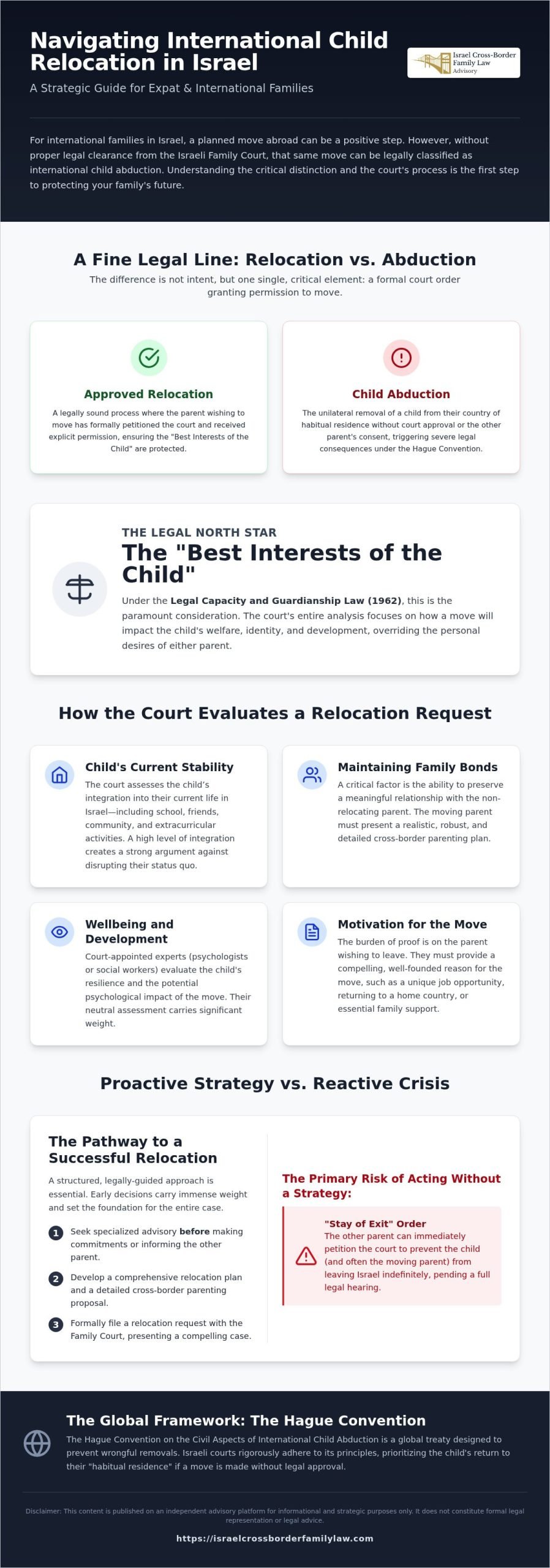
The Central District courts operate under the Legal Capacity and Guardianship Law, 1962. When a relocation file is opened in Kfar Saba, the court almost always involves “Shil” (Social Services). These social workers conduct deep investigations into the family history and the child’s current “Status Quo” in the local community. If your child is well-integrated into a Kfar Saba school or youth movement, the court will be hesitant to disrupt that stability without a compelling reason. This is especially true in international cases governed by the Hague Convention on the Civil Aspects of International Child Abduction, which serves as a global safeguard against the unilateral removal of children from their home country. Judges in the Central District are known for their rigorous adherence to these international standards to ensure children aren’t wrongfully removed from their habitual residence.
When a Relocation Lawyer is Necessary
Engaging a child relocation lawyer Kfar Saba is essential long before any suitcases are packed. The weight of early decisions cannot be overstated. If you notify the other parent of your intent to move without a structured legal strategy, you may face an immediate “Stay of Exit” order that grounds you and your child in Israel indefinitely. Conversely, if you are the parent staying behind, you need immediate protection against a potential unilateral move. A specialized lawyer acts as a bridge between the local Israeli court’s expectations and the complex realities of International Custody & Relocation, ensuring that your strategy accounts for both jurisdictions from day one. Seeking clarity early helps prevent the move from being classified as an abduction, which carries severe legal and personal consequences.
The “Best Interests of the Child” Standard in Israel
The “Best Interests of the Child” standard serves as the legal North Star for every custody decision in Israel. According to the Legal Capacity and Guardianship Law of 1962, the best interests of the child are defined as the paramount consideration in any legal proceeding concerning the child’s upbringing, custody, or residence. In the Kfar Saba Family Court, judges don’t simply weigh the benefits of a new job or a better climate; they analyze how a move will fundamentally impact the child’s identity and development. The welfare of the child is a supreme principle that overrides the personal desires or individual rights of either parent.
Judges often appoint psychologists or social workers to act as neutral experts to help determine the best path forward. These professionals assess the child’s resilience and the strength of their bond with both parents. For an expat family, this evaluation is intense. The court needs to be certain that the relocation won’t result in the permanent loss of the relationship with the parent remaining in Israel. This focus on habitual residence is a technical priority often emphasized by the Israeli Ministry of Justice when coordinating with foreign authorities in cross-border disputes.
Evaluating the Move’s Impact
When a case is heard in the Central District, the court examines the child’s existing roots. This includes their social, educational, and emotional ties to the local Kfar Saba community. A vague plan to move is rarely sufficient. A successful relocation strategy requires a detailed plan showing exactly how the child will thrive. You must present specific details regarding school placements, healthcare access, and the presence of extended family support in the destination country. The court’s primary fear is that the child will be uprooted from a stable environment in Israel only to face emotional isolation abroad.
The Burden of Proof for the Relocating Parent
The parent wishing to move carries a heavy legal burden. You must demonstrate that the relocation is not only a viable option but the best possible path for the child’s future. This involves providing concrete evidence, such as letters of intent from schools or proof of specialized medical care if needed. Because these international dynamics are so complex, it’s wise to request a confidential case review to understand how these factors apply to your specific family structure.
A critical technical requirement often discussed with a child relocation lawyer Kfar Saba is the “mirror order.” This is a legal mechanism where the destination country’s court recognizes and adopts the Israeli court’s custody and visitation rulings. Without a mirror order, the parent staying in Israel has little protection if the relocating parent decides to stop following the agreed-upon visitation schedule once they cross the border. Ensuring that rulings are enforceable in both jurisdictions is a cornerstone of a safe relocation strategy.
Local vs. Cross-Border Legal Expertise in Kfar Saba
This section is published on an independent advisory platform and provides strategic guidance rather than formal legal representation.
Many families in the Sharon region assume that any local family lawyer can handle a move abroad. While a generalist may be well-versed in domestic divorce, they often lack the specialized knowledge required for complex transnational litigation. A child relocation lawyer Kfar Saba must do more than file papers at the local court on Hanevi’im Street; they must act as a strategic bridge between two different legal cultures. For example, an Israeli court order that isn’t drafted with the destination country’s specific laws in mind may be unenforceable once you arrive in the United States or the United Kingdom.
The Hague Convention Factor
The most significant risk in international cases involves the Hague Convention Child Abduction protocols. Under this international treaty, moving a child without the other parent’s explicit, court-ratified consent is legally considered abduction. In Israel, the judicial system prioritizes these cases to ensure a swift resolution. As of 2026, Israeli courts are mandated to hold an initial hearing within 15 days of a Hague petition being filed. Most of these cases reach a resolution within 45 to 90 days. A pre-emptive strategy is essential to avoid emergency return orders. These orders can force a child back to Israel immediately, often before the actual merits of the relocation are even discussed by a judge.
Bridging the Gap Between Israel and the US
For the Anglo community in the Central District, legal issues often span multiple borders. You might have professional interests in the US while maintaining a primary residence in Kfar Saba. This multi-jurisdictional complexity requires an advisory approach that coordinates with foreign counsel. Specialized practitioners focus on the unique needs of For Expats and Foreign Nationals who must ensure their Israeli parenting plan is recognized by US state courts. Understanding how local Israeli rulings interact with foreign legal frameworks is a critical differentiator. A standard local practitioner may overlook the technical requirements of foreign equity markets or regulatory oversight that can impact a family’s financial stability during a move. Seeking clarity on these cross-border intersections before you commit to a move helps protect your parental rights in both nations.
Key Factors Courts Consider in Relocation Cases
Israeli judges in the Central District don’t view relocation as a simple change of address. They examine the sincerity of the move and the long-term impact on the child’s development. A child relocation lawyer Kfar Saba will tell you that the court prioritizes the parent’s willingness to facilitate a continued bond with the parent remaining in Israel. If the move is perceived as an attempt to alienate the other parent, the court is likely to deny the request. Economic improvements, such as a higher salary or better housing, are secondary to the emotional stability of the child.
The child’s own wishes also carry significant weight, provided they have reached a level of maturity to express a reasoned preference. Courts often use independent experts to interview children in a neutral setting. These experts look for signs of coaching or pressure from either parent. A legitimate opportunity for a better lifestyle must be balanced against the potential trauma of losing daily contact with a primary caregiver. Judges look for a “good faith” reason for the move, such as returning to a support network of extended family or a unique professional advancement that cannot be replicated in Israel.
The Parenting Plan: A Global Perspective
A successful relocation requires a robust, long-distance parenting plan. This isn’t a standard visitation schedule. It must account for international holidays, extended summer breaks, and consistent digital communication via video calls or messaging apps. You must also address the allocation of travel costs, which can be substantial for families moving between Israel and the US. Ensuring this plan is recognized by both the Kfar Saba Family Court and the foreign jurisdiction is essential for long-term peace of mind. Without this mutual recognition, a parent may find themselves without legal recourse if the other party stops following the agreed-upon schedule.
Parental Alienation Risks
Israeli courts have a very low tolerance for parental alienation. If a judge believes relocation is being used as a weapon to “cut off” the other parent, the relocating parent risks losing custody entirely. Mitigation starts early. You should build a cooperative framework and demonstrate a history of encouraging the child’s relationship with the other parent before ever filing a relocation request. Demonstrating a commitment to the child’s relationship with the “left-behind” parent is often the most persuasive evidence in a relocation case. If you’re concerned about how these factors apply to your situation, request a confidential consultation to discuss your strategy.
Strategic Advisory for International Families in Kfar Saba
Expats and international families in the Sharon region often face a unique set of emotional and cultural challenges when entering the Israeli legal system. The Hebrew-speaking environment and the specific procedural nuances of the Central District courts can feel alienating. Success in these cases requires moving beyond simple litigation to focus on comprehensive risk management. While a child relocation lawyer Kfar Saba manages the courtroom proceedings, a strategic advisory approach ensures that every decision is informed by the broader multi-jurisdictional landscape. This perspective is vital for families who must balance Israeli court expectations with the legal and financial realities of their destination country.
Navigating the intersection of different legal cultures requires a steady hand and a clear map. For families accustomed to US or UK legal standards, the Israeli focus on “habitual residence” and the mandatory involvement of social services can be surprising. Strategic advisory acts as a bridge, helping you translate your international lifestyle into terms the Kfar Saba Family Court understands. By identifying potential pitfalls early, you can avoid the high-stakes crises that often arise from unilateral decisions or poorly drafted agreements. Before you take any formal steps, it is essential to request a confidential case review to assess your standing.
Getting Clarity Before You Commit
The value of a strategy session lies in the ability to see the “long game” before taking legal action. Relocation orders have permanent financial and legal consequences, including long-term travel costs and the potential for child support adjustments. Understanding these implications helps you make informed decisions rather than emotional ones. For those seeking a deeper understanding of how these principles are applied in practice, the Israel Family Law YouTube channel offers a wealth of educational videos designed for the English-speaking community. Gaining this clarity ensures that when you do engage with the court, your case is built on a foundation of documented facts and realistic expectations.
Compliance Disclaimer
This content is published on an independent advisory platform and is provided exclusively for informational and educational purposes. It does not constitute formal legal advice or the establishment of an attorney-client relationship. While strategic advisory focuses on risk assessment and decision-making guidance, formal legal representation in the Israeli courts requires a separate engagement with licensed attorneys. The complexities of cross-border family law mean that every case is unique; therefore, general information should never replace personalized counsel tailored to your specific jurisdictional needs.
Securing Your Family’s Global Transition
Successfully navigating an international move requires more than just logistical planning; it demands a sophisticated understanding of how the Israeli Central District courts evaluate a child’s welfare. You now understand that the Kfar Saba Family Court prioritizes stability and the preservation of parental bonds above all else. By focusing on a robust, cross-border parenting plan and addressing potential Hague Convention risks early, you protect your family from the devastating consequences of legal disputes. Engaging a child relocation lawyer Kfar Saba ensures your strategy bridges the gap between the Israeli system and the requirements of foreign jurisdictions.
This independent advisory platform offers specialized cross-border family law expertise tailored specifically for the expat community in the Sharon region. Our calm, strategic approach focuses on risk management, ensuring you have a deep understanding of US-Israel legal intersections before you take action. Clarity is your most valuable asset when the weight of early decisions can impact your parental rights for years to come. It’s possible to move forward with confidence when you have a clear map of the legal landscape.
Get clarity before you commit. Request a confidential consultation to begin building a secure strategy for your family’s future.
Frequently Asked Questions
Can I move my child from Kfar Saba to another country without the other parent’s consent?
No, you cannot move your child out of Israel without the other parent’s written consent or a formal order from the Kfar Saba Family Court. Doing so is legally classified as parental kidnapping under both Israeli law and international treaties. Even if you have a primary custody order, you still need specific permission to change the child’s country of residence. It’s essential to consult a child relocation lawyer Kfar Saba before making any travel arrangements.
How long does an international child relocation case typically take in Israel?
The timeline varies significantly depending on the nature of the case. For Hague Convention petitions involving a child wrongfully removed to Israel, courts are mandated to hold an initial hearing within 15 days, with most cases resolved within 45 to 90 days. However, a standard relocation request filed in the Central District can take a year or longer. This duration allows for social service investigations and psychological evaluations to determine the child’s best interests.
Does the Israeli court favor the mother in relocation cases?
Israeli law does not officially favor one parent over the other in relocation disputes. The court’s sole focus is the “Best Interests of the Child” standard as defined in the Legal Capacity and Guardianship Law. While judges historically considered the “tender years” doctrine for very young children, modern rulings prioritize the primary caregiver’s role and the child’s emotional stability. Both parents must demonstrate how the move or stay will impact the child’s welfare.
What happens if I relocate and then the other parent files a Hague Convention claim?
If you relocate without consent and a Hague Convention claim is filed, the court will likely order the child’s immediate return to Israel. These proceedings focus on the child’s “habitual residence” rather than the merits of who is the better parent. Exceptions to a return order are interpreted very strictly by Israeli judges. You may face significant legal costs and a damaged standing in future custody hearings if you move unilaterally without legal clearance.
Can a child over 12 decide if they want to relocate from Israel?
A child over the age of 12 has a significant voice in the proceedings, but they don’t have the final decision. The court values the child’s maturity and their specific reasons for wanting to move or stay. A judge or a court-appointed professional will interview the child in a neutral setting to ensure they aren’t being pressured. While their preference is influential, the court still makes the final determination based on the child’s overall welfare and stability.
How much does it cost to hire a child relocation lawyer in Kfar Saba?
The cost of legal assistance depends on the complexity of the cross-border issues and the duration of the litigation. Standard court filing fees for non-fixed sum family claims are currently 3,481 NIS as of July 2026. Beyond these fees, professional rates for a child relocation lawyer Kfar Saba reflect the multi-jurisdictional expertise required to manage international evidence and foreign legal experts. It’s best to request a detailed fee structure during your initial strategy session.
What is a “mirror order” and why do I need one for international relocation?
A mirror order is a legal document issued by a court in the destination country that “mirrors” the terms of the Israeli custody agreement. This ensures that your parenting plan and visitation rights are enforceable outside of Israel. Without this protection, the parent remaining in Kfar Saba has very little recourse if the relocating parent decides to stop following the agreed schedule. It’s a critical tool for maintaining cross-border legal security for both parents and the child.
Is mediation required for relocation cases in the Central District?
Yes, the “Dispute Resolution Law” requires all families in the Central District to attend initial meetings with the court’s assistance unit before they can litigate. These “Mahut” sessions are designed to explore the possibility of a consensual agreement. While you aren’t forced to settle, you must participate in this process in good faith. Mediation is often a more stable way to build a long-distance parenting plan than a contested and emotionally draining court battle.

Article by
Gabriel Lior
A Personal Journey That Became a Mission
The advisory was founded by an American father Gabriel Lior, LLB, MBA , global entrepreneur, and cross-border advisor who spent more than a decade navigating the Israeli family court system firsthand and now lives in Singapore with his son.
As a divorced parent in a cross-border family, Gabriel faced nearly every legal challenge a foreign parent can encounter in Israel — including child custody disputes, child support proceedings, property matters in Israel and abroad, false accusations, and complex immigration and relocation proceedings.
Over the years, he learned the hard way how difficult it is for non-Israeli parents to understand the system, identify the right legal strategy, and choose the right legal representation — especially when language, culture, and jurisdictional differences are involved. He also witnessed how foreign parents and new immigrants are often disadvantaged or taken advantage of by service providers and institutions simply because they lack local knowledge or fluency.
From Client to Advisor
To truly understand — and survive — the system, Gabriel pursued formal legal education in Israel, completing two Israeli law degrees, alongside a BA and MBA earned in the United States. This was never about becoming a practicing attorney, but about gaining a deep, structural understanding of how the system works — and where it breaks down for foreign parents.
This rare combination of:
Firsthand client experience
Israeli legal and US business education
International business and negotiation training
Decades of commercial execution
created a unique perspective – one that understands both sides of the table.
After years of litigation, persistence, and at times self-representation, he ultimately succeeded in securing custody of his son and relocating abroad through a rare legal victory in the Israeli Supreme Court — becoming one of the first fathers in Israel to do so under these circumstances.
Disclaimer
Important Disclaimer:
The information provided on this website and in its content is for general informational and educational purposes only and does not constitute legal advice, legal opinion, or legal representation.
Gabriel Lior is not licensed to practice law in Israel (nor is he interested in doing so) and does not provide legal services, despite having completed 2 Law Degrees. The services offered are advisory in nature and are intended to provide general guidance, strategic insight, and information regarding cross-border family law considerations.
No attorney-client relationship is formed by accessing this website, reading its content, or communicating with us.
Any decisions made based on this information are at your own discretion and risk. For legal advice specific to your situation, you should consult a licensed attorney in the relevant jurisdiction.
Where appropriate, we may refer clients to independent, licensed attorneys or professionals. Such referrals do not constitute legal representation and no liability is assumed for services provided by third parties.