The first priority is to establish where your child is and whether they’re safe. If you’re asking what to do if my ex takes my child to Tel Aviv, uncertainty about location, consent, and timing can make every next step feel urgent. Start with confirmed facts and a clear timeline rather than assumptions.
Record the last confirmed contact, travel and expected return dates, existing parenting arrangements, and messages about the trip. Your child’s usual home, the circumstances of the journey, and the countries involved may help determine which authorities or professionals are relevant. A Hague Convention process may apply in some situations, but it doesn’t decide long-term custody and does not fit every family in the same way.
Use this overview to organise reliable information and prepare focused questions before deciding on support. Independent cross-border guidance can help clarify priorities and practical next steps. Any legal advice or representation must come from an independent licensed attorney.
Key Takeaways
- If you’re considering what to do if my ex takes my child to Tel Aviv, separate confirmed facts from assumptions and note any immediate safety concerns.
- Whether a situation involves removal or retention depends on the circumstances. Your child’s habitual residence also needs careful consideration.
- A Tel Aviv destination alone doesn’t determine which process applies or what the outcome may be.
- Prepare a concise summary of the countries involved, key dates, known facts, and unanswered questions before seeking support.
- Independent cross-border guidance can help organise priorities and practical next steps. Any legal advice or representation comes from an independent licensed attorney.
If Your Ex Takes Your Child to Tel Aviv, Start With Safety and Reliable Facts
Learning that your child may be in Tel Aviv can be shocking, especially when details are incomplete or communication has stopped. Slow your response enough to separate what you know from what you fear may have happened. If you’re deciding what to do if my ex takes my child to Tel Aviv, use this order: assess immediate safety, record confirmed facts, preserve relevant communications, and list the questions that still need answers.
- Assess immediate safety. Consider whether you have a specific reason to believe your child is in immediate danger. If so, seek appropriate local emergency assistance where the child is believed to be. An online article cannot assess an urgent safety situation.
- Record what is known. Note the last confirmed location, when you learned it, and how. Identify the source, such as a direct message from the other parent or a recent call with your child.
- Preserve communications. Keep relevant messages and travel information already available, along with existing parenting documents. Preserve the original records and keep your own notes separate from them.
- Organise the next questions. List what remains uncertain, such as the child’s current arrangements, the expected return date, or whether travel plans changed. This keeps later conversations focused on facts.
What to establish about the child’s current situation
Start with the most recent information you can verify. Record the child’s last confirmed location, the date and time, and the source. Note any direct communication about their wellbeing, who is with them, and what arrangements have been described. If a relative or friend passed on information, label it as second-hand rather than treating it as confirmed.
Keep unanswered questions visible. For example, “I have not spoken directly with my child since Tuesday” is clearer than guessing why contact stopped. Separating fact, report, and unknown can be important when more than one country and system is involved.
What to preserve without escalating the situation
Make a factual timeline while events are fresh. Include dates, locations, direct communications, travel details you already have, and agreed arrangements that help explain the context. Save original messages where possible, and note when a conversation took place instead of relying on memory alone.
- Keep the timeline neutral and correct errors if you discover them.
- Avoid threats, public accusations, or statements about events you can’t verify.
- Organise relevant parenting documents privately rather than sharing sensitive records broadly.
A calm, accurate record helps you ask clearer questions and reduces the risk of confusing assumptions with evidence. For general background, the Hague Convention on the Civil Aspects of International Child Abduction describes an international framework concerning some cross-border child abduction situations. Whether it is relevant depends on the facts, so first establish what happened and what remains unknown.
How Cross-Border Removal, Retention, and the Hague Convention May Differ
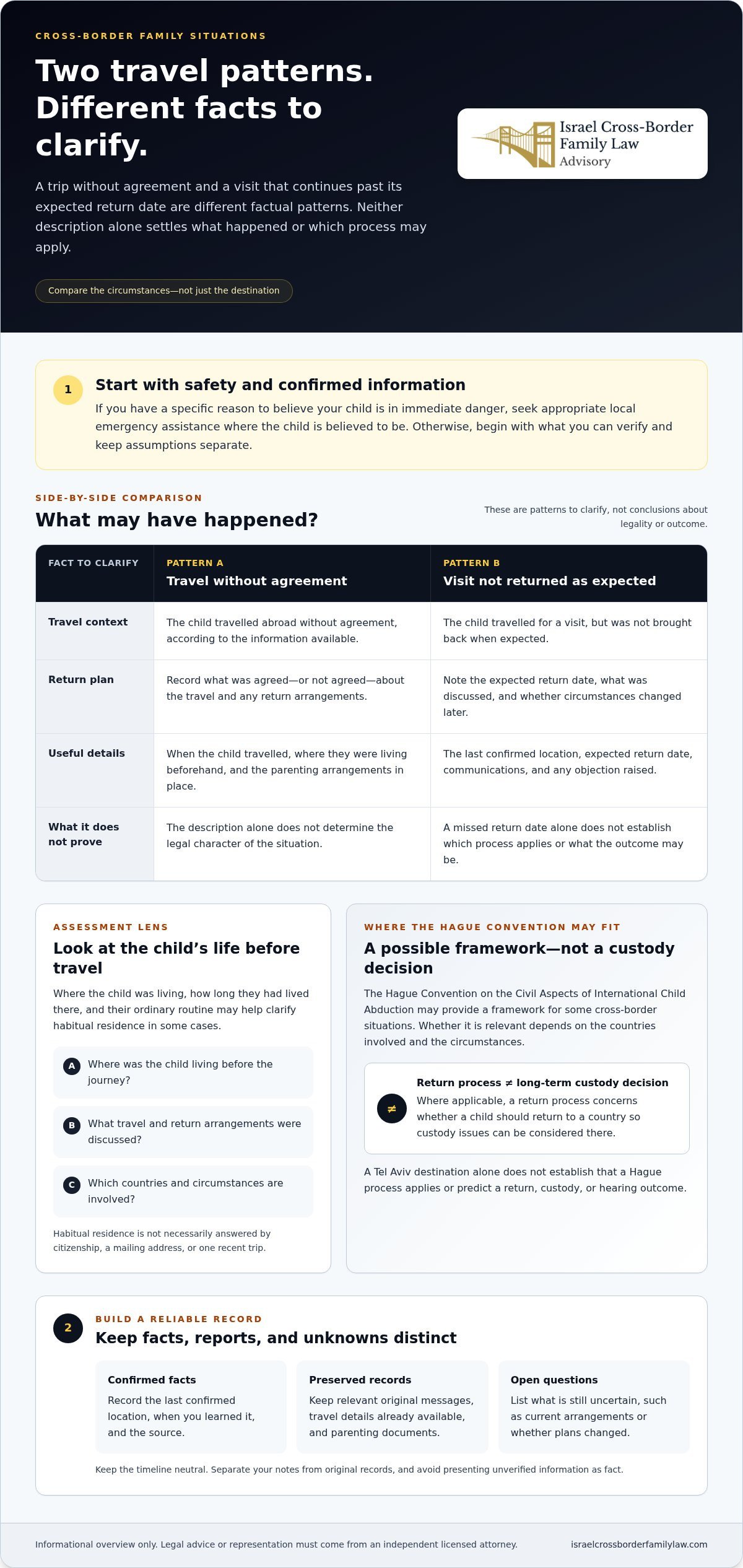
Once you have a basic timeline, consider what kind of cross-border situation the facts may describe. Removal and retention refer to different patterns, not automatic findings that a parent acted unlawfully. A child may have travelled across a border, or a planned visit may have continued beyond the agreed return date. The context matters, including where the child was living and what arrangements the parents had made.
The Hague Convention on the Civil Aspects of International Child Abduction may provide a framework for some cross-border cases. Its relevance depends on the countries involved and the circumstances. It is distinct from a decision about long-term custody: where applicable, a return process concerns whether a child should return to a country so custody issues can be considered there. Read the overview of Hague Convention and child abduction guidance alongside the facts of your situation, not as a prediction of what will happen.
Why the timeline and prior arrangements matter
Consider where the child was living before travelling to Israel, how long they had lived there, and what their ordinary routine looked like. These details may help assess the child’s habitual residence, a central concept in some Hague Convention cases. It isn’t necessarily answered by citizenship, a mailing address, or a single recent trip. The full circumstances need to be considered.
Also record whether travel was agreed, what return date or other limits were discussed, whether either parent objected, and whether circumstances changed later. A child taken abroad without agreement presents a different factual pattern from a child who travelled for a visit and was not brought back as expected. Neither description alone settles the legal character of the situation.
Why no treaty or court outcome should be assumed
Treaty status, possible exceptions, and current procedures are country-specific. Israel’s government provides information about Israeli law on international child abduction, but general information cannot determine how a particular set of facts will be assessed. An independent licensed attorney can assess the legal questions that apply to your situation.
Don’t infer that a Hague process applies, or predict return, custody, or a hearing result, simply because Tel Aviv is the destination. The other country’s role, the child’s circumstances before travel, parental rights and arrangements, and the sequence of events may all matter. Procedures can change, so verify current country-specific information before acting on general guidance.
If the terms and dates are difficult to put in order, a cross-border advisory conversation can help organise the countries involved, known facts, and questions to raise with independent counsel. The service provides information and strategic orientation, not legal advice or representation. It can help you see what still needs assessment before deciding on a next step.
What the Tel Aviv Location Does, and Does Not, Tell You
Knowing that Tel Aviv is involved can help focus your enquiries, but the city name alone doesn’t establish which process applies or what may happen next. It may describe where your child was last seen, where someone expects them to be, or what another person has reported. For a parent asking what to do if my ex takes my child to Tel Aviv, first clarify what “in Tel Aviv” means and how reliable that information is.
Keep the location in context. The countries involved, the child’s life before the trip, any travel agreement, the timing of events, and the child’s current circumstances may all be relevant together. A destination is one fact in that picture, not a shortcut to a conclusion.
Facts the destination can help you organise
Write down whether Tel Aviv is a confirmed current location, an intended destination, or an unverified report. Record when you learned it and how, such as through a direct message, a conversation, or information passed on by someone else. If you have a known address or local contact detail, keep it private and record where it came from rather than sharing it publicly.
| What a Tel Aviv location may help clarify | What the location cannot answer by itself |
|---|---|
| Whether Tel Aviv is the child’s reported destination or a confirmed location | Where the child was habitually resident before travelling |
| When and how the location information was obtained | Whether travel was agreed, or whether an agreed stay has changed |
| Which local details may help identify the child’s current arrangements | Which legal process applies or what a court might decide |
| Which facts remain uncertain and need careful verification | Which authority or court has responsibility in the specific circumstances |
Questions the destination cannot answer by itself
Tel Aviv does not, on its own, prove where a child’s habitual residence is, whether a parent consented to travel, or whether a particular treaty framework applies. Nor does a city name establish that every cross-border family dispute will follow the same route. Similar destinations can be part of very different family histories, travel arrangements, and country-to-country circumstances.
Venue, authority, and procedure are separate questions that need a current, case-specific assessment. Don’t assume that a local address automatically determines where a matter must be considered, or that a general description of Israeli procedure settles the issue. Confirm current information with appropriately qualified professionals before making decisions that depend on a particular process.
Use the location as a practical lead: note what is known, identify the source, and list what still needs to be established. This keeps a specific place useful without asking it to carry more meaning than the facts support.
Prepare a Clear Timeline and Questions Before Taking the Next Step
A concise written summary can make a cross-border discussion more focused, especially when details span two countries, time zones, and several conversations. You don’t need to resolve every uncertainty before preparing it. Aim for a one-page summary that distinguishes what you know from what you need to find out, and keep your preferred outcome separate from the factual record.
Build a usable chronology
List events in date order, beginning with where your child was living and the arrangements in place before travel. Add travel dates, any agreed return date, communications about the plans, and later changes or objections. Describe each event neutrally. Mark approximate dates or second-hand accounts as uncertain instead of filling gaps with guesses.
A practical summary can use these headings:
- Countries involved: Where the child lived, where they travelled from, and where they are believed to be now.
- Key dates: Relevant travel, contact, agreement, objection, and expected return dates.
- Current known facts: Confirmed details about the child’s location and arrangements, with the source of each fact.
- Unresolved questions: What you don’t yet know, such as whether plans changed or which procedures may be relevant.
- Your priorities: What you hope to address, clearly separated from what has been established so far.
Keep the initial enquiry brief. A short summary and relevant dates are enough to begin a conversation. Don’t send passports, full case files, or sensitive documents at this stage. Organise relevant records privately so you can discuss what information may be appropriate to share later through an independent professional’s process.
Prepare focused questions for independent counsel
Before speaking with an independent licensed attorney, note the questions you need answered. Ask which countries’ procedures may be relevant, what deadlines need prompt verification, and which documents or evidence should be provided through the lawyer’s process. You can also ask whether a proposed step may affect your child, communications with the other parent, or options available to you.
Cross-border parenting arrangements can involve immediate travel questions as well as longer-term plans. The relevant context may include where the child has been living, existing arrangements, and the countries connected to the family. International custody and relocation guidance can help frame those broader issues, but it can’t determine how a particular case should proceed.
If you’re unsure how to organise the countries, dates, priorities, and open questions, independent cross-border guidance can help you prepare a clearer summary before deciding on further support. It offers strategic orientation. Any legal advice or representation must come from an independent licensed attorney through a separate engagement.
How Independent Cross-Border Guidance Can Help You Plan
When you’re working out what to do if my ex takes my child to Tel Aviv, it can be difficult to see which facts, countries, and questions need attention first. Israel Cross Border Law Firm provides independent strategic guidance and informational support to families with matters involving Israel and another country. Its services do not include legal advice or representation.
A cross-border strategy session can help bring the moving parts into one clear picture. The discussion covers the countries involved, your priorities, and the facts gathered. It can help you organise questions and documents to raise with a licensed lawyer, and plan practical next steps. The aim is orientation, not a prediction of what will happen in a particular case.
What an advisory discussion can help organise
You can use the discussion to distinguish established information from gaps, set out what matters most to you, and prepare questions for an independent licensed lawyer. It can also help you organise relevant documents so you can discuss what may be appropriate to share through a lawyer’s process. The aim is to provide a clearer basis for deciding what support may be useful, not to predict an outcome.
For example, a parent may have a confirmed travel date but only an indirect report about the child’s present arrangements. Keeping those details separate helps describe the situation accurately. The session can also help identify practical questions about communications, timing, and which professionals may need to assess the circumstances.
Any legal advice or representation must come from an independent licensed attorney through that attorney’s own firm. Israel Cross Border Law Firm’s advisory service does not replace that role where legal advice is needed, and using the service does not create an attorney-client relationship.
Understand the process before committing
You can begin with a concise initial enquiry. It is free and is not a paid booking. Share a short summary and relevant dates only; don’t send passports, full case files, or sensitive documents in the initial enquiry. The process starts by sharing the essentials, then discussing next steps, including your circumstances, preferred language, and contact method.
Before any paid advisory work begins, scope and fees must be agreed. The cross-border strategy session is a 45-60 minute video call and costs USD 200. It includes discussion of the countries involved, priorities, and facts gathered, along with help organising questions and documents to raise with a licensed lawyer and planning practical next steps. Where appropriate, Israel Cross Border Law Firm can introduce an independent licensed attorney. See the cross-border strategy session pricing information for the session details.
Israel Cross Border Law Firm communicates in English, French, or Russian, and enquiries can be initiated from abroad. It supports families in Israel, including those in Tel Aviv, Jerusalem, Herzliya, Ra’anana, Netanya, Haifa, Modi’in, Beit Shemesh, Kfar Saba, Hod Hasharon, Ramat Gan, Givatayim, Petah Tikva, Ashdod, Be’er Sheva, Eilat, Caesarea, and Zichron Ya’akov.
You don’t need to have every answer in advance. Bring the countries involved, key dates, your priorities, and the questions you most need to resolve. That preparation can make the discussion more focused while leaving legal decisions to independent licensed counsel.
Choose a Clear, Informed Next Step
There may not be one immediate answer to what to do if my ex takes my child to Tel Aviv. The most useful next step depends on what is established, what remains uncertain, and which decisions may need attention first. Different countries and systems can approach family matters in different ways, so don’t treat a familiar process in one country as a complete guide to another.
Before committing to a course of action, consider what you need to clarify and what could change as new information emerges. You can review a decision as the facts develop. A measured response helps you act with purpose rather than letting uncertainty set the direction.
Use reliable information to guide each decision, and seek the appropriate independent professional support for questions that require a legal assessment.
Frequently Asked Questions
What should I do first if my ex takes my child to Tel Aviv?
First decide whether the information you have points to an immediate safety emergency or a need to clarify arrangements. If there’s immediate danger, seek appropriate local emergency assistance. If not, consider sending one brief, neutral message asking for confirmation of your child’s wellbeing and expected contact arrangements. Avoid repeated or confrontational messages, which may make communication harder. Keep a note of any reply, including the date and time.
Does the Hague Convention apply if my child has been taken to Tel Aviv?
It may be relevant, but the child’s destination is only one part of the assessment. Israel is part of the 1980 Hague Convention framework, which concerns children under 16. The countries connected to the situation and the child’s circumstances before travel also need to be considered. A return proceeding, if applicable, is not a decision about long-term custody. An independent licensed attorney can assess how the framework relates to your family’s circumstances.
Can I contact my child while they are in Israel?
You may try to maintain ordinary, reassuring contact, such as a brief message or a familiar routine for calls, if that is appropriate in your circumstances. Keep communication focused on your relationship with your child rather than asking them to explain adult decisions. If contact arrangements are already written down, refer to those terms when planning your request. Avoid sharing private family details publicly or asking others to pressure your child.
What information should I prepare before speaking with an independent lawyer?
Alongside your chronology, note the names of any countries, courts, or authorities already involved and whether another professional is advising you. Identify documents by type and date, such as an order or written travel agreement, without sending them unsolicited. If records use different languages, note the language and whether you have a translation. Ask the lawyer how they prefer to receive relevant material securely.
Does the fact that my child is in Tel Aviv determine which court handles the matter?
No, not in every kind of cross-border family dispute. For a Hague return petition, if the child’s location in Israel is unknown, the petition can be filed with the Family Court in Tel Aviv. That detail does not establish the right venue for other matters or determine the outcome. The applicable route depends on the type of issue and current procedures, so confirm it for your circumstances with an independent licensed attorney.
Can I start getting cross-border guidance while I am outside Israel?
Yes. An enquiry can be initiated from abroad, so you don’t need to be physically in Israel to begin organising your questions. Keep the first message concise and include only a short account of the situation and relevant dates. The initial enquiry is free and isn’t a paid booking. You don’t need to send passports, full case files, or sensitive documents at this stage.
Does contacting ICBFL create an attorney-client relationship?
No. Contacting ICBFL or making an initial enquiry does not create an attorney-client relationship or binding legal obligations. It also does not begin a paid advisory booking. If you later choose paid advisory work, its scope and fees are agreed before that work begins. Any attorney relationship is separate and established directly with an independent licensed attorney through that attorney’s own firm.

Article by
Gabriel Lior
A Personal Journey That Became a Mission
The advisory was founded by an American father Gabriel Lior, LLB, MBA , global entrepreneur, and cross-border advisor who spent more than a decade navigating the Israeli family court system firsthand and now lives in Singapore with his son.
As a divorced parent in a cross-border family, Gabriel faced nearly every legal challenge a foreign parent can encounter in Israel — including child custody disputes, child support proceedings, property matters in Israel and abroad, false accusations, and complex immigration and relocation proceedings.
Over the years, he learned the hard way how difficult it is for non-Israeli parents to understand the system, identify the right legal strategy, and choose the right legal representation — especially when language, culture, and jurisdictional differences are involved. He also witnessed how foreign parents and new immigrants are often disadvantaged or taken advantage of by service providers and institutions simply because they lack local knowledge or fluency.
From Client to Advisor
To truly understand — and survive — the system, Gabriel pursued formal legal education in Israel, completing two Israeli law degrees, alongside a BA and MBA earned in the United States. This was never about becoming a practicing attorney, but about gaining a deep, structural understanding of how the system works — and where it breaks down for foreign parents.
This rare combination of:
Firsthand client experience
Israeli legal and US business education
International business and negotiation training
Decades of commercial execution
created a unique perspective – one that understands both sides of the table.
After years of litigation, persistence, and at times self-representation, he ultimately succeeded in securing custody of his son and relocating abroad through a rare legal victory in the Israeli Supreme Court — becoming one of the first fathers in Israel to do so under these circumstances.
Disclaimer
Important Disclaimer:
The information provided on this website and in its content is for general informational and educational purposes only and does not constitute legal advice, legal opinion, or legal representation.
Gabriel Lior is not licensed to practice law in Israel (nor is he interested in doing so) and does not provide legal services, despite having completed 2 Law Degrees. The services offered are advisory in nature and are intended to provide general guidance, strategic insight, and information regarding cross-border family law considerations.
No attorney-client relationship is formed by accessing this website, reading its content, or communicating with us.
Any decisions made based on this information are at your own discretion and risk. For legal advice specific to your situation, you should consult a licensed attorney in the relevant jurisdiction.
Where appropriate, we may refer clients to independent, licensed attorneys or professionals. Such referrals do not constitute legal representation and no liability is assumed for services provided by third parties.