This article is published on an independent advisory platform (not a law firm). Do NOT use language that implies attorney-client relationship, legal representation, or giving legal advice. Focus on strategy, risks, and decision-making guidance. Soft CTA to advisory call / WhatsApp.
What if your carefully drafted US estate plan is essentially invisible to an Israeli bank? Many international families discover too late that assets in Jerusalem or Tel Aviv aren’t automatically governed by their domestic legal documents. Navigating these complexities requires the guidance of an israeli estate attorney who understands the intersection of the Succession Law of 1965 and international tax obligations. It’s common to feel overwhelmed by Hebrew legal terminology or the specific requirements of the Registrar of Inheritance, known as Rasham HaYerushot.
You’re likely concerned about potential double taxation or the validity of your existing will across borders. This guide provides a clear roadmap for protecting cross-border assets and streamlining the Israeli probate process. We will examine the differences between succession and probate orders, address the capital gains tax traps, and offer a strategy for managing assets without the need for constant travel. By gaining clarity on the system now, you can avoid costly disputes among heirs later. Get clarity before you commit. Request a confidential consultation.
This article is published on an independent advisory platform (not a law firm). Do NOT use language that implies attorney-client relationship, legal representation, or giving legal advice. Focus on strategy, risks, and decision-making guidance. Soft CTA to advisory call / WhatsApp.
Key Takeaways
- Learn why an israeli estate attorney is essential for bridging the gap between US common law expectations and the Israeli civil law system.
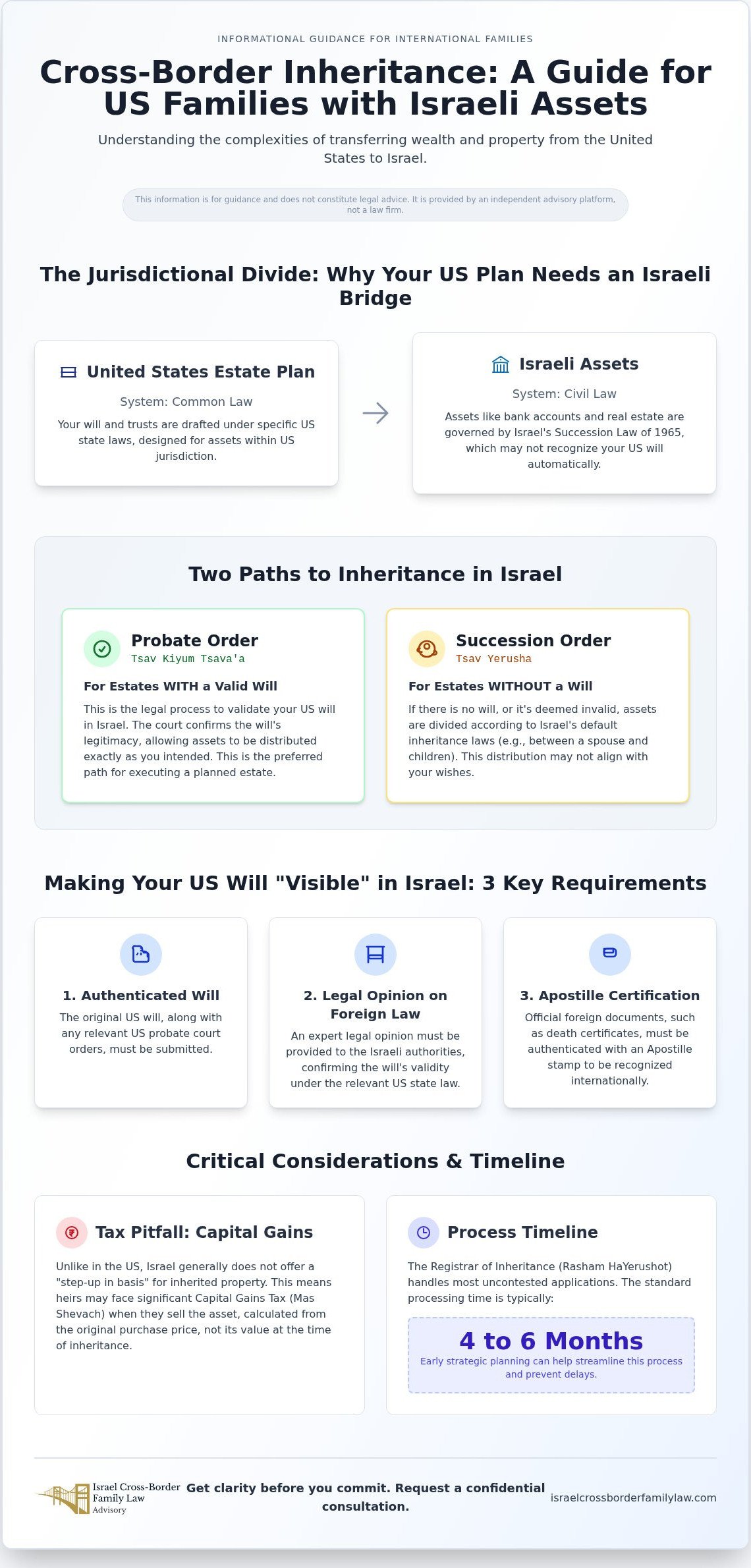
- Understand the procedural differences between a Succession Order (Tsav Yerusha) and a Probate Order (Tsav Kiyum Tsava’a) for assets in Israel.
- Identify the mandatory requirements for validating a US will, including the necessity of a Legal Opinion on foreign law and Apostille certification.
- Recognize the impact of Israeli Capital Gains Tax (Mas Shevach) and why inheriting property doesn’t always mean a “step-up in basis” for tax purposes.
- Discover how early strategic decisions can significantly reduce the 4 to 6 month timeline typically required by the Registrar of Inheritance.
This article is published on an independent advisory platform (not a law firm). Soft CTA to advisory call / WhatsApp.
The Role of an Israeli Estate Attorney in Cross-Border Matters
An israeli estate attorney who focuses on cross-border law acts as a strategic guide for families managing assets across two distinct jurisdictions. While a domestic lawyer in Israel may understand local probate, they often lack the perspective needed to address how those decisions impact a beneficiary’s tax reporting obligations in the United States. Managing a multi-national estate requires an integrated approach that respects the Civil Law foundations of the Israeli system while addressing the Common Law expectations of heirs living abroad. This role is about creating a cohesive plan for the transfer of assets, ensuring that Israeli inheritance laws are navigated without creating financial friction in the US.
For many international families, the first challenge is the language and cultural barrier. Hebrew legal documents and the administrative procedures of the Israeli court system can be difficult to navigate without a bridge. An advisor helps translate these complexities into plain English, ensuring that families have the clarity they need to make informed decisions. This is particularly important for expats and foreign nationals who need to manage assets in major hubs like Tel Aviv or Jerusalem without being physically present in the country.
Why Cross-Border Expertise Matters
The intersection of Israeli law and international tax treaties is a critical area where domestic expertise often falls short. For example, while Israel does not have a direct estate tax, the distribution of assets can trigger significant capital gains liabilities or US reporting obligations like the FBAR. A cross-border specialist prioritizes strategy over just paperwork, focusing on the long-term protection of the estate’s value and the needs of the beneficiaries. Coordinating with your existing US professional team ensures that the global strategy remains aligned and that no jurisdictional requirements are missed.
Identifying When You Need Specialized Counsel
Specialized guidance becomes necessary when an estate involves high-value assets or complex family structures that cross borders. Certain situations demand a more sophisticated approach than a standard inheritance application to avoid future litigation or tax traps. Consider these common scenarios:
- Ownership of Israeli real estate by residents of cities like New York, Miami, or Los Angeles.
- Dual-citizenship holders with pension funds, life insurance, or bank accounts in both the US and Israel.
- Cases where a US-based trust holds title to property in Israeli cities such as Herzliya, Ra’anana, or Netanya.
- Situations where heirs reside in Israel but the deceased lived and held assets primarily in the US.
This article is published on an independent advisory platform (not a law firm). Soft CTA to advisory call / WhatsApp.
Navigating the Israeli Probate and Succession Process
The path to inheriting assets in Israel follows a specific administrative sequence. Most cases begin with the Registrar of Inheritance, known as Rasham HaYerushot. This body handles uncontested applications and ensures that the estate meets all regulatory requirements before an order is issued. If a dispute arises or a family member files an objection within the mandatory 14-day window after publication, the case moves from the Registrar to the Israeli Family Court for judicial review. Making informed decisions during the initial filing stage is critical; errors in documentation can lead to significant delays in a process that already typically takes 4 to 6 months for residents living abroad.
For international families, the logistical requirements are often the most demanding part of the roadmap. Israeli authorities require foreign documents, such as death certificates or wills executed in the US, to be authenticated with an Apostille. This certification verifies the document’s legitimacy for use in Israel. Additionally, any document not written in Hebrew or Arabic requires a certified translation. An experienced israeli estate attorney helps families manage these requirements, ensuring that every piece of evidence meets the Registrar’s standards before submission. You can discuss your specific documentation needs to avoid common filing mistakes.
Step-by-Step Roadmap to Israeli Probate
The process starts with gathering legalized documents. Once the application is filed, a mandatory publication fee of 215 NIS is paid to announce the request in a daily newspaper. This step protects potential creditors or unknown heirs. A unique aspect of the Israeli system is the involvement of the Attorney General’s office, which reviews every probate application to ensure the public interest and the rights of minors or incapacitated individuals are protected. If you file your petition online, the current fee is 538 NIS, and you must deliver the original physical will to the Registrar within seven days of the digital submission.
Succession Order vs. Probate Order
The type of order you request depends entirely on whether the deceased left a valid will. A Succession Order, or Tsav Yerusha, is used when someone dies intestate. In these cases, assets are distributed according to the default rules set by the Succession Law of 1965. Conversely, a Probate Order, or Tsav Kiyum Tsava’a, is required to give legal force to a written will. Determining which track applies to your family situation is a foundational step that dictates how assets like real estate or bank accounts will eventually be transferred to the beneficiaries.
This article is published on an independent advisory platform (not a law firm). Soft CTA to advisory call / WhatsApp.
US Wills and Israeli Assets: The Validity Challenge
Many international families believe that a properly executed US will automatically covers their assets globally. This is a common myth. In reality, an Israeli bank or the Land Registry will not freeze or transfer assets based solely on a US probate order. A will executed in New York, California, or Florida is not immediately enforceable in Israel. It must first undergo a specific recognition process under the Israeli Law of Inheritance of 1965. Without this, your heirs may find themselves locked out of accounts or unable to sell inherited real estate.
Another significant risk involves the use of separate wills for different countries. If a person creates a will in the US and another in Israel without careful coordination, they risk creating “conflicting wills.” One document might accidentally revoke the other, or they may contain contradictory instructions regarding the same global assets. It is often more effective to develop a unified strategy. You can learn more about dual country wills for the US and Israel to understand how to align your estate plan across borders.
Recognizing a Foreign Will in Israel
To validate a US document, the Israeli Registrar requires a “Legal Opinion” on foreign law. This is a formal document provided by an expert who confirms the will is valid according to the laws of the jurisdiction where it was signed. For example, if the testator lived in Florida, the expert must prove the will meets Florida’s legal standards. This expert opinion typically costs between 3,000 and 7,000 ILS. While Israeli courts generally respect formal US wills, they may scrutinize “Holographic” or handwritten wills more closely, especially if they lack witnesses. Challenges often arise if there is a lack of clarity regarding the testator’s mental capacity or if the document doesn’t explicitly mention Israeli property.
The Benefit of an Israeli-Specific Will
Having a document tailored specifically for the Israeli system can significantly reduce probate timelines. An israeli estate attorney can help draft a document that addresses local assets directly, such as a “Keren Hishtalmut” (study fund) or specific apartments in Jerusalem or Tel Aviv. US legal terminology doesn’t always have a direct equivalent in Israel. Using local terms ensures that Israeli executors and the Registrar understand the instructions without ambiguity. This proactive approach helps avoid the administrative friction that often occurs when trying to force a US-style trust or executor structure into the Israeli Civil Law framework.
This article is published on an independent advisory platform (not a law firm). Soft CTA to advisory call / WhatsApp.
Common Pitfalls and Risks in Israeli Inheritance
Families often attempt to resolve inheritance matters through informal handshakes or private agreements to avoid the perceived complexity of the court system. In Israel, these agreements lack legal standing unless the Registrar or the Family Court formally approves them. This often leads to intense disputes years later when heirs attempt to sell property or close bank accounts. Additionally, the Israeli system recognizes specific spousal rights that can sometimes override the literal text of a will. If a surviving spouse is left without adequate support, they may have a legal claim for maintenance from the estate, regardless of what the document says. An israeli estate attorney helps families identify these cultural and legal friction points before they escalate into litigation.
The intersection of family law and estate management is often where the most significant risks lie. For instance, obligations related to previous marriages or ongoing financial duties can complicate how an estate is settled. You may find it helpful to see our guide on cross-border child support and enforcement to understand how these different legal areas can overlap and impact your inheritance strategy.
The Tax Dimension for US Citizens
Don’t let the fact that Israel has no inheritance tax lead to a false sense of security. For a US beneficiary, the reporting requirements are substantial. Inheriting an Israeli bank account often triggers the need for an FBAR (Foreign Bank Account Report) filing. If the assets are held in an Israeli trust, you may be required to submit IRS Form 3520. Perhaps the most significant trap is the Capital Gains Tax, known in Israel as Mas Shevach. When you sell inherited real estate, you’ll likely face a 25% tax on the appreciation. Because Israel doesn’t provide a “step-up in basis” at death, the tax is calculated from the date the deceased originally purchased the asset, not the date you inherited it.
Procedural Delays and Bureaucratic Hurdles
Administrative errors are the primary cause of probate delays. Missing a single Apostille on a US death certificate can stall a case at the Registrar for months. In cases with multiple heirs or high-value assets, the court may appoint a “Menahel Izavon,” or Estate Administrator, to oversee the distribution. While this process unfolds, the estate must continue paying municipal property taxes (Arnona) and utility bills. If these are neglected, the municipality can place liens on the property, further complicating the eventual transfer of title.
This article is published on an independent advisory platform (not a law firm). Soft CTA to advisory call / WhatsApp.
Strategic Planning: Moving Forward with Clarity
Successful cross-border inheritance isn’t just about submitting paperwork to the Registrar. It’s about developing a comprehensive strategy that protects assets in both jurisdictions. Taking an “Advisory First” approach means prioritizing risk management and tax efficiency before any forms are filed. When you consult with an israeli estate attorney, the goal is to identify potential hurdles early rather than reacting to bureaucratic delays as they happen. This proactive method allows families to understand their options and the likely outcomes of their choices. You can message us via WhatsApp to discuss your initial strategy concerns.
Transparency remains a cornerstone of effective planning. Families need to understand the financial and procedural commitments involved from the start. You can view our transparent pricing philosophy to see how we structure our services. Understanding how our advisory works is the first step toward gathering the necessary documentation for a confidential review. Having a clear view of the process helps reduce the anxiety often associated with foreign legal systems.
Creating a Cross-Border Roadmap
Start by creating a detailed inventory of all assets held in both the US and Israel. This list should include real estate, bank accounts, and pension funds. Identifying potential conflicts between US-based and Israeli-based beneficiaries early can prevent costly litigation. A key part of this roadmap is establishing a direct communication protocol between your US legal team and your israeli estate attorney. This ensures that a decision made in one country doesn’t create an unintended tax or legal crisis in the other. Coordination is the best defense against double taxation or administrative errors.
Get Clarity Before You Commit
A preliminary assessment provides a clear picture of the risks and timelines ahead. This is especially valuable for the Anglo community and expats who may be unfamiliar with the cultural nuances of the Israeli legal system. While the process of cross-border probate is inherently complex, it’s manageable when you have a structured plan. Seeking clarity early ensures that you make decisions based on facts rather than assumptions. This strategic foundation protects your family’s legacy and provides peace of mind throughout the transition.
This article is published on an independent advisory platform (not a law firm). Soft CTA to advisory call / WhatsApp.
Securing Your Family Legacy Across Borders
Managing an inheritance between the US and Israel requires more than simple document filing; it demands a unified strategy that addresses two distinct legal cultures. We’ve explored how the non-automatic validity of foreign wills and the specific requirements of the Registrar of Inheritance can create significant hurdles for international families. By prioritizing an advisory-first approach, you can identify tax risks like the Israeli capital gains tax and avoid the procedural delays that often stall cross-border probate cases.
Engaging an israeli estate attorney who specializes in the US-Israel corridor ensures that your global assets are protected and your family’s interests are represented with clarity. While the bureaucracy of a foreign legal system can feel overwhelming, having a clear roadmap allows you to move forward with confidence. Strategic planning today prevents legal disputes and financial surprises tomorrow, keeping your focus where it belongs: on your family’s future.
Taking the first step toward understanding your options is the most effective way to manage cross-border complexity. With the right guidance, navigating the Israeli probate process becomes a structured, manageable task. Get clarity before you commit. Request a confidential consultation.
This article is published on an independent advisory platform (not a law firm). Soft CTA to advisory call / WhatsApp.
Frequently Asked Questions
Does Israel have an inheritance tax for US citizens?
Israel does not currently impose an inheritance or estate tax; this was abolished in 1981. However, US citizens must remain aware of their US federal estate tax obligations and Israeli capital gains tax, known as Mas Shevach. When an inherited asset like an apartment in Jerusalem is eventually sold, a 25% capital gains tax applies based on the original purchase price. Coordinating with an israeli estate attorney ensures these cross-border tax implications are integrated into your strategy.
Is a US will valid for assets located in Israel?
A US will is not automatically valid or enforceable in Israel. For assets like bank accounts in Tel Aviv or real estate in Herzliya, you must petition the Registrar of Inheritance for a Probate Order. This process requires a “Legal Opinion” from an expert to prove the will’s validity in its US jurisdiction. Without this formal recognition, the document holds no legal weight within the Israeli banking or land registry systems.
How long does the probate process take in Israel for foreigners?
The probate process for foreigners typically takes between 4 and 6 months for uncontested cases. While the Israeli Registrar of Inheritance has digitalized many filings to improve efficiency, cross-border cases involve additional layers of verification. Factors like obtaining a Legal Opinion on foreign law and coordinating document authentication in the US contribute to this timeline. Families in cities like Ra’anana or Netanya often find that early strategy prevents unnecessary administrative delays.
Do I need to travel to Israel to handle an inheritance or probate case?
You generally don’t need to travel to Israel to manage an inheritance or probate matter. Most procedures can be handled remotely through a Power of Attorney signed and notarized at an Israeli consulate or via an Apostille in the US. This allows your israeli estate attorney to represent your interests before the Registrar or the Family Court in Jerusalem or Tel Aviv without requiring your physical presence in the country.
What is an Apostille and why is it required for my Israeli legal documents?
An Apostille is an international certification that authenticates a public document for use in another country. For Israeli probate, you must obtain an Apostille for US death certificates and original wills. This ensures the Israeli Registrar recognizes the documents as legitimate. Without this certification, the Israeli authorities cannot accept foreign evidence, which is why document legalization is a foundational step in any cross-border inheritance roadmap.
Can I disinherit a child in an Israeli will as I can in the US?
Israeli law generally allows you to disinherit a child, similar to US common law. However, the Succession Law of 1965 provides certain protections for dependent family members. If a child or spouse is left without support, they may be eligible to file a claim for maintenance from the estate. This is a nuanced area where the literal text of a will may be challenged based on the specific financial needs of the survivors.
What happens if someone dies in Israel without a will?
If someone dies in Israel without a will, their assets are distributed according to the default rules of the Succession Law of 1965. Usually, the estate is divided between the surviving spouse and the children. If the deceased owned property in Haifa or Modi’in, the spouse typically receives 50% of the asset and the children share the remaining 50%. These rules are rigid and don’t account for specific family preferences or tax strategies.
How much does an Israeli estate attorney typically cost for a probate case?
The cost of handling an estate matter varies based on the complexity of the assets and whether the will is contested. Standard costs include government filing fees, such as the 538 NIS online application fee and the 215 NIS publication fee. Expert legal opinions on foreign law also carry separate costs. For a comprehensive overview of how professional fees are structured for international families, you should review the specific pricing philosophy of your chosen advisor.

Article by
Gabriel Lior
A Personal Journey That Became a Mission
The advisory was founded by an American father Gabriel Lior, LLB, MBA , global entrepreneur, and cross-border advisor who spent more than a decade navigating the Israeli family court system firsthand and now lives in Singapore with his son.
As a divorced parent in a cross-border family, Gabriel faced nearly every legal challenge a foreign parent can encounter in Israel — including child custody disputes, child support proceedings, property matters in Israel and abroad, false accusations, and complex immigration and relocation proceedings.
Over the years, he learned the hard way how difficult it is for non-Israeli parents to understand the system, identify the right legal strategy, and choose the right legal representation — especially when language, culture, and jurisdictional differences are involved. He also witnessed how foreign parents and new immigrants are often disadvantaged or taken advantage of by service providers and institutions simply because they lack local knowledge or fluency.
From Client to Advisor
To truly understand — and survive — the system, Gabriel pursued formal legal education in Israel, completing two Israeli law degrees, alongside a BA and MBA earned in the United States. This was never about becoming a practicing attorney, but about gaining a deep, structural understanding of how the system works — and where it breaks down for foreign parents.
This rare combination of:
Firsthand client experience
Israeli legal and US business education
International business and negotiation training
Decades of commercial execution
created a unique perspective – one that understands both sides of the table.
After years of litigation, persistence, and at times self-representation, he ultimately succeeded in securing custody of his son and relocating abroad through a rare legal victory in the Israeli Supreme Court — becoming one of the first fathers in Israel to do so under these circumstances.
Disclaimer
Important Disclaimer:
The information provided on this website and in its content is for general informational and educational purposes only and does not constitute legal advice, legal opinion, or legal representation.
Gabriel Lior is not licensed to practice law in Israel (nor is he interested in doing so) and does not provide legal services, despite having completed 2 Law Degrees. The services offered are advisory in nature and are intended to provide general guidance, strategic insight, and information regarding cross-border family law considerations.
No attorney-client relationship is formed by accessing this website, reading its content, or communicating with us.
Any decisions made based on this information are at your own discretion and risk. For legal advice specific to your situation, you should consult a licensed attorney in the relevant jurisdiction.
Where appropriate, we may refer clients to independent, licensed attorneys or professionals. Such referrals do not constitute legal representation and no liability is assumed for services provided by third parties.