In Israel, the court you choose for your divorce often matters more than the reasons why the marriage ended. For an expat, the decision between civil vs religious divorce in israel for expats isn’t just a matter of tradition. It’s a high-stakes jurisdictional move that can dictate the future of your global assets. You’re likely feeling anxious about the “Race to Jurisdiction” and the fear that a religious court might not protect your international interests or custody rights. It’s a valid concern, especially since March 2026 legislative changes have expanded the reach of religious authorities into certain civil matters.
We understand that the complexity of a dual legal system feels overwhelming when you’re already facing a significant life transition. This guide will help you understand the nuances of the Israeli system and how to strategically navigate cross-border complexities to protect what you’ve built. We’ll examine the specific roles of the Rabbinical and Family Courts, the impact of the phasing out of the “Tender Years Doctrine,” and the critical strategic importance of the “Gett” requirement for international families.
Key Takeaways
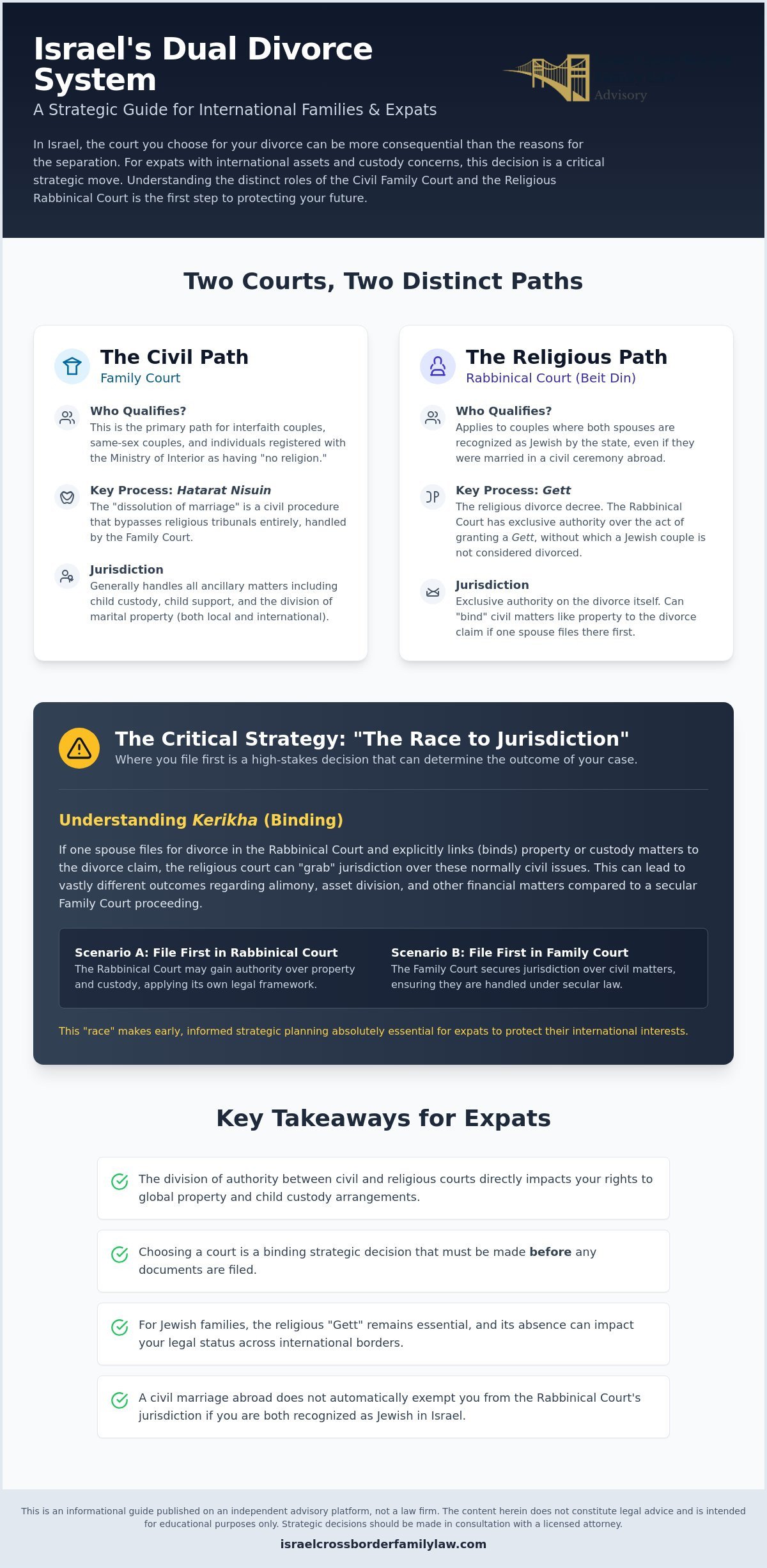
- Understand how the division of authority between civil and religious courts impacts your rights to global property and child custody arrangements.
- Learn why the choice of civil vs religious divorce in israel for expats is a strategic decision that must be made before any documents are filed.
- Recognize the ongoing importance of the religious “Gett” for Jewish families and how its absence can affect your legal status across multiple borders.
- Identify the specific eligibility requirements for “Hatarat Nisuin” and how it serves as a civil alternative for interfaith or same-sex couples.
- Develop a framework for navigating the “Race to Jurisdiction” to ensure your case is heard in the forum best suited for your international interests.
The Dual Legal System: Understanding Religious vs. Civil Jurisdiction in Israel
Israel operates without a unified civil marriage or divorce framework, a reality that often shocks international families. Instead, jurisdiction is split between civil Family Courts and various religious tribunals, such as the Rabbinical or Sharia courts. This structure, often referred to as The Dual Legal System, is rooted in the “Personal Status” of the individuals involved. Your religious affiliation, as recognized by the state, determines which laws apply to the core of your marital status. If you are Jewish, the state views your marriage and its dissolution through the lens of religious law, regardless of how secular your lifestyle may be.
For many US citizens and Anglos, this creates a landscape of high-stakes complexity. In the United States, a single court typically handles all aspects of a divorce. In Israel, you might find yourself appearing before a civil judge for property matters and a panel of rabbis for the divorce decree itself. Understanding the interplay between civil vs religious divorce in israel for expats is essential because a misstep in where you file first can fundamentally alter your rights to international assets or custody. Recent 2026 legislative shifts have only increased this complexity, granting religious courts expanded powers to arbitrate certain civil disputes when both parties consent.
To better understand how these two systems interact and the strategic importance of where you start your case, watch this helpful video:
The Family Court vs. The Rabbinical Court (Beit Din)
The Family Court is a secular institution that generally handles matters of custody, child support, and property division. However, the Rabbinical Court (Beit Din) maintains exclusive authority over the actual act of divorce, known as the “Gett.” A critical strategic element is the concept of “binding” or kerikha. If one spouse files for divorce in the Rabbinical Court first and explicitly connects property or custody to that claim, the religious court can “grab” jurisdiction over those civil issues. This can lead to significantly different outcomes than a civil court proceeding, particularly regarding alimony or the division of specific assets.
Who Falls Under Religious Jurisdiction?
Determining which court has power over your life depends on the “Member of a Recognized Religious Community” test. If the Ministry of Interior registers you as Jewish, the Rabbinical Court likely holds authority over your marriage. It’s a common misconception that a US marriage certificate provides an exemption from this system. Even if you married in a civil ceremony abroad, the Israeli legal system will likely funnel your divorce through religious channels if you are both recognized as Jewish. For expats and foreign nationals, verifying how the state classifies your religious status is the first step in any strategic plan. Failing to do so can result in unexpected jurisdictional battles that last for years.
Civil Divorce for Expats: The Process of Marriage Dissolution (Hatarat Nisuin)
For individuals who don’t fall under the authority of a recognized religious community, Israel provides a specific civil path known as Hatarat Nisuin, or the dissolution of marriage. This process is a vital alternative for the international community. While much of the discussion regarding civil vs religious divorce in israel for expats focuses on the Rabbinical courts, Hatarat Nisuin bypasses religious tribunals entirely. It serves as the primary legal mechanism for interfaith couples, same-sex couples, and those officially registered with the Ministry of Interior as having “no religion.”
The process isn’t automatic. When you file a petition for dissolution, the case often moves to the President of the Family Court. Their specific role is to determine whether any religious court in Israel has a valid claim to jurisdiction over the couple. You must effectively prove a negative: that no religious tribunal, whether Jewish, Muslim, Christian, or Druze, has the authority to handle your divorce. This jurisdictional clearance is the gatekeeper to a secular proceeding.
The “No Religion” and Interfaith Exception
Expats often arrive in Israel with civil marriage certificates from their home countries. However, your registration in the Israeli Population Registry dictates your path. If you aren’t recognized as belonging to a specific religious group, you can verify your status to qualify for civil dissolution. Many US expats find this route preferable because it keeps the entire case within the Family Court system. This secular environment generally applies the Balance of Resources Law of 1973, which favors an equal division of assets accumulated during the marriage. This predictability is often a relief for those concerned about the more traditional interpretations found in religious courts.
Procedural Steps for Civil Dissolution
The journey begins with filing a formal petition in the Family Court. Because these cases often involve marriages performed abroad, the court typically requires a “foreign law expert opinion.” This document explains how the laws of your home jurisdiction, such as New York or London, would treat the dissolution. These opinions are essential for the Israeli judge to understand the legal context of the original marriage contract. Utilizing specialized services for expats and foreign nationals can ensure these expert opinions meet the strict evidentiary standards of the Israeli court.
Before initiating this process, it’s wise to seek a strategic review of your registration status. Small errors in how you were initially registered upon making Aliyah or receiving a work visa can complicate your eligibility for a civil dissolution later. Clear planning ensures you don’t inadvertently find yourself fighting a jurisdictional battle you could have avoided.
Religious Divorce (Gett): When the Rabbinate Has Exclusive Authority
For Jewish couples, the legal end of a marriage in Israel is not defined by a civil judge’s signature but by the delivery of a physical document known as the Gett. This religious bill of divorce is the only mechanism the state recognizes for the formal dissolution of a Jewish union. It’s a common trap for international families to assume that a civil decree from a US court settles the matter. However, without a Gett, you may find yourself in a “limping marriage,” where you are legally single in your home country but remain fully married under Israeli law. This status prevents you from remarrying within Israel and can create significant complications regarding the legal status of future children.
The Rabbinical court maintains exclusive authority over this specific act, and they possess robust enforcement mechanisms to ensure compliance. If a spouse refuses to give or receive the Gett, a situation known as Saruvanut Gett, the court can apply severe sanctions. These include stay-of-exit orders that prevent a person from leaving Israel, the freezing of bank accounts, or even the revocation of a driver’s license. For expats with transnational interests, these sanctions can be devastating, effectively halting their ability to manage global business or travel for family obligations. Understanding the nuances of the Gett process is essential for anyone navigating the choice of civil vs religious divorce in israel for expats.
The Requirement for Jewish Expats
The Rabbinate often claims jurisdiction over Jewish individuals worldwide if they are physically present in Israel or have a sufficient connection to the state. This reach extends even to those who married through non-traditional means, such as the “Utah marriage” or other online civil ceremonies. While these marriages are registered civilly in Israel, the state still requires a religious dissolution if the parties are Jewish. This creates a complex overlap where a couple must satisfy both the civil requirements for registration and the religious requirements for a final decree. Failing to account for this dual requirement early in the planning phase can lead to years of legal limbo.
Grounds for Divorce in Religious Courts
Unlike the “no-fault” divorce systems common in most US states, the Rabbinical courts often require specific grounds to compel a divorce. While an agreed-upon divorce is straightforward, a contested case may require evidence of adultery, domestic issues, or what is termed a “rebellious spouse” claim. These grounds are not merely formal; they have direct financial consequences. For example, a wife’s right to Mezonot Isha (spousal maintenance) can be forfeited if the court finds her at fault under religious law. This stark difference between secular and religious standards is why the initial strategy regarding which court handles the “ancillary matters” like alimony is so critical for protecting your financial future.
Strategic Considerations: The Race to Jurisdiction and US-Israel Issues
In the Israeli legal landscape, the timing and location of your initial filing create a ripple effect that can last for years. This tactical phenomenon is known as the “Race to Jurisdiction.” For anyone weighing the merits of civil vs religious divorce in israel for expats, understanding this race is the difference between a predictable outcome and a legal ambush. The court that receives the first valid petition often gains the authority to decide ancillary matters like property division and child custody. If one spouse moves faster, they can effectively choose the legal framework that will govern your family’s future.
This decision is particularly weighted for US expats who maintain significant assets in the United States. Israeli courts may have different views on what constitutes “marital property” compared to courts in New York or California. A 2026 Supreme Court decision has made it increasingly difficult to exclude pre-marital inheritances and real estate from the general pool of assets, except in very specific circumstances. Without a proactive strategy, you risk having an Israeli court apply local standards to your international holdings. Coordinating with a cross-border family lawyer before any papers are served is the only way to ensure your global interests are protected.
Filing First: Family Court vs. Rabbinical Court
The Family Court is generally viewed as the more favorable forum for the spouse with fewer assets. As a secular institution, it strictly applies the Balance of Resources Law of 1973, which mandates an equal division of assets accumulated during the marriage. However, the Rabbinical Court allows for a “Binding of Claims” (Kricha). If a spouse files for divorce in the religious court first and explicitly links the property division to that claim, the Rabbinical Court can “grab” jurisdiction. This can lead to outcomes that prioritize traditional religious interpretations over secular equity, which often complicates the division of complex financial instruments like 401ks or equity grants.
Enforceability of Foreign (US) Divorce Decrees
Many expats believe that a US divorce decree automatically settles their status in Israel. This is a misconception. While Israel recognizes foreign judgments, you must go through a formal process called “Exequatur” to make that decree enforceable locally. As of early 2026, the court filing fee for a family claim to enforce a foreign judgment is ₪568. The Israeli court will review the foreign order to ensure the original court had proper jurisdiction and that the ruling doesn’t violate Israeli public policy. This process is vital for cross-border child support enforcement, as a US order cannot be collected through Israeli channels until it is officially recognized.
The complexity of these overlapping systems means that a single mistake in the early stages can dictate the next five years of your life. Before you take any formal steps, it’s essential to request a strategic review of your case to identify potential jurisdictional risks.
Navigating Your Path: Why Expert Advisory is Essential
The decisions you make in the first 30 days of a separation often dictate the trajectory of the next five years. For international families, the choice between civil vs religious divorce in israel for expats is not merely a legal formality; it is a foundational strategic move. While the Israeli system is highly structured, it can be punitive for those who approach it with “Anglo” expectations of procedural norms or no-fault fairness. The complexity of managing assets across borders requires a strategy that precedes any court filing.
Adopting a strategy-first approach allows you to minimize both conflict and cost. By identifying the most favorable jurisdiction before your spouse does, you maintain control over the legal framework applied to your life. This proactive planning is essential because the Israeli legal reality often clashes with the cultural expectations of expats from the US or UK. Understanding these nuances early ensures that your global interests remain protected throughout the process. Please note that this content is published on an independent advisory platform and does not constitute formal legal representation or an attorney-client relationship.
Avoiding Common Expat Pitfalls
Expats frequently fall into predictable traps that complicate their cases. One common mistake is assuming that US law will apply simply because the marriage took place in a state like New York or California. In reality, Israeli courts apply local statutes to parties residing within the state. Another significant risk is waiting too long to file. In the “Race to Jurisdiction,” procrastination often results in losing the ability to choose between the Family Court and the Rabbinical Court. Finally, ignoring the religious requirements can lead to severe personal restrictions. The Rabbinical courts frequently issue “Stay of Exit” orders to prevent a party from leaving Israel until a Gett is delivered, a risk that can halt international business operations or family visits indefinitely.
The Role of Cross-Border Legal Strategy
A dual-licensed advisor serves as a critical bridge between the US and Israeli legal systems. They provide a comprehensive roadmap that accounts for the division of US-based retirement accounts alongside Israeli real estate. This specialized oversight ensures that a settlement reached in one country is recognized and enforceable in the other. By focusing on the advisory phase before litigation begins, you can navigate the nuances of how the advisory works to build a stable future. This strategic coordination is the only way to effectively manage the inherent risks of a cross-border divorce.
Get clarity before you commit. Request a confidential consultation.
Securing Your Future Across Borders
The landscape of Israeli family law is inherently complex, particularly for those managing lives and assets across multiple jurisdictions. As we have explored, the choice between civil vs religious divorce in israel for expats is often a race against time and a test of strategic foresight. Whether you are navigating the dissolution of marriage through a secular Family Court or addressing the essential requirements of the Rabbinical Court, your early decisions will define your financial and personal stability for years to come.
Our team acts as a bridge between the US and Israeli legal systems. We are licensed in both Israel and the US, offering specialized expertise in international family law and a dedicated focus on cross-border asset protection. This dual-qualified approach ensures that your strategy accounts for the legal realities of both nations, providing a steady hand through a challenging transition. We focus on providing the clarity you need to make informed decisions before formal commitments are made.
Get clarity before you commit. Request a confidential consultation.
You don’t have to navigate these complexities alone. With a well-structured roadmap, it is possible to protect your global interests and move forward with confidence.
Frequently Asked Questions
Disclaimer: This content is published on an independent advisory platform and does not constitute formal legal representation or legal advice. Legal services are only provided by licensed attorneys under a separate engagement. This information focuses on strategy, risks, and decision-making guidance.
Can I get a civil divorce in Israel if I am a US citizen?
Yes, you can, but only if you aren’t subject to the jurisdiction of a religious court. If you are an interfaith couple, same-sex couple, or registered as having “no religion,” you can pursue Hatarat Nisuin (dissolution of marriage) in the Family Court. However, if the state recognizes both parties as Jewish, the Rabbinical court maintains exclusive authority over the act of divorce itself.
What happens if my spouse refuses to give me a Gett in Israel?
If a spouse refuses a Gett, the Rabbinical Court can impose significant sanctions to compel compliance. These measures include stay-of-exit orders to prevent international travel, freezing bank accounts, or revoking professional licenses. Because these sanctions can halt an expat’s ability to manage global affairs, it is vital to have a strategy for civil vs religious divorce in israel for expats before this stage is reached.
Does the Rabbinical Court have jurisdiction over my US-based property?
It can, but only if that jurisdiction is “grabbed” through a first-filing process known as binding. If one spouse files for divorce in the Rabbinical Court first and explicitly includes property division, that court may claim authority over global assets. This often results in a different outcome than the secular Family Court, which typically applies the 1973 Balance of Resources Law to divide assets equally.
How long does the Hatarat Nisuin (civil dissolution) process take?
An agreed-upon civil dissolution usually takes between 3 to 6 months to conclude. If the case is contested or involves complex jurisdictional questions from the President of the Family Court, the timeline can extend significantly. The process requires proving that no religious court has authority; this sometimes involves obtaining expert opinions on foreign law to satisfy the Israeli court’s evidentiary standards.
Is a US divorce decree automatically recognized in Israel?
No, a US divorce decree is not automatically recognized and must undergo a formal process called “Exequatur.” You must file a petition for recognition with the Israeli Family Court or Rabbinical Court. The court will verify that the US court had proper jurisdiction and that the ruling doesn’t conflict with Israeli public policy before granting it legal force within Israel.
What is the “Race to Jurisdiction” in Israeli divorce law?
The “Race to Jurisdiction” refers to the strategic advantage gained by the spouse who files first in either the Family Court or the Rabbinical Court. Since each court applies different legal principles to matters like property and alimony, the first valid filing often dictates which system will govern the civil aspects of the divorce. This makes early strategic planning essential for protecting international interests.
Can I file for divorce in the US while living in Israel?
You can file in the US if you meet the residency requirements of a specific state, but this doesn’t stop an Israeli court from claiming jurisdiction if your spouse files locally. This creates a “conflict of laws” where both systems might issue competing orders. Coordinating between US and Israeli proceedings is critical to avoid unenforceable judgments or unexpected travel restrictions while in Israel.
Do I need a separate lawyer for the Rabbinical and Family courts?
You don’t necessarily need separate lawyers, but you do need an advisor who understands the distinct procedures of both systems. A practitioner familiar with both secular family law and religious protocols ensures your civil vs religious divorce in israel for expats strategy remains cohesive across all forums. This integrated approach is vital for managing the intersection of US and Israeli legal requirements.

Article by
Gabriel Lior
A Personal Journey That Became a Mission
The advisory was founded by an American father Gabriel Lior, LLB, MBA , global entrepreneur, and cross-border advisor who spent more than a decade navigating the Israeli family court system firsthand and now lives in Singapore with his son.
As a divorced parent in a cross-border family, Gabriel faced nearly every legal challenge a foreign parent can encounter in Israel — including child custody disputes, child support proceedings, property matters in Israel and abroad, false accusations, and complex immigration and relocation proceedings.
Over the years, he learned the hard way how difficult it is for non-Israeli parents to understand the system, identify the right legal strategy, and choose the right legal representation — especially when language, culture, and jurisdictional differences are involved. He also witnessed how foreign parents and new immigrants are often disadvantaged or taken advantage of by service providers and institutions simply because they lack local knowledge or fluency.
From Client to Advisor
To truly understand — and survive — the system, Gabriel pursued formal legal education in Israel, completing two Israeli law degrees, alongside a BA and MBA earned in the United States. This was never about becoming a practicing attorney, but about gaining a deep, structural understanding of how the system works — and where it breaks down for foreign parents.
This rare combination of:
Firsthand client experience
Israeli legal and US business education
International business and negotiation training
Decades of commercial execution
created a unique perspective – one that understands both sides of the table.
After years of litigation, persistence, and at times self-representation, he ultimately succeeded in securing custody of his son and relocating abroad through a rare legal victory in the Israeli Supreme Court — becoming one of the first fathers in Israel to do so under these circumstances.
Disclaimer
Important Disclaimer:
The information provided on this website and in its content is for general informational and educational purposes only and does not constitute legal advice, legal opinion, or legal representation.
Gabriel Lior is not licensed to practice law in Israel (nor is he interested in doing so) and does not provide legal services, despite having completed 2 Law Degrees. The services offered are advisory in nature and are intended to provide general guidance, strategic insight, and information regarding cross-border family law considerations.
No attorney-client relationship is formed by accessing this website, reading its content, or communicating with us.
Any decisions made based on this information are at your own discretion and risk. For legal advice specific to your situation, you should consult a licensed attorney in the relevant jurisdiction.
Where appropriate, we may refer clients to independent, licensed attorneys or professionals. Such referrals do not constitute legal representation and no liability is assumed for services provided by third parties.