The most significant risk for an international family in Zichron Ya’akov isn’t the divorce itself, but the potential for a jurisdictional collision between two very different legal systems. If you’re an expat, you likely realize that your assets, pension, and parental rights span multiple countries, making the local landscape feel particularly daunting. Choosing divorce mediation for expats in Zichron Ya’akov is often the most effective strategic move to prevent these complexities from spiraling into a costly, public litigation in the Haifa district courts.
This 2026 guide explains how to navigate the mandatory Mahut process, including the 60-day stay of proceedings, while protecting your global interests. You’ll learn the critical differences between the Israeli Rabbinical and Family Court systems, how to handle cross-border asset division, and why a strategy-first approach is essential for a legally binding agreement. By focusing on clarity before commitment, you can secure your future. This strategy avoids the emotional and financial drain of a public court battle. Detailed strategy videos are available on the Israel Family Law YouTube channel to support your decision making process.
Key Takeaways
- Understand why the private nature of mediation is a strategic advantage for expats living in the close-knit Zichron Ya’akov community.
- Navigate the mandatory 2026 Mahut process and the 60-day stay of proceedings to ensure your international interests are protected early.
- Learn how divorce mediation for expats in Zichron Ya’akov effectively manages the complexities of dual-citizenship and foreign asset valuation, including 401ks and RSUs.
- Prepare for success by identifying cross-border non-negotiables regarding children’s travel and holidays before entering the first session.
- Gain clarity on how early strategic planning prevents jurisdictional conflicts and the high costs of litigation in the Haifa district courts.
The Advantages of Divorce Mediation for Expats in Zichron Ya’akov
Zichron Ya’akov is home to a unique demographic of international professionals, tech leaders, and academic families who value both their privacy and their time. For these residents, divorce mediation for expats in Zichron Ya’akov represents a sophisticated alternative to the traditional adversarial system. By applying universal family law principles within a structured, collaborative framework, couples can reach resolutions that respect their global lifestyle. This approach is particularly effective for those who need to maintain a functional relationship for the sake of their children while protecting complex, cross-border interests.
To better understand the strategic benefits of choosing mediation over litigation in the Israeli system, watch this helpful video from our channel:
One of the most immediate benefits is the preservation of family capital. Litigation in the Haifa district is often characterized by a "war of attrition" that can drain financial reserves through endless motions and expert testimonies. Mediation, by contrast, operates on a fixed-goal basis. It allows parties to focus on equitable outcomes rather than legal posturing. This efficiency is crucial for expats who may be managing assets in multiple currencies and jurisdictions, as it keeps the decision-making power in the hands of the family rather than a judge who may be unfamiliar with foreign financial structures.
Privacy and Discretion in the Zichron Community
Zichron Ya’akov functions as a close-knit community where personal and professional reputations are deeply intertwined. A public court battle can expose sensitive financial data and personal grievances to the public record, potentially impacting one’s standing in local and international business circles. Mediation offers a private forum where discussions remain confidential. This discretion allows families to settle their affairs quietly, ensuring that the details of their transition don’t become common knowledge among neighbors or colleagues in the tech sector.
Navigating the Haifa District Legal Landscape
While the Haifa Family Court has jurisdiction over Zichron Ya’akov, the court system itself is increasingly geared toward encouraging mediated settlements. Judges in the Haifa district generally view agreements reached through mediation more favorably than those resulting from a high-conflict trial. A mediated agreement is seen as more sustainable because it was built on mutual consent rather than a court-imposed decree. For expats, this local judicial preference provides an additional layer of security; a well-drafted agreement is more likely to be approved quickly, allowing the family to move forward with their lives in Israel or abroad without further legal delays.
Understanding the Compulsory Mediation (Mahut) Process in Israel
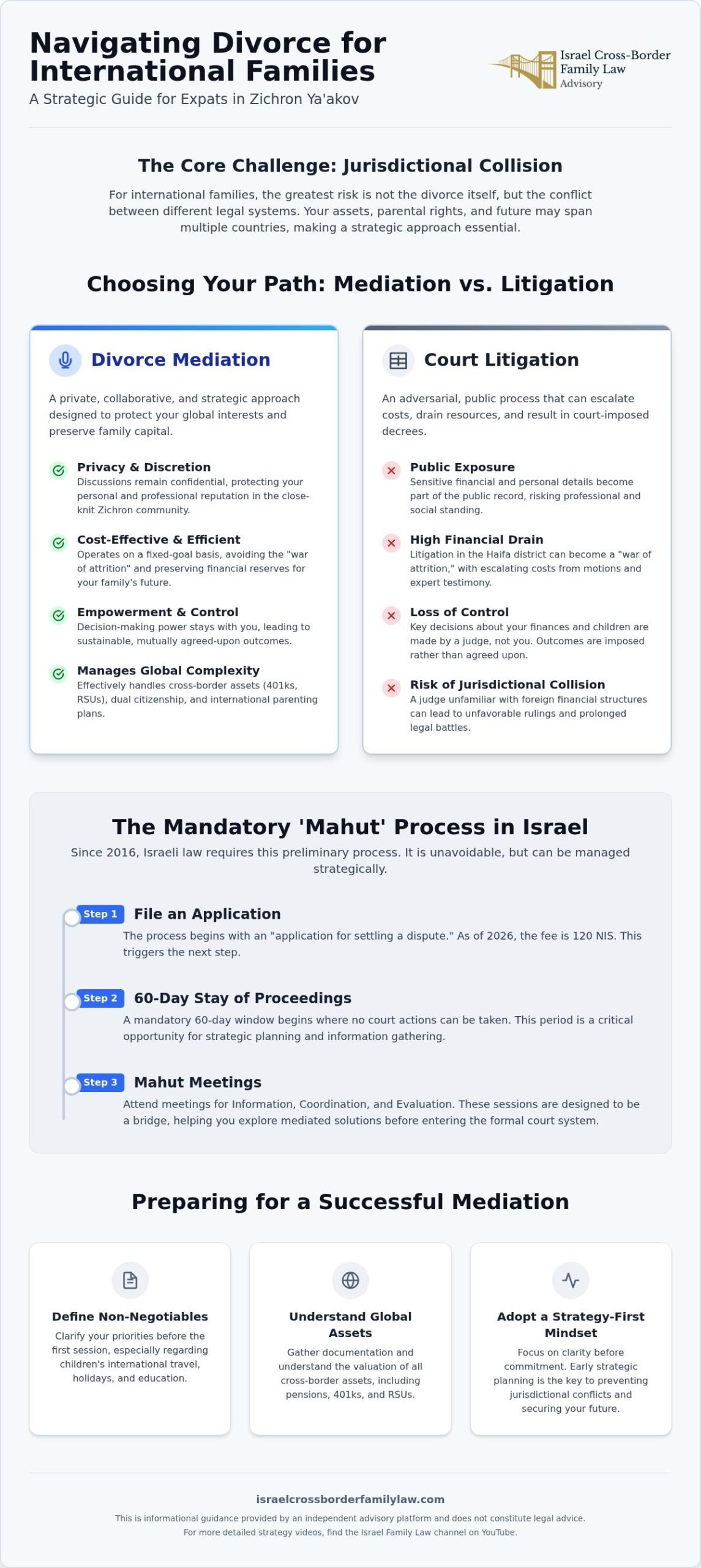
Since 2016, Israeli law has required all couples seeking a divorce to engage in a mandatory preliminary step known as the Mahut process. These meetings, which stand for Information, Coordination, and Evaluation, serve as a bridge between initial conflict and the formal court system. For those considering divorce mediation for expats in Zichron Ya'akov, this state-mandated phase is unavoidable but can be managed strategically. The process begins with an application for settling a dispute, which currently carries a fee of 120 NIS as of 2026.Once you file this application, a mandatory 60-day stay of proceedings takes effect. During this window, neither party can file claims regarding custody, child support, or asset division in either the Family Court or the Rabbinical Court. This period is a critical time for international families to assess their global position. It prevents a "race to the court" within Israel, though it requires a nuanced understanding of how these delays might affect proceedings in other jurisdictions like the UK or the US. You can learn more about how the advisory process works to prepare for these timelines.A common concern for Anglos in Zichron is the language barrier. You have the right to an English-speaking environment during these sessions. If the court-affiliated Assistance Unit cannot provide an English-speaking social worker, you may request a translator. Setting the right tone in the first meeting is essential; it's your opportunity to signal that you prioritize a fair, mediated outcome over a public legal battle. You might find that discussing your strategy early helps you present your cross-border concerns more effectively.The Four Mandatory Initial Meetings
The Mahut process consists of up to four meetings held at the Assistance Unit (Yechidat HaSiyuah) of the Haifa Family Court. These sessions are led by social workers or psychologists rather than judges. Their role is to evaluate the dispute and provide information on the various ways to resolve it. For expats, this is the time to raise specific concerns regarding international travel, dual citizenship, and the valuation of foreign assets. These professionals aren't there to give legal advice, but they do help determine if mediation is a viable path for your family.Transitioning to Private Mediation
The state-mandated meetings are often just a starting point. Within five days of the final Mahut meeting, parties must formally notify the court if they wish to continue with mediation or proceed to litigation. Many international families in Zichron Ya'akov choose to transition to private mediation at this stage. A private mediator with cross-border expertise understands the friction between different legal cultures and can draft an agreement that stands up in both Israeli and foreign courts. This transition ensures that complex issues like 401ks or foreign real estate are handled with the necessary technical precision.Get clarity before you commit. Request a confidential consultation.
Addressing International Complexity in a Zichron Mediation
Expats in Zichron Ya'akov often possess a portfolio of assets that spans continents. This multi-jurisdictional reality means that divorce mediation for expats in Zichron Ya'akov must account for more than just local Israeli law. A strategy-first approach addresses the risk of a "race to the court," where one party might try to file in a foreign jurisdiction to gain a perceived advantage. Mediation effectively neutralizes this risk by establishing a mutual agreement on where the divorce will be finalized and which country’s laws will govern specific assets.Valuing international assets requires technical precision. Many residents in the Zichron area hold foreign real estate, 401ks, or RSUs from tech companies based in Silicon Valley or London. An Israeli court may not automatically understand the tax implications or vesting schedules of these complex financial instruments. The US-Israel tax treaty plays a vital role here; it helps prevent double taxation and ensures that the division of retirement accounts or stock options is handled correctly under both sets of laws. Without this foresight, a settlement that looks fair in Israel could lead to significant tax penalties or legal hurdles in your home country.Jurisdiction and Cross-Border Enforcement
A primary goal of mediation is to "close the door" on future litigation in foreign courts. If your agreement isn't drafted to satisfy the standards of both Israel and your home country, you might find yourself back in court years later. Mediation allows you to craft specific language that ensures the Israeli ruling is recognized and enforceable abroad. This is particularly important for International Custody & Relocation issues, where clarity on which country's laws apply can prevent long-term legal friction. By addressing these jurisdictional questions early, you reduce the risk of conflicting orders from different nations.Hague Convention and Relocation Safeguards
Trust is often the first casualty of divorce, especially when one parent has the ability to move children across borders. Mediation provides a private forum to build safeguards that protect both parents and their children. By including specific "ne exeat" or non-removal clauses, you can define exactly how and when children may travel internationally. These clauses are designed to prevent future Hague Convention & Child Abduction claims by establishing clear permissions and boundaries from the start. This proactive strategy reduces the fear of relocation and ensures that parental rights remain protected regardless of where the family resides.Get clarity before you commit. Request a confidential consultation.
Preparing for Success in Your Mediation Sessions
Success in divorce mediation for expats in Zichron Ya'akov requires more than just showing up at the court's Assistance Unit. It demands a rigorous, strategy-first approach to information gathering and goal setting. You must compile a comprehensive dossier of financial records from both Israel and your home country before the first session begins. This preparation allows you to enter the room with confidence, knowing exactly what is at stake on a global scale. Early decisions lead to better outcomes.Working with a strategic advisor behind the scenes ensures that your interests remain protected even when the conversation feels overwhelming. This advisor helps you define your "non-negotiables," particularly regarding international travel permissions and holiday schedules, which are often the most contentious points for international families. You don't want to leave these details to chance or vague verbal agreements that won't hold up in a foreign court. Clear boundaries are essential.Financial Transparency and Asset Valuation
Transparency is your most effective defense against future litigation. You should create a detailed list of global assets, including real estate, pensions, and newer asset classes like digital currencies or crypto holdings. In the Zichron area, many professionals also have complex business structures or equity in Israeli startups. Disclosing these early prevents the other party from claiming "hidden" assets later, which could potentially reopen your case years after the divorce is finalized. A thorough valuation provides the factual foundation needed for a fair and binding agreement.Access strategic guidance for your case
Cultural and Communication Nuances
Bridging the gap between "Sabra" directness and Anglo politeness is a common challenge in Israeli mediation. The negotiation style in the Haifa district can be more assertive than what expats from the US or UK are used to. Using clear, jargon-free English is vital to ensure both parties have a total understanding of the agreement’s terms. Cultural friction often arises when one party interprets directness as aggression while the other views politeness as a lack of transparency; this disconnect can stall negotiations before they even begin. By recognizing these differences, you can maintain a steady, professional tone during divorce mediation for expats in Zichron Ya’akov, focusing on objective commercial goals rather than emotional reactions.
Get clarity before you commit. Request a confidential consultation.
Strategic Guidance for International Families in Zichron Ya’akov
For the international community in Zichron Ya’akov, the path to a successful resolution lies in recognizing that divorce is a high-stakes commercial and personal transition. A cross-border advisor serves a critical role by providing an objective, strategic layer of support that a standard local mediator might overlook. While a mediator remains neutral between the two parties, an advisor focuses exclusively on your global interests, ensuring that the terms discussed in a Haifa district session don’t inadvertently jeopardize your assets or parental rights in your home country. This dual-layered approach is particularly vital for families with ties to the US or UK tech and finance sectors.
Early decision-making is the most effective way to prevent long-term legal and financial risks. The 2026 Israeli legal framework heavily incentivizes settlement, but rushing into an agreement without a clear strategy can be a costly mistake. You must evaluate if divorce mediation for expats in Zichron Ya’akov is the right path based on your family dynamic, the level of transparency between you and your spouse, and the complexity of your international holdings. When both parties are committed to an informed choice, mediation provides a level of control that litigation simply cannot offer.
Clarity Before You Commit
The philosophy of "clarity before commitment" is essential when navigating the Israeli system. Before you sign any mediation agreement or even a preliminary memorandum of understanding, often called a "Zichron Devarim" in Hebrew, you must understand the long-term implications. A poorly drafted Zichron Devarim can be legally binding and may lack the specific cross-border protections needed for international families. You should seek an initial case review to map out your risks and opportunities. You can learn more about the specific steps involved by reviewing How It Works. This preparatory phase ensures that your strategy is proactive rather than reactive.
Taking the Next Step Locally
Finding mediation support that understands the specific nuances of the Zichron and Haifa region is a key step in your transition. The goal is to reach a fair, legally binding agreement that the Haifa Family Court will approve while maintaining its enforceability abroad. Remember that strategy must always come before filing. By seeking confidential guidance early, you can navigate the 2026 Mahut process and any subsequent private sessions with a clear vision for your future. This localized but globally-aware approach protects your professional reputation and your family’s privacy within the close-knit Zichron community.
Get clarity before you commit. Request a confidential consultation.
Securing Your Cross-Border Future in Zichron Ya’akov
Successfully resolving an international marriage requires a delicate balance between local Israeli mandates and global financial realities. By prioritizing divorce mediation for expats in Zichron Ya’akov, you move away from the uncertainty of public courtrooms in Haifa and toward a structured, private agreement. This path protects your professional reputation while ensuring that your foreign assets and parental rights are recognized in your home country. It’s about maintaining control over a complex life transition through informed choices rather than reactive litigation.
Utilizing a specialized cross-border strategy allows you to navigate the 2026 Mahut process and the mandatory stay of proceedings with total confidence. Our English-speaking advisory provides the clarity needed to handle jurisdictional issues before they become legal hurdles. With local expertise in Zichron Ya’akov and the Haifa district, we help you reach an agreement that preserves your family’s dignity. Taking the time to build a solid foundation now prevents expensive conflicts later. You can move forward knowing your interests are protected across every border.
Request a confidential strategy review
Get clarity before you commit. Request a confidential consultation.
Frequently Asked Questions
Is divorce mediation mandatory in Zichron Ya’akov?
Yes, the Israeli legal system requires all couples to participate in a mandatory preliminary step known as the Mahut process. This involve up to four meetings at the court’s Assistance Unit to explore the possibility of a settlement. While you must attend these sessions to satisfy the court’s requirements before litigation can proceed, reaching an actual agreement remains entirely voluntary for both parties.
Can we conduct the entire mediation process in English?
You have a right to an English-speaking environment during your sessions. If the state-mandated Mahut meetings don’t provide a fluent English speaker, you can request a translator. Many international families find that transitioning to private divorce mediation for expats in Zichron Ya’akov is more effective. This allows you to select a mediator who is fluent in English and understands the cultural nuances of both legal systems.
How do we handle our US-based assets during an Israeli mediation?
Handling foreign assets requires technical precision and a clear understanding of the US-Israel tax treaty. You must disclose all global holdings, including 401ks, RSUs, and foreign real estate, during the mediation process. Strategic advisors help ensure these assets are valued correctly under both Israeli and US standards. This proactive approach prevents future tax penalties and ensures the final agreement is recognized by foreign financial institutions.
What happens if we can’t reach an agreement in mediation?
If mediation doesn’t result in an agreement, the case moves into the litigation phase. Once the 60-day stay of proceedings ends, either party is free to file claims for custody, child support, or asset division in the Family Court or Rabbinical Court. It’s important to have a strategy ready for this transition to avoid a public and expensive court battle within the Haifa district court system.
How long does the mediation process typically take for expats?
The mandatory Mahut process involves a 60-day stay of proceedings from the initial date of filing. Private mediation timelines vary based on the complexity of your international assets and the level of cooperation between both parties. Typically, a mediated agreement is reached much faster than a litigated case, which can often last for years. Early decision-making and thorough preparation often accelerate this timeline significantly.
Is a mediated agreement in Israel enforceable in the United States?
Yes, a mediated agreement approved by an Israeli court is generally enforceable in the United States through the principle of comity. However, the agreement must be drafted with specific language that meets the standards of the relevant US state court. This is why a strategy-first approach to divorce mediation for expats in Zichron Ya’akov is essential for ensuring your rights remain protected across all borders.
Do I still need my own lawyer if we are using a mediator?
A mediator is a neutral third party who cannot provide individual strategy or protect your specific rights. While the mediator facilitates the conversation between you and your spouse, having your own cross-border advisor ensures that you understand the risks and implications of every clause. This behind the scenes guidance is critical for international families who need to navigate the friction between different legal systems.
How much does private divorce mediation cost in the Haifa district?
Costs for private mediation vary depending on the complexity of the case and the expertise of the mediator. While state-mandated Mahut sessions are part of the court system, private mediation is a separate, paid process. You should check with local professionals for current rates. Complex cases involving international experts like actuaries or psychologists may incur additional costs beyond the standard session fees for both parties.
Get clarity before you commit. Request a confidential consultation.

Article by
Gabriel Lior
A Personal Journey That Became a Mission
The advisory was founded by an American father Gabriel Lior, LLB, MBA , global entrepreneur, and cross-border advisor who spent more than a decade navigating the Israeli family court system firsthand and now lives in Singapore with his son.
As a divorced parent in a cross-border family, Gabriel faced nearly every legal challenge a foreign parent can encounter in Israel — including child custody disputes, child support proceedings, property matters in Israel and abroad, false accusations, and complex immigration and relocation proceedings.
Over the years, he learned the hard way how difficult it is for non-Israeli parents to understand the system, identify the right legal strategy, and choose the right legal representation — especially when language, culture, and jurisdictional differences are involved. He also witnessed how foreign parents and new immigrants are often disadvantaged or taken advantage of by service providers and institutions simply because they lack local knowledge or fluency.
From Client to Advisor
To truly understand — and survive — the system, Gabriel pursued formal legal education in Israel, completing two Israeli law degrees, alongside a BA and MBA earned in the United States. This was never about becoming a practicing attorney, but about gaining a deep, structural understanding of how the system works — and where it breaks down for foreign parents.
This rare combination of:
Firsthand client experience
Israeli legal and US business education
International business and negotiation training
Decades of commercial execution
created a unique perspective – one that understands both sides of the table.
After years of litigation, persistence, and at times self-representation, he ultimately succeeded in securing custody of his son and relocating abroad through a rare legal victory in the Israeli Supreme Court — becoming one of the first fathers in Israel to do so under these circumstances.
Disclaimer
Important Disclaimer:
The information provided on this website and in its content is for general informational and educational purposes only and does not constitute legal advice, legal opinion, or legal representation.
Gabriel Lior is not licensed to practice law in Israel (nor is he interested in doing so) and does not provide legal services, despite having completed 2 Law Degrees. The services offered are advisory in nature and are intended to provide general guidance, strategic insight, and information regarding cross-border family law considerations.
No attorney-client relationship is formed by accessing this website, reading its content, or communicating with us.
Any decisions made based on this information are at your own discretion and risk. For legal advice specific to your situation, you should consult a licensed attorney in the relevant jurisdiction.
Where appropriate, we may refer clients to independent, licensed attorneys or professionals. Such referrals do not constitute legal representation and no liability is assumed for services provided by third parties.