
This article is published on an independent advisory platform and is for informational purposes only. It does not constitute legal advice or an attorney-client relationship. Legal services are only provided by licensed attorneys under a separate engagement.
An Israeli bank will not release funds based on a foreign will or foreign court order alone, regardless of how clearly the document is drafted or executed in your home country. It’s common to feel overwhelmed when an account is frozen immediately after a loss, particularly when you’re faced with Hebrew paperwork and the bank’s demand for your physical presence. You might even worry that US tax implications like FATCA or the $100,000 IRS reporting threshold will complicate the transfer of your family’s legacy. This guide explains how to gain control of inherited israeli bank accounts by navigating the two-track process of legal validation and regulatory compliance without leaving your home. You will learn the exact steps to obtain an Israeli Succession Order, manage the 3 to 9 month timeline for asset release, and ensure your transfer meets all cross-border legal standards. To better understand the legal framework, you can watch detailed explanations on the Israel Family Law YouTube channel. Get clarity before you commit. Request a confidential consultation.
Key Takeaways
- Understand why Israeli banks freeze assets immediately and why foreign court orders aren’t sufficient for fund release.
- Learn how to gain control of inherited israeli bank accounts by obtaining the specific Israeli Probate or Succession Order required by local law.
- Prepare for the rigorous banking compliance phase, including FATCA reporting and the detailed documentation needed for international transfers.
- Discover how to manage the entire process from abroad, including the collection of necessary apostilles and international death certificates.
- Determine whether to close the account or maintain it as a non-resident based on your long-term financial strategy and tax obligations.
Understanding the Immediate Freeze and the Legal Framework
This article is published on an independent advisory platform and does not constitute an attorney-client relationship. Legal services are only provided by licensed attorneys under a separate engagement.
Israeli financial institutions, including major entities like Bank Leumi and Bank Hapoalim, operate under a strict regulatory environment. When an account holder passes away, the bank is legally obligated to freeze the account immediately to prevent unauthorized withdrawals or the dissipation of assets. This action is rooted in the Israeli legal system, specifically under the Israeli Inheritance Law of 1965. This law ensures that assets are distributed according to a valid will or the default rules of succession. Learning how to gain control of inherited israeli bank accounts starts with understanding that this freeze isn’t a sign of trouble; it’s a standard legal safeguard designed to protect the estate until the proper heirs are identified.
To better understand how cross-border inheritances are managed, watch this helpful video:
The Role of the Israeli Bank in the Inheritance Process
Banks in Israel act as the ultimate gatekeepers of the deceased’s liquidity. A common misconception among international families is that a pre-existing Power of Attorney remains valid after death. In Israel, any Power of Attorney granted by the deceased expires the moment they pass away. You can’t use it to pay bills or transfer funds once the bank is notified. Even if you present a certified death certificate, the bank will not release the funds. They require a specific court-issued document: either a Probate Order or a Succession Order. Without these, the account remains “frozen” for protection. This is different from being “blocked” due to non-compliance with anti-money laundering (AML) or FATCA regulations, which can happen if the bank lacks updated tax residency information for the heirs.
Anglo and Expat Challenges in Israeli Banking
For expats and foreign nationals, the process involves extra layers of complexity. Language barriers are a primary hurdle. Banks require Hebrew translations for almost all foreign documents, and these translations often need to be notarized or certified by an Israeli attorney. Being a non-resident also changes the bank’s risk profile for the account. Early decisions, such as how and when you notify the bank, can significantly impact your strategy. If you notify the bank before you have a local legal strategy in place, you might find yourself locked out of necessary information for months. It’s vital to seek clarity before you commit to a specific path. Get clarity before you commit. Request a confidential consultation.
This article is published on an independent advisory platform and does not constitute an attorney-client relationship. Legal services are only provided by licensed attorneys under a separate engagement.
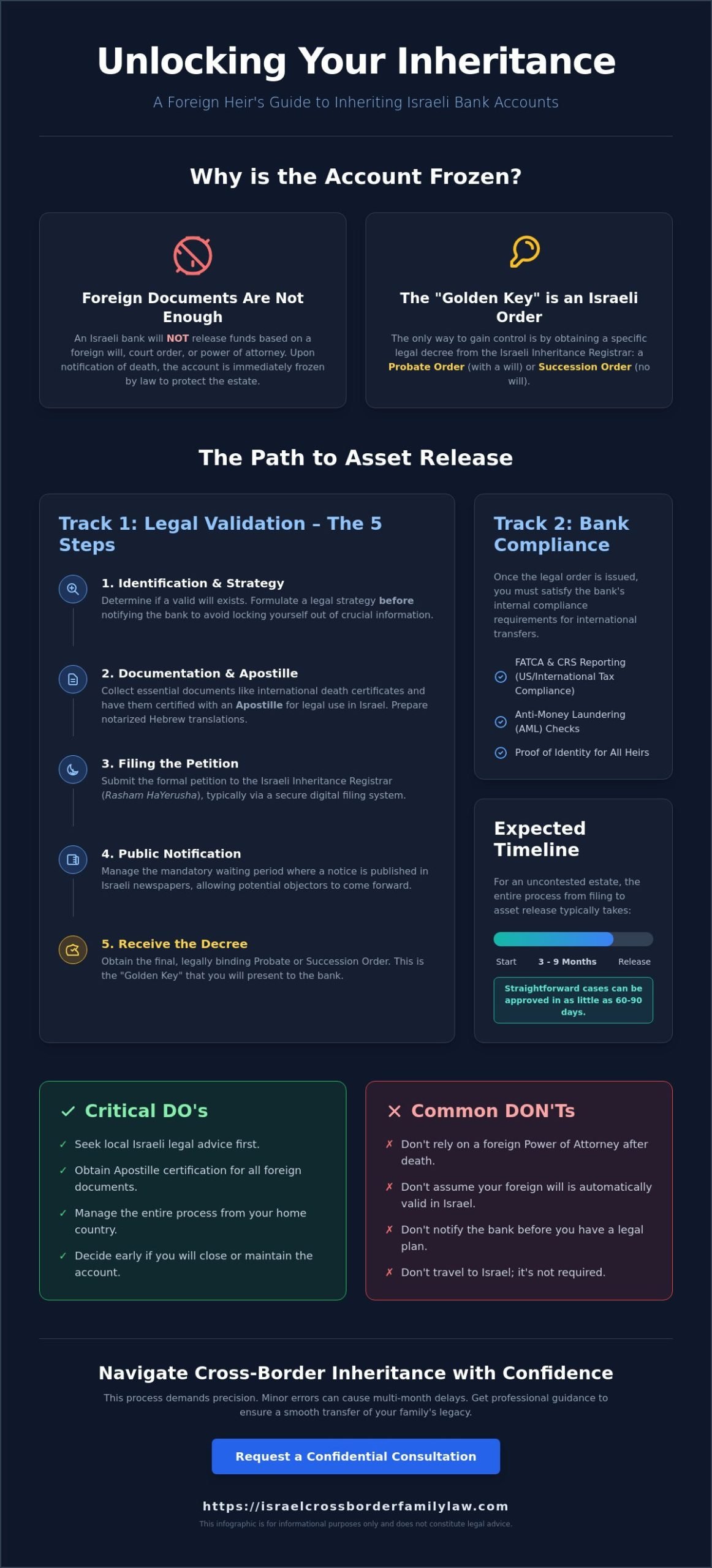
Once the bank freezes the assets, the only path to recovery is through the Israeli legal system. Understanding how to gain control of inherited israeli bank accounts requires securing a specific decree from the Inheritance Registrar (Rasham HaYerusha). This process validates who is legally entitled to the funds and provides the bank with the necessary indemnity to release them. For an uncontested estate, obtaining this order typically takes between 3 and 9 months, though straightforward cases can be approved in as little as 60 to 90 days. It’s a structured procedure that demands precision, as even minor errors in the initial filing can lead to multi-month delays.
The process follows five distinct steps:
- Identification: You must first determine if there’s a valid will to guide the distribution.
- Documentation: Collect international death certificates and secure the necessary apostilles for all foreign-issued papers.
- Filing: Submit the formal petition to the Inheritance Registrar, usually via a digital filing system.
- Notification: Manage the mandatory public notice period in Israeli newspapers to allow for potential objections.
- Decree: Receive the final, legally binding order that serves as the “Golden Key” to the bank’s vault.
Probate Order vs. Succession Order: Which Do You Need?
A Probate Order (Tzav Kiyum Tzava’a) is necessary if the deceased left a will. It confirms the document’s validity and appoints the beneficiaries. If no will exists, you must apply for a Succession Order (Tzav Yerusha). In these cases, the court applies the Israeli Inheritance Law of 1965 to determine the heirs. This framework also addresses complex historical situations, such as Holocaust-era asset claims, which may require additional genealogical proof to establish the line of succession. Knowing how to gain control of inherited israeli bank accounts involves identifying which of these two paths fits your family’s situation before you begin the paperwork.
The Complexity of Cross-Border Documentation
For international families, the most common point of failure is the documentation. Israeli authorities won’t accept a US death certificate or a foreign will without an Apostille. This is an international certification that makes the document legally valid in IL. Technical errors in these filings often lead to significant delays or outright rejection. Understanding the how it works of the local system is vital to avoid these bureaucratic deadlocks. Small mistakes in Hebrew translation or improper notarization can stall an application for months. It’s often helpful to request a confidential consultation to review your specific documentation requirements before making commitments.
This article is published on an independent advisory platform and does not constitute an attorney-client relationship. Legal services are only provided by licensed attorneys under a separate engagement.
Obtaining the court order is only half the battle. To understand how to gain control of inherited israeli bank accounts, you must also clear the bank’s internal compliance hurdles. These checks are often more rigorous than the court process itself. Banks are required to follow international standards, which means they’ll ask for extensive personal information before unfreezing any funds. This is a standard regulatory safeguard, but it can feel invasive to heirs who aren’t familiar with Israeli banking culture.
The Regulatory Hurdle for US Citizens
Israeli banks are notably risk-averse when dealing with US-taxable persons. This caution stems from FATCA compliance in Israel
This article is published on an independent advisory platform and does not constitute an attorney-client relationship. Legal services are only provided by licensed attorneys under a separate engagement.
The final submission of your Israeli Probate Order to the bank’s legal department marks the transition from legal validation to financial execution. This is the definitive moment in how to gain control of inherited israeli bank accounts, yet it is often where heirs encounter a frustrating “lack of communication” from local bank clerks. Legal departments in major Israeli banks can take several weeks to verify the court decree and clear the funds for distribution. During this time, it’s common for non-resident heirs to receive little to no status updates unless they have a representative managing the file locally.
One of the first strategic choices you’ll face is whether to close the account entirely or keep it open as a non-resident. For most international heirs, closing the account is the logical choice. Maintaining an Israeli bank account as a non-resident involves high monthly fees and ongoing reporting requirements under CRS and FATCA. If you choose to close the account, the bank will require a final set of instructions regarding the distribution of the balance to the legal heirs. This usually involves a formal closing statement signed by all beneficiaries or their authorized representative.
Wire Transfers and Currency Conversion
Moving funds from IL to the US involves navigating currency conversion and international wire protocols. Most Israeli bank accounts are held in New Israeli Shekels (NIS). Converting these to USD within the bank can result in unfavorable exchange rates and high transaction fees. You should weigh the benefits of a direct bank transfer against using an Attorney Trust Account. A trust account can sometimes simplify the distribution when there are multiple heirs in different jurisdictions, as it allows for a single transfer from the bank followed by individual distributions. For more information on how these processes are structured, you can review our pricing and process overview.
Dealing with Outstanding Debts and Taxes
Before the bank releases the final balance, all of the deceased’s outstanding debts in Israel must be settled. This includes utility bills, local taxes, or medical expenses. While Israel has not had an inheritance tax since 1981, the bank must ensure that no other liens exist against the assets. In some complex cases, particularly those involving large sums or business interests, the bank may request a ‘Tax Clearance’ from the Israeli Tax Authority. This document confirms that the state has no further claims on the funds. Ensuring these details are handled before the final wire transfer prevents funds from being caught in a bureaucratic deadlock. If you’re ready to begin the final distribution phase, you can contact us to coordinate your transfer strategy.
This article is published on an independent advisory platform and does not constitute an attorney-client relationship. Legal services are only provided by licensed attorneys under a separate engagement.
The path to successfully resolving an international estate is rarely just about the paperwork. While the previous sections detailed the legal and banking steps, the most successful outcomes depend on a strategy-first approach. A common error among international families is rushing to notify the bank or filing for a probate order before understanding the full scope of the estate. These early decisions can lead to bureaucratic deadlocks that add months to the process. Learning how to gain control of inherited israeli bank accounts requires you to balance local legal requirements with the specific risk management protocols of the bank’s compliance department.
Risk-based decision making is a critical component of this journey. You will occasionally face bank requirements that seem redundant or illogical from a US or UK perspective. In these moments, you must decide whether to challenge the bank’s demand or simply comply to keep the process moving. Often, a physical presence in Tel Aviv or Jerusalem is the only way to resolve a clerk’s specific objection. Having a team on the ground allows for direct, face-to-face negotiation with bank managers, which is frequently more effective than sending emails from abroad. This is particularly vital for expats and foreign nationals who don’t have the luxury of visiting a local branch in person.
Clarity Before Commitment
Cross-border situations are inherently complex because they involve two different legal cultures and tax systems. Before you file any documents with the Inheritance Registrar, you should seek a comprehensive strategy session. This helps you identify potential pitfalls, such as the 25% capital gains tax that might apply if you sell certain inherited assets later. You can find additional educational resources on the Israel Family Law YouTube channel, which offers deeper insights into the cultural nuances of the Israeli legal system. Getting a clear view of the timeline and costs early on prevents expensive mistakes in the final distribution phase.
Requesting Professional Guidance
A cross-border legal advisory operates differently than a standard local law firm. It acts as a bridge between the “start-up nation” and your home jurisdiction. Effective representation must be both bilingual and bicultural to navigate how to gain control of inherited israeli bank accounts without losing information in translation. This specialized guidance ensures that your actions in Israel remain compliant with US reporting rules like Form 3520 for foreign inheritances. Get clarity before you commit. Request a confidential consultation to discuss your family’s specific needs and develop a risk-based strategy for your assets.
This article is published on an independent advisory platform and does not constitute an attorney-client relationship. Legal services are only provided by licensed attorneys under a separate engagement.
Securing Your Family’s Financial Legacy
Successfully learning how to gain control of inherited israeli bank accounts requires a strategy that bridges the gap between the Israeli court system and global banking regulations. You must navigate the dual challenges of obtaining a local probate order and clearing rigorous FATCA and AML compliance checks. While the process is complex, it can be managed efficiently from abroad by leveraging a team on the ground in both Tel Aviv and New York. This bicultural and bilingual expertise is essential for translating sophisticated legal requirements into actionable steps. With decades of experience in cross-border probate matters, the right guidance ensures that your family’s assets are protected and transferred with minimal friction. Every decision made in the early stages impacts the final timeline and tax outcome. Get clarity before you commit. Request a confidential consultation to begin your journey with confidence. We look forward to helping you move forward with peace of mind.
This article is published on an independent advisory platform and does not constitute an attorney-client relationship. Legal services are only provided by licensed attorneys under a separate engagement.
Frequently Asked Questions
How long does it take to unfreeze an Israeli bank account after death?
Unfreezing an Israeli bank account typically takes between 3 and 9 months for an uncontested estate. Straightforward cases can sometimes be approved in 60 to 90 days, while more complex situations involving international heirs can take longer. This timeline includes the time needed for the Inheritance Registrar to issue a decree and the bank’s internal legal department to review the file.
Do I need to fly to Israel to claim my inheritance?
You don’t need to fly to Israel to manage this process or claim your assets. Most international heirs handle the entire procedure remotely by appointing a local representative with a power of attorney. This allow a “team on the ground” to manage physical bank visits, Hebrew documentation, and the filing of court petitions while you remain in your home country.
Is there an inheritance tax in Israel for US beneficiaries?
Israel does not have an inheritance or estate tax; a policy that has been in effect since 1981. However, US beneficiaries must still comply with their home country’s regulations. For example, US citizens who receive more than $100,000 from a foreign estate are required to file Form 3520 with the IRS to report the transfer of funds.
Can I use a US Power of Attorney to manage an Israeli bank account?
A US Power of Attorney is not sufficient to manage an account after the owner’s death. In the IL legal system, any power of attorney granted by the deceased expires immediately upon their passing. To access the funds, you must obtain a specific Israeli Probate or Succession Order, as the bank will not recognize foreign court orders or foreign powers of attorney.
What happens if the original owner died decades ago?
You can still claim the assets even if the original owner died decades ago, as there is no statutory deadline for filing an inheritance claim in Israel. While the passage of time doesn’t expire your rights, it can create practical challenges. You may need to reconstruct family trees or track down bank records that have been moved to long-term archives.
What if I cannot find the original will for the Israeli assets?
If you can’t find the original will, the estate is typically handled through a Succession Order. This process distributes the assets according to the default rules of the 1965 Inheritance Law. Under these rules, the estate is usually split between the surviving spouse and the children, ensuring a legal distribution even in the absence of a physical document.
How much are the legal fees for reclaiming an Israeli bank account?
Legal fees for learning how to gain control of inherited israeli bank accounts vary based on the complexity of the cross-border situation. Costs are influenced by the number of heirs, the need for international document apostilles, and the specific compliance requirements of the bank. Seeking a strategy session early on helps you understand the potential costs before making significant commitments.
Can I transfer the inherited funds directly to my US bank account?
You can transfer the inherited funds directly to a US account once the bank’s legal and compliance departments clear the Probate Order. The bank will require you to complete KYC and FATCA documentation before executing the wire. It’s often helpful to coordinate the timing of the transfer to manage currency conversion rates from NIS to USD effectively.

Article by
Gabriel Lior
A Personal Journey That Became a Mission
The advisory was founded by an American father Gabriel Lior, LLB, MBA , global entrepreneur, and cross-border advisor who spent more than a decade navigating the Israeli family court system firsthand and now lives in Singapore with his son.
As a divorced parent in a cross-border family, Gabriel faced nearly every legal challenge a foreign parent can encounter in Israel — including child custody disputes, child support proceedings, property matters in Israel and abroad, false accusations, and complex immigration and relocation proceedings.
Over the years, he learned the hard way how difficult it is for non-Israeli parents to understand the system, identify the right legal strategy, and choose the right legal representation — especially when language, culture, and jurisdictional differences are involved. He also witnessed how foreign parents and new immigrants are often disadvantaged or taken advantage of by service providers and institutions simply because they lack local knowledge or fluency.
From Client to Advisor
To truly understand — and survive — the system, Gabriel pursued formal legal education in Israel, completing two Israeli law degrees, alongside a BA and MBA earned in the United States. This was never about becoming a practicing attorney, but about gaining a deep, structural understanding of how the system works — and where it breaks down for foreign parents.
This rare combination of:
Firsthand client experience
Israeli legal and US business education
International business and negotiation training
Decades of commercial execution
created a unique perspective – one that understands both sides of the table.
After years of litigation, persistence, and at times self-representation, he ultimately succeeded in securing custody of his son and relocating abroad through a rare legal victory in the Israeli Supreme Court — becoming one of the first fathers in Israel to do so under these circumstances.
Disclaimer
Important Disclaimer:
The information provided on this website and in its content is for general informational and educational purposes only and does not constitute legal advice, legal opinion, or legal representation.
Gabriel Lior is not licensed to practice law in Israel (nor is he interested in doing so) and does not provide legal services, despite having completed 2 Law Degrees. The services offered are advisory in nature and are intended to provide general guidance, strategic insight, and information regarding cross-border family law considerations.
No attorney-client relationship is formed by accessing this website, reading its content, or communicating with us.
Any decisions made based on this information are at your own discretion and risk. For legal advice specific to your situation, you should consult a licensed attorney in the relevant jurisdiction.
Where appropriate, we may refer clients to independent, licensed attorneys or professionals. Such referrals do not constitute legal representation and no liability is assumed for services provided by third parties.
Related Insights & Resources

Legal Advice for Expats Divorcing in Israel: A Complete Guide
The dissolution of a marriage for an expatriate in Israel presents a complex and often...Read More →
Legal Separation for International Couples: A US-Israel Guide
When your life and assets span both the United States and Israel, pursuing a legal...Read More →
Préparer Votre Enfant à une Évaluation de la Garde : Un Guide pour les Familles Transfrontalières
La manière la plus efficace de préparer votre enfant à une évaluation de la garde...Read More →