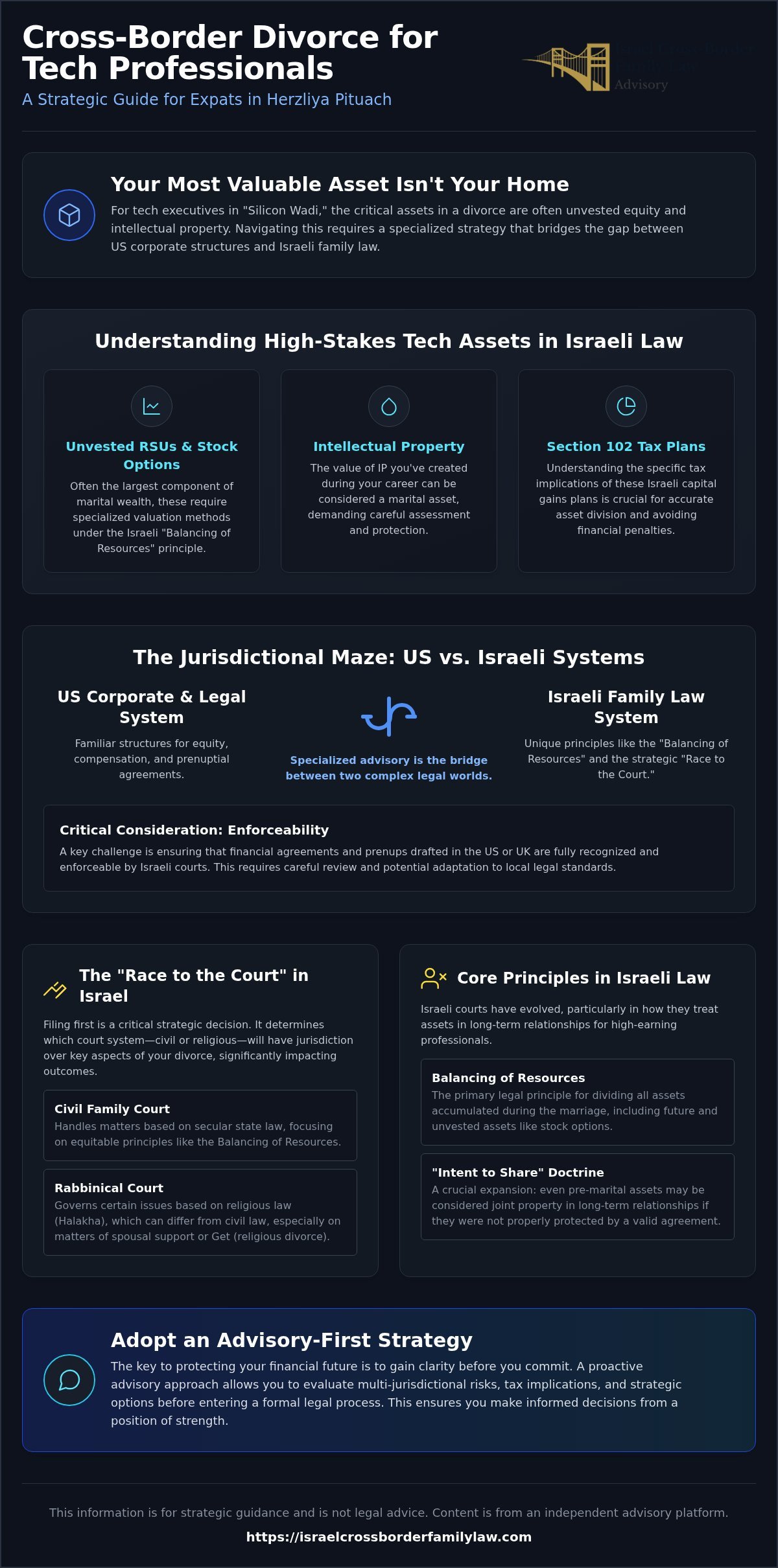
In the high-stakes professional environment of Herzliya Pituach, your most valuable marital asset isn’t your family home; it’s the unvested equity and intellectual property you’ve built over years in the tech sector. You’ve likely spent your career navigating the fast-paced "Silicon Wadi," but the complexity of a cross-border divorce can feel like a system failure you weren’t prepared for. It’s natural to feel overwhelmed by the Israeli "race to the court" or the fear that your RSUs might be misvalued in an unfamiliar legal framework.
Finding a family lawyer for tech workers in Herzliya Pituach who understands the nuances of Section 102 tax plans and US-Israel jurisdictional conflicts is critical for protecting your financial future. This guide provides a strategic framework to help you navigate these multi-jurisdictional risks with confidence. We’ll explore how to handle unvested stock options, manage international child relocation concerns, and bridge the gap between US and Israeli legal systems to ensure your assets remain secure.
Key Takeaways
- Learn how unvested RSUs, stock options, and intellectual property are categorized and valued under the Israeli “Balancing of Resources” principle.
- Understand the strategic importance of the “Race to the Court” and how filing first in the correct jurisdiction impacts your global asset division.
- Discover why a specialized family lawyer for tech workers in Herzliya Pituach is necessary to bridge the gap between US corporate structures and Israeli family law.
- Gain clarity on ensuring cross-border financial agreements and US-drafted prenups are fully enforceable and recognized by Israeli courts.
- Adopt an advisory-first strategy to evaluate multi-jurisdictional risks and tax implications before committing to a formal legal process.
Why Herzliya Pituach Tech Professionals Require Specialized Family Law Strategy
Herzliya Pituach serves as the beating heart of Israel’s high-tech sector, housing a unique demographic of American expats, British Anglos, and high-level executives. With Israel’s tech workforce reaching approximately 450,000 professionals in 2026, and a recruitment rate of 8% in the first half of the year, the concentration of innovation-based wealth in this specific coastal region is unprecedented. Standard legal approaches often overlook the complexities inherent in these careers. A family lawyer for tech workers in Herzliya Pituach must understand that your financial reality involves more than just a salary; it’s a mix of global equity, intellectual property, and cross-border tax obligations.
Traditional litigation models often fail because they treat a tech executive’s portfolio like a standard local asset. In reality, your career trajectory involves rapid scaling, potential exits, and vesting schedules that don’t always align with the calendar year. A family lawyer for tech workers in Herzliya Pituach helps bridge the gap between US corporate structures and the local legal landscape. Defining cross-border family law in this context means recognizing that your life likely spans two legal systems, often involving US-based assets or dual citizenship. A calm, advisory approach is essential to prevent a standard dispute from escalating into a destructive legal battle.
To better understand the nuances of cross-border legal strategy, watch this helpful video:
The Intersection of High-Tech Assets and Israeli Family Law
Israeli courts have become increasingly sophisticated in how they view high-earning tech professionals. Following a significant Supreme Court ruling in February 2025, the "intent to share" principle has expanded, meaning even pre-marital assets can now be considered joint property in long-term relationships if they weren’t properly protected. Professional reputation is often as valuable as the bank balance in the tech community. A tech-sector divorce is essentially a specialized financial event that requires a deep understanding of how future stock options are treated during marital dissolution.
Addressing the Expat and Anglo Experience in Herzliya
Expats often find the "race to the court" confusing, as the first to file determines whether religious or civil law takes the lead on certain issues. Navigating the dual jurisdiction of Israeli Rabbinical and Civil courts can be a culture shock for those used to Western legal systems. Specialized guidance for For Expats & Foreign Nationals is vital to ensure your rights are protected in a language you understand. This includes verifying that prenuptial and financial agreements drafted in the US or UK are actually enforceable within the Israeli system. It’s about building a bridge between your corporate background and the local legal reality.
Managing High-Stakes Financial Assets: RSUs, Options, and IP
Tech compensation in Herzliya Pituach often consists of complex equity packages rather than simple cash salaries. Protecting these assets requires more than a standard property division approach. A family lawyer for tech workers in Herzliya Pituach must analyze how the Israeli Spouses’ Property Relations Law applies to unvested RSUs and founder equity. The February 2025 Supreme Court ruling on the "intent to share" principle has made it even more critical to define which assets are truly separate, as even pre-marital property can now be subject to division based on how it was used during the marriage.RSUs and Stock Options in Divorce Settlements
Israeli courts typically apply a "time-rule" formula to divide equity, calculating the portion of the vesting period that occurred during the marriage. Distinguishing between active appreciation, driven by your professional efforts, and passive market growth is a vital strategic move. Delaying the division until actual vesting dates can maximize value while ensuring both parties share the market risk. It’s also important to consider Section 102 compliant plans. These offer a 25% capital gains tax rate instead of the standard marginal income tax rates, which can reach 50% for high earners in 2026 when including the 3% surtax on income exceeding ILS 721,560.Business Asset Protection for Tech Founders
Startup equity and Intellectual Property (IP) present unique valuation challenges, especially before an IPO. Forensic accounting is often necessary to determine a fair market value for founder shares and to account for the "Balancing of Resources" principle. Protecting your voting rights and operational control is a primary concern during marital dissolution. Implementing buy-sell agreements or specific corporate governance clauses can prevent a personal dispute from destabilizing the company. You can schedule a review of these corporate risks to ensure your professional interests are shielded from unnecessary exposure.Transfers involving US-based 401(k)s or brokerage accounts require specific coordination to avoid immediate tax penalties. Israeli courts cannot issue a Qualified Domestic Relations Order (QDRO) for US retirement funds. Without a coordinated cross-border strategy, you risk double taxation or losing a significant portion of your portfolio to tax inefficiency. Understanding these jurisdictional conflicts is the first step toward a secure financial exit.Get clarity before you commit. Request a confidential consultation.
Jurisdictional Strategy: The US-Israel Cross-Border Complexity
Living between two innovation hubs like Silicon Valley and Herzliya Pituach creates a complex jurisdictional puzzle. When a marriage ends, the location where you file for divorce can significantly alter the outcome of your asset division and parental rights. This is especially true for those with dual ties, where the legal systems of both the US and Israel may claim authority. Identifying a family lawyer for tech workers in Herzliya Pituach who understands these cross-border dynamics is the first step in a sound strategy. Decisions made in the first 48 hours often dictate the financial trajectory of the next decade.The US-Israel Tax Treaty plays a vital role in determining support payments and protecting global income. While the treaty provides some relief from double taxation, it doesn’t cover every scenario. For instance, as of 2026, the US and Israel still haven’t signed a Totalization Agreement. This means self-employed tech professionals or consultants may face double social security taxes if their status isn’t managed correctly. Additionally, while Article 21 of the treaty exempts certain social security benefits from tax in both countries, applying these rules to high-income earners with dual citizenship requires careful cross-border planning.Navigating the Israeli ‘Race to the Court’
Israel operates a dual legal system where both the civil Family Court and the religious Rabbinical Court have authority over divorce. The first party to file a comprehensive claim usually "locks in" the jurisdiction for issues like property division. This creates a tactical "Race to the Court" that can catch expats off guard. Filing in the Rabbinical Court may offer different outcomes for alimony or asset valuation than the Family Court. Early advisory is essential because once papers are served, your strategic options narrow quickly, and "jurisdiction snatching" can become a reality.Hague Convention and International Relocation
For many tech families, a divorce often triggers a desire for one parent to move back to the US. However, moving children across borders without a formal agreement or court order can lead to claims under the Hague Convention. Israeli courts take these matters seriously; a "wrongful removal" can result in a court-ordered return of the children to Israel. You should review our guide on international custody and relocation before making any travel plans. Managing these risks requires a proactive approach that prioritizes the stability of the children while protecting your parental rights in both jurisdictions.Get clarity before you commit. Request a confidential consultation.
Download as HTML](https://t.mtrbio.com/israelcrossborderfamilylaw)
Strategic Tools for Asset Protection: Prenuptial and Financial Agreements
In the high-velocity world of Israeli tech, financial agreements aren’t just legal documents; they’re essential risk management tools. For professionals in Herzliya Pituach, a standard agreement often falls short because it doesn’t account for the multi-jurisdictional nature of their wealth. A family lawyer for tech workers in Herzliya Pituach can help you navigate the specific requirements of the Israeli Spouses’ Property Relations Law while ensuring your global interests remain protected. Given the 2025 Supreme Court ruling that expanded the "intent to share" principle, having a robust, written strategy for pre-marital assets is now more important than ever for those with significant equity or intellectual property.
Crafting Enforceable Cross-Border Prenuptial Agreements
Ensuring a US-drafted prenuptial agreement stands up in an Israeli court is a common challenge for expats. Israeli judges look for specific markers of fairness and full disclosure that may differ from various US state standards. One critical pitfall is the lack of "Independent Legal Advice" from practitioners who understand both legal systems. Without this, an agreement can be overturned if a spouse claims they didn’t understand the long-term implications of the document they signed. Key clauses must explicitly address future tech earnings, IP rights, and the treatment of assets held in family trusts to ensure they aren’t commingled or subjected to the "Balancing of Resources" principle later.
Postnuptial Agreements for Evolving Tech Careers
Careers in tech rarely stay static. A startup founder at the "Seed" stage has a vastly different financial profile than one who has just closed a "Series A" or reached a major liquidity event. Postnuptial agreements allow couples to update their financial arrangements as their wealth evolves, addressing new equity grants or relocation contingencies that weren’t present when they first married. Postnups are a ‘stability tool’ for tech founders. They provide clarity during periods of rapid growth, ensuring that personal legal structures keep pace with professional success and protecting the company’s cap table from personal disputes.
Protecting inheritance and generational wealth also requires proactive planning. In Israel, inherited assets are generally excluded from division, but this protection is often lost if those funds are used to pay off a joint mortgage or are deposited into a joint account. Strategic use of family trusts can help preserve these assets. By maintaining clear boundaries and updated agreements, you can ensure that family wealth remains secure even as your career in the Herzliya tech ecosystem continues to scale.
Get clarity before you commit. Request a confidential consultation.
Clarity Before Commitment: The Advisory Approach to Family Law
Choosing a family lawyer for tech workers in Herzliya Pituach is a decision that extends far beyond finding a litigator. For professionals in the Silicon Wadi, a divorce isn’t just a personal transition; it’s a complex financial restructuring. Standard legal models in Israel often prioritize immediate conflict, yet a strategic advisory model focuses on the preservation of global assets and the minimization of tax exposure. You wouldn’t launch a startup without a clear roadmap, and your personal life deserves the same level of calculated strategy. This approach ensures that you understand the risks of the Israeli "race to the court" before any papers are served.
Why Tech Executives Choose Strategic Advisory
Tech executives often prioritize long-term financial health over winning minor points in a courtroom. The goal is to achieve an outcome that respects the "Balancing of Resources" principle while protecting your professional reputation. Mediation and collaborative law are frequently more effective than litigation for families with multi-jurisdictional ties. These methods allow for more creative solutions regarding unvested equity and cross-border parenting plans. You can understand how the advisory process works to see how a non-adversarial start can often lead to a more stable financial finish.
Privacy is paramount in the Herzliya Pituach ecosystem. High-profile tech divorces require extreme discretion to prevent personal matters from affecting investor confidence or company valuation. Cultural and linguistic alignment for Anglo-expats is also critical. You need an advisor who understands both the Israeli legal system and the nuances of US corporate benefits. This ensures that no detail regarding your 401(k) or RSU vesting schedule is lost in translation between two very different legal cultures. Finding a family lawyer for tech workers in Herzliya Pituach who speaks your professional language is essential for maintaining control over the narrative.
Next Steps for Professionals in Herzliya Pituach
Taking the right first steps can prevent a difficult situation from becoming a financial disaster. Early intervention helps preserve family relationships and wealth, ensuring you make informed choices before the legal system takes control of the timeline. Consider these immediate actions:
- Gather all financial documentation for RSUs, stock options, and intellectual property.
- Identify all US-based assets, including retirement funds and brokerage accounts.
- Conduct a confidential case review to evaluate jurisdictional risks between the US and Israel.
- Review any existing prenuptial agreements for enforceability in Israeli courts.
By focusing on strategy before commitment, you can navigate the complexities of international family law with the same precision you apply to your career. Informed decisions today protect your innovation-based wealth tomorrow.
Get clarity before you commit. Request a confidential consultation.
Secure Your Professional and Financial Future
Navigating a divorce in the Herzliya Pituach tech hub presents challenges that standard legal approaches often overlook. Protecting unvested equity requires specialized cross-border expertise and a high degree of tech-sector financial literacy. By prioritizing a strategic advisory model over aggressive litigation, you can maintain control over your assets and your professional reputation. The complexities of US-Israel jurisdictional conflicts make early, informed decisions essential for any Anglo-expat professional.
Finding a family lawyer for tech workers in Herzliya Pituach who understands these multi-jurisdictional risks is the first step toward a stable transition. You’ve worked hard to build your career; you can protect those results by focusing on clarity before you commit to a formal legal process.
Request a confidential consultation
Taking a proactive approach allows you to bridge the gap between two different legal worlds while keeping your long-term goals in focus. It’s possible to manage this transition with the same precision you apply to your professional life.
Get clarity before you commit. Request a confidential consultation.
Frequently Asked Questions
How are unvested RSUs divided in an Israeli divorce for a tech worker?
Israeli courts apply a "time-rule" formula to divide unvested Restricted Stock Units. This formula calculates the portion of the vesting period that overlapped with the marriage. Only the marital portion is subject to the Balancing of Resources principle. Strategic planning involves analyzing the 25% capital gains tax rate under Section 102 plans versus the 50% marginal rate for high earners. Clarity on these tax implications is vital for a fair financial outcome.
Can a US prenuptial agreement be enforced in Israel if we live in Herzliya?
A US prenuptial agreement is generally enforceable in Israel; however, it must comply with specific Israeli procedural and fairness requirements. Courts in the Tel Aviv and Herzliya region look for proof that both parties received independent legal advice and fully understood the document. Following the February 2025 Supreme Court ruling, agreements must be explicitly drafted to protect pre-marital assets from being reclassified as joint property through the "intent to share" principle.
What is the ‘Race to the Court’ and how does it affect tech professionals?
The "Race to the Court" refers to the dual jurisdiction system between Israeli Family Courts and Rabbinical Courts. For tech professionals in Herzliya, the first party to file a comprehensive claim often determines which court handles property division and support. This choice can significantly impact how complex tech assets are valued. Early strategy is essential to ensure your case is heard in the venue best suited for multi-jurisdictional financial matters.
How does the US-Israel tax treaty impact alimony or child support payments?
The US-Israel tax treaty helps prevent double taxation on income, but its application to alimony and child support requires careful coordination. While child support is generally not taxable, alimony may have different implications depending on your residency status. Because there is no Totalization Agreement between the two countries, high-earning expats must structure payments to minimize exposure to both Israeli income tax and US social security taxes while maintaining compliance with Article 21.
Is it possible to relocate back to the US with children after a divorce in Israel?
Relocating to the US with children requires either the written consent of the other parent or a specific relocation order from an Israeli court. Moving without these can trigger a "wrongful removal" claim under the Hague Convention. Courts prioritize the children’s best interests, but they also consider the parent’s professional opportunities. Strategic guidance helps parents build a case for relocation that respects Israeli law while facilitating a return to the US.
How are startup shares and founder equity valued during an Israeli asset division?
Startup shares and founder equity are valued through forensic accounting and market analysis during an Israeli asset division. The "Balancing of Resources" principle requires an equal division of the value of business interests acquired during the marriage. For pre-IPO companies, this often involves complex valuations that account for funding rounds and intellectual property. Protecting voting rights and operational control is a major strategic priority for founders navigating this process in Herzliya.
Do I need a lawyer in both the US and Israel for my cross-border divorce?
While you might not need two separate firms, working with a family lawyer for tech workers in Herzliya Pituach who is qualified in multiple jurisdictions is highly beneficial. This professional acts as a bridge between the Israeli legal system and US corporate structures. They ensure that US-based assets, like 401(k) plans or RSUs, are handled in a way that satisfies both Israeli court orders and US financial regulations, preventing costly jurisdictional conflicts.
How can I protect my professional reputation in Herzliya during a family law dispute?
Protecting your professional reputation involves choosing private resolution methods like mediation or collaborative law over public litigation. In the tight-knit tech community of Herzliya Pituach, discretion is vital for maintaining investor confidence and company stability. A family lawyer for tech workers in Herzliya Pituach prioritizes confidentiality and strategic negotiations. This approach allows you to resolve personal matters quietly while ensuring your professional standing in the innovation sector remains intact.
Request a confidential consultation
Get clarity before you commit. Request a confidential consultation.
The advisory was founded by an American father Gabriel Lior, LLB, MBA , global entrepreneur, and cross-border advisor who spent more than a decade navigating the Israeli family court system firsthand and now lives in Singapore with his son.
As a divorced parent in a cross-border family, Gabriel faced nearly every legal challenge a foreign parent can encounter in Israel — including child custody disputes, child support proceedings, property matters in Israel and abroad, false accusations, and complex immigration and relocation proceedings.
Over the years, he learned the hard way how difficult it is for non-Israeli parents to understand the system, identify the right legal strategy, and choose the right legal representation — especially when language, culture, and jurisdictional differences are involved. He also witnessed how foreign parents and new immigrants are often disadvantaged or taken advantage of by service providers and institutions simply because they lack local knowledge or fluency.
From Client to Advisor
To truly understand — and survive — the system, Gabriel pursued formal legal education in Israel, completing two Israeli law degrees, alongside a BA and MBA earned in the United States. This was never about becoming a practicing attorney, but about gaining a deep, structural understanding of how the system works — and where it breaks down for foreign parents.
This rare combination of:
Firsthand client experience
Israeli legal and US business education
International business and negotiation training
Decades of commercial execution
created a unique perspective – one that understands both sides of the table.
After years of litigation, persistence, and at times self-representation, he ultimately succeeded in securing custody of his son and relocating abroad through a rare legal victory in the Israeli Supreme Court — becoming one of the first fathers in Israel to do so under these circumstances.
*Important Disclaimer:
The information provided on this website and in its content is for general informational and educational purposes only and does not constitute legal advice, legal opinion, or legal representation.

Article by
Gabriel Lior
A Personal Journey That Became a Mission
The advisory was founded by an American father Gabriel Lior, LLB, MBA , global entrepreneur, and cross-border advisor who spent more than a decade navigating the Israeli family court system firsthand and now lives in Singapore with his son.
As a divorced parent in a cross-border family, Gabriel faced nearly every legal challenge a foreign parent can encounter in Israel — including child custody disputes, child support proceedings, property matters in Israel and abroad, false accusations, and complex immigration and relocation proceedings.
Over the years, he learned the hard way how difficult it is for non-Israeli parents to understand the system, identify the right legal strategy, and choose the right legal representation — especially when language, culture, and jurisdictional differences are involved. He also witnessed how foreign parents and new immigrants are often disadvantaged or taken advantage of by service providers and institutions simply because they lack local knowledge or fluency.
From Client to Advisor
To truly understand — and survive — the system, Gabriel pursued formal legal education in Israel, completing two Israeli law degrees, alongside a BA and MBA earned in the United States. This was never about becoming a practicing attorney, but about gaining a deep, structural understanding of how the system works — and where it breaks down for foreign parents.
This rare combination of:
Firsthand client experience
Israeli legal and US business education
International business and negotiation training
Decades of commercial execution
created a unique perspective – one that understands both sides of the table.
After years of litigation, persistence, and at times self-representation, he ultimately succeeded in securing custody of his son and relocating abroad through a rare legal victory in the Israeli Supreme Court — becoming one of the first fathers in Israel to do so under these circumstances.
Disclaimer
Important Disclaimer:
The information provided on this website and in its content is for general informational and educational purposes only and does not constitute legal advice, legal opinion, or legal representation.
Gabriel Lior is not licensed to practice law in Israel (nor is he interested in doing so) and does not provide legal services, despite having completed 2 Law Degrees. The services offered are advisory in nature and are intended to provide general guidance, strategic insight, and information regarding cross-border family law considerations.
No attorney-client relationship is formed by accessing this website, reading its content, or communicating with us.
Any decisions made based on this information are at your own discretion and risk. For legal advice specific to your situation, you should consult a licensed attorney in the relevant jurisdiction.
Where appropriate, we may refer clients to independent, licensed attorneys or professionals. Such referrals do not constitute legal representation and no liability is assumed for services provided by third parties.